Solutions
Your first hunt, live this afternoon.
Free to start · No download for participants
Explore outdoor treasure hunt clues with clever prompts, ready-to-use examples, setup steps, group variations, scoring ideas, and planning tips.
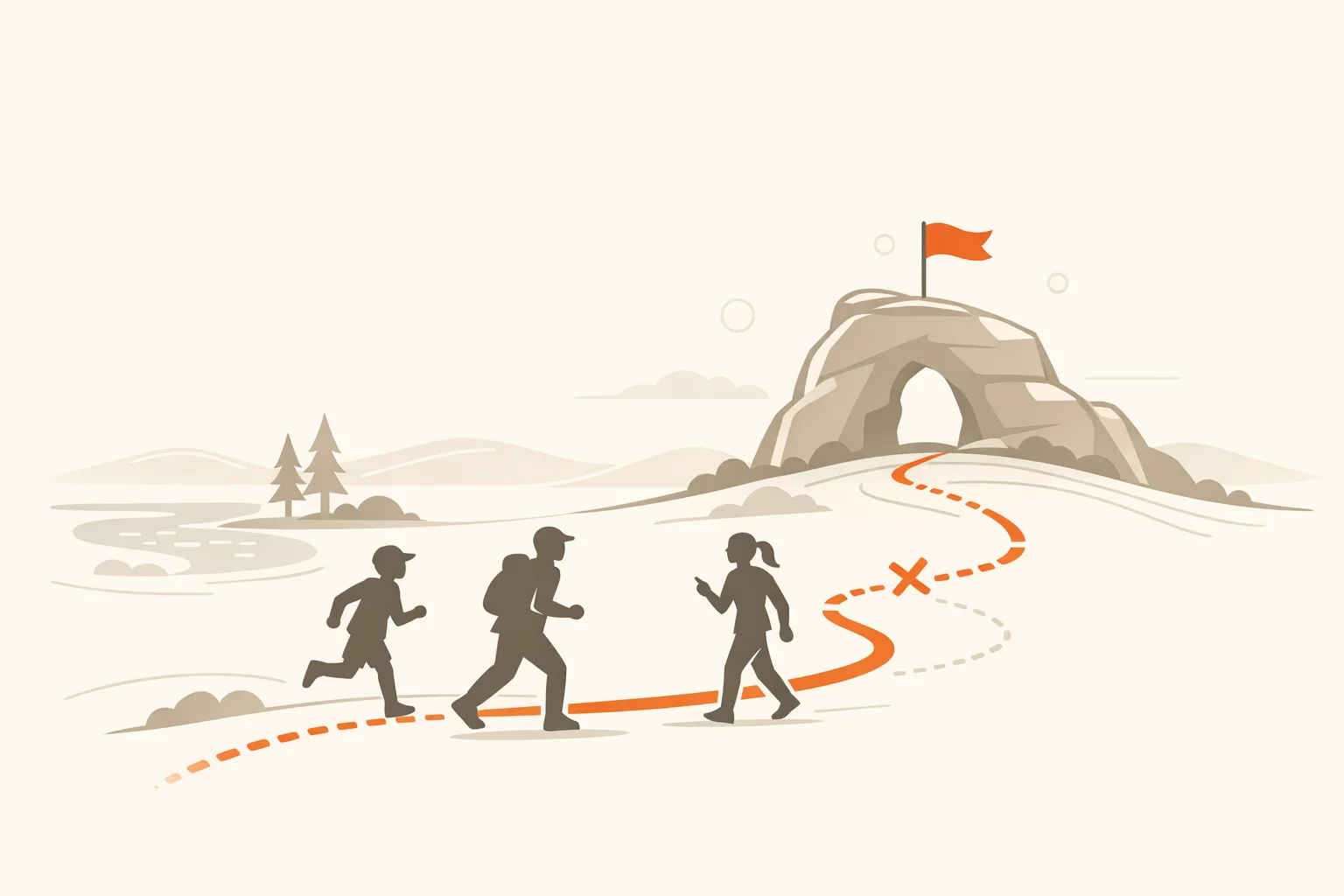
Outdoor treasure hunt clues turn any park, campus, or neighborhood into a living puzzle. The right prompts make people look up, look around, and actually participate. This guide gives you practical setup steps and 35 ready‑to‑use clue ideas that work for kids, teens, adults, and mixed groups, plus scoring models and facilitation tips drawn from real events.
The pattern we keep seeing: clear goals, quick wins early, and clue variety beat cleverness-for-cleverness’ sake. Good hunts feel like momentum.
A great clue nudges attention to the environment and gives just enough friction to feel earned. It’s specific to the place, solvable without a lecture, and moves the group forward.
Outdoor time has measurable cognitive upsides that pair well with clue-solving. Reviews of nature exposure point to attentional restoration and stress recovery, which help people refocus and interact better while moving between locations. See summaries in Frontiers in Psychology on restorative environments, a PNAS study linking nature walks to reduced rumination, and practical benefits aligned with CDC guidance on physical activity.
What usually shifts the dynamic is a clue that rewards noticing, not sprinting.
You don’t need a production crew. You need clarity, a walk-through, and a weather plan.
Below are 35 field-tested prompts. Mix and match. Adapt details to your space. Riddle answers follow each clue so you can place them accurately.
Riddle-style location clues
1) I wear a crown of green and trade your breath for mine. Answer: A large tree.
2) I point your way without a word, painted on stone for all to learn. Answer: Compass rose or directional plaque.
3) My face is numbers, my hands chase light, I watch the day and mark its flight. Answer: Outdoor clock or sundial.
4) I swallow drops and spit them tall, children laugh when I sing at all. Answer: Fountain or splash pad.
5) I guard the path with iron grin; step through my teeth to enter in. Answer: Gate with metal bars.
6) I keep your wheels from rolling free; I’m short, stout, and fixed to me. Answer: Bike rack.
7) I’m a book you cannot read; my rings record each year you need. Answer: Tree stump rings.
8) I draw a line both thin and wide where water kisses earth at tide. Answer: Shoreline or riverbank edge.
9) I’m stone that learned to speak in thanks, a name and date on city planks. Answer: Dedication plaque.
10) I’m a seat without a back that likes to hide in green. Answer: Low boulder or sitting stone.
Short rhyming clues that nudge noticing
11) Where shade and echo share a roof, your voice comes back in softer proof. Answer: Under a pedestrian bridge or tunnel.
12) Find steps that climb with metal grace; count to eight to reach the place. Answer: Stairway with ~8 steps.
13) Four lines meet, then arrows spin; trace the paint to where you’ve been. Answer: Painted trail junction.
14) When wind is strong I raise my chin; count my stripes to win again. Answer: Flag; teams count stripes.
15) I draw a web that humans cross; I hum with cars but gather moss. Answer: Overpass pillar or footbridge understructure.
16) Pebbles crunch beneath your feet; the path turns white before the street. Answer: Gravel path segment.
17) I may be wild, I may be planned; I keep the bees at your command. Answer: Pollinator garden or planter box.
18) My wooden ribs hold books of green; a living wall you’ve surely seen. Answer: Trellis with vines or hedge wall.
19) Sit where trunk becomes a throne; the bark remembers all it’s known. Answer: Bench carved into a tree or tree bench.
20) I’m painted bright on city skin; the hidden bird is tucked within. Answer: Mural with a small bird detail.
GPS or map-guided prompts
21) Check in where latitude matches your team number; small plaza with compass tiles. Answer: Plaza compass inlay.
22) GPS within 10 meters of the park’s only octagon; what is it? Answer: Stop sign by park entrance.
23) Pinpoint the midpoint between playground and pond; snap a proof shot at the halfway marker. Answer: Distance marker or distinctive tree.
24) Follow the contour line closest to 200 ft elevation until it kisses a paved path; take a team photo there. Answer: Trail contour crossing.
25) Reach the map square that looks like a lowercase “r” from above; what anchors the curve? Answer: Curved bench or rail.
Quick photo and video tasks
26) Photo: Three shadows making one tall figure near the tallest pole.
27) Photo: Something older than everyone on your team.
28) Video: A five-second “wind orchestra” using only things that rustle.
29) Photo: An object that looks like it’s smiling but isn’t a face.
30) Video: Your best slow-motion leap across a painted line.
Playful mini-mysteries for kids or mixed ages
31) I never drink, and yet I thirst; feed me and I’ll glow. Answer: Campfire ring or fire pit (supervised areas only).
32) I wave without a hand, I dance without a band. Answer: Tall grass or reeds.
33) I’m a tiny home with feather beds; peek politely, mind the heads. Answer: Birdhouse or nest box.
34) I climb the wall without a sound; I’ll green your bricks and soften ground. Answer: Ivy or moss patch.
35) I’m a tunnel for the tiny folk beneath your feet; look where roots and rivers meet. Answer: Small culvert or root crossing.
Use a balanced mix to keep different skill sets valuable. Here’s a ready bundle you can drop into your run sheet or app.
Why this mix works: movement plus micro-creative acts creates energy without exhausting people. Research on gamified tasks shows small but reliable gains for motivation and follow-through when the structure is clear and feedback is visible, a pattern echoed in recent meta-analyses of gamified learning.
Keep your model simple enough that participants can predict how to win.
If you want automation and live feedback without juggling tools, a purpose-built scavenger hunt app can handle prompts, media uploads, GPS/QR verification, and scoring while you host.
Kids and families
Favor tactile discovery and visible landmarks. Keep routes compact. Add sensory cues and animal/plant themes.
Teens
Raise the puzzle layer one notch and include social creativity (short video bits, meme-y photo frames) plus opt-in bonus challenges for high-energy groups.
Adults and friends
Lean into local lore, hidden design details, food stops, or light competition between pairs. People enjoy playful status when it’s earned and photographed well.
Work teams
Short bursts, mixed skills. Combine trivia from your org’s history or campus with public markers nearby. Competition should be friendly and specific: “first three to unlock the bridge plaque,” not “run the fastest.”
Campus orientation
Use GPS check-ins and plaques to teach paths and resources. Place answers where students will need to go later anyway (library hours sign, student services entrance).
Tourism activations
Design for story. Build a mini narrative that carries people between anchors like an old theater, a founder statue, and a modern mural. The city becomes the set.
Most casual hunts run well at 8–12 core clues with 2–4 optional bonuses. Fewer than that risks feeling short; too many can drain energy, especially in the heat.
Use an easy-medium-hard arc at the start, then settle into medium with optional bonuses. The first two should be near-guaranteed solves to lock in momentum.
Stagger starting clues and route teams in different orders to the same anchors. Rotating starts spread the crowd without changing your clue set.
Design answers that are self-verifying: plaques, GPS coordinates, unique photos, or QR codes placed at the target. Short, specific media prompts double as proof.
Most groups enjoy 45–90 minutes in one zone with hydration breaks. Longer formats work when you add chapters, clear regroup points, and light snacks.
Yes. Reviews point to attentional restoration and mood benefits outdoors, which help people focus and collaborate. See Frontiers in Psychology on restorative environments and a PNAS study on nature walks and reduced rumination. Physical activity guidance from the CDC aligns with light, social movement too.
Keep points in round numbers and verify with photos, GPS, or QR. If you want automation, run it through a platform that manages prompts, uploads, and a live leaderboard while you host.
That’s the backbone. Pick a zone, set a clear route, write to the environment, and let quick wins build momentum. Outdoor treasure hunt clues work best when they make people feel observant and successful. The rest is just a good afternoon outside together.