Solutions
Your first hunt, live this afternoon.
Free to start · No download for participants
Plan an indoor scavenger hunt for kids with clever prompts, ready-to-use examples, setup steps, group variations, scoring ideas, and planning tips.
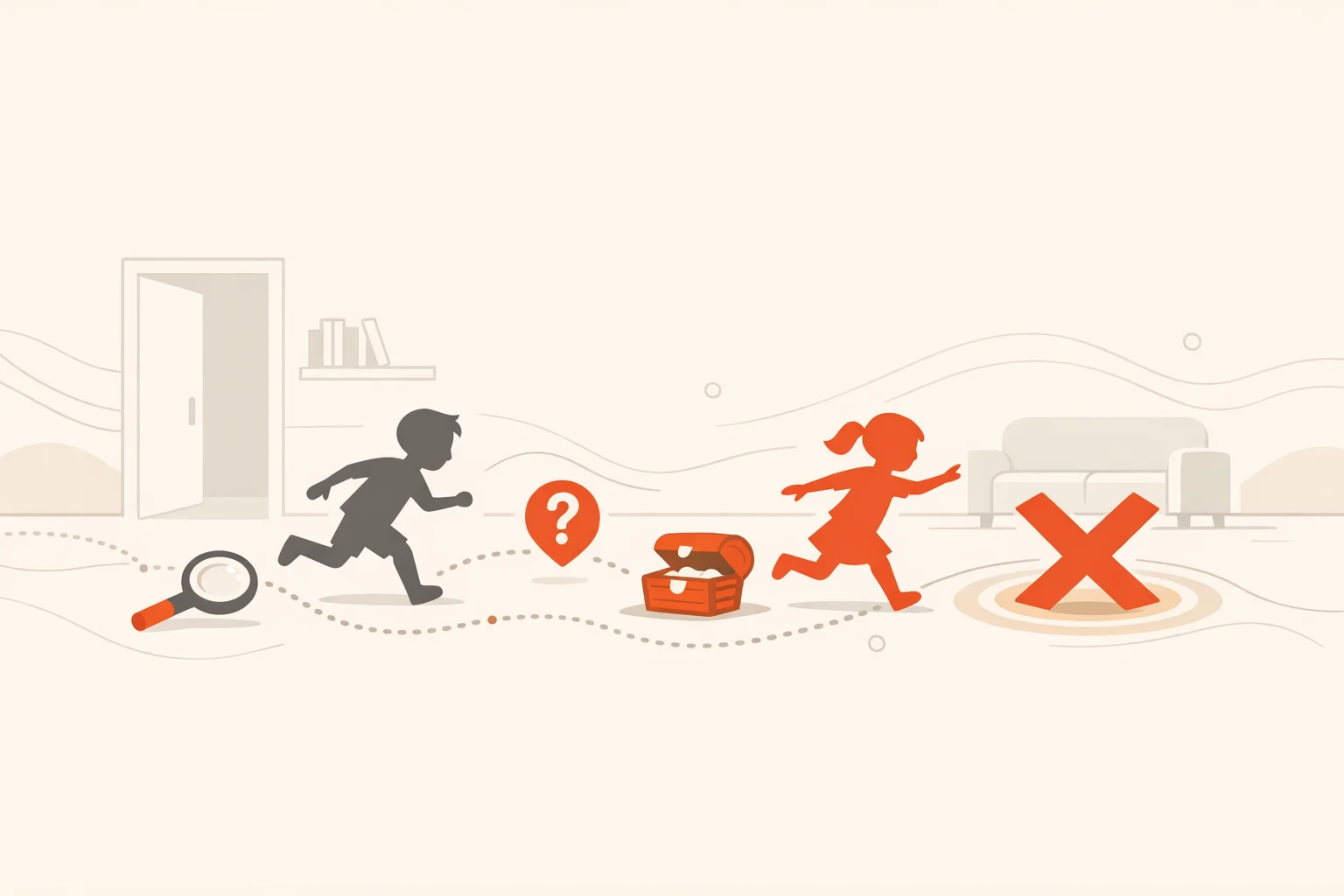
An indoor scavenger hunt turns rainy afternoons and cramped living rooms into small adventures. The best ones don’t feel like worksheets. They feel like play with purpose: a couple of quick wins in the first minutes, a middle stretch with one thoughtful challenge, and a finish that lands with a grin big enough to trigger the inevitable “again!”
Across hundreds of kid hunts, three patterns decide whether energy spikes or fizzles: variety, visibility, and a finish that pays off. Variety lets different brains shine. Visibility lets kids see progress without constant adult refereeing. A good finish rewards effort with delight rather than chores.
Design for those three and you get movement, focus, and the kind of belly laughs adults secretly hope for.
Play isn’t filler between “real” learning. It builds language, social skills, and executive function. The American Academy of Pediatrics’ clinical report synthesizes how developmentally appropriate play strengthens attention, working memory, self‑control, and problem solving. See the AAP guidance on the power of play. (publications.aap.org)
Indoor hunts also sneak in movement when outdoor time isn’t an option. The CDC recommends at least 60 minutes of daily physical activity for ages 6–17. A lively hunt moves the needle without feeling like exercise. See the CDC’s child activity overview and school‑aged guidelines. (cdc.gov)
An indoor scavenger hunt is a guided search through a home, classroom, or venue where kids find items, decode clues, or complete quick photo and video tasks. Done right, kids stop spectating and start participating.
Nobody quits a game they are winning. Make the first clue a guaranteed win.
Different ages notice different things. Pre‑readers need pictures and landmarks. Early readers handle short rhymes. Older kids like deduction more than collecting. Harvard’s Center on the Developing Child offers practical handouts by age that map play to attention, working memory, and self‑control. Scan the executive function activities by age to tune your clues. (developingchild.harvard.edu)
Need something you can screenshot or print and run in minutes? Use this 12‑item starter list and add three of your own to make it yours:
Give each team a color card and a small bag. They collect five objects that clearly match that color, then arrange them by size for a bonus.
Try this: Find five blue things that aren’t toys, then sort from smallest to largest.
Assign each team five letters. They bring back or photograph items starting with those letters.
Try this: Find something that starts with R, S, T, L, and N.
Hide short rhymes that point to locations without naming them outright.
Try this: I am where the cold lives and lights up at night. Open me gently to find your next bite. (Fridge)
Get hands exploring: rough, smooth, squishy, and bumpy.
Try this: Bring one rough, one smooth, and one squishy item.
Kids identify or create sounds in safe ways. Headphones off. Ears on.
Try this: Record three different house sounds: a ding, a snap, and a whoosh.
Make them notice stripes, polka dots, and zigzags hiding in plain sight.
Try this: Snap photos of one stripe, one dot, and one zigzag.
Geometry without the worksheet. No moving furniture allowed.
Try this: Find a triangle, a circle, and a rectangle you can point to without touching anything.
Reading vibes count. Send them to the place where books like to nap.
Try this: Your next clue hides where stories rest between adventures. (Bookshelf)
Safe‑only scavenging among wooden spoons and timers. Keep the stove off limits.
Try this: Bring a wooden spoon, a measuring cup, and a timer without opening more than two drawers.
Create a mini‑narrative so the task feels like a mission, not a list.
Try this: “Bear” is trapped where laundry spins. Bring proof of rescue with a team selfie nearby.
Hide pieces to a small puzzle. The assembled image reveals the final location.
Try this: Find four hidden pieces, assemble them, then go where the picture points.
Sketch a simple map with X marks. Let kids navigate to each zone in any order.
Try this: Three Xs mark the spots: near the light, under the art, by the plants.
Collect “artifacts,” then write playful labels that make ordinary things feel rare.
Try this: Build a three‑item exhibit called “Things That Make Mornings Work,” with labels.
Use a flashlight to make silhouettes kids must match with real objects.
Try this: Match this shadow to the object that made it.
Use safe scents only. Let noses guide the next step.
Try this: Follow the citrus scent to your next clue.
Turn laundry into a race without the nagging.
Try this: Find and match three pairs of socks hiding in plain sight.
Build to a brief instead of free form so constraints do the teaching.
Try this: Build a bridge 10 studs long that can hold a spoon for 3 seconds.
Word search, but with titles. It rewards scanning and pattern spotting.
Try this: Stack two books whose spines create the word “STAR.”
Write a reversed clue that kids decode in a mirror. Low tech. Big reveal.
Try this: “EROM ROOD ROOLF” should tell you where to look next.
Hide QR codes that unlock the next prompt plus a warmer or colder hint.
Try this: Scan the code where the plants drink.
Short, silly video prompts kids can nail quickly and watch back for laughs.
Try this: Film a 5‑second slow‑motion high‑five in a funny spot.
Make numbers appear in real spaces so arithmetic feels like discovery.
Try this: Find two numbers in the room that add to 12. Show proof.
Tactile discovery without peeking. It also slows the pace in a good way.
Try this: Guess three items in the bag using only touch, then find their twins.
Perspective is a clue, too. Age becomes the sorting hat.
Try this: Bring something older than you and something newer than last year.
Recreate a pose from a famous painting or poster with props from one room.
Try this: Pose like The Scream using only items from the living room.
Drop these straight into your hunt to hit the main styles without overthinking it.
For activity targets by age, the CDC’s school‑aged guidelines help you think about run time and intensity without overcooking it. (cdc.gov)
Points per task usually beat first‑to‑finish for mixed groups. Add a small bonus window at the halfway mark to re‑energize the room. Dock points for unsafe rushing and reward creativity for photo and video flair.
If you want automation, photo and video judging, QR unlocks, and a live leaderboard without a clipboard, a scavenger hunt app removes most of the admin so you can actually enjoy the chaos.
How long should an indoor scavenger hunt last? Aim for 20–40 minutes total with two easy wins at the start. Younger kids usually prefer the shorter end of that range.
How many clues do I need? Eight to fifteen prompts with 3–4 styles usually feels complete without dragging.
What prizes work without overshadowing the game? Choose playful rewards like pick‑the‑song privileges, stickers, or “call the next game” rights. Save big gifts for birthdays.
How do I make it inclusive for pre‑readers or kids with different needs? Use picture clues, clear boundaries, non‑physical alternatives, and rotating roles such as reader, spotter, navigator, and timekeeper.
Can this count toward daily activity goals? It can contribute, especially when prompts require movement between rooms and short active tasks. The CDC recommends 60 minutes daily for ages 6–17. See the CDC overview. (cdc.gov)
Where can I find research to guide the learning side of play? The AAP’s clinical report on play and Harvard’s executive‑function resources are strong, practical starting points. See the AAP report and Harvard’s activity guide. (publications.aap.org)
Design for real participation, not perfect props. Borrow these structures, tune them to your space, and let kids’ curiosity carry the rest.