Solutions
Your first hunt, live this afternoon.
Free to start · No download for participants
Learn how social gamification uses competition, collaboration, and visibility to drive engagement, plus real examples and design mistakes to avoid.
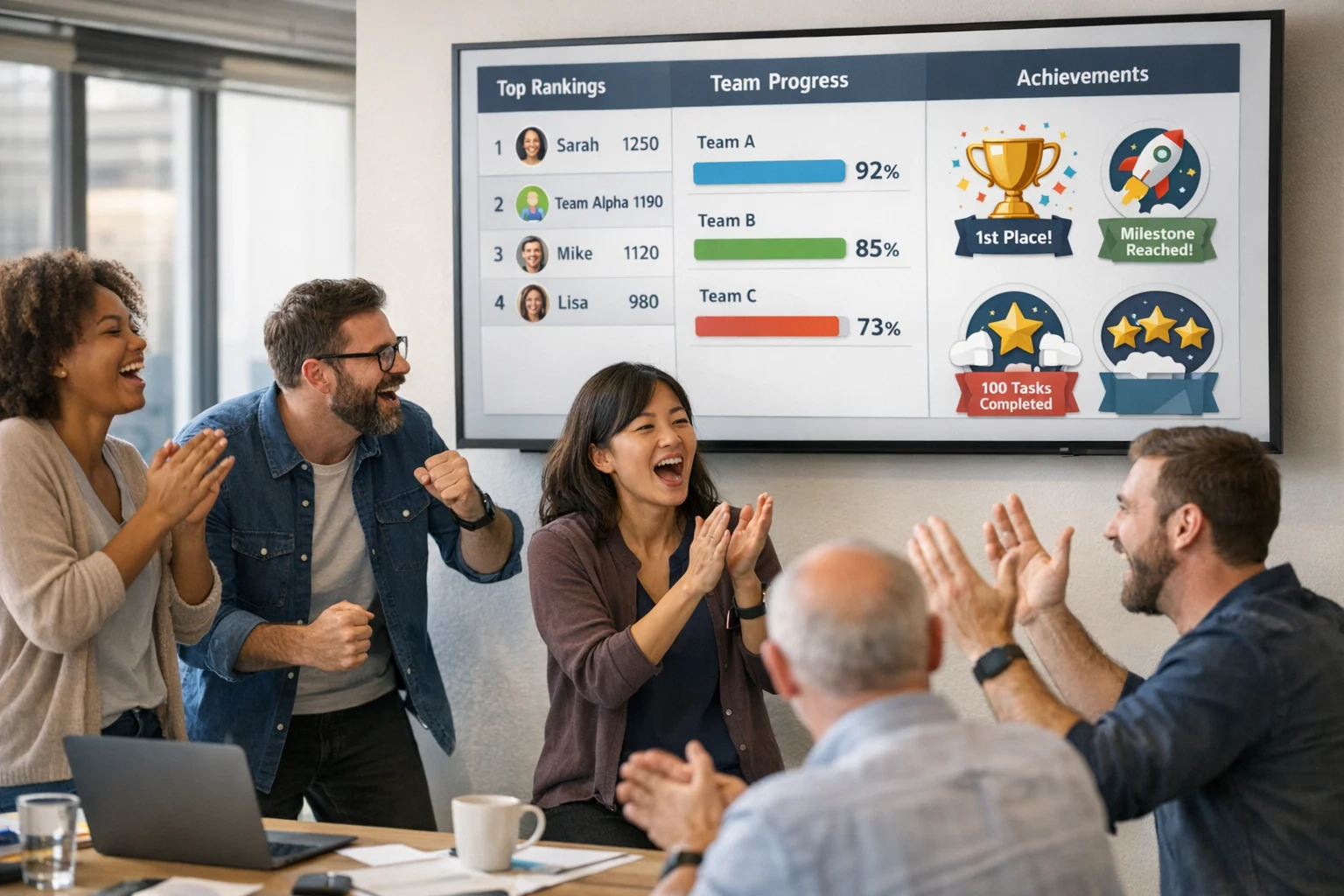
Social gamification uses social dynamics like competition, collaboration, and visibility to make participation feel meaningful and contagious. Do it right and people don’t just click more; they care more. Do it wrong and you get public leaderboards that quietly demotivate half the room.
Social gamification is the use of social feedback loops to shape behavior: people see each other acting, compare progress, and respond. It’s not just badges and points. It’s the way visibility, status, and peer dynamics turn small actions into habits.
Underneath the mechanics is psychology. Systems that respect autonomy, competence, and relatedness tend to sustain motivation longer than those that rely on blunt rewards. That’s Self‑Determination Theory in plain clothes: give people real choice, clear progress, and a sense of belonging, and they’ll keep showing up. (selfdeterminationtheory.org)
If you’re looking for evidence, meta-analyses in education and training show gamification can deliver positive effects when designed well, with particularly strong results when competition and collaboration are combined. The effects vary by context and design quality, which is exactly why structure matters more than slogans. (link.springer.com)
Scavify naturally fits these use cases because it turns participation into shareable micro‑challenges, automates scoring, and runs on both browser and app. Not a sales pitch, just the reality of what makes this simpler to launch at scale.
Competition works when it’s bounded, fair, and fresh. Unbounded, same‑for‑all leaderboards create runaway winners and silent quitters. The fix isn’t to kill competition; it’s to shape it.
A useful nuance: upward comparisons help some people more than others. Individual differences in social comparison orientation moderate the effect, so give participants control over notifications and surfaces. (pmc.ncbi.nlm.nih.gov)
Collaboration is the counterweight to rivalry. Use shared goals, pooled points, and role‑based contributions so different strengths matter.
Most teams find a hybrid works best: inter‑team competition plus intra‑team cooperation. It keeps stakes meaningful while preserving psychological safety.
Visibility is the quiet powerhouse of social gamification. People respond to what’s seen.
Duolingo’s leagues. Learners compete in week‑long tiers that promote or demote based on XP earned. The design mixes short sprints, tiered competition, and public recognition without making global rank the point. The company’s own explanation of leagues and the Diamond Tournament shows how transparent rules sustain engagement. (blog.duolingo.com)
Strava segments. Community‑created segments with public leaderboards make personal effort visible and socially meaningful. KOM/QOM crowns, yearly boards, and friend comparisons keep goals attainable even if global leaders are out of reach. Clarity about what counts on a segment is part of what makes the loop trustworthy. (support.strava.com)
Stack Overflow badges. Badges publicly reward valued contributions like editing, answering well, or improving old posts. The system’s help pages explain both the criteria and the purpose: to nudge helpful behaviors the community wants more of. (stackoverflow.com)
These patterns translate well to the workplace: time‑boxed tiers, trustable rules, and recognition that points at meaning, not just numbers.
Week 1: Frame the behavior and rules. - Define the one behavior you must increase. Write the rulebook in plain language. - Pick a sprint length (usually one week for workplaces, one day for events) and decide how winners are determined. - Choose 2–3 reward paths so different strengths matter.
Week 2: Build the social surfaces. - Configure a feed that shows real actions with names and photos. - Set up tiers or cohorts so comparisons are fair. - Add lightweight recognition: spotlight callouts, digital badges with clear meaning.
Week 3: Pilot with a small cohort. - Run a short, friendly competition between two teams. Watch where energy spikes or drops. - Ask three questions after day two: What felt fun? What felt confusing? What felt unfair? - Fix the unfair first. Then clarify what to do next. Only then tune difficulty.
Week 4: Launch and measure. - Announce the sprint, the cohorts, and how to win. Show last week’s pilot photos or stories. - Keep updates tight: a single midday leaderboard snapshot, a late‑day “final push,” and a celebratory wrap. - Publish weekly summaries with names and moments, not just numbers.
Launching this with Scavify is straightforward because challenge variety, scoring automation, and browser + app access are built‑in, which shortens Weeks 2 and 3 considerably. The usefulness is the point; the tool should disappear into the experience.
One giant leaderboard. It flatters the top 5 percent and discourages the rest. Use tiers, teams, and resets.
Rewarding the proxy, not the outcome. When a metric becomes the target, quality often suffers. Healthcare’s experience with wait‑time targets is a classic case study in Goodhart’s law. Design measures that are hard to game, and pair quantity with quality indicators. (pubmed.ncbi.nlm.nih.gov)
Public shaming. Visibility should recognize effort and progress, not embarrass people. Default to opt‑in public surfaces and let participants control notifications.
Only extrinsic rewards. If your system ignores autonomy, competence, and relatedness, expect short burns and fast drop‑off. Mix recognition, mastery paths, and choice. (selfdeterminationtheory.org)
Static difficulty. As skills rise, fixed challenges get boring. Rotate challenge types and add adaptive tiers.
Treat your first 1–2 cycles like experiments. Track a handful of metrics, then decide what to keep, change, or cut.
If you’re using leaderboards, watch for widening gaps. Adaptive, tiered boards and periodic reseeding keep comparisons fresh and fair, which research suggests is where leaderboards help rather than harm. (pmc.ncbi.nlm.nih.gov)
Below are quick, field‑tested prompts you can run in an app‑based format during a team day, onboarding sprint, or campus orientation. Mix creative, knowledge, and location‑based tasks so different strengths matter.
It’s gamification with people in the loop. You use social signals like leaderboards, teams, and public recognition so participants see each other acting and feel motivated to join in.
It can, and the odds go up with good design. Meta‑analyses show positive effects on learning and engagement, particularly when competition and collaboration are combined and rules are clear. Context and implementation quality drive the spread in outcomes. (link.springer.com)
None in isolation. Leaderboards can motivate when they’re tiered and time‑boxed; badges work when they signal valued behaviors; points are bookkeeping. The combination, tuned to your behavior target and audience, is what works. (pmc.ncbi.nlm.nih.gov)
Use adaptive tiers, weekly resets, and team‑based scoring. Show personal progress first and peer comparisons second. Research suggests design and feedback placement significantly influence motivation and performance. (sciencedirect.com)
No, not if you design for autonomy, competence, and relatedness. Give people choice, visible progress, and genuine recognition and you’re working with intrinsic motivation, not against it. (selfdeterminationtheory.org)
Public shaming, manipulative scarcity, and rewarding proxies that harm real outcomes. Goodhart’s law is real: when you reward the metric, people may contort behavior to hit it. Pair quantity with quality and audit the top of any ranking. (pubmed.ncbi.nlm.nih.gov)
You can hack a version with sheets and chat threads, but it’s tedious and easy to break. An app purpose‑built for challenges, check‑ins, scoring, and feeds removes admin burden and scales to larger groups.
Pick one behavior and one social surface. Run a 5‑day sprint with two teams, one leaderboard per team, and a daily spotlight. Learn, adjust, then scale.
Design social gamification like someone who cares about human motivation and group dynamics. Keep loops tight, rules fair, and recognition generous. If you want a fast way to pilot without wrangling spreadsheets, Scavify’s challenge variety, automation, and browser + app flexibility make the logistics painless so you can focus on the experience.