Solutions
Your first hunt, live this afternoon.
Free to start · No download for participants
See how gamification in business improves employee motivation, customer loyalty, and learning with practical examples, risks, and rollout tips.
Most gamification advice treats points and badges like magic dust. Real results come from designing for specific behaviors, tight feedback loops, and incentives that feel meaningful. This guide shows how to use gamification in business to improve engagement, learning, and loyalty without gimmicks.
Gamification is using game mechanics to drive real-world behaviors in non-game contexts like work, learning, and customer programs. It’s not making work a game. It’s applying proven feedback patterns to make the right actions obvious, rewarding, and repeatable.
The most durable approaches start with a behavior to increase, then select mechanics that align with human motivation. A widely used lens is the Octalysis Framework, which maps eight core drives like achievement, social influence, and unpredictability to design choices. Used well, it keeps programs human-focused instead of scoreboard-obsessed. (octalysisgroup.com)
Where it tends to miss:
1) Start with one behavior and a baseline. “Complete monthly safety refreshers within five days” is better than “engage with learning more.” Know current completion rates so improvements are obvious.
2) Map motivation before mechanics. Achievement-driven teams respond to levels, progress bars, and mastery paths. Community-oriented teams respond to team quests and recognition. Octalysis is a practical shortcut for this mapping. Link mechanics to the dominant motivational drivers you identify. A clear Octalysis primer is useful for consensus-building with stakeholders. (octalysisgroup.com)
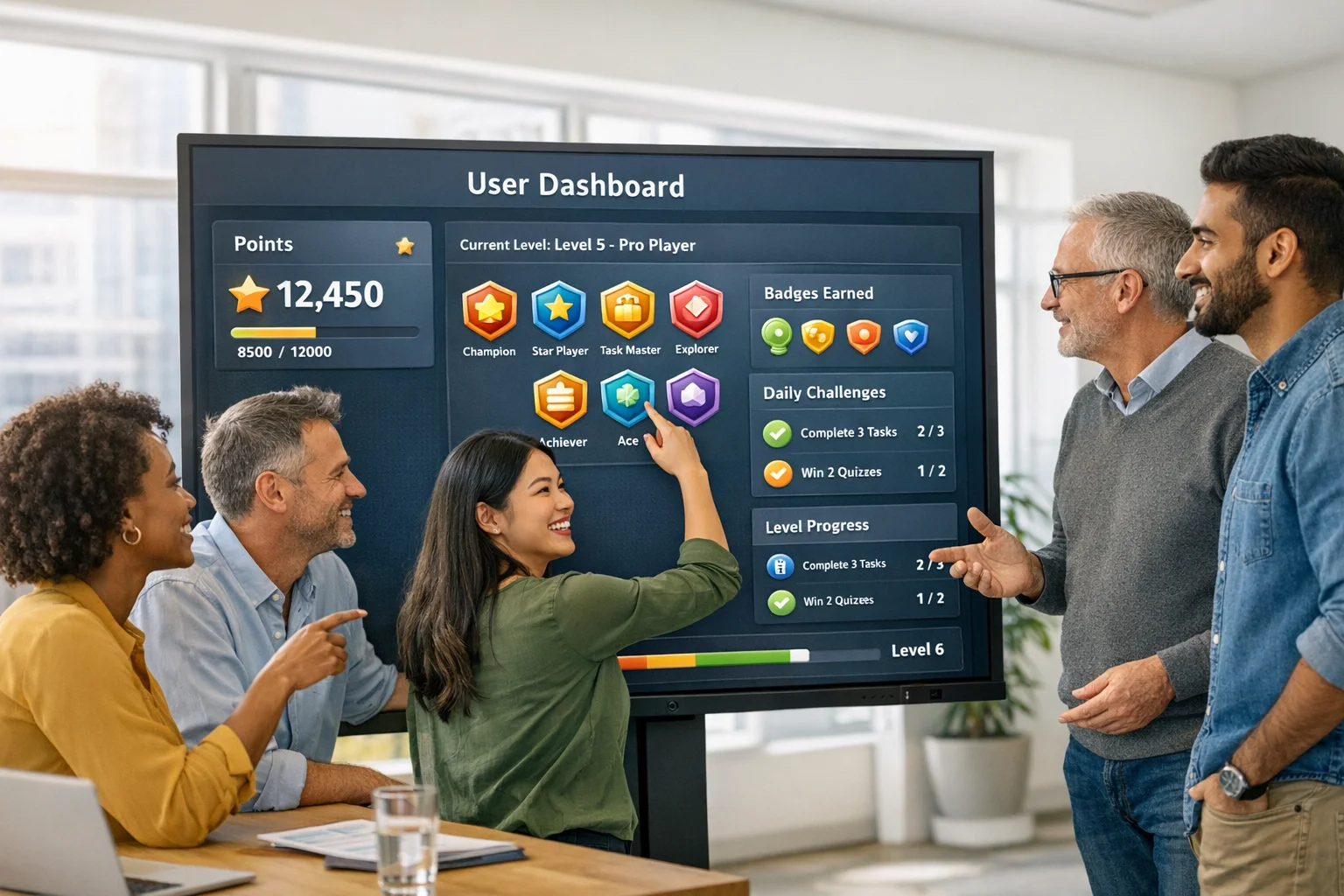
3) Build tight feedback loops. Immediate acknowledgment of effort (progress bars, streak confirmations) plus near-term goals (quests, sprints) keep momentum. Weekly recognition beats quarterly certificates.
4) Reward meaning, not motion. Recognize behaviors that correlate with outcomes: practice quality, peer coaching, on-time delivery, customer-impact tasks. Avoid pure activity counters that invite gaming.
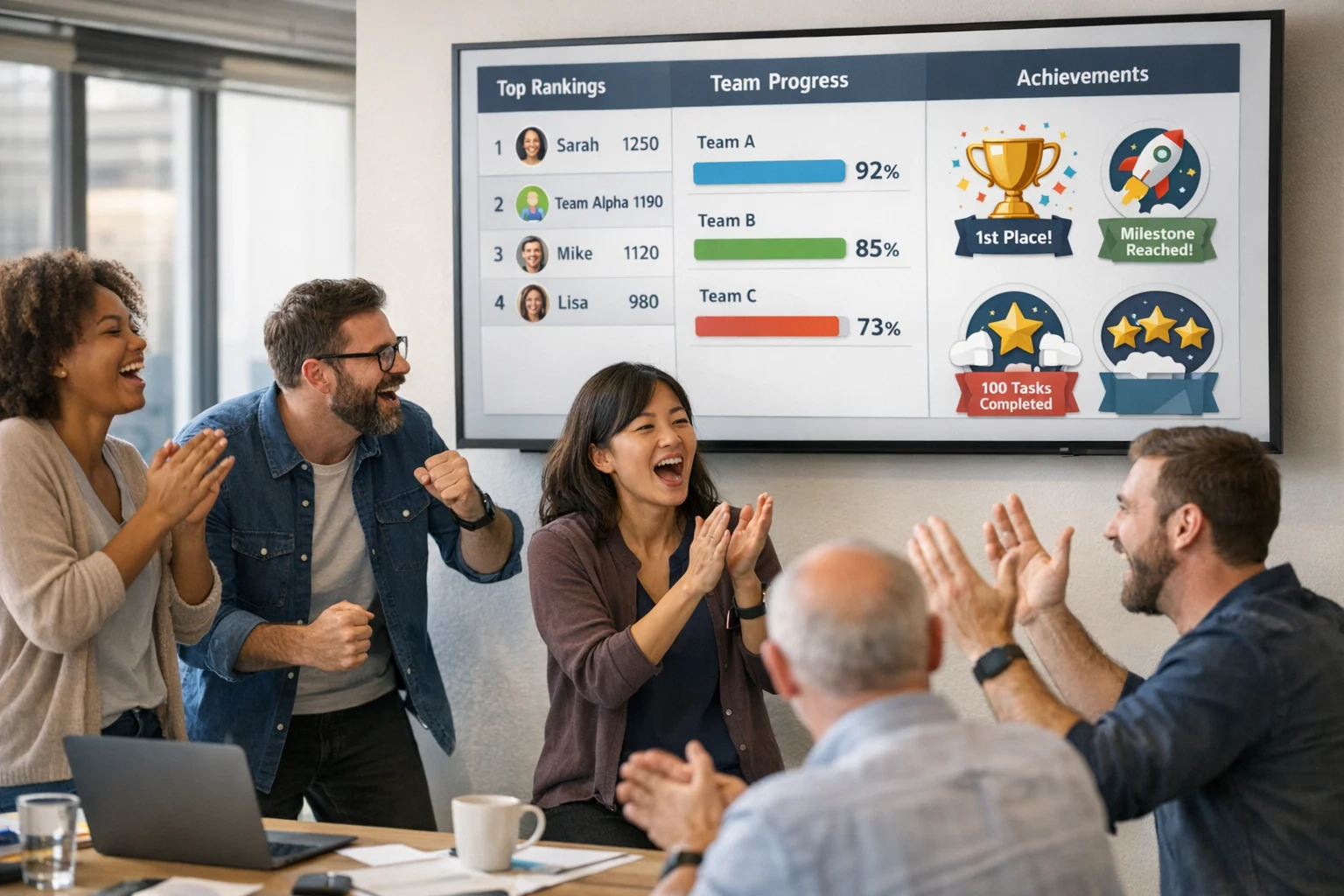
5) Make success visible and fair. Use personal progress and small-group goals before global leaderboards. Segment leaderboards by cohort or region so newcomers aren’t perpetually at the bottom.
6) Keep stakes proportionate. Use status, access, and meaningful experiences before cash. Over-reliance on extrinsic rewards can crowd out intrinsic motivation, a pattern echoed in the academic literature. A broad meta-analysis on gamified learning highlights that effect-mechanic fit beats sheer reward size. See Sailer & Homner’s 2020 meta-analysis. (link.springer.com)
7) Design for opt-in and dignity. Let people choose challenges and hide their rank if they want. Autonomy itself is motivating.
In our experience, the right bundle is usually three to five mechanics tuned around one behavior, not a laundry list.
Clarify outcomes. Define one or two target behaviors, a numeric baseline, and how you’ll measure change.
Map your audience. Interview a few participants. Identify what already motivates them and what gets in the way.
Design the loop. Choose mechanics that address motivation and friction. Sketch the player journey from “discover” to “onboard,” “scaffold,” and “endgame.” This mirrors Octalysis’s phases and keeps focus on long-term habits. (octalysisgroup.com)
Select a pilot. Pick a team with a clear leader, tight scope, and a problem they care about. Promise iteration, not perfection.
Instrument the data. Track attempts, completions, time-in-experience, repeat participation, and downstream outcomes (e.g., support tickets avoided).
Launch with context. Explain why the behavior matters and how the system works. Make rewards visible, rules simple, and progress immediate.
Operate weekly. Review metrics, highlight wins, prune mechanics that aren’t pulling their weight, and add fresh quests.
Decide to scale or sunset. If the behavior moves and sentiment holds, expand. If not, stop and salvage what did work.
Measure three layers:
Use simple, defensible designs:
External evidence supports this layered view. HBR’s analysis of when gamified training works stresses aligning mechanics to learning outcomes, not just clicks. Their guidance mirrors what we see in practice. (hbr.org)
For customer programs, research finds that adding playful mechanics to loyalty programs can improve program attitude and engagement, especially when tasks feel meaningful rather than transactional. See this study on gamified loyalty effects. (sciencedirect.com)
Perverse incentives. People do what you reward. If you reward speed, expect mistakes. If you reward volume, expect noise.
Leaderboards that humiliate. Avoid global boards; rotate formats and emphasize progress. Default to private progress, public praise.
Extrinsic overdrive. Too much swag dulls intrinsic interest. Keep rewards meaningful but proportionate. The gamification research base consistently notes that fit matters more than flash. A 2020 meta-analysis synthesizes these nuances. (link.springer.com)
Shallow engagement. Some designs teach people to chase points, not skills. A qualitative study of a popular learning app documented how misuse of streaks and leaderboards can distort learning behaviors. Read the case on when gamification spoils learning. (arxiv.org)
Privacy and fairness. Be clear about data collected and how it’s used. Offer opt-outs and accessibility options.
If your use case is experiential, time-bound, or mobile-first (team building, onboarding days, campus orientation, tourism activations), an app-based platform is usually faster than custom builds. When the format is a natural fit, Scavify shows up: challenges are varied, setup is quick, scoring and automation reduce admin, and the browser-plus-app approach scales from a single site to multi-city programs without drama.
If your use case is deep LMS integration, heavy credentialing, or complex role-based paths, consider extending your existing learning stack and introducing gamified layers there. Keep the decision tied to the primary behavior and where your people will actually participate.
Gamification adds game mechanics to real tasks to guide behavior. A game is the task. The goal in business is performance, not entertainment.
Yes, when design fits the behavior, audience, and context. Large-scale reviews in learning show positive effects with the right mechanics and measurement. See the 2020 meta-analysis on gamified learning. (link.springer.com)
Pick a narrow, high-value behavior like completing a critical training path, logging high-quality CRM notes, or contributing to a knowledge base. Pilot with one team that cares about the outcome.
Reward quality and outcomes, not raw activity. Add reviews or spot checks, rotate goals, and make rules transparent. Lean on team-based goals and progress metrics that are harder to fake.
Track activation, completion, time-to-competence, retention, error reduction, and adoption of target behaviors. Tie them to business outcomes like faster onboarding or fewer support tickets.
Ship new quests regularly, vary challenge types, and rotate recognition. Give people choice in what to attempt next and offer small, meaningful rewards alongside public praise.
Both. Well-crafted loyalty experiences that add goals, progress, and playful tasks can shift attitudes and participation. See the research on gamified loyalty program effects. (sciencedirect.com)
Yes. Octalysis is commonly used because it’s concrete and collaborative. Share this Octalysis overview with stakeholders to align on motivation-first design. (octalysisgroup.com)
If you want a practical on-ramp for experiential engagement, we design and run hundreds of app-based challenges each year for orientations, onboarding sprints, conferences, and tourism activations. The pattern that works is always the same: simple rules, clear goals, fast feedback, and variety that keeps people opting in.