Solutions
Your first hunt, live this afternoon.
Free to start · No download for participants
Explore the benefits of gamification in the workplace, from stronger participation and training retention to better recognition, morale, and teamwork.

Most workplaces don’t suffer from a lack of content. They suffer from a lack of participation. Gamification, done thoughtfully, turns passive consumption into active participation by adding structure, feedback, and small stakes that people can feel.
The research backs the need for better engagement. Only about 20% of employees globally are engaged according to Gallup’s State of the Global Workplace 2026. That’s a lot of untapped energy sitting in calendars and compliance portals. Gamification is not a silver bullet. It is a proven way to create conditions where people opt in more often, stay longer, and learn faster if you build it with care. See Gallup’s 2026 data summary for context on engagement trends. Gallup’s State of the Global Workplace 2026.
Gamification uses familiar game mechanics to nudge real work forward. Think progression (levels, streaks), feedback (instant results, hints), recognition (badges, shout‑outs), and choice (pathways, difficulty). The mechanics are wrappers. The core is motivation design.
Two patterns are consistent in the research. First, gamified training and learning show small but meaningful effects on motivation, behavior, and cognitive outcomes when designed well. The Sailer and Homner meta‑analysis synthesized dozens of studies and found positive effects across motivation, behavior, and learning outcomes. The gamification of learning meta‑analysis.
Second, workplace performance lifts when gamified training is paced over time with progression and feedback rather than a one‑off trivia blast. Harvard Business Review highlights research showing that carefully designed gamified training can significantly improve employee performance when it uses levels, instant feedback, and light competition over time. HBR on whether gamified training gets results.
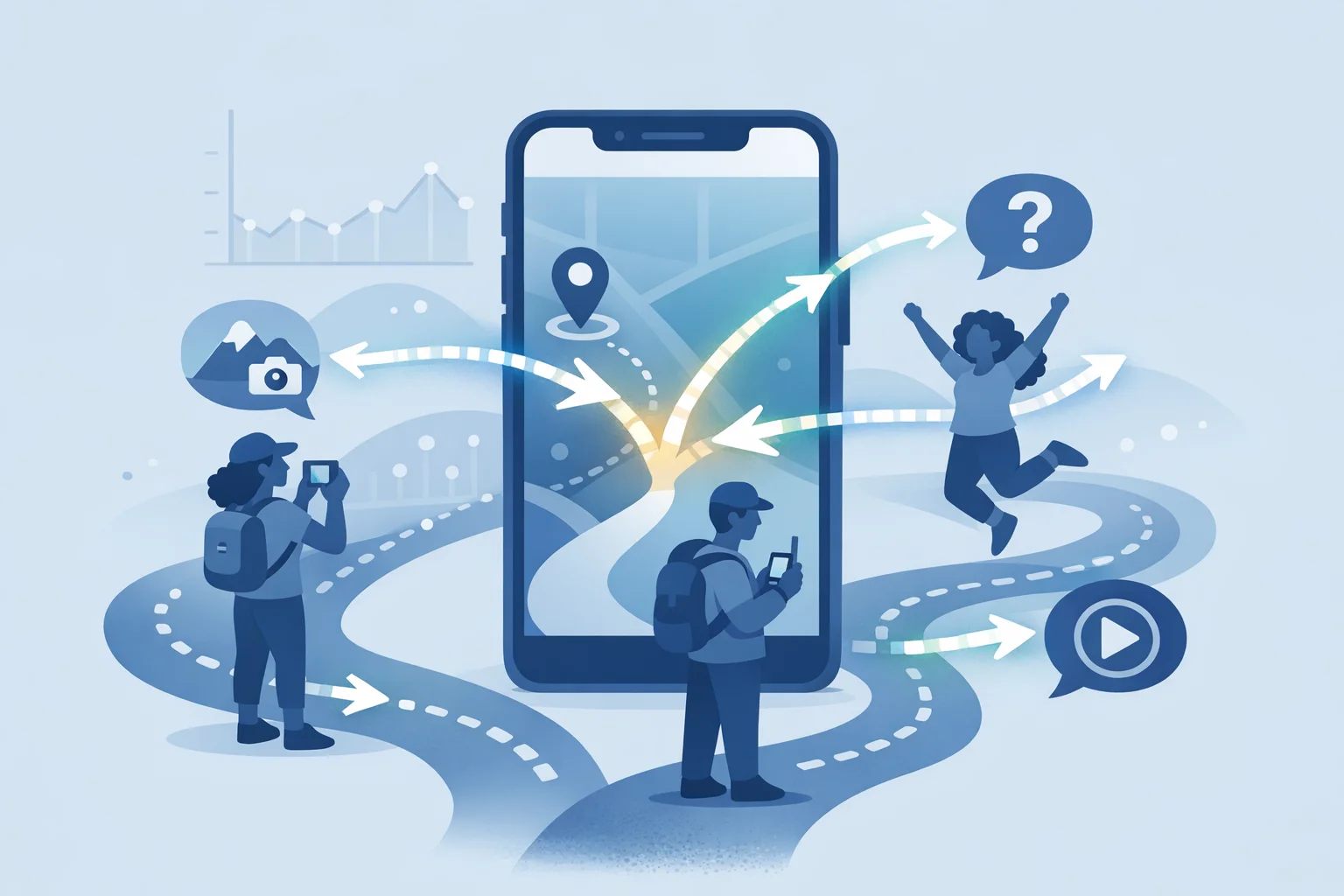
In practice, this looks like short challenges, immediate signals, and visible progress toward a shared goal. Tools like Scavify make this easy by automating points, progress, and verification through photo, video, GPS, QR, quiz, and Q&A challenges in an app or browser.
Attendance is table stakes. Participation is the real gap. A pattern we keep seeing is simple: when people can see progress, earn light recognition, and choose their path, more people opt in and stay in.
What usually shifts the dynamic is clarity and pacing. Short, relevant challenges with immediate feedback beat long sessions every time. Expect participation rates to climb as friction drops and people see their effort reflected back quickly.
What to watch: challenge acceptance rate, daily active participants, and completion velocity.
Well‑designed challenges create repetition and retrieval without tedium. That’s where gains in retention show up. The Sailer and Homner meta‑analysis found positive effects on cognitive and behavioral outcomes, especially when social interaction and narrative were present. Evidence on motivation and learning effects.
HBR’s coverage of paced, feedback‑rich training aligns with what we see on the ground: levels, instant feedback, and lightweight competition translate into better performance on the job, not just in the LMS. HBR summary of performance impact.
What to watch: pre‑ and post‑assessment deltas, time to competency, and skill application checks 30 to 60 days later.
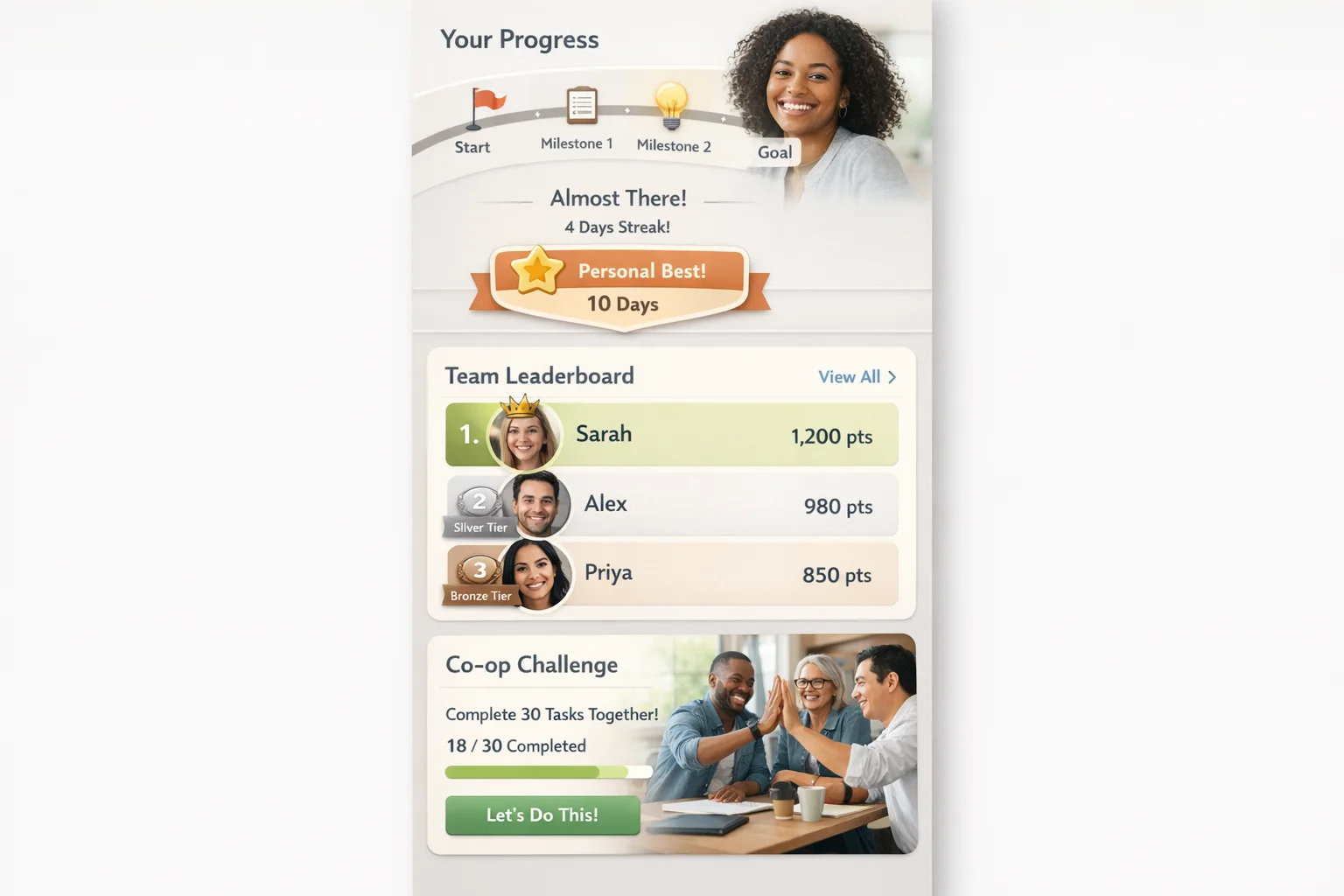
Gamification makes invisible progress visible. Progress bars, streaks, and levels answer the silent questions people carry into any program: Where am I, what’s next, and how will I know I’m done?
When teams see progress, they self‑manage. Managers get out of the role of reminder‑in‑chief. It’s less policing, more pacing.
What to watch: percent of users with active streaks, level distribution, and drop‑off points by step.
Delayed feedback dilutes learning. Instant feedback accelerates it. In our experience, the fastest way to move from awareness to ability is a loop that goes challenge to attempt to feedback in seconds, not weeks.
Practical nuance: keep feedback specific and actionable. “Incorrect” is a dead end. “Incorrect - try steps 2 and 3 again” is a path.
What to watch: average attempts per challenge, hint usage, and improvement within session.
Recognition works when it’s earned, visible, and tied to meaningful effort. Gamification gives you many lightweight recognition moments that don’t require a ceremony or a gift card.
Badges are fine. Named shout‑outs inside a live feed are better. Rotating spotlights on different behaviors keep the system from becoming a single‑metric race.
What to watch: distribution of recognition across the population, repeat earners vs first‑time earners, and correlation with program KPIs.
A pattern we keep seeing: competition raises energy early, but team‑based goals and co‑op mechanics sustain it. Think squads working to unlock a shared milestone or a leaderboard weighted by improvement, not just totals.
The goal is friendly pressure, not a winner‑take‑all dynamic that discourages late movers. Keep leaderboards contextual, rotate challenges, and celebrate progress, not just placement.
What to watch: team participation variance, lifts among middle performers, and opt‑out rates.
Gamification shines when the target behavior is small, repeatable, and observable. Daily micro‑actions with streaks and cues are stronger than quarterly marathons. Over time, the extrinsic wrapper becomes less necessary as the behavior gets internalized.
The motivation science behind this is clear. Systems that support competence, autonomy, and relatedness tend to create more durable motivation and better well‑being at work. Reviews of Self‑Determination Theory in organizational contexts link these needs to stronger engagement and performance. Annual Reviews overview of SDT in work organizations.
What to watch: streak counts, recency and frequency of target behaviors, and decay after incentives are reduced.
Most onboarding is a flood. Gamification turns it into a path. New hires complete focused missions that map to milestones: meet people, learn systems, practice key tasks. The pacing respects attention. The format reduces second‑week “what now” moments.
Add social check‑ins and you get connection, not just completion.
What to watch: time to first independent task, first‑week mission completion, and new‑hire confidence scores at day 10 and day 30.
People will cross the building or jump into a thread to help a teammate clear a challenge that matters. Design a few missions that require tapping another team’s knowledge and you get collaboration by design, not by memo.
Make it easy to ask and easy to give. Lightweight prompts and visible gratitude go a long way.
What to watch: number of cross‑team interactions per participant, time to answer knowledge prompts, and repeat helper rates.
Every attempt is a data point. You don’t need vanity metrics. You need where people struggle, where they fly, and what correlates with outcomes. Gamification systems surface this quickly so you can iterate on the actual blocker, not the loudest complaint.
Practical move: review item‑level analytics weekly for the first month. Fix the top two friction points. Rerun. Small changes compound.
What to watch: item difficulty curves, drop‑off heatmaps, and the link between challenge completion and downstream KPIs.
Most failures share the same roots. The system overemphasizes points, ignores context, and accidentally punishes the people you most want to help. SHRM’s guidance calls out this risk and argues for alignment with culture and motivation rather than gamification for its own sake. SHRM on unlocking engagement beyond points.
There is also a real debate about extrinsic rewards crowding out intrinsic motivation. The takeaway for practitioners is simple: use points and prizes lightly, design for competence and autonomy, and spotlight meaningful progress. Keep the game in service of the work, not the other way around.
Platforms like Scavify help here by automating challenge creation, verification, points, and leaderboards, with browser plus app flexibility and the scale to run across locations without extra admin overhead.
A quick set designed for onboarding, training, and everyday connection. Mix and match.
Measure the before and after on the behaviors that matter, not only the in‑app stats.
Ground your expectations in the evidence. Meta‑analyses point to modest, consistent gains when design fits context. Your job is to remove friction, create feedback, and make progress visible. The lift compounds.
The strongest benefits are higher participation, faster skill acquisition, clearer goals, instant feedback, better recognition, healthier competition, habit formation, smoother onboarding, stronger cross‑team connection, and actionable data. Expect small, compounding gains when design matches your context and goals.
Performance improves when training is paced over time with levels, instant feedback, and light competition. Research summarized by Harvard Business Review links this approach to measurable performance gains in the workplace, beyond just course completion.
Use extrinsic rewards lightly and temporarily. Focus on competence, autonomy, and relatedness to build intrinsic motivation. Recognize improvement and consistency. Rotate spotlights so the same few people don’t dominate. Keep the “game” in service of real work.
Pick 3 to 5 metrics tied to business outcomes, such as time to competency, error or rework reduction, lift in product demo rates, or post‑training quality measures. Pair them with participation metrics like completion velocity and streaks for context.
Yes, provided you move beyond one‑off quizzes. Use short scenarios, immediate feedback, spaced repetition, and real‑world prompts. Track knowledge checks at day 1, 7, and 30 to show retention and reduce future violations.
Use improvement‑weighted leaderboards, team goals, and tiered challenges. Celebrate most improved, best helper, or longest streaks. Mix collaborative tasks with individual ones so many paths lead to recognition.
Short, high‑signal challenges that mirror real tasks. Photo or video proof of a process, quick multiple‑choice checks on sticky concepts, QR hunts through key resources, and GPS check‑ins for cross‑team introductions all work well.
When you need to launch quickly, automate verification, and scale across teams and locations, a platform helps. Scavify supports a variety of challenge types, automates points and progress, and works in both app and browser, which reduces friction for participants and admins.
If you want a deeper cut on design patterns, we share more examples and templates in our guides on team building, onboarding, and campus orientations. The common thread is the same: make participation active and the results get easier to measure.