Solutions
Your first hunt, live this afternoon.
Free to start · No download for participants
See how AI gamification uses adaptive challenges, real-time feedback, and personalization to increase engagement while cutting manual campaign work.
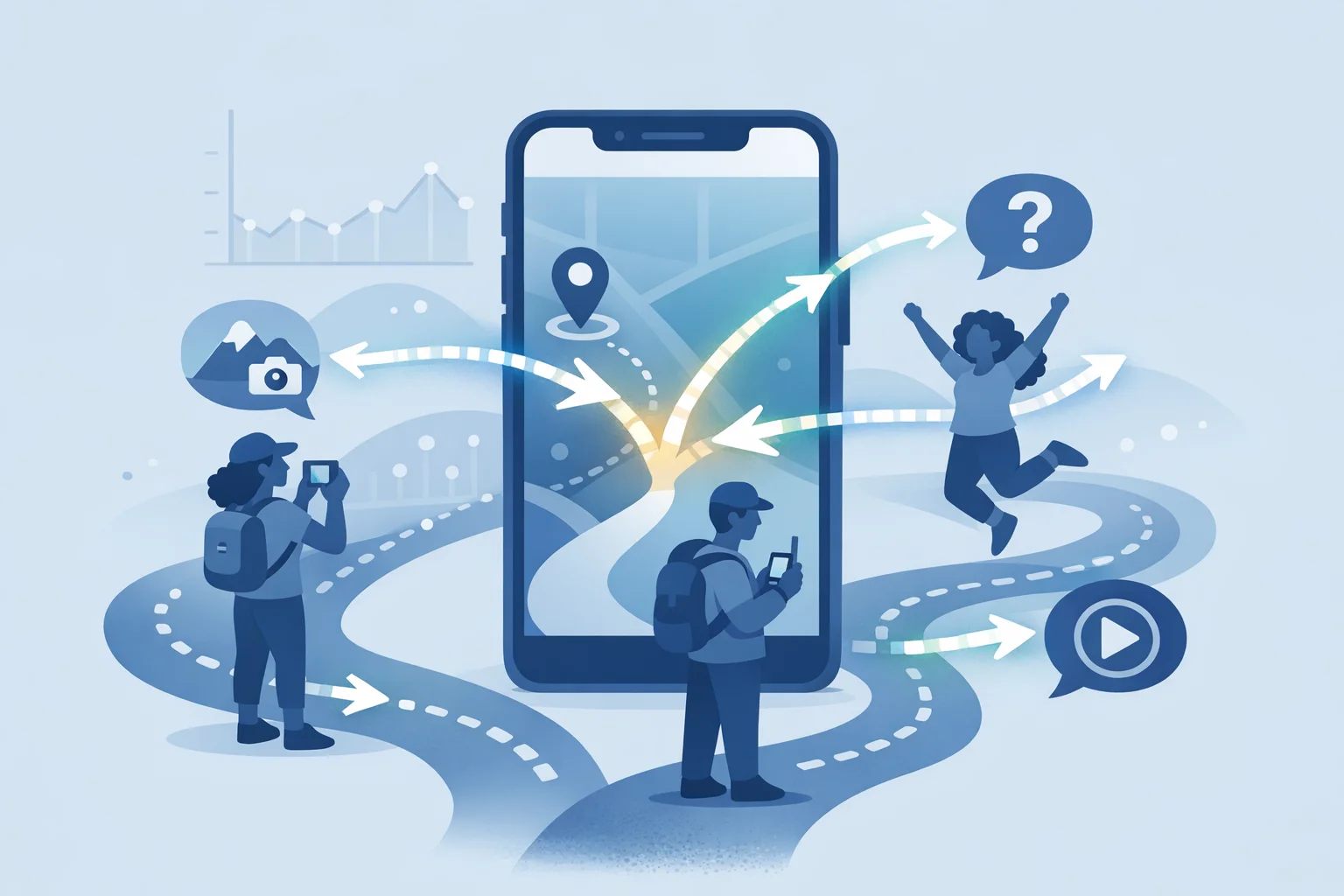
AI gamification isn’t about sprinkling points and badges on top of boring. It’s about using machine learning to tune challenges, feedback, and rewards to each person so participation stops feeling generic and starts feeling relevant. Done right, it lifts interaction quality while quietly reducing manual campaign work. Done wrong, it’s noise with confetti.
AI gamification pairs behavioral design with algorithms that adapt content, difficulty, timing, and rewards in real time. Instead of static leaderboards and blanket points, systems learn which challenge nudges which person today, not last quarter.
In practice, four loops drive the system:
Teams that try to launch all four loops at once usually stall. Ship one tight loop, prove the lift, then expand.
A pattern we keep seeing: programs that honor three basic psychological needs outperform those that treat people like points receptacles. Those needs are autonomy, competence, and relatedness. Design choices that expand choice sets, match difficulty to current skill, and enable lightweight social proof tend to sustain participation. That alignment reflects decades of research summarized under Self-Determination Theory. See the overview of the basic psychological needs by the SDT research community. Self-Determination Theory: autonomy, competence, relatedness. (selfdeterminationtheory.org)
Prompts matter, too. Behavior typically occurs when motivation, ability, and a prompt align at once. If the challenge is too hard or arrives at the wrong moment, motivation collapses. The Fogg Behavior Model is a useful lens when tuning prompts and friction. A concise explanation of the Fogg Behavior Model. (thebehavioralscientist.com)
Two practical implications:
Most static A/B tests assume stable winners. Engagement rarely behaves that way. As audiences, contexts, and content drift, the “best” option shifts.
Contextual multi-armed bandits: Rather than splitting traffic evenly, bandits continuously rebalance exposure toward options performing better for given contexts (role, location, time of day), while still exploring alternatives. Google’s Firebase documents how its Remote Config Personalization uses a contextual bandit for real-time experience selection. Contextual bandits for in-app personalization. (firebase.google.com)
Skill estimation for difficulty: For challenge difficulty to stay “just right,” systems estimate participant skill and uncertainty, then match tasks accordingly. Microsoft’s TrueSkill work shows a Bayesian approach to ranking skill with uncertainty tracking, a useful pattern beyond gaming. Bayesian skill rating concept behind TrueSkill. (microsoft.com)
Spaced challenges and memory: When your objectives include durable learning (onboarding, compliance, product knowledge), spacing matters. The research record indicates that distributing practice over time improves retention versus massed practice. See the Psychological Science paper on optimal intervals for spacing. Evidence for spacing effects in learning. (files.eric.ed.gov)
Feedback shaping: Immediate, specific feedback tends to outperform delayed, vague feedback for skill acquisition. Many teams over-index on badges and under-invest in feedback clarity.
Exploration vs. exploitation: Don’t shut exploration off after a quick “win.” Nonstationary environments punish overconfidence.
If you want a deeper, hands-on view of bandits in production-style ML stacks, the TF-Agents tutorial on per-arm features is a solid technical reference. Tutorial on contextual bandits with per-arm features. (tensorflow.org)
More data is not better; better data is better. Capture signals that map cleanly to decisions you’ll make.
Minimum viable profile often beats sprawling identity graphs no one audits.
For governance, align to a straightforward, recognized framework. The NIST AI Risk Management Framework is practical for non-legal teams and keeps risk thinking close to system design and operation. NIST AI RMF 1.0 official document. (nvlpubs.nist.gov)
Different contexts need different knobs. A few patterns we’ve seen repeat.
Here are sample prompts designed to adapt by difficulty, location, and timing. Keep them short, specific, and a little curious.
As the system learns, it can route novices more confidence-builders and send veterans the stretch tasks. It can also time prompts to the moments they’re likely to land.
Most teams don’t need a research lab. They need a crisp loop and honest instrumentation.
1) Pick one outcome. “Increase cross-team intros by 25% over four weeks” beats “drive engagement.”
2) Define the challenge library. Draft 15 to 30 challenges tagged by topic, difficulty, modality, and privacy constraints. Make opt-out pathways explicit.
3) Choose the learning loop. Start with a contextual bandit for selection and a simple skill score with uncertainty for difficulty.
4) Ship a two-week pilot. Include a holdout group or a randomized baseline route. Keep your exploration rate nonzero.
5) Instrument feedback. Track first-response time, completion friction points, repeat attempts, and post-challenge confidence.
6) Run a retro. Keep the two or three strongest patterns, drop the ornamental flourishes, add two new hypotheses.
7) Scale gradually. Expand the challenge library, not the ruleset complexity. Automate what’s obviously working.
A useful benchmark: If challenge diversity per participant stays flat while completions rise, you’re probably over-optimizing one tactic.
Leaderboard tunnel vision. Public ranking can demotivate most of the middle. Fix by offering private progress views, achievement paths, and peer badges. There’s long-standing evidence that certain extrinsic rewards can undermine intrinsic motivation if misapplied. Treat public rankings as a spice, not a base. Meta-analysis on rewards and intrinsic motivation. (selfdeterminationtheory.org)
One-off quests. A flashy kickoff followed by silence teaches people to ignore you. Fix with small, predictable cycles.
Data hoarding. Collecting attributes you never use only increases risk. Fix by trimming to actionable signals and aligning to an AI risk framework. Guidance from NIST’s AI Risk Management Framework. (nvlpubs.nist.gov)
Static difficulty. If the same five people win everything, your difficulty curve is broken. Borrow skill-rating ideas that track ability and uncertainty, then match tasks accordingly. TrueSkill’s approach to skill with uncertainty. (microsoft.com)
Overfitting the last event. What worked last quarter might not work during budget season. Keep exploration alive.
Scavify exists to make passive participation active. On programs where adaptive challenges, timely prompts, and lightweight social proof matter, platforms like Scavify earn their keep by:
We don’t preach one format. We build conditions where real participation happens.
It’s the use of machine learning to adapt game-like elements (challenges, rewards, timing, difficulty) to each participant, based on their behavior and context, to drive a specific objective.
Traditional approaches are static: one challenge set, one points scheme. AI gamification continuously selects and reshapes challenges and rewards per person, often via contextual bandit algorithms rather than one-and-done A/B tests. See Google’s description of contextual bandits in Remote Config Personalization. Contextual bandits in production. (firebase.google.com)
When environments drift and user segments behave differently, bandits tend to allocate traffic more efficiently while still exploring. That usually improves outcomes and reduces opportunity cost compared to static splits.
Track a lightweight skill score with uncertainty and match tasks accordingly. Microsoft’s TrueSkill research is a useful mental model here, even outside gaming contexts. Bayesian skill rating. (microsoft.com)
For learning goals, mixing retrieval practice with spacing improves retention. The literature supports spaced practice over massed practice for durable learning. Research on spacing effects. (files.eric.ed.gov)
Use rewards as information, not control. Private progress, competence-signaling feedback, and optional social highlights usually help. Overly controlling, extrinsic-only rewards can backfire, as summarized in a prominent meta-analysis. Rewards and intrinsic motivation evidence. (selfdeterminationtheory.org)
Meta-analyses in education and workplace settings show generally positive but design-dependent effects. Adaptive feedback and personalization are among features linked to better outcomes. Meta-analysis on gamification design features and learning outcomes. (link.springer.com)
Create a short risk register, define data retention, enable opt-outs, and align to a public framework like NIST’s AI RMF for process guardrails. NIST’s AI RMF. (nvlpubs.nist.gov)
If you’re building team building, onboarding, or campus orientation experiences and want them to feel alive without micromanaging every detail, AI-powered personalization with a tight behavioral backbone is the move. Scavify was built to make that practical at any scale.