Solutions
Your first hunt, live this afternoon.
Free to start · No download for participants
Improve retention with gamified training that blends challenges, feedback, and rewards. See what works, what fails, and how to apply it at work today.
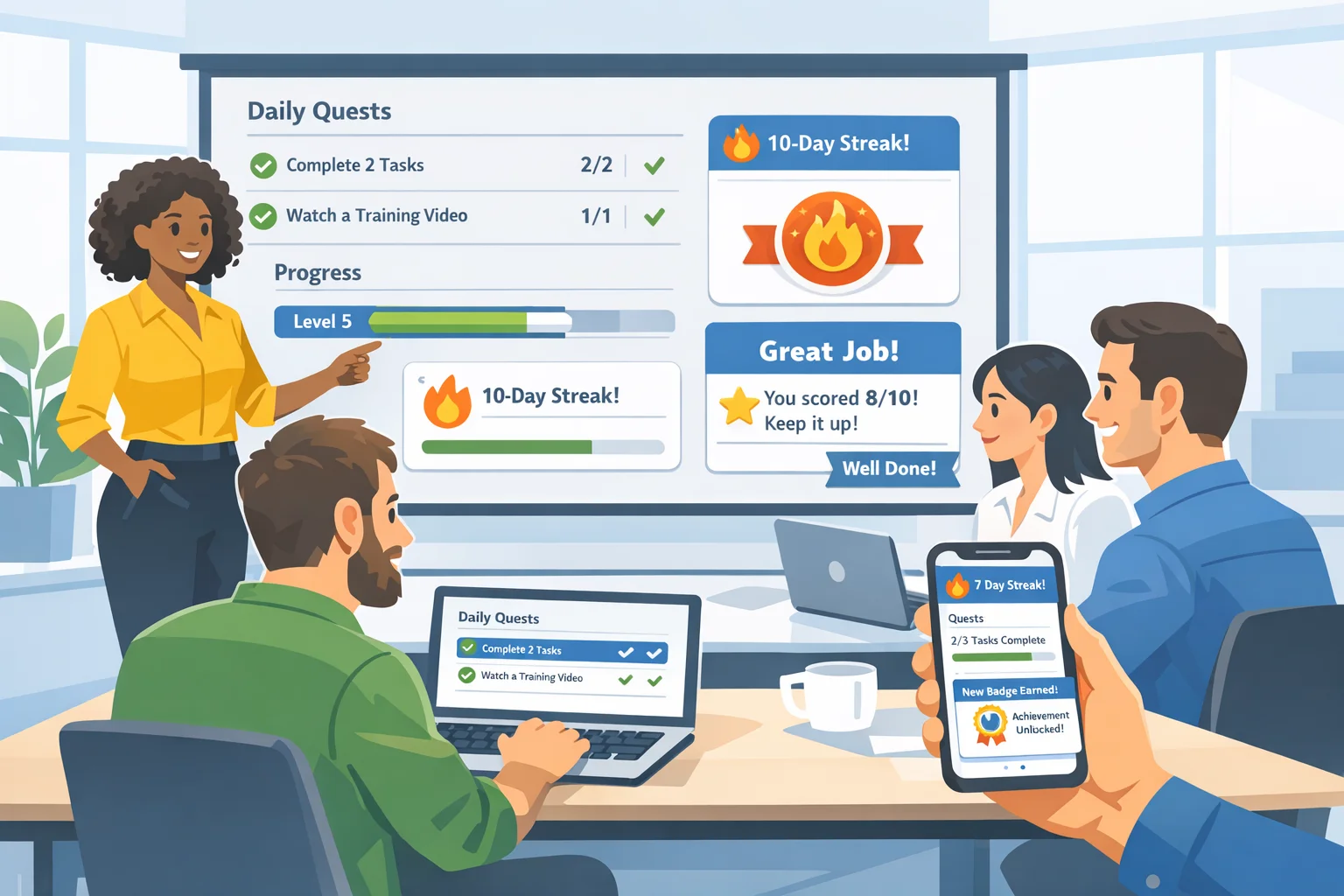
Most gamified training tries to make work feel like a game. The versions that actually move the needle treat training like a series of well-designed challenges, with fast feedback, meaningful progress, and just enough social energy to keep momentum. That’s the line this guide walks: how to design gamified training that improves retention and changes on-the-job behavior.
Gamified training uses specific game design elements to make practice active: clear goals, challenge progression, points or progress indicators, immediate feedback, and social structures that create momentum. It is not “turning work into a video game.” It’s turning passive content into interactive, measurable practice.
Two distinctions save headaches: - Gamification vs. game-based learning. Gamification adds game elements to non-game training. Game-based learning builds a full game to teach. You likely need the former for speed and scalability. - Engagement vs. performance. Engagement is a means, not the end. If the mechanics don’t translate to behavior on the job, they’re ornamental.
A large open-access meta-analysis finds that gamification can improve cognitive, motivational, and behavioral outcomes when design matches context. Social structures matter: competition combined with collaboration often outperforms pure competition. Translation: points alone won’t do it, but structured challenges with feedback and the right social layer can. (link.springer.com)
The learning science is straightforward. Retrieval practice (having people recall or apply information from memory) reliably improves long-term retention across topics and formats. Build more “try it now” moments and you’ll see better recall later. (pubmed.ncbi.nlm.nih.gov)
Spacing practice over time beats one-and-done marathons. Even multi-month gaps can help if reviews are well-timed. That’s why drip-fed challenges often outperform single workshops with perfect slides and no follow-up. (journals.sagepub.com)
Feedback drives improvement, but quality and timing matter. Evidence syntheses show feedback is one of the highest-impact, lowest-cost levers in education when it’s clear, actionable, and tied to goals. In practice: short, specific feedback inside each challenge beats quarterly scorecards. (educationendowmentfoundation.org.uk)
Sustained motivation tends to follow Self-Determination Theory: support people’s sense of autonomy, competence, and relatedness. Mechanically: give choice, make progress visible and winnable, and include team moments that feel human, not staged. (selfdeterminationtheory.org)
1) Start with job behaviors. Define the observable actions that matter (e.g., “ask two diagnostic questions before proposing a fix”). Write challenges that force those moves.
2) Design with MDA, not mechanics-in-a-vacuum. Map from Mechanics to the Dynamics they create to the Aesthetic (felt experience) you want. For example, a “streak” (mechanic) creates momentum (dynamic) and a sense of progress (aesthetic). If the dynamic is pressure or shame, rethink the mechanic. (cs.northwestern.edu)
3) Build retrieval into the core loop. Ask people to recall, decide, demonstrate, or explain every few screens. If content can be scrolled past without doing anything, expect it to evaporate. (pubmed.ncbi.nlm.nih.gov)
4) Deliver tight feedback. Feedback should be fast, specific, and forward-looking: what happened, why it matters, what to do next. Avoid generic confetti.
5) Space the challenges. Release in short arcs over days or weeks. Make reviews feel like new challenges, not repeats. (journals.sagepub.com)
6) Calibrate the social layer. Tiered or team-based comparison beats a single global leaderboard for most groups, especially mixed-experience cohorts. The goal is energy, not humiliation. (sciencedirect.com)
7) Measure for decisions. Commit to how you’ll use data before launch: what will you continue, change, or stop based on results?
1) Target behaviors and scenarios. Write 6–10 high-frequency moments people face: customer pushback, safety checks, system triage, or campus navigation. Use screenshots, photos, or short clips to ground each.
2) Draft challenges that force the move. Convert each scenario into a set of micro-challenges: a timed decision, a short video demo, a multiple-choice branch, a short-form explanation. Aim for 30–90 seconds per challenge to keep flow.
3) Layer feedback and hints. Build answer-specific feedback that names the misconception and shows a better move. Give optional hints to preserve autonomy for advanced learners. (educationendowmentfoundation.org.uk)
4) Space the release. Ship a starter arc this week, a review arc next week, and a “transfer” arc a bit later that applies skills in a new context. The cadence can flex. The spacing principle is what matters. (journals.sagepub.com)
5) Choose the right social structure. Use small teams, tiers, or progress maps rather than one global rank. Offer personal bests and streaks for solo motivation. Research and practice both suggest this reduces demotivation among lower-ranked participants while preserving competitive spark. (sciencedirect.com)
Mechanics to use - Progress maps and streaks. Visible, steady progress builds competence and momentum. - Adaptive difficulty. Make later challenges react to earlier performance. - Choice boards. Let learners pick which challenges to tackle first to support autonomy. (selfdeterminationtheory.org) - Team goals. Blend cooperation and light competition. Small wins add up. - Timed decisions. Light time pressure simulates real constraints without punishing slower readers.
Mechanics to be careful with - Global leaderboards. Fun for top performers; risky elsewhere. Tiered or time-bounded boards are safer defaults. (sciencedirect.com) - Badges for everything. Overuse dilutes meaning. Tie badges to clear skill milestones or transfer to work. - Extrinsic-only rewards. If rewards feel controlling, they can crowd out intrinsic interest. Tie rewards to competence and progress, not just compliance. (selfdeterminationtheory.org)
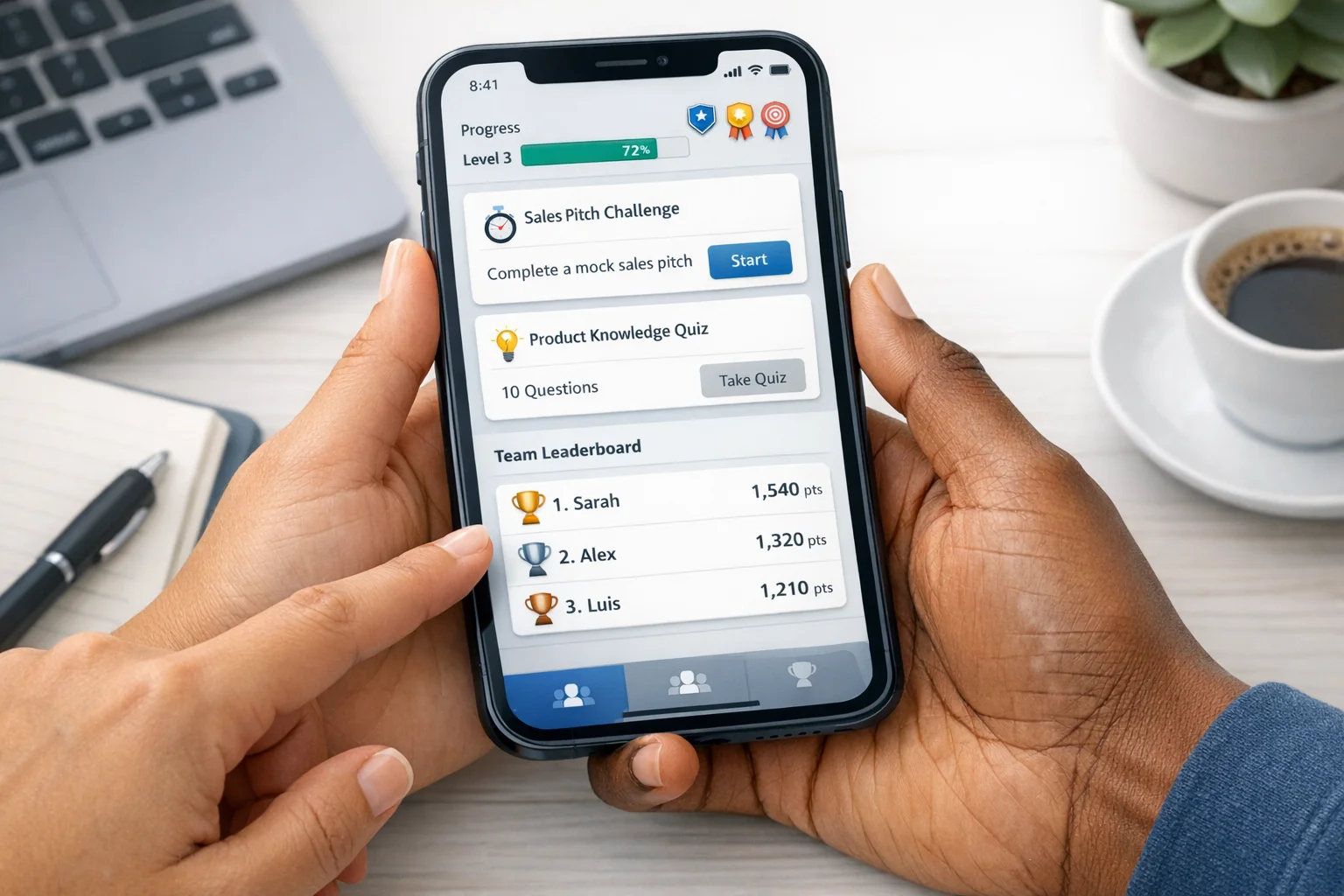
Below are compact, app-ready prompts. Each one is designed as a mini-mystery, not a directive.
Onboarding sprint (week 1) - [Photo | 20 pts]: Show the tool every new hire claims is “secretly essential.” - [Q&A | 30 pts]: Your team’s weekly standup happens when and where? - [Multiple Choice | 40 pts]: Which two policies require manager sign-off before purchase? - [Video | 50 pts]: In 20 seconds, teach a shortcut you used today. - [QR Code | 30 pts]: Scan the code at the spot where IT solves 80% of issues.
Safety refresher (field ops) - [GPS Check-in | 40 pts]: Confirm the nearest eyewash station to your route. - [Multiple Choice | 50 pts]: Which two steps prevent the most ladder incidents? - [Photo | 30 pts]: Show a trip hazard you eliminated today. - [Video | 60 pts]: Demonstrate the “pause and point” before energizing. - [Q&A | 40 pts]: What’s the first question before entering a confined space?
If you’re running challenge-based programs at scale, Scavify naturally fits this format with mixed challenge types, automation, and mobile-plus-browser access. That’s our lane.
Pilot small, then widen. Choose one audience and 2–3 target behaviors. Confirm challenge clarity, feedback quality, and data capture. Fix rough edges fast.
Communicate like a coach, not a poster. Tell people why the challenges exist, how long they take, and what “good” looks like. Show a 20–30 second screen recording to reduce first-time friction.
Make it easy to start again. Prominent “resume” buttons, calendar nudges, and end-of-arc reminders keep spacing intact without nagging. (journals.sagepub.com)
Automate the boring parts. Auto-enroll cohorts, schedule releases, and deliver feedback inside the experience. Keep manual scoring out of it.
Use a blend of learning science metrics and business metrics. A simple translation of the Kirkpatrick model helps: reaction, learning, behavior, and results. Design your data capture to hit levels 2–4, not just smile sheets. (kirkpatrickpartners.com)
Add quick A/Bs where feasible. For example, send half the cohort a spaced review arc and compare their delayed challenge scores and relevant system behaviors to the half without it. If you can’t run A/Bs, stagger rollouts and compare early vs. late groups. (journals.sagepub.com)
Training that turns content into interactive challenges with clear goals, fast feedback, and visible progress so people actually practice what matters on the job.
Yes, when the mechanics match the context. Meta-analytic work shows positive effects on cognitive, motivational, and behavioral outcomes, especially when social structures aren’t just pure competition. (link.springer.com)
Retrieval-focused challenges, immediate feedback, and spaced releases. These three, used together, consistently outperform pretty wrappers around static content. (pubmed.ncbi.nlm.nih.gov)
Not always, but global, always-on leaderboards can demotivate those in the bottom half. Prefer small teams, tiers, or time-bounded boards. (sciencedirect.com)
Make rewards informational, not controlling. Recognize mastery milestones and progress; avoid rewards that feel like compliance payments. Support autonomy, competence, and relatedness to sustain motivation. (selfdeterminationtheory.org)
Pair challenge data with one behavior metric the business already tracks (e.g., safety check completions). Look for change after the spaced review arc, not just after week one. (journals.sagepub.com)
When you want mixed challenge types, automation, mobile-plus-browser access, and easy rollout across teams. It’s a natural fit for challenge-based training without building a custom stack.
Long enough to space learning and see transfer. Many teams run short arcs across weeks, with periodic refreshers tied to real-world cycles. The spacing principle matters more than a fixed calendar. (journals.sagepub.com)