Solutions
Your first hunt, live this afternoon.
Free to start · No download for participants
Build gamification in learning and development that lifts completion, recall, and buy-in. Get practical tactics for onboarding, training, and upskilling.
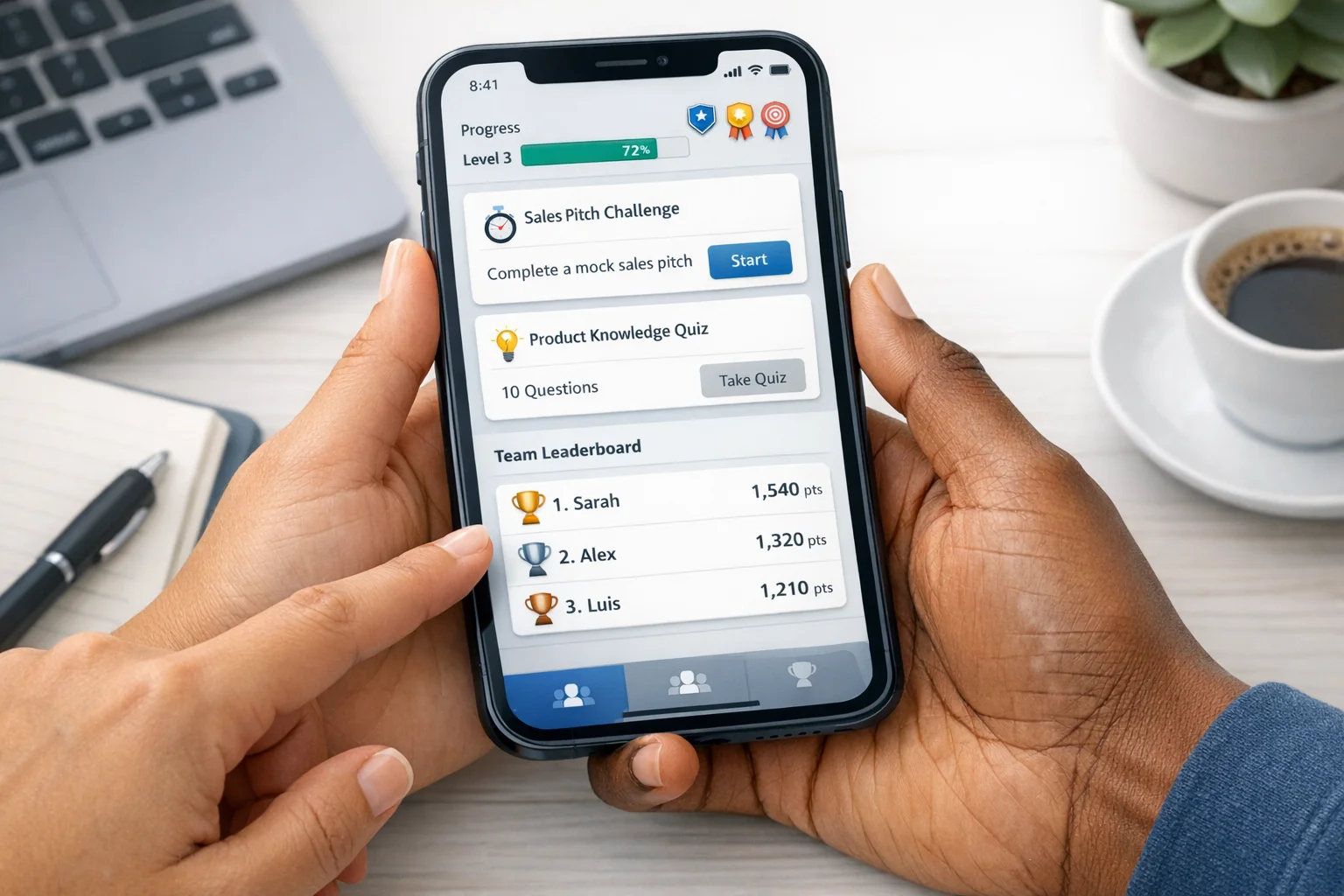
Most L&D teams have tried “gamification” at least once. Points. Badges. Maybe a leaderboard. Engagement jumps for a week, then the graph settles back to normal. The problem isn’t the idea of gamification. It’s shallow execution that chases novelty instead of behavior change.
Here’s a practical guide to designing gamification in learning and development that actually sticks. It’s built from field patterns, research that holds up, and the messy realities of onboarding, compliance, and upskilling.
A pattern we keep seeing: teams add badges and a leaderboard to flat content, call it a win, and wonder why nothing changed two months later. That’s because shallow rewards spike novelty, not capability. Even Gartner called this a decade ago, predicting that most gamification efforts would fail primarily due to poor design. Old quote, still useful as a warning label. (cmswire.com)
What usually shifts the dynamic is when the “game” is welded to the learning task itself. Instead of rewarding time spent, you reward correct decisions under constraints, repeated over time, with feedback. The mechanics serve memory and motivation, not the other way around.
Both can work. But they don’t work for the same reasons. Landers’ theory of gamified learning explains that game elements influence learning by affecting the psychological and behavioral processes around instruction, not by magic. Translation: mechanics should amplify a sound instructional design, not replace it. (journals.sagepub.com)
The research base isn’t hype-free, which is exactly why it’s useful.
Meta-analyses show small-to-moderate positive effects. Across education and training contexts, gamification tends to improve motivation and, in many cases, learning outcomes, with effects moderated by design quality and context. Sailer and Homner’s meta-analysis is a solid overview. (link.springer.com)
Mechanics must map to motivation. Self-determination theory (SDT) is the cleanest lens: support autonomy, competence, and relatedness to drive high-quality motivation. When gamification supports these needs, outcomes improve; when it undermines them, expect churn. (selfdeterminationtheory.org)
Memory mechanics matter more than cosmetics. Retrieval practice (testing effect) reliably boosts long-term retention versus re-reading. Good gamification leans into repeated retrieval with feedback over time. That’s not a fad; it’s one of the most replicated findings in cognitive psychology. (journals.sagepub.com)
Results vary by element. Narrative can lift satisfaction, but doesn’t automatically raise knowledge scores without strong task alignment. Design details decide the outcome. (journals.sagepub.com)
Workplace training evidence is growing. Reviews of gamified professional training suggest positive effects on engagement and learning when mechanics are tightly coupled to job tasks. Field studies in security awareness, for example, show measurable behavior change when programs are designed around real threats and ongoing practice. (tandfonline.com)
If you remember one thing from the literature: gamification is a force multiplier. It amplifies good instructional design. It can’t rescue weak content.
These are the ingredients that consistently make programs stick.
Start with the performance target. Define the on-the-job behavior you want in plain language. Back-cast the minimal set of knowledge and decisions learners must demonstrate.
Map mechanics to SDT.
Design for retrieval and spacing. Build short, repeatable challenges over days and weeks. Score and surface streaks for correct recall, not just logins. (journals.sagepub.com)
Use narrative as scaffolding, not theater. A thin story can frame relevance and reduce friction, but it won’t fix poor task design. Keep fiction in service of function. (journals.sagepub.com)
Reward signal, not noise. Points should reinforce accurate decisions, faster correct responses, and transfer to job scenarios. Avoid XP for seat time.
Calibrate difficulty like a good game. Early wins to onboard. Then purposeful stretch. Avoid cliffs that punish novices.
Make feedback specific and immediate. Tell learners exactly what was right, what was wrong, and why it matters on the job.
Respect opt-in. Voluntary participation and clear value props beat forced fun. Mandatory competition is a quiet morale killer.
A simple, repeatable sequence we’ve used across onboarding, compliance, and enablement.
1) Define the job moments. Pick 3–5 high-frequency, high-cost mistakes you want to eliminate. Convert each into a decision scenario.
2) Choose your core loop. For most training, the loop is: read/see a scenario, make a decision under a constraint, get feedback, repeat later with variation. Make it quick. 2–3 minutes per loop.
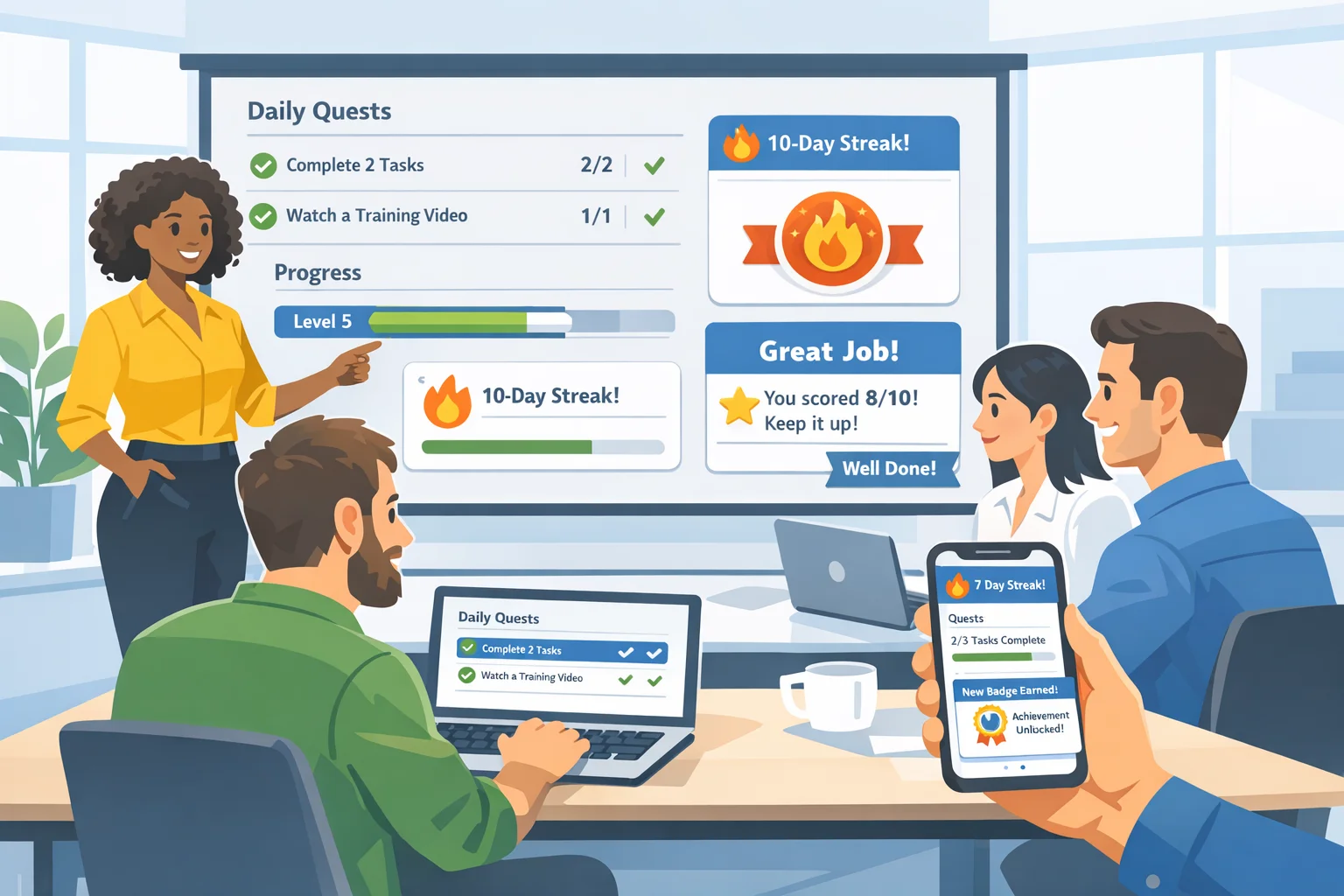
3) Select mechanics with intent. - Progression: levels tied to competency milestones, not time. - Streaks: for consecutive correct answers across days. - Quests: bundles of 5–7 scenarios around a theme. - Social: team totals or peer review where collaboration is part of the job.
4) Prototype tiny. Build one quest. Ship to 20–50 learners. Instrument everything.
5) Instrument the right metrics. Baselines first. Then track accuracy deltas, time-to-correct, voluntary re-engagement, and follow-up retention.
6) Iterate like a product. Kill mechanics that don’t move the target behavior. Double-down on the ones that do.
In our experience, this light, iterative cadence beats quarter-long content builds that land fully formed and fully off-target.
Completion rates are comfort food. Eat less of them.
Track these instead: - Retrieval accuracy over time: same concept, new context, delayed interval. - First-try pass rates: by scenario type and difficulty band. - Time-to-correct: how quickly learners recover from errors after feedback. - Behavioral proxies: fewer safety incidents, lower phishing click rates, better CRM hygiene depending on the program. Security and compliance studies that ran long enough to measure behavior change found significant improvements when training was gamified and continuous. (papers.ssrn.com) - Transfer tasks: performance on job-like tasks not seen in training.
Method note: space your assessments. Don’t just test five minutes after training; test again days or weeks later to validate retention. That’s how you catch whether learning stuck. (journals.sagepub.com)
These patterns work across common L&D scenarios. The trick is to keep challenges tight, job-relevant, and replayable.
Goal: accelerate context, reduce new-hire friction.
Goal: reduce risky behavior; improve policy fluency.
Goal: sharpen discovery and objection handling.
Goal: reduce incidents; reinforce checklists.
If you deliver these as app-based challenges, automation and variety matter. This is where a platform like Scavify naturally fits: quick to launch, browser or app based, with mixed challenge types and scoring that reinforce accuracy and repetition without heavy lift from your team.
Use this checklist to avoid buyer’s remorse: - Mechanic flexibility: beyond points/badges to quests, streaks, branching, peer review. - Content integration: can you make the challenge about the actual decision, not just attendance? - Feedback control: immediate, specific, configurable. - Scheduling: spaced delivery and reinforcement. - Analytics: accuracy over time, difficulty bands, transfer proxies, not just completions. - Launch/scale: can you stand up a pilot in days and scale to thousands without rework? - Access: mobile app plus browser for deskless and desked learners.
If a vendor can’t show you accuracy deltas and retention curves from a pilot, keep walking.
Structural gamification adds layers like points, badges, leaderboards, and levels around content. Content-integrated gamification bakes the skill into the challenge so success requires correct decisions, not time spent. The latter is much more likely to transfer to the job.
Often, yes, when designed well. Meta-analyses report small-to-moderate positive effects on motivation and learning, with outcomes depending on context and mechanics. Treat it as a design tool, not a magic switch. (link.springer.com)
Elements that support SDT and retrieval: clear goals, progressive difficulty, immediate feedback, optional paths, team quests where collaboration matters, and spaced challenges that require recall. These map cleanly to autonomy, competence, relatedness, and memory. (selfdeterminationtheory.org)
Light narrative can improve learner reactions and make scenarios feel more relevant. Alone, it won’t guarantee higher knowledge scores. Use it to frame decisions, not to distract. (journals.sagepub.com)
Track retrieval accuracy over time, first-try pass rates, time-to-correct, and behavior proxies tied to the program (e.g., phishing click rates after security quests). Build delayed post-tests to validate retention. (papers.ssrn.com)
Likely pointsification, public leaderboards that demotivate many, or rewards linked to activity instead of accuracy and transfer. Gartner’s long-ago failure prediction was about poor design, not the concept itself. (cmswire.com)
When your format benefits from mobile or browser-based, quick, varied challenges at scale. Scavify makes it easy to build quests that reinforce correct decisions through repetition, automate scoring, and keep content fresh without a production crew. It’s not a replacement for instructional design; it’s the fast lane for delivering it.
Good gamification doesn’t feel like a gimmick. It feels like clarity under pressure. Make the right decision, get immediate feedback, come back tomorrow a little sharper. Do that for a month and you’ve got something that sticks.