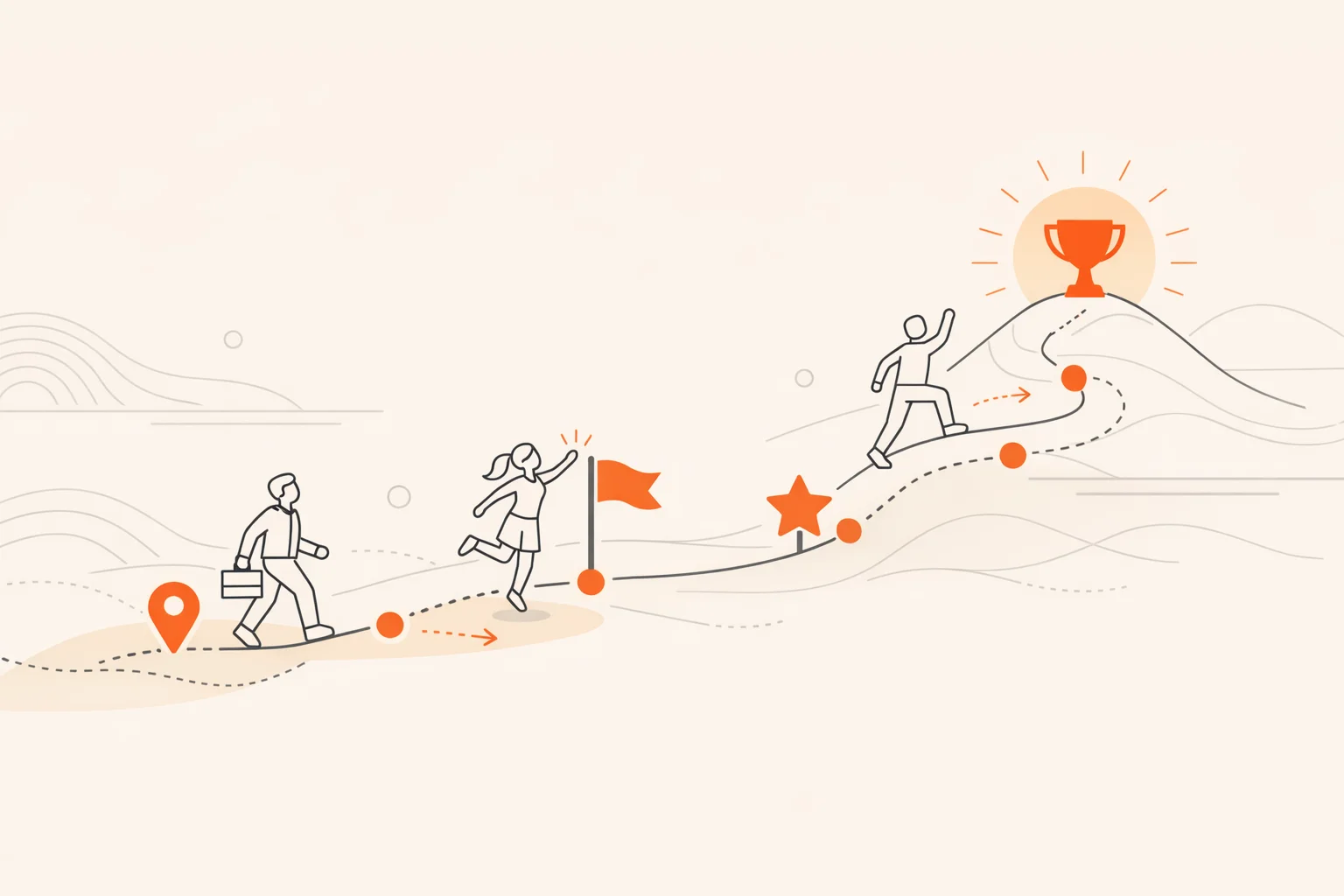
Gamification in the workplace isn’t about turning serious work into a video game. It’s about using a few proven game design elements to make progress visible, feedback immediate, and participation socially reinforced. That combination reliably nudges the real behaviors most organizations care about: completing training on time, sharing knowledge, onboarding faster, participating in culture, and adopting new processes.
What usually separates success from noise is design intent. Gamification that starts with a clear behavior and honest constraints tends to work. Gamification stapled on as points, badges, and leaderboards with no connection to job reality tends to wither.
In our experience, the winners use just enough structure to keep people moving, then get out of the way.
- Start with a single target behavior and design backward from it; don’t start with features.
- Use feedback, progress, and social proof to sustain effort; points alone fade fast.
- Protect intrinsic motivation by offering meaningful choices and recognition, not just prizes.
- Measure behavior change, not hype: completions, cycle time, quality, and participation equity.
What gamification in the workplace actually is
A practical definition: applying selected game design elements like goals, progress feedback, challenges, and social recognition to non-game work so people stay engaged long enough to build a habit or reach an outcome. That’s distinct from building a game. The goal is performance, not entertainment.
Grounding this in theory helps. Self‑determination theory suggests intrinsic motivation grows when people feel autonomy, competence, and relatedness. Good workplace gamification aligns with those needs through optional challenges, visible skill progress, and social acknowledgment. See the American Psychological Association’s overview of self‑determination theory for the underlying model.
Heads up
“Points, badges, and leaderboards” are seasoning, not the main course. They can amplify a good design, not rescue a bad one.
What the research says today
- Engagement is scarce. Gallup’s State of the Global Workplace 2026 reports global engagement at roughly one in five employees and quantifies the productivity cost of disengagement at the multi‑trillion‑dollar level. A sober backdrop for any program promising behavior change. Source: Gallup 2026 and the published report PDF.
- When designed well, training results improve. A synthesis in Harvard Business Review found that gamified training built around progression, timely feedback, points, and light competition over time can meaningfully improve employee performance. See Does Gamified Training Get Results?
- Meta‑analyses show durable effects on learning. A widely cited review found a positive, medium‑sized relationship between gamification and learning outcomes, with stronger effects when progress, narrative, and collaboration are part of the design. Reference: Sailer & Homner (2020).
- Long‑running real‑world examples exist. Salesforce’s Trailhead has sustained multi‑year participation using ranks, badges, quests, and community status tied to real skills. See Trailblazer ranks and this overview of Trailblazer Quests.

Where gamification reliably helps
Use gamification when the work benefits from repetition, timely feedback, or visible progress.
- Onboarding. Reduce time‑to‑confidence by turning the first 30–90 days into a clear journey with small wins, social introductions, and visible progress.
- Training and development. Replace long, infrequent content drops with shorter challenges, immediate checks for understanding, and streaks that reward consistency.
- Safety and compliance. Make the right behavior the obvious behavior with quick checks, spot challenges, and public recognition for teams that sustain standards.
- Knowledge sharing. Nudge posting, tagging, and solution sharing with targeted prompts and peer recognition. Celebrate usefulness, not volume.
- Sales enablement. Anchor learning to live deals: timely playbooks, short scenario challenges, and team performance quests that avoid sandbagging.
Risks, failure modes, and how to de‑risk them
Gamification can backfire if it crowds out intrinsic motivation or rewards the wrong thing. Classic meta‑analytic work on rewards shows that poorly designed tangible rewards can undermine interest, while positive feedback tends to enhance it. See Deci, Koestner, and Ryan’s 1999 Psychological Bulletin review and follow‑ups like Deci et al. 2001 for the debates and nuance.
Common pitfalls we keep seeing:
- Points with no purpose. Activity for activity’s sake burns trust. Tie every mechanic to a real outcome.
- Perverse incentives. Leaderboards that reward speed over quality invite shortcuts. Score what you actually value.
- One‑size‑fits‑all rewards. Not everyone wants swag. Recognition, growth, and autonomy often travel further.
- Excess surveillance. Gamification is not a monitoring program. Participation should feel voluntary and respectful.
- Short‑term sugar highs. Launch spikes are easy. Sustained behavior change takes cadence and refresh.
Watch out
If success depends on collaboration, avoid solo leaderboards that pit teammates against each other. Recognize team outcomes and individual contributions separately.
Mechanics that move behavior (and why)
A pattern we see again and again: simple, interpretable mechanics beat novelty.
- Clear goals. Define exactly what “good” looks like. Ambiguity kills momentum.
- Progress feedback. Progress bars, streaks, and checkpoints make effort feel consequential.
- Immediate feedback. Quizzes, spot checks, and scenario challenges with instant scoring tighten the learning loop.
- Social proof and recognition. Activity feeds, shout‑outs, and badges signal what the group values.
- Choice and pathing. Parallel tracks let people pick relevant challenges, preserving autonomy.
- Cadence. Time‑boxed quests and seasonal refreshes reset attention.
Implementation steps that work in real organizations
- Identify one behavior worth moving first, not five.
- Map the micro‑actions that lead to that behavior and where people currently fall off.
- Choose 2–3 mechanics that directly support those actions.
- Prototype on a small cohort and time box the pilot to 2–4 weeks.
- Ship with plain‑language rules and a visible finish line.
- Review results with participants and adjust mechanics, not just prizes.
- Scale gradually and retire mechanics that stop earning their keep.
Measurement that proves it’s working
Design measurement the way you design the game: for clarity.
- Adoption: percent of targeted employees who opt in within the first week; daily and weekly active participation.
- Velocity: time from first step to milestone completion; time between check‑ins.
- Quality: assessment scores, task quality ratings, rework rates.
- Outcomes: time‑to‑productivity for new hires; completion rates for priority modules; cycle time for key processes.
- Equity: representation across roles, locations, and identity groups; concentration of points among a few.
Concise, defensible reporting:
- Report a single primary outcome first. Example: “Onboarding time to first customer call fell from 19 to 14 days.”
- Keep vanity metrics (total badges) separate from outcome metrics (certified proficiency).
- Pair numbers with a short participant quote to humanize the insight.
Use cases and practical patterns
- Onboarding journeys. Give new hires a map for their first 30–90 days with checkpoints, peer intros, and a capstone task that proves readiness. Tie rewards to milestones, not attendance.

- Training and development. Convert bulky courses into sprints: 10–15 minute missions with quick checks and immediate feedback. HBR’s review of gamified training outcomes outlines why this cadence sustains performance.
- Employee engagement. Use monthly quests that rotate themes: innovation, customer stories, safety wins, process fixes. Recognize useful contributions publicly.
- Safety and compliance. Run micro‑drills with photo or video proof, then elevate smart prevention ideas to company‑wide challenges.
- Knowledge sharing. Score answers accepted by peers, not just posts created. Reward maintainers who keep docs current.
- Sales enablement. Attach scenario challenges to active opportunities and celebrate post‑mortems that improve the playbook.
Nobody quits a game they feel they’re winning. Design the first challenge to make everyone feel like a winner.
Copy‑ready challenge examples for workplace programs
- Recreate our core value using only objects on your desk
- Which channel closes the most tickets after 5 pm?
- Scan the code hidden where new hires pick up badges
- Check in at the spot every team demos their work
- Teach a 30‑second tip you wish you knew last month
A browser‑plus‑app format is flexible here. If you prefer a turnkey approach, a mature scavenger hunt app can deliver these mechanics with automation, proof capture, and live leaderboards without extra admin work.

Tools and how to choose a platform without the headaches
When tools help, they reduce manual work: automating scoring, validating completions (photo, video, QR, GPS), handling rewards, and surfacing analytics in real time. Choose for operational reality, not demos.
| Selection factor | Scavify | Typical hunt app |
|---|
| Play in a mobile browser & app | Yes | Usually app only |
| Challenge variety (photo, video, trivia, QR, GPS) | All five | Limited |
| Admin effort to launch | Minutes | Hours |
| Automation (scoring, proof capture, leaderboards) | Built in | Partial |
| Scale from one site to multi‑city programs | Designed for scale | Varies |
Selection checklist:
- Confirm it supports the two or three mechanics you actually plan to use.
- Ensure proof types match your environment (photo/video for office, GPS/QR for onsite).
- Ask for data access: exportable results, participant anonymization, and cohort comparisons.
- Pilot with a real audience and real constraints before you sign long commitments.
Mini case study: Trailhead’s long‑running engagement engine
Salesforce’s Trailhead remains a clean example of sustained, scaled gamification tied to real skill progression. Learners complete modules and projects, earn points and badges, and advance through public ranks linked to their profile and community status. The mechanics are simple, the value is real, and the cadence is ongoing. Explore the rank system in Trailblazer ranks and how quests shape momentum in this Trailhead Quests overview. A broader help view reinforces the same pattern: points, badges, ranks, and modular content with immediate checks for understanding (Trailhead terminology).

FAQ: straight answers to common questions
Does gamification actually work in the workplace
Yes, when it points at a clear behavior and uses mechanics that match real work. A 2020 meta‑analysis found positive effects on learning outcomes, especially with progress, narrative, and collaborative elements (Sailer & Homner). HBR likewise reports performance gains when training is paced and reinforced over time (HBR 2023).
How do we avoid cheap points and protect intrinsic motivation
Anchor mechanics to meaningful goals. Offer choices in challenges, make progress visible, and recognize usefulness over volume. Classic research warns that dangling irrelevant tangible rewards can undermine interest, while positive feedback supports motivation (Deci et al. 1999).
What should we measure beyond badges
Measure adoption, velocity, quality, outcomes, and equity. Examples: time‑to‑productivity for new hires, completion rates for critical modules, assessment scores, rework rates, and participation distribution across teams.
What behaviors are the best starting points
Onboarding milestones, required skills training, documentation upkeep, and lightweight safety practices. These have clear definitions of done, natural feedback loops, and visible benefits to the team.
When does a leaderboard help vs hurt
It helps when tasks are independent and speed or volume truly matter. It hurts when work requires collaboration or thoughtful quality. In those cases, show team progress and highlight useful contributions instead of raw totals.
Do we need an app or can we DIY in spreadsheets
You can prototype in spreadsheets or chat tools to validate the design. At scale, purpose‑built platforms reduce manual work with automated scoring, proof capture, live leaderboards, and analytics. Choose based on your real audience and constraints.
Is there evidence beyond training, like for customer programs
Yes. A 2024 meta‑analysis in marketing tied well‑designed gamification to higher engagement, word‑of‑mouth, and loyalty, while also flagging design pitfalls—useful for employee‑facing programs that borrow similar mechanics (meta‑analytics review).
What’s the simplest way to get started next week
Pick one behavior, draft three challenges, write the plain‑English rules, and pilot with a single team for two weeks. Debrief, adjust, then decide whether to scale.
If you want the mechanics without the maintenance burden, Scavify’s browser‑plus‑app approach fits onboarding, training, engagement, and live events with challenge variety, automation, and scale. And if your use case is more exploratory, start small, test honestly, and only keep what actually moves behavior.