Solutions
Your first hunt, live this afternoon.
Free to start · No download for participants
Understand actionable gamification, the Octalysis framework, and how to apply it beyond points and badges to real product and workplace challenges.
Actionable gamification is design that changes real behavior, not just dashboards. It aligns what people want to feel with what you need them to do, then proves it with data. If you’ve seen points, badges, and leaderboards fizzle after two weeks, that’s the difference.
Actionable gamification is a behavior design approach that links your target outcomes to specific human drives and implements mechanics that make the next right action easier, more satisfying, and more visible.
It isn’t a cosmetic layer of points, badges, and leaderboards. Those can help, but only when they reinforce a meaningful loop. Otherwise, they turn into noise and, worse, crowd out intrinsic motivation.
Two principles keep efforts honest:
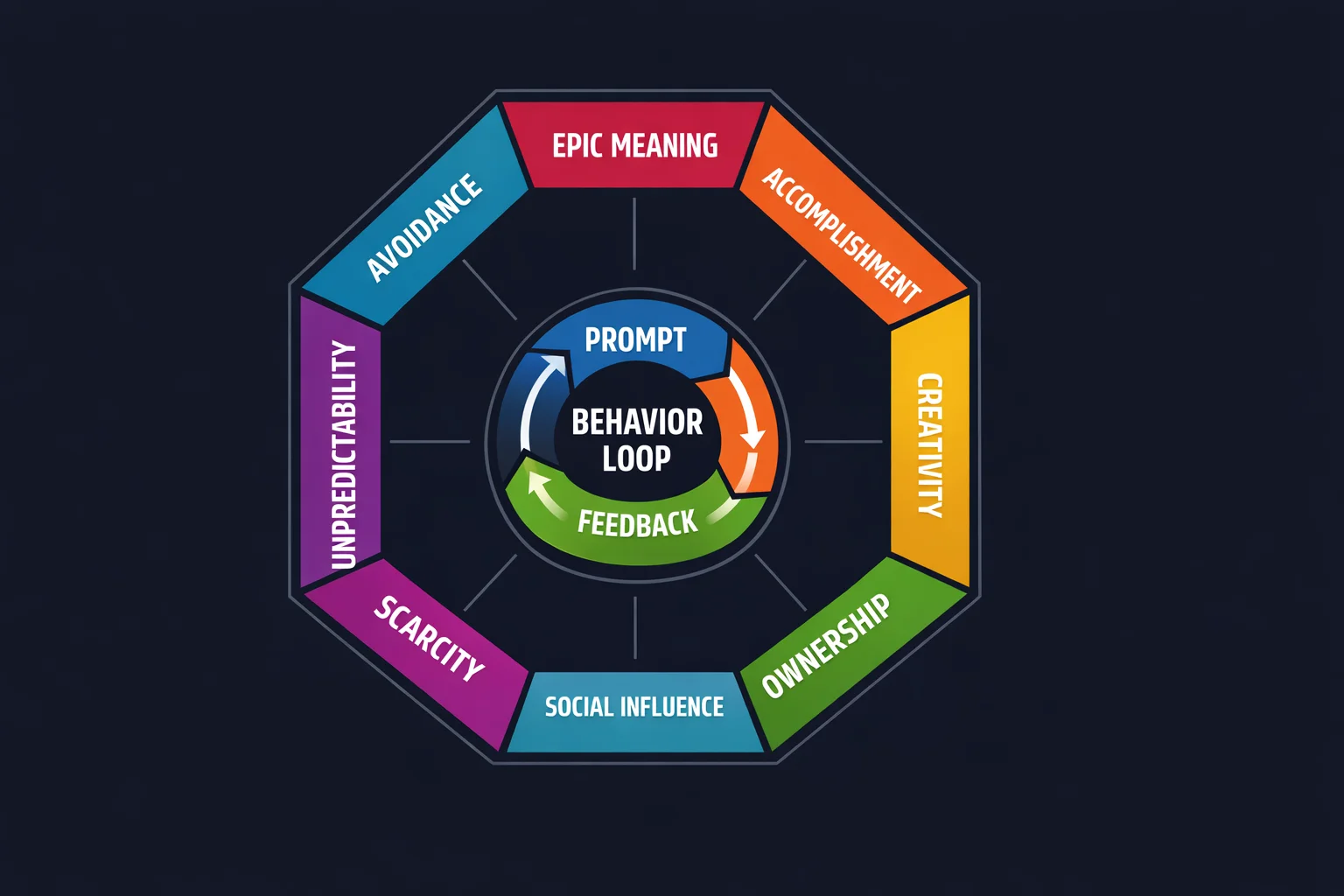
Yu-kai Chou’s Octalysis organizes motivation into eight “core drives.” It’s a useful way to see which levers you’re actually pulling instead of guessing. A quick tour in working language:
Chou also distinguishes “white hat” (long-term uplifting) from “black hat” (short-term urgent) dynamics. Sustainable systems rely more on the former. A concise overview of the framework and drives lives on Yu-kai Chou’s site in The Octalysis Framework for Gamification & Behavioral Design. (yukaichou.com)
In practice, we see teams get leverage when they choose two or three core drives to emphasize and let the others support. All eight at once feels like a theme park; two or three feels like a purpose.
Three foundations from behavior science keep designs grounded.
B=MAP (Fogg Behavior Model). A behavior happens when Motivation, Ability, and a Prompt converge. If behavior isn’t happening, at least one is missing. Use it as a debugging tool: lower ability friction, strengthen a prompt, or connect with a stronger motive. See the model explained clearly on the Fogg Behavior Model site. (behaviormodel.org)
Self-Determination Theory (SDT). People sustain effort when three needs are met: autonomy, competence, and relatedness. If your design undermines these, expect drop-off after the novelty fades. The classic overview is Ryan & Deci’s 2000 paper, Self-Determination Theory and the Facilitation of Intrinsic Motivation. (selfdeterminationtheory.org)
Measure UX with HEART. Google’s HEART framework helps translate fuzzy “engagement” into trackable UX dimensions: Happiness, Engagement, Adoption, Retention, Task success. It’s useful for separating leading signals (e.g., adoption, task success) from lagging ones (e.g., retention). For the original reference, see Google’s CHI paper, Measuring the User Experience on a Large Scale. (research.google.com)
Pattern we keep seeing: once teams align their target behavior to a clear motive (Octalysis), remove friction to make the action easy (B=MAP), and choose two or three HEART dimensions to watch, experiments start paying off.
Most failures trace back to three avoidable patterns:
PBL as the product. Points, badges, and leaderboards shipped without a behavior loop or motivational fit. Gartner flagged this a decade ago: most enterprise gamification efforts failed primarily due to poor design, especially overreliance on obvious mechanics. That critique still holds. See reporting on the finding in Computer Weekly. (computerweekly.com)
Extrinsic rewards crowding out intrinsic motivation. If a task is inherently interesting, conditional rewards can undermine people’s desire to engage. The effect depends on context, but the risk is real. Ryan, Deci, and Koestner’s meta-analysis remains the reference: A Meta-Analytic Review of Experiments Examining the Effects of Extrinsic Rewards on Intrinsic Motivation. (selfdeterminationtheory.org)
Measurement theater. Tallying badges earned instead of behaviors that drive outcomes. HEART is a useful antidote: pick a small set of goals, signals, and metrics per initiative, then instrument deliberately. (research.google.com)
Use this sequence. It’s simple on paper and surprisingly durable in the field.
1) Define the single critical behavior. Name one action that correlates with long-term success: submit the first report, complete the onboarding quest, invite one teammate, file the week’s safety check.
2) Map to motives. Pick two or three Octalysis drives that naturally motivate that behavior. Document why they fit, and which ones you’re intentionally not using. (yukaichou.com)
3) Design the loop. Spell out the moments of prompt, the easiest version of the action, and instant feedback. Check ability friction with B=MAP: if motivation is modest, the action must be tiny. (behaviormodel.org)
4) Select mechanics that express the motive. Examples: quests and progress bars for accomplishment, co-op goals and shout-outs for social influence, creation challenges for empowerment.
5) Instrument HEART. Choose 2–3 dimensions with one metric each. Example: Adoption (first key action), Task Success (completion rate), Retention (7-day return rate). (research.google.com)
6) Ship a thin slice. Launch the smallest complete loop you can run for two weeks.
7) Review, adjust, and only then add rewards. Rewards should reinforce the story you’re telling, not replace it.
8) Scale what compounds. Bake in rituals (weekly wins, seasonal quests) and community mechanics that persist without heavy ops.
A broad research review found gamification effects are mixed and design-dependent. Translation: get the fit right, or results will be noisy. See Hamari, Koivisto, and Sarsa’s review, Does Gamification Work?. (creativegames.org.uk)
Turn passive attendance into active discovery. You want people to move, meet, and remember.
If you’re running an app-based hunt or activation, this is exactly where Scavify shines: flexible challenge types, automation for scoring and leaderboards, and mobile + browser options that scale from a single cohort to multi-venue events. Keep it simple to start; the energy comes from clear missions, not feature sprawl.
Illustrative challenge snippets:
Use mechanics as expressions of motive, not as the motive itself.
A note on leaderboards: they can motivate the top slice and quietly demotivate the middle. If you use them, localize (team or cohort), rotate categories, and highlight improvement, not just rank.
Tie mechanics to behaviors and behaviors to outcomes. Then instrument.
Evidence brief you can cite when asked “does gamification work?”: effects are context-dependent and design-sensitive. The literature shows positive, mixed, and null results because quality of fit varies. That’s exactly why mapping motives first pays off. See Hamari et al.’s review. (creativegames.org.uk)
Short-term urgency can move numbers; it can also burn trust. Favor “white hat” dynamics that build capability, contribution, and connection over “black hat” traps that juice fear of loss or manufactured scarcity. Octalysis’s white/black framing is a practical gut-check when a mechanic feels iffy. Start there. (yukaichou.com)
Three quick filters before launch:
It’s gamification that starts from human motivation, designs repeatable behavior loops, and proves impact with clear metrics, not just cosmetic rewards.
Octalysis focuses on the underlying motives that drive behavior and helps you choose mechanics that express those motives. PBL can be part of the toolkit, but only after motive and loop fit are clear. For an overview, see Octalysis’s core drives explainer. (yukaichou.com)
Yes: use B=MAP. If a behavior isn’t occurring, either motivation is weak, ability is too hard, or the prompt is missing or ill-timed. Start by making the action easier, then refine the prompt, and finally consider motivation. See the Fogg Behavior Model. (behaviormodel.org)
They can, depending on how they’re used. Conditional rewards for already-interesting tasks can reduce intrinsic motivation, while informative feedback and autonomy-supportive environments can increase it. See the 1999 meta-analysis by Deci, Koestner, and Ryan. PDF. (selfdeterminationtheory.org)
Pair a North Star outcome with a small set of HEART-aligned input metrics (e.g., Adoption, Task Success, Retention). Instrument prompts, actions, and feedback so you can see where loops break. The original HEART paper is a good reference. Link. (research.google.com)
Sometimes, and it depends on design quality and context. The best evidence shows positive but mixed effects across domains, which is what you’d expect when motive-mechanic fit varies. See Hamari, Koivisto, and Sarsa’s literature review. PDF. (creativegames.org.uk)
Because they skip motive mapping and loop design, then slap on PBL. Gartner’s analysis called out poor design as the root cause for most enterprise failures. See coverage in Computer Weekly. (computerweekly.com)
When your goal is active discovery, social connection, and memory-making across spaces: campus orientation, conferences, onboarding days, city activations. The format is built for movement, moments, and measurable participation.
If you’re planning an activation, orientation, or team day and want it to feel alive rather than obligatory, this is what we build at Scavify: challenge variety, automation, and scale without chaos. Start small, choose two motives, and design a loop people will happily repeat.