Solutions
Your first hunt, live this afternoon.
Free to start · No download for participants
Explore 12 types of gamification and when to use each one. Match mechanics like points, quests, and leaderboards to the right learning or engagement goal.
Gamification works when you match the mechanic to the behavior you need. Not to what looks fun on a slide. The difference shows up in participation rates, completion quality, and whether energy holds after the kickoff.
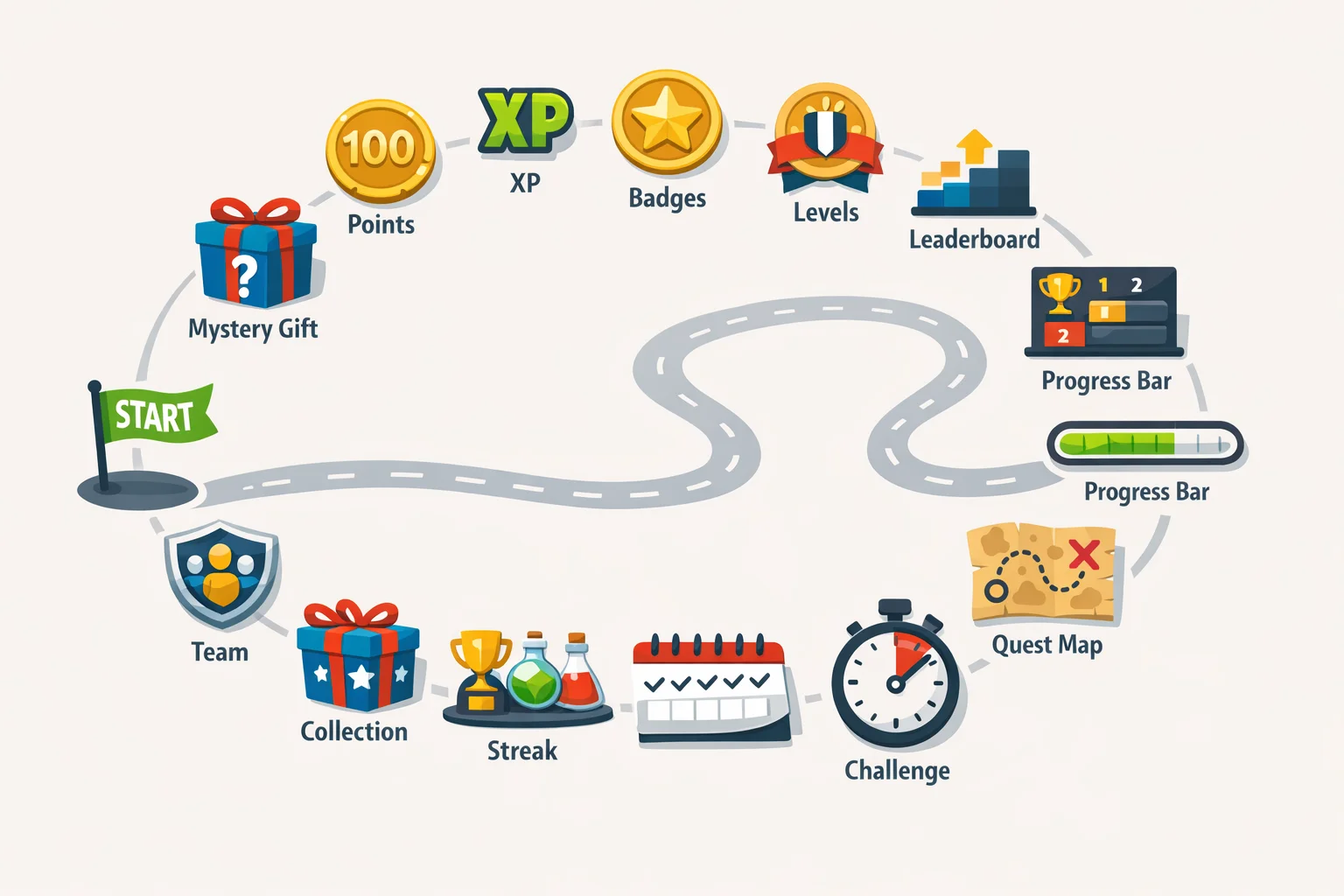
Here’s a practical guide to 12 gamification types that consistently show up in winning programs, plus when to use each and what to avoid.
The most reliable gains come from mechanics that serve basic psychological needs: autonomy, competence, relatedness. That is the backbone of Self Determination Theory, a widely used lens for behavior change and learning design. Use mechanics that let people choose paths (autonomy), see and feel their skill growth (competence), and connect with others with purpose (relatedness). See the concise Self Determination Theory overview for context. Self Determination Theory overview. (sciencedirect.com)
Another practical lens is Octalysis, which organizes motivation into eight core drives and helps you pick mechanics that fit your audience and phase of the journey. It is especially useful for diagnosing stale programs that rely on one drive, usually extrinsic rewards. Octalysis framework overview. (octalysisgroup.com)
If you want the evidence base, recent syntheses show small to large positive effects when gamification is well designed, with variation by audience, duration, and design principles. A 2023 meta-analysis in Frontiers in Psychology reported a large effect on learning outcomes and highlighted the value of combining mechanics, dynamics, and aesthetics in design. Meta-analysis of gamified learning. (frontiersin.org)
Before the 12 types, a quick reward check. SAPS is a simple way to think about extrinsic rewards:
In practice, status, access, and power tend to cost less and create healthier cycles than stuff, which can crowd out intrinsic motivation if overused. See the SAPS concept origin from Gabe Zichermann for terms and examples. SAPS rewards primer. (influitive.com)
Now, the 12 types and when to use each.
What it is: A running tally of activity or skill growth. Often paired with levels.
Works best for: Onboarding, training, and any flow with frequent micro-actions that deserve acknowledgment.
Use when: You need lightweight feedback loops that say “this counted” without stopping the flow.
Watch outs: Points that map to the wrong thing train the wrong behavior. Calibrate so quality matters, not just quantity.
Design tips: Use XP for skill-relevant tasks and scale values by effort or impact. Tie XP thresholds to meaningful unlocks, not just vanity.
What it is: Visible markers of specific accomplishments.
Works best for: Milestone recognition, compliance moments, and encouraging exploration of optional paths.
Use when: You want to highlight progress worth sharing or certify completion.
Watch outs: Badge bloat kills meaning. Treat badges like editorial real estate.
Design tips: Write human badges. “First field sale completed” lands better than “Level 2.” Pair badges with status or access rewards for extra pull.
What it is: Structured tiers that unlock content, privileges, or tougher challenges.
Works best for: Skill-building programs and multi-week initiatives where visible growth keeps people invested.
Use when: You need a clear path from novice to proficient and want to pace difficulty.
Watch outs: Hard gates can stall momentum. Offer multiple routes and soft prerequisites.
Design tips: Combine levels with XP and short quests. Let people preview the next level to create healthy pull.
What it is: Ranked lists that surface comparative performance.
Works best for: Short bursts, sprints, and cultures that enjoy friendly competition.
Use when: You can segment or tier rankings so more people see themselves in the game. Weekly resets help.
Watch outs: One big global board often creates a motivated top slice and a quiet bottom. Research on leaderboards is mixed and design sensitive, with recent work emphasizing adaptivity and position feedback. See an experimental test in education as well as newer studies on adaptive ranking effects. Empirical test of leaderboards in learning. Adaptive leaderboard effects study. (journals.sagepub.com)
Design tips: Use divisions, peer cohorts, or role-based boards. Show “people like me” and near-neighbor ranks. Reset or season your boards to prevent permanent hierarchies.
What it is: Real-time visualization of how far someone has come and what remains.
Works best for: Multi-step flows, onboarding, and programs where completion matters.
Use when: You can show honest, 1:1 progress that reduces uncertainty and supports the goal gradient effect people speed up as they near a goal. Field and lab studies show acceleration as goals loom larger. Goal gradient research. (papers.ssrn.com)
Watch outs: Fake progress backfires. If a bar jumps from 40 to 90 without real work, trust drops.
Design tips: In product or checkout flows, ensure the indicator mirrors the actual steps. This is a recurring usability guideline in large-scale UX research. Progress indicator guidance from checkout UX research. (baymard.com)
What it is: Self-contained, purposeful tasks with clear objectives and constraints.
Works best for: Training scenarios, campus orientation, event activations, and field learning.
Use when: You want people moving, noticing, and applying knowledge in context.
Watch outs: If quests feel like chores, energy drops. Keep objectives crisp and meaningful.
Design tips: Blend media types and difficulty. Let teams choose from a menu so autonomy stays high.
What this looks like in a scavenger hunt - [Photo | 25 pts]: Capture the campus spot every alum can name in one breath. - [GPS Check-in | 40 pts]: Check in where the first company value was written. - [Q&A | 20 pts]: Which exhibit shows the product’s original patent year? - [Video | 50 pts]: Rehearse our 30-second safety drill with a prop you find. - [QR Code | 30 pts]: Scan the clue near the artifact that traveled 3,000 miles.
What it is: Short windows to complete focused goals.
Works best for: Kickoffs, launches, hack-style learning, and conference engagement.
Use when: You need urgency and a reason to re-engage tomorrow.
Watch outs: Endless sprints become noise. Rotate themes and include recovery days.
Design tips: Stack mechanics. Points for participation, bonus for completion, small team goals to unlock access or status.
What it is: Consecutive-day completion counters with small daily targets.
Works best for: Habit formation in microlearning, language, or wellness.
Use when: You want consistent, bite-size practice and a visible routine.
Watch outs: Rigid streaks can punish life. Systems that include planned slack keep motivation intact. Duolingo’s streak design openly applies habit research and introduces flexible repair to avoid collapse, while foundational studies show habit formation times vary widely beyond the oversimplified 21 or 66 day myths. Duolingo’s streak design and slack. Habit formation study. (blog.duolingo.com)
Design tips: Set a default daily target that is trivially winnable and a stretch target that earns status or access. Offer one or two built-in “skip” or “freeze” tokens per month without guilt.
What it is: Structured sets to complete artifacts, topics, skills, or locations.
Works best for: Orientation, product knowledge, and tourism activations where breadth matters.
Use when: You need exploration plus completion energy.
Watch outs: Collections become busywork if set size is arbitrary. Group items into meaningful themes and show what each completion unlocks.
Design tips: The endowed progress effect shows that giving people a head start can increase completion rates and speed. Use it sparingly and transparently. Endowed progress effect. (papers.ssrn.com)
What it is: Shared goals where individual actions roll up to team outcomes.
Works best for: Culture-building, cross-functional training, and prosocial goals.
Use when: Collaboration is part of the job and you want to reinforce interdependence.
Watch outs: Social loafing appears when tasks are too loose or metrics are unclear. Assign roles and make individual contributions visible inside the team.
Design tips: Research in social and educational contexts suggests cooperative structures can outperform pure competition for interdependent tasks, with design and team composition shaping outcomes. Use team challenges with visible individual inputs to balance identity and contribution. Cooperation vs competition findings. (papers.ssrn.com)
What it is: Bracketed or seasonal competitions with clear win conditions.
Works best for: Short campaigns, sales sprints, or events where head-to-head energy is desired.
Use when: You can protect newcomers and avoid runaway winners.
Watch outs: Competition amplifies social comparison. That can motivate, but it can also trigger envy or disengagement in some groups. Use divisions, caps, or handicaps and rotate formats. Recent organizational research maps how status competition and metric quality shape these outcomes. Competition, envy, and metric quality. (journals.sagepub.com)
Design tips: Mix solo and team brackets. Offer multiple ways to win accuracy, improvement, contribution not just volume.
What it is: Unpredictable bonuses that create surprise, like mystery boxes or variable drops.
Works best for: Occasional delight and recognition when the base system already feels fair.
Use when: You can keep rewards non-monetary and clearly separate from required outcomes.
Watch outs: Variable rewards demand caution. In games, loot box style mechanics are linked to elevated arousal and problematic behaviors for some audiences. In non-game programs, avoid money-like outcomes and always keep probabilities transparent. Loot box arousal and urge evidence. (pmc.ncbi.nlm.nih.gov)
Design tips: Use surprise as a spice, not the meal. Think “random acts of recognition” rather than chance-based progression.
Here is a simple way to select mechanics without overcomplicating the stack:
A pattern we keep seeing: programs that feel lively use a small mix 3 to 5 mechanics tuned to the moment. Points and levels for competence, quests for autonomy, and teams for relatedness is a reliable trio. The details doing the quiet work are the honest progress, the right scale of competition, and rewards that fit the culture.
If your engagement involves scavenger hunts, campus orientation, or event activations, platforms like Scavify make the practical side easier setting up quests, GPS check-ins, QR codes, and automated scoring across teams. The heavy lift is still choosing mechanics that serve the outcome.
Common types include points and XP, badges, levels, leaderboards, progress bars, quests, time-boxed challenges, streaks, collections, team cooperation, tournaments, and random rewards. The right mix depends on your behavior goals and culture.
Mechanics that build competence and visible progress tend to win. Levels with XP, quests that apply knowledge, and honest progress indicators support persistence. Evidence syntheses report positive effects when design aligns with audience and duration. Meta-analysis of gamified learning. (frontiersin.org)
Sometimes. They can increase time on task or focus effort, but they also risk discouraging those far from the top. Design choices matter tiers, resets, and near-neighbor views help more people feel in the game. Empirical test of leaderboards in learning. (journals.sagepub.com)
Favor SAPS rewards status, access, and power over stuff and tie them to behaviors you genuinely value. Keep autonomy high through meaningful choice. SAPS rewards primer. (influitive.com)
They are powerful for routine, but rigid streaks can punish life events. Include designed slack or repair so one bad day does not erase months of effort. Duolingo’s approach is a useful reference, and habit research shows formation timelines vary widely. Duolingo’s streak design and slack. Habit formation study. (blog.duolingo.com)
Exactly what remains and why it matters. Map steps 1:1, avoid big unexplained jumps, and connect completion to meaningful outcomes. In UX research, clear step indicators reduce friction and confusion. Progress indicator guidance from checkout UX research. (baymard.com)
Use them for occasional delight, never for core progression. Keep rewards non-monetary, transparent, and clearly optional to avoid unintended consequences. Loot box arousal and urge evidence. (pmc.ncbi.nlm.nih.gov)
Keep it simple. Use quests for movement and purpose, points with a short level ladder for feedback, a team scoreboard that resets daily, and a clean progress bar. Add a few surprise recognitions for standout moments rather than chance-based rewards.