Solutions
Your first hunt, live this afternoon.
Free to start · No download for participants
Try 35 team building activities for college students that strengthen trust and belonging, with options for orientation, classes, clubs, and campus events.
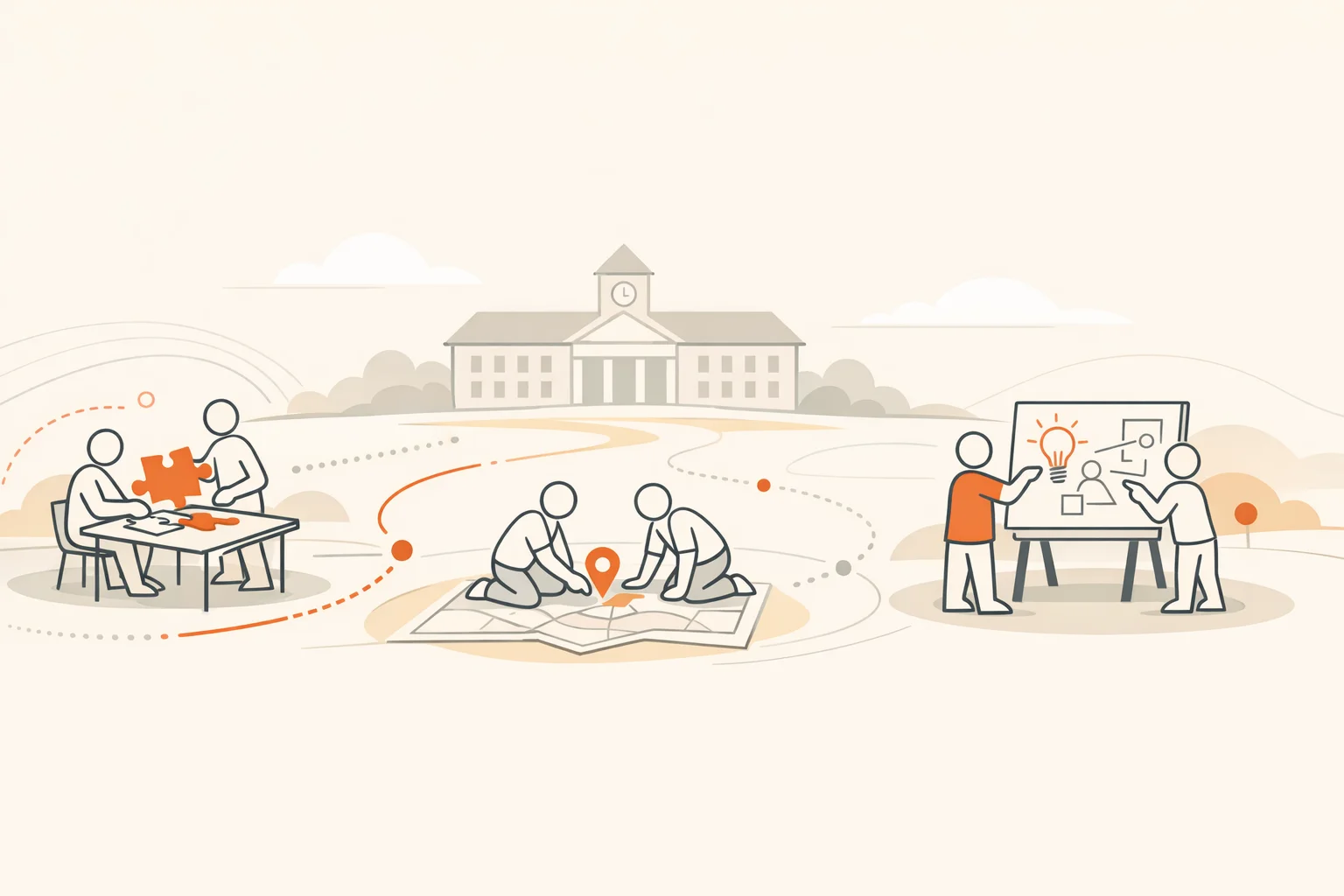
College students will try almost anything once, but they come back to experiences that feel real, low friction, and a little competitive. The best team activities don’t ask students to perform; they invite them to participate. They create small wins fast, then build toward shared momentum.
Most campus programs already know the headline: participation drives belonging. Research keeps pointing to the same levers — student‑faculty contact, cooperation among students, and active learning — as drivers of growth and persistence. Those show up in the NSSE engagement framework and in long‑term outcomes tracked by the Gallup‑Purdue Index. (nsse.indiana.edu)
This list is built for orientation teams, RAs, student org leaders, peer mentors, and faculty who want options that actually work on a real campus schedule. Use it to spark day‑one connections, energize a weekly meeting, or anchor a full‑scale campus event.
Nobody quits a game they’re winning in the first five minutes.
Scavenger hunts turn passive icebreakers into active exploration. With Scavify, teams complete photo, video, GPS, QR, and trivia challenges on campus, track progress on a live leaderboard, and see each other’s submissions in a real‑time feed.
It scales to hundreds, runs in an app or a mobile browser, and auto‑scores so staff can focus on energy instead of spreadsheets.
Classic games make it easy for strangers to talk. Mix strategy titles with party games so different play styles show up. If you want to build a full vibe — snacks, brackets, and table rotation — this practical guide to hosting a game night is handy.
Run a DIY escape room in a classroom or common space, or use a campus partner that hosts them. These formats reward parallel problem‑solving and shared discovery — the essence of active learning. A widely cited meta‑analysis in PNAS found active learning improves exam performance and reduces failure rates in undergraduate courses. (doi.org)
For a ready‑made classroom version, explore escape‑room‑style resources like Breakout EDU’s cognitive‑science take on engagement. (resources.breakoutedu.com)
Trivia brings cross‑major mixing. Keep teams random, rotate topics, and award micro‑badges for best team name or comeback round. Quick lightning rounds keep the room awake.
Teams get a bag of odd props and 10 minutes to script a 60‑second performance using all items. Applause‑vote the winner. It’s fast, silly, and surprisingly bonding.
Short, punchy, and perfect for first meetings. Seed with a playful example so students understand the tone: interesting, not incriminating.
Small teams design a product for campus life, then pitch in 90 seconds. Give bonus points for customer research, a simple cost sketch, or a lo‑fi prototype sketched on a whiteboard.
Pairs sit back to back. One describes a simple image while the other draws. Switch roles. Debrief the difference between precise and ambiguous language.
Circle game. Student A mimes an action. Student B asks “What are you doing?” A names a different action. B switches to that action, and so on. Chaos, then laughter.
Lay tape to mark two sides of the room and move for answers. Start light, then add values‑based prompts relevant to campus life. Keep it kind. For prompt ideas, see these Would You Rather questions.
Line of buckets, no hands. Move ping‑pong balls from start to finish using any approved tools. Teaches iteration because the first strategy rarely wins.
Pairs link wrists and complete simple tasks like writing a note or opening a snack. Communication beats strength every time.
Go around the circle adding one sentence to a story. Add constraints like a genre or a forbidden word to increase focus and fun.
Teams build one runway look using only newspaper and tape. Set a soundtrack. Confidence is half the grade.
Call out a number. Students form groups of that size, share a quick prompt, then reset. Keep rounds under a minute to maintain energy.
One blindfolded “pilot,” two “tower” guides, everyone else as obstacles. The tower brings the pilot safely to a taped‑off runway using verbal directions only.
Teams get string and a rubber band. No hands on cups. Build a pyramid fast. Designed frustration makes the victory sweeter.
Create a light obstacle course. One teammate is blindfolded and guided through by voice. Switch roles so everyone gives and receives instructions.
The classic design sprint. Limit materials, add a drop height, and celebrate survivals with over‑the‑top ceremony.
Students write one little‑known fact anonymously. Draw, guess, reveal. It’s a safe way to surface unexpected common ground.
Route teams through 6–8 stations across campus. Mix physical tasks with quick puzzles. Add time bonuses for helping another team or showing campus pride.
One‑hour projects like writing thank‑you cards for local nonprofits or prepping hygiene kits. Service‑learning is linked to stronger engagement and even retention in multiple studies summarized by Campus Compact. (compact.org)
Create a bingo card of campus moments and sights. Teams submit photos to claim squares. First bingo wins, blackout becomes the stretch goal.
One student receives folding instructions; the partner can’t see the paper. Communication carries the day. Swap and compare.
Instead of objects, use prompts like “same hometown region,” “first‑gen,” or “morning person.” Celebrate lines, then share one standout square.
Two rings of chairs, inner facing outer. Three‑minute prompts, rotate, repeat. It’s face time without the awkward loitering.
Break one puzzle into bagged clusters. Mix between teams so they must negotiate trades and collaborations to finish.
Teams race to GPS check in at 3–5 iconic spots and answer a short trivia at each. Works beautifully inside a Scavify hunt with auto‑scored GPS and trivia.
Spaghetti, tape, string, one marshmallow. Highest freestanding tower in 12 minutes. Share quick debriefs on testing early versus saving the marshmallow for the end.
Line up by birthday, shoe size, or distance from campus without speaking. Nonverbal strategies emerge fast.
Pairs draw a topic with two positions. After 60 seconds they must switch sides and continue. It builds perspective‑taking without the heat.
Use dice or cards with icons. In 10 minutes, teams pitch a micro‑story. Vote for “most cinematic,” not “best,” to keep it light.
Teams remix the campus mascot for a new context — sustainability, esports, community service — and present a two‑slide pitch.
Send teams to collect quick facts from student services: tutoring hours, counseling drop‑ins, wellness programs. Tie to small rewards so the info sticks. Experiences that combine relationships with meaningful tasks echo what Gallup calls out as critical undergraduate experiences tied to later engagement. See the Gallup‑Purdue findings. (news.gallup.com)
Lay out craft sticks, rubber bands, cardboard, and clips. Prompt: build a device that moves a ping‑pong ball 3 feet. Judge on creativity and demo success.
Two things: quick competence and visible progress. Short, structured rounds help everyone contribute. Active formats outperform passive ones in learning contexts, too, which is consistent with findings from a meta‑analysis of active learning. (pubmed.ncbi.nlm.nih.gov)
Most campus contexts reward 15–30 minutes. It fits between classes, reduces setup fatigue, and leaves time for a closing debrief.
Three to five is usually the sweet spot. Big enough for diversity of thought, small enough that no one hides.
Use formats that run hybrid by default. Scavify works in a browser or app, auto‑scores across locations, and supports asynchronous play so commuters aren’t penalized.
Design for multiple ways to participate: alternatives to running, captions for videos, quiet roles like clue logic or scorekeeping. Ask for access needs in advance.
Track simple signals: completion rate, repeat attendance, and one‑line reflections. Over time, relate these to retention or persistence indicators you already watch. NSSE’s emphasis on cooperation and active learning as part of engagement is a useful north star. See NSSE’s framework. (nsse.indiana.edu)
Belonging isn’t a speech; it’s a sequence of small shared wins. Pick a few activities that fit your constraints, run them cleanly, and make those wins public. If you want the automation, challenge variety, and scale to carry a full orientation or campus‑wide adventure, Scavify makes it simple to launch and fun to play.