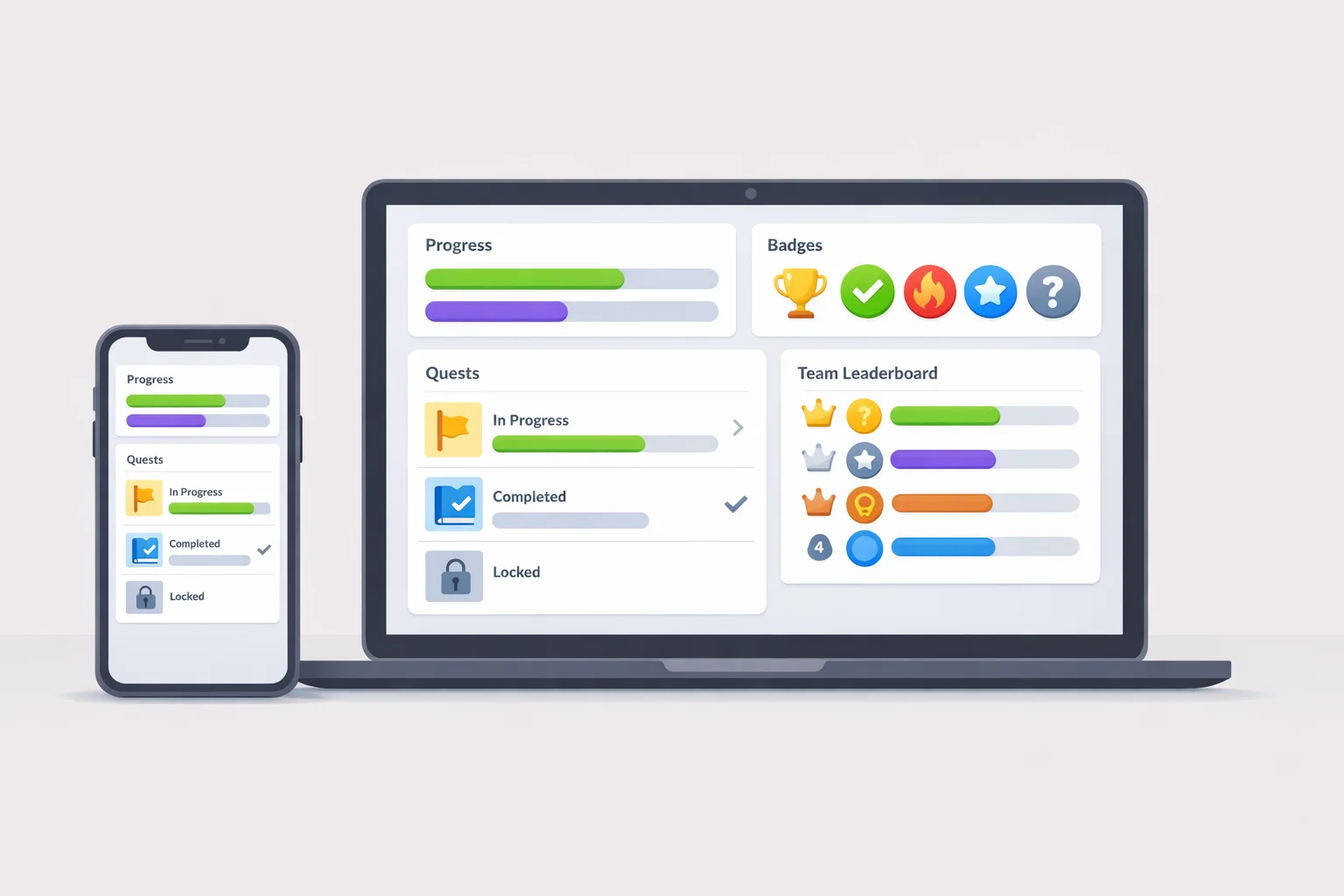
If you’re choosing a gamification eLearning platform, compare the parts that actually shape behavior: the mechanics learners feel, the learning design under the hood, and the operational plumbing that keeps momentum from stalling. This guide walks through the features that matter, how to evaluate them, and what usually separates a lively program from a bored audience.
At a Glance
- Design for outcomes, not optics. Points and badges are fine, but tie them to real skills, behaviors, or decisions you can verify.
- Standards aren’t optional. Require SCORM/xAPI for content portability and LTI 1.3 for modern LMS integrations.
- Measure at the challenge level. Track which mechanics change behavior, not just logins and completions.
- Pilot like an operator. Run a small proof with clear success metrics, then scale what works.
What actually matters in a gamification eLearning platform
- Clarity of outcomes. Engagement is a means, not the end. Define the behaviors or decisions you want to see more often.
- Mechanics-to-outcomes fit. Match elements (quests, levels, streaks) to the job to be learned. If the mechanic rewards time-on-task but the goal is decision quality, you’ll get grinders, not mastery.
- Friction design. Good platforms help you set the right amount of effort between attempts: easy enough to move, hard enough to matter.
- Feedback loop speed. Fast, specific feedback beats generic congratulations. The platform should support targeted hints, partial credit, and re-attempt logic without admin gymnastics.
- Instrumentation. If you can’t see which challenge, hint, or mechanic caused movement, you’ll be optimizing vibes.
In research, gamification tends to show small-to-moderate positive effects when aligned to learning goals, with variation based on design quality and context. That’s a polite way of saying mechanics alone don’t carry the day. A 2020 meta-analysis found positive effects across cognitive, motivational, and behavioral outcomes; design choices like combining competition with collaboration improved results. Another broad review echoed a positive but context-dependent effect. These are nudges, not silver bullets. See the details in a 2020 Educational Psychology Review meta-analysis and an Educational Research Review synthesis. A 2020 meta-analysis in Educational Psychology Review. (link.springer.com) A complementary Educational Research Review meta-analysis. (sciencedirect.com)
Core mechanics to compare (and how they really work)
Design and platform features need to support these mechanics with nuance, not just checkboxes.
- Points/XP. Useful for pacing and basic reinforcement. Look for configurable earning rules, decay, and caps so points don’t turn into inflation. Bonus if you can award “quality-weighted” points (e.g., first-try accuracy worth more).
- Badges/Achievements. They work when they mark real milestones and unlock something meaningful (access, status, tools). Verify custom criteria, stacking, and expiration for recertification.
- Levels/Progression. Levels should gate difficulty and unlock new content or capabilities, not just rename point totals. Confirm support for branching and prerequisite logic.
- Quests/Challenges. The workhorse. You want multiple challenge types (scenario, MCQ, simulation, media upload, GPS/QR for field tasks) with templates you can remix fast.
- Leaderboards. Great for some audiences, alienating for others. Prioritize configurable scopes (team, region, role), “personal best” views, and opt-out options. Use seasonal resets to avoid runaway leads.
- Streaks and habits. Streaks help, but make them forgiving (grace days, catch-up credits). Otherwise you generate avoidable churn the first time someone travels.
- Narrative and theme. Light, optional narrative increases stickiness; heavy-handed fiction can feel childish in professional contexts. Choose platforms that let you dial theme up or down.
- Collaboration mechanics. Team quests, peer endorsements, and assist credits open the door to social learning without forcing performative competition.
Learning science meets gamification: design to drive outcomes
- Retrieval and spacing. Mechanics that bring concepts back just as they’re fading (spaced review quests, mixed practice) improve retention.
- Feedback quality. Explain why an answer is right or wrong and connect it to the next attempt. Automate hints so facilitators don’t become a bottleneck.
- Reflection prompts. Short, targeted reflections turn activity into insight; award points for substance, not volume.
- Positive challenge framing. Moderate difficulty with visible progress tends to hold attention longer than either trivial or punishing tasks.
Again, effectiveness is strongly mediated by design and context. The pattern across meta-analyses: properly-aligned mechanics produce meaningful, if not magical, gains. Educational Psychology Review synthesis. (link.springer.com) Educational Research Review meta-analysis. (sciencedirect.com)
Content, authoring, and standards (SCORM, xAPI, LTI)
A platform’s learning potential is limited by its authoring depth and interoperability.
- Authoring depth. Look for multi-step scenarios, conditional feedback, reusable question banks, and easy media capture. Branching should be visual and editable without developer help.
- SCORM support. If you use third-party content or need portability, insist on SCORM 2004 (ideally 4th Ed) and 1.2 playback plus reporting. This ensures you can track completion, scores, and time across systems in a predictable way. For reference, see the SCORM 2004 4th Edition testing requirements from ADL. ADL SCORM 2004 4th Ed testing requirements. (adlnet.gov)
- xAPI and LRS readiness. xAPI lets you capture rich, event-level data (“Actor–Verb–Object”) from courses, simulations, AR/VR, or on-the-job tasks into a Learning Record Store (LRS). Prefer platforms that can both emit and consume xAPI, and that play nicely with an external LRS. The canonical spec is maintained by ADL. ADL’s xAPI specification repository. (github.com)
- LTI 1.3 (and Advantage). If you need smooth single sign-on and grade return into higher-ed or enterprise LMSs, LTI 1.3 is the modern path. Verify certifications and support for deep linking and roster services. See the official 1EdTech pages on LTI 1.3. 1EdTech LTI 1.3 overview and specifications. (imsglobal.org)
Analytics that move the needle
- Level 0: Health. MAU/WAU, daily challenge attempts, time-to-first-action after invite.
- Level 1: Activity. Attempts per learner, completion velocity, drop-off points by challenge.
- Level 2: Learning. First-try accuracy, error patterns, time-to-mastery windows by objective.
- Level 3: Behavior. Post-training task adoption, field validation, supervisor-confirmed changes.
- Level 4: Outcome proxies. Quality metrics, reduced rework, safety leading indicators, NPS from internal customers.
The platform should allow: cohort comparisons, per-challenge analytics, A/B testing of hints or difficulty, and xAPI exports to your BI stack. If you choose to centralize data, confirm compatibility with an external LRS and your data warehouse. The benefit of xAPI/LRS is unifying learning events across tools and contexts. See ADL’s xAPI specification details for how statements are structured and exchanged. (github.com)
Delivery, admin, and ops features people underestimate
- Mobile-first delivery. Offline-friendly progress, background uploads, and battery-sane media capture.
- Notifications. Granular rules: reminders, streak rescues, nudge on new unlocks, opt-out controls.
- Moderation & integrity. Media review queues, plagiarism checks for text responses, geofencing, QR validation.
- Roles & permissions. Fine-grained roles for authors, reviewers, facilitators, and local admins.
- Integrations. HRIS/SSO for user provisioning, messaging tools for announcements, LMS grade sync.
- Localization. UI and content translation, right-to-left support, locale-based leaderboards.
Security, privacy, and accessibility requirements
- Access control & SSO. SAML or OpenID Connect, with SCIM or API-based provisioning and deprovisioning.
- Data governance. Data retention windows, export/erasure requests, audit logs, and clearly-documented sub-processors.
- Accessibility. WCAG 2.1 AA support across authoring and learner experiences is table stakes. Confirm keyboard access, captions, descriptive alt text, focus states, and color contrast. The W3C’s technical recommendation outlines the criteria. W3C’s WCAG 2.1 Recommendation. (w3.org)
A practical evaluation playbook (scorecard, pilot, proof)
1) Define must-win outcomes. Name the three behaviors or decisions you must see in the field within 60–90 days of launch.
2) Scorecard your requirements. Weight each category below from 1–5 for importance, then score vendors 1–5 for capability. Keep the math simple and visible.
- Mechanics & motivation (20%). Depth and configurability of points, badges, quests, levels, leaderboards, streaks, collaboration.
- Learning design (20%). Branching, conditional feedback, assessment types, reflection support, reusable banks.
- Interoperability (15%). SCORM 2004/1.2, xAPI emit/ingest, LTI 1.3, SSO.
- Analytics (15%). Challenge-level data, funnels, A/B testing, exports, early-warning indicators.
- Admin & delivery (10%). Mobile offline, notifications, moderation, localization, roles.
- Security & accessibility (10%). SSO, governance, WCAG 2.1 AA conformance details.
- Services & support (10%). Launch support, SLAs, training, roadmap transparency.
3) Run a two-week pilot.
- Launch to a representative slice (varied roles/regions).
- Include at least one high-signal, on-the-job challenge.
- Predefine success metrics (e.g., first-try accuracy + time-to-completion + supervisor confirmation).
4) Conduct a postmortem worth reading. Combine platform analytics, xAPI event trails, and qualitative feedback. Keep the decision criteria transparent.
Feature comparison checklist you can copy
- Mechanics: Points, XP, badges, levels, quests, streaks, leaderboards, collaboration.
- Learning design: Branching, templates, partial credit, targeted hints, reflection prompts.
- Challenge types: MCQ, scenario branching, simulations, short/long text, photo/video, QR, GPS, file upload.
- Authoring ops: Versioning, review workflows, reusable banks, localization, theme controls.
- Interoperability: SCORM 2004 4th Ed & 1.2, xAPI emit/ingest, external LRS compatibility, LTI 1.3.
- Analytics: Challenge-level metrics, funnels, A/B, exports to BI, early warnings.
- Delivery: Mobile apps + browser, offline, notifications, performance on low bandwidth.
- Integrity: Cheating safeguards, identity checks as appropriate, media moderation.
- Accessibility: WCAG 2.1 AA, captions, keyboard navigation, contrast, screen reader support.
- Security & privacy: SSO, audit logs, data retention, encryption at rest/in transit, DPA.
Observed patterns, pitfalls, and fixes from the field
- Points without purpose. Points that don’t unlock anything lose meaning fast. Fix: tie thresholds to real unlocks (content, tools, recognition) and reduce “grindable” actions.
- Leaderboard fatigue. All-time global boards crown the same names forever. Fix: show personal bests, weekly slices, or team-scoped boards.
- Badge spam. Too many micro-badges create noise. Fix: celebrate milestones that map to capability, not just clicks.
- One-speed difficulty. If everything is medium, nothing teaches. Fix: layer difficulty and reveal advanced challenges on mastery, not time served.
- “We can’t measure that.” You can, with xAPI. Capture the decisions and their context, not just completion. ADL’s xAPI specification explains how to structure such events. (github.com)
Mini challenge examples for training and onboarding
Use these as patterns, not prescriptions. Keep challenges short, specific, and verifiable.
- [Scenario MCQ | 40 pts]: A customer says, “It’s too expensive.” Choose the next-best question, not a rebuttal.
- [Photo | 30 pts]: Show the product setup that avoids the top support ticket this quarter.
- [Video | 60 pts]: Demo the new handoff checklist in under 60 seconds.
- [QR Code | 20 pts]: Scan the code by the tool most often misconfigured and note the fix.
- [Q&A | 50 pts]: In 50 words, explain the policy change as if to a new hire.
When Scavify naturally fits
When your learning program benefits from real-world challenges, short interactive bursts, and visible progression, Scavify’s app-based approach tends to click. The platform’s challenge variety, automation, and scale flexibility make it useful for onboarding, training refreshers, and event-based learning where mobile capture, GPS/QR, and quick analytics matter. It runs in a browser or app, so participation stays high without wrestling logins.
FAQs
What’s the difference between gamification and game-based learning?
Gamification adds selected game elements (points, quests, levels) to non-game learning. Game-based learning uses full games to teach. Gamification is lighter-weight and easier to align to micro-behaviors; game-based approaches can be deeper but costlier to build.
Do points and badges actually improve learning?
They can, when paired with good learning design. Meta-analyses show positive effects on motivation and learning, but the size of the impact depends on alignment and context. Mechanics alone won’t fix weak content or irrelevant objectives. See summaries in Educational Psychology Review and Educational Research Review. Evidence synthesis on gamification effects. (link.springer.com) Complementary meta-analysis of learning outcomes. (sciencedirect.com)
When should I avoid leaderboards?
If your audience spans wide skill bands or is collaboration-first, global leaderboards can demotivate. Use team-scoped boards, personal bests, or periodic resets. Ensure there are paths to recognition that don’t require topping an all-time chart.
What standards should my platform support: SCORM, xAPI, or both?
If you rely on packaged courses or external vendors, you’ll want SCORM 2004 (plus 1.2) for compatibility. If you care about detailed, cross-context analytics, require xAPI to capture event-level data into an LRS. Most mature stacks use both. ADL SCORM 2004 reference. (adlnet.gov) ADL xAPI specification. (github.com)
What is an LRS and why would I need one?
A Learning Record Store is where xAPI statements live. It lets you unify learning data from courses, simulations, mobile tasks, and even offline activities. If you want challenge-level insights across tools, an LRS is the backbone. Technical grounding in the xAPI spec. (github.com)
How important is LTI 1.3?
If you integrate with LMSs in higher ed or large enterprises, LTI 1.3 matters for secure launches, deep linking, roster, and grade return. It’s the modern standard under the 1EdTech umbrella. LTI 1.3 core specification details. (imsglobal.org)
What accessibility bar should I set?
Require WCAG 2.1 AA conformance for both learner and authoring experiences. Ask vendors to demonstrate keyboard navigation, captioning, color contrast, focus indicators, and screen reader compatibility on real flows. W3C’s WCAG 2.1 Recommendation. (w3.org)
How should I run a credible pilot before buying?
Pick a representative audience, launch a two-week quest pack with at least one on-the-job challenge, define success metrics (first-try accuracy, time-to-completion, supervisor confirmation), and instrument with xAPI for event-level insights. Roll up results into a short decision memo you’d be willing to share with your exec sponsor.
If you’re considering experiential onboarding, field training, or event-based learning, Scavify’s challenge-first approach may be a natural complement to your LMS and content library. It’s built to make passive participation active, with the operational guardrails that keep programs running without heroics.