Solutions
Your first hunt, live this afternoon.
Free to start · No download for participants
Learn how gamification works with clear examples, practical use cases, and tips for education, work, and engagement.
You don’t need another frothy “gamification is magic” post. You need numbers you can trust, the caveats that matter, and where those numbers actually apply. Below are 55 evidence-backed statistics and signals we use to separate durable design patterns from passing fads.
A pattern we keep seeing: motivation spikes early, performance follows more slowly, and poorly matched mechanics fall flat. Meta-analyses are your best bet for signal over noise, but they aggregate very different interventions. That’s why you’ll see both “medium effect” and “mixed results” in legitimate papers. Read the effect size, sample, and design notes before you copy a tactic.
These 15 statistics summarize the most robust academic findings.
1) Cognitive learning outcomes show a small-to-moderate positive effect (Hedges’ g = 0.49; k = 19; N = 1,686) in a leading meta-analysis. (link.springer.com)
2) Motivational outcomes show g = 0.36 (k = 16; N = 2,246) in the same analysis. (link.springer.com)
3) Behavioral outcomes (e.g., participation) show g = 0.25 (k = 9; N = 951). (link.springer.com)
4) When only high‑rigor studies are considered, motivational and behavioral effects become less stable, while cognitive effects remain significant. Translation: design quality and study rigor matter. (link.springer.com)
5) Competition combined with collaboration outperforms competition alone for motivational outcomes. If you must use leaderboards, give teams a shared target. (link.springer.com)
6) Another meta-analysis of 30 interventions with 3,202 participants reports an overall Hedges’ g = 0.504 for academic performance. Shorter interventions in that corpus showed larger average effects. (sciencedirect.com)
7) A 2023 meta-analysis across 49 studies (N = 5,071) reports a large overall effect (Hedges’ g = 0.822) on learning outcomes, with design combinations (mechanics + dynamics + aesthetics) performing best. (frontiersin.org)
8) In that same 2023 analysis, the mechanics + dynamics + aesthetics combo achieved the highest subcategory effect (g = 1.285), while a dynamics + aesthetics pairing performed poorly (g = −3.162). Design choices swing outcomes. (frontiersin.org)
9) A 2024 meta-analysis focusing on academic performance reports a moderately positive effect (Hedges’ g ≈ 0.782) across regions, levels, and subjects. (repository.eduhk.hk)
10) For behavior change in education, a 2021 review finds a moderate positive effect (Cohen’s d = 0.48; 95% CI 0.33–0.62). (pubmed.ncbi.nlm.nih.gov)
11) Systematic evidence on engagement time is mixed: in one review, 2 of 5 time‑on‑task studies showed medium to large gains, 3 of 5 showed no significant effect. (link.springer.com)
12) In computerized cognitive training, gamification significantly boosts motivation/engagement (g = 0.72) but shows no reliable improvement on cognitive outcomes (g = 0.27, n.s.). Expect energy first, skill transfer later. (games.jmir.org)
13) Those same cognitive‑training tasks feel more demanding/difficult (g = −0.52) to users when gamified. Don’t confuse “harder” with “better.” (games.jmir.org)
14) Narrative “game fiction” alone doesn’t reliably move cognitive outcomes in meta-analytic tests. Story helps when it structures problem‑solving, not when it’s just set dressing. (link.springer.com)
15) Negative cases exist. A well‑cited longitudinal classroom study found lower intrinsic motivation and grades in a rewards‑heavy gamified course vs. a non‑gamified section. Over‑rotating on points/badges can backfire. (itl2tlfa16.wordpress.com)
These 8 statistics capture how behavior shifts around key mechanics and platforms.
16) Large‑scale analyses of badges show behavior spikes before award thresholds, evidence that badges can steer short‑term activity when thresholds are visible. (cs.stanford.edu)
17) On Stack Overflow, empirical badge studies documented increased user activity immediately before badge awards compared to after. Expect pre‑award surges more than sustained lifts. (researchgate.net)
18) In Q&A communities, some research challenges the universality of “steering,” suggesting effects depend on user type and design. One study finds some contributors are not affected by badges despite high activity. (arxiv.org)
19) Duolingo disclosed that 63% of daily active users had a 7‑day+ streak, up from 53% the prior year, showing how streak mechanics shape participation consistency at scale. (fintool.com)
20) In mobile app cognitive‑training RCTs, gamification raises motivation (g = 0.72) without reliably raising cognitive outcomes. Calibrate expectations: use it to get reps, then measure transfer separately. (games.jmir.org)
21) Reviews of online program engagement found heterogeneous results: some mediums show medium/large gains, others no effect, reinforcing the “mechanic‑context fit” rule. (link.springer.com)
22) Behavioral change effects from educational gamification average d ≈ 0.48, a practical bump if the target behavior is tightly coupled to the outcome you want. (pubmed.ncbi.nlm.nih.gov)
23) Across 49 learning studies (N = 5,071), design mix matters: richer combinations beat single‑mechanic deployments. Don’t ship points‑only. (frontiersin.org)
These 7 stats reflect what employees actually encounter—and what they say motivates them.
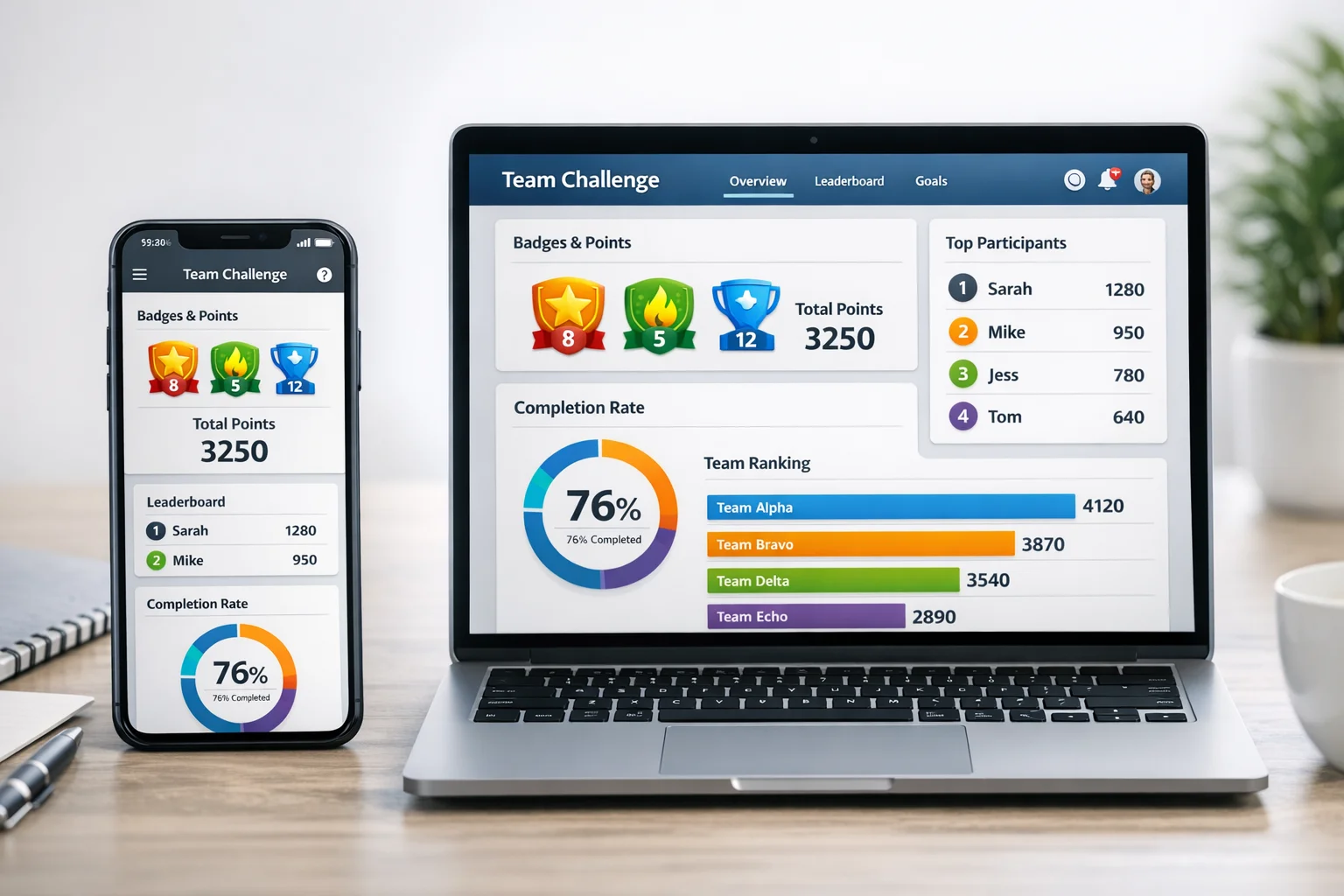
24) The most commonly encountered element at work is badges (71%), followed by points (59%), rewards (56%), leaderboards (51%), and levels (47%). (talentlms.com)
25) Asked to rank what motivates them most, employees put rewards first, then badges, points, leaderboards, and levels—almost exactly the order of what they see most. Familiar mechanics still do heavy lifting. (talentlms.com)
26) In head‑to‑head comparisons of training, gamified versions lift self‑reported motivation to 83%, while boredom in non‑gamified tracks rises to ~49%. (talentlms.com)
27) Combination beats isolation: meta-analyses show competition‑plus‑collaboration environments produce stronger motivational effects than competition alone. (link.springer.com)
28) Narrative wrappers (“game fiction”) don’t consistently change cognitive results by themselves. Use story to structure goals and feedback, not as decoration. (link.springer.com)
29) In cognitive‑training contexts, users report gamified tasks feel harder (g = −0.52) even as motivation increases, a reminder to price in perceived effort. (games.jmir.org)
30) In badge‑driven communities, expect threshold effects (activity clusters before awards) more than flat‑line engagement. Time your prompts accordingly. (cs.stanford.edu)
If you build training, onboarding, or sales enablement, these 16 stats describe the current ground truth.
31) 61% of employees report receiving training with gamification. (talentlms.com)
32) Among those receiving gamified training, 83% feel motivated. (talentlms.com)
33) In non‑gamified training, 61% feel bored and unproductive. (talentlms.com)
34) 89% say gamification makes them feel more productive at work. (talentlms.com)
35) 88% say it makes them happier at work. (talentlms.com)
36) 89% believe they’d be more productive if their work were more gamified. (talentlms.com)
37) 43% haven’t noticed gamification elements at work yet—room to grow. (talentlms.com)
38) 33% want more game‑like features in their training software. (talentlms.com)
39) 89% say gamification boosts their sense of competition/eagerness. (talentlms.com)
40) The share of employees who’d spend more time in software because of game elements grew by 4 points to 89% year over year. (talentlms.com)
41) In recruiting, 45% have seen gamified elements during the process. (talentlms.com)
42) 78% say gamified recruiting would make a company more desirable. (talentlms.com)
43) Cisco’s DevNet Zone reported a 259% increase in page views following advanced gamification during a major event. (blogs.cisco.com)
44) In that same activation, participants earned 1,068 “Guru Level 1” badges, indicating sustained exploration, not just one‑and‑done clicks. (blogs.cisco.com)
45) Deloitte Leadership Academy saw a 47% increase in weekly returning users after introducing gamification to its leadership portal. (forbes.com)
46) SAP Community Network’s post‑launch case study reported a 1,113% increase in activity (content creation, comments, feedback) after adding gamification. Scale matters when the mechanics map to real work. (dokument.pub)
If you’re building a business case, these 6 stats give you a conservative range.
47) The global gamification market was USD 36.86B in 2025. (fortunebusinessinsights.com)
48) It’s projected at USD 46.69B in 2026. (fortunebusinessinsights.com)
49) Forecasts reach USD 308.85B by 2034. (fortunebusinessinsights.com)
50) That implies a 26.64% CAGR (2026–2034). (fortunebusinessinsights.com)
51) North America held ~43.0% share in 2025, the leading region by revenue. (fortunebusinessinsights.com)
52) North America market revenue is cited at USD 2.72B (2025) within those estimates. (fortunebusinessinsights.com)
These 3 signals round out the picture from large‑scale platforms.
53) Across 49 learning studies and 5,071 participants, richer design combinations outperform single‑mechanic deployments. Use more than points. (frontiersin.org)
54) Duolingo’s streak mechanic correlates with higher week‑over‑week participation consistency across a massive user base (63% with 7‑day+ streaks). Streaks are powerful—but design for recovery when they break. (fintool.com)
55) In cognitive‑training RCTs, gamification’s biggest reliable lift is motivation. Treat it as a compliance engine for repetitions; measure skill separately. (games.jmir.org)
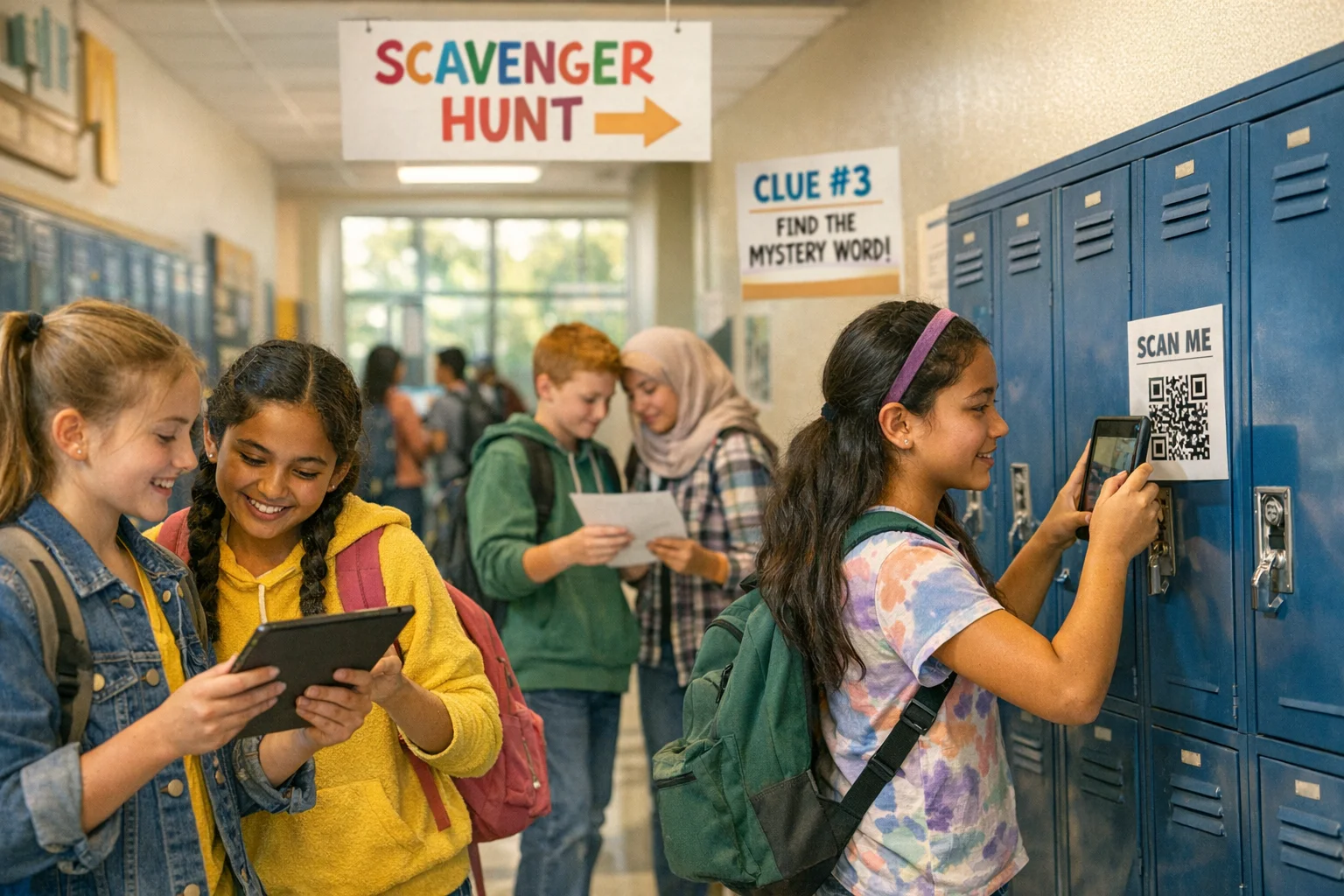
A quick note on Scavify. When you need to mobilize people in the real world (teams, campuses, conferences, tourism activations), app‑based challenges turn passive attendance into active participation without a week of setup. Mix photo, GPS, QR, and quiz‑style tasks; automate scoring; keep the energy up. That’s where gamification stops being a buzzword and becomes the structure people actually follow.
Small to moderate on average, with credible meta‑analyses reporting cognitive outcomes around g ≈ 0.49 and academic performance around g ≈ 0.50–0.78 depending on corpus and design quality. Motivation effects are often larger. (link.springer.com)
Often, yes. Multiple reviews show stronger effects on motivation/engagement than on end performance, especially in cognitive‑training contexts. Design for the handoff from motivation to skill transfer. (games.jmir.org)
Sometimes. Pure competition underperforms; blended competition‑plus‑collaboration tends to do better for motivation. If you use leaderboards, add team goals and personal mastery paths. (link.springer.com)
Badges top the list (71%), then points (59%), rewards (56%), leaderboards (51%), and levels (47%). Reward structures and recognition consistently rank as most motivating. (talentlms.com)
Yes. A longitudinal classroom study found lower intrinsic motivation and grades in a reward‑heavy gamified course vs. control. Mechanics that crowd out autonomy or mastery can depress outcomes. (itl2tlfa16.wordpress.com)
Estimates put it at USD 36.86B (2025), USD 46.69B (2026), projecting to USD 308.85B by 2034 at 26.64% CAGR. North America leads by share. (fortunebusinessinsights.com)
Deloitte’s Leadership Academy saw +47% weekly returning users after introducing gamification. Cisco’s DevNet Zone logged +259% page views during a gamified activation. (forbes.com)
Start with one meaningful behavior, one feedback loop, and one social dynamic (usually small‑team collaboration with light competitive framing). Instrument for both participation and outcome. If you need rapid field deployment, an app‑based challenge platform like Scavify can shorten the distance from idea to live, measurable activity.