Solutions
Your first hunt, live this afternoon.
Free to start · No download for participants
Make learning more active with scavenger hunt ideas, questions, and formats for students, teachers, and classrooms.
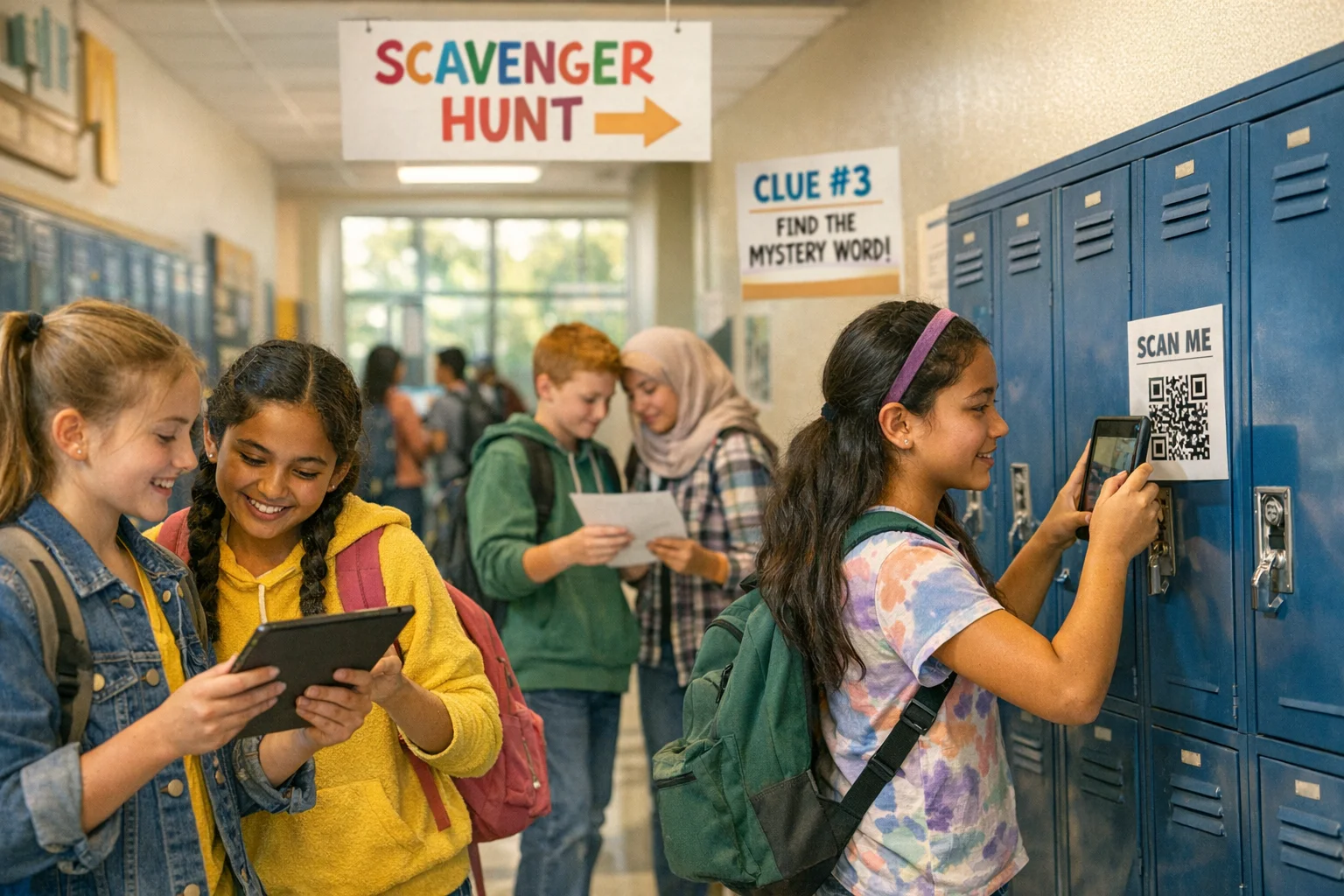
Learning sticks when students move, search, and make choices. School scavenger hunts turn passive lessons into active missions that surface curiosity, teamwork, and real evidence of understanding.
Active learning reliably outperforms sit-and-get. A large meta-analysis of 225 STEM courses found higher exam performance and lower failure rates with active methods vs lecture. (www2.math.upenn.edu)
Quick movement breaks and physically active lessons also correlate with better classroom behavior and aspects of cognition. Reviews of classroom-based activity show positive effects on on-task behavior and related outcomes, especially in primary grades, when integrated with instruction. See the systematic review and meta-analysis on classroom activity and the CDC’s guide to integrating classroom physical activity. (link.springer.com)
Hunts also lean on retrieval practice. Asking students to recall, explain, and apply during the hunt strengthens memory more than re-reading. That’s the core of the retrieval practice literature and related reviews. (labs.wsu.edu)
Start with outcomes. Decide what students must show, not just what they’ll see. Evidence could be a photo of a real-world example, a 15-second explanation, or a multiple-choice checkpoint.
Design short loops. Most groups thrive on 20 to 40 minutes with 8 to 15 challenges. Enough to feel like a quest, short enough to keep urgency.
Vary the challenge types. Mix Photo, Video, QR Code, Multiple Choice, Q&A, and GPS Check-in. Variety prevents energy dips.
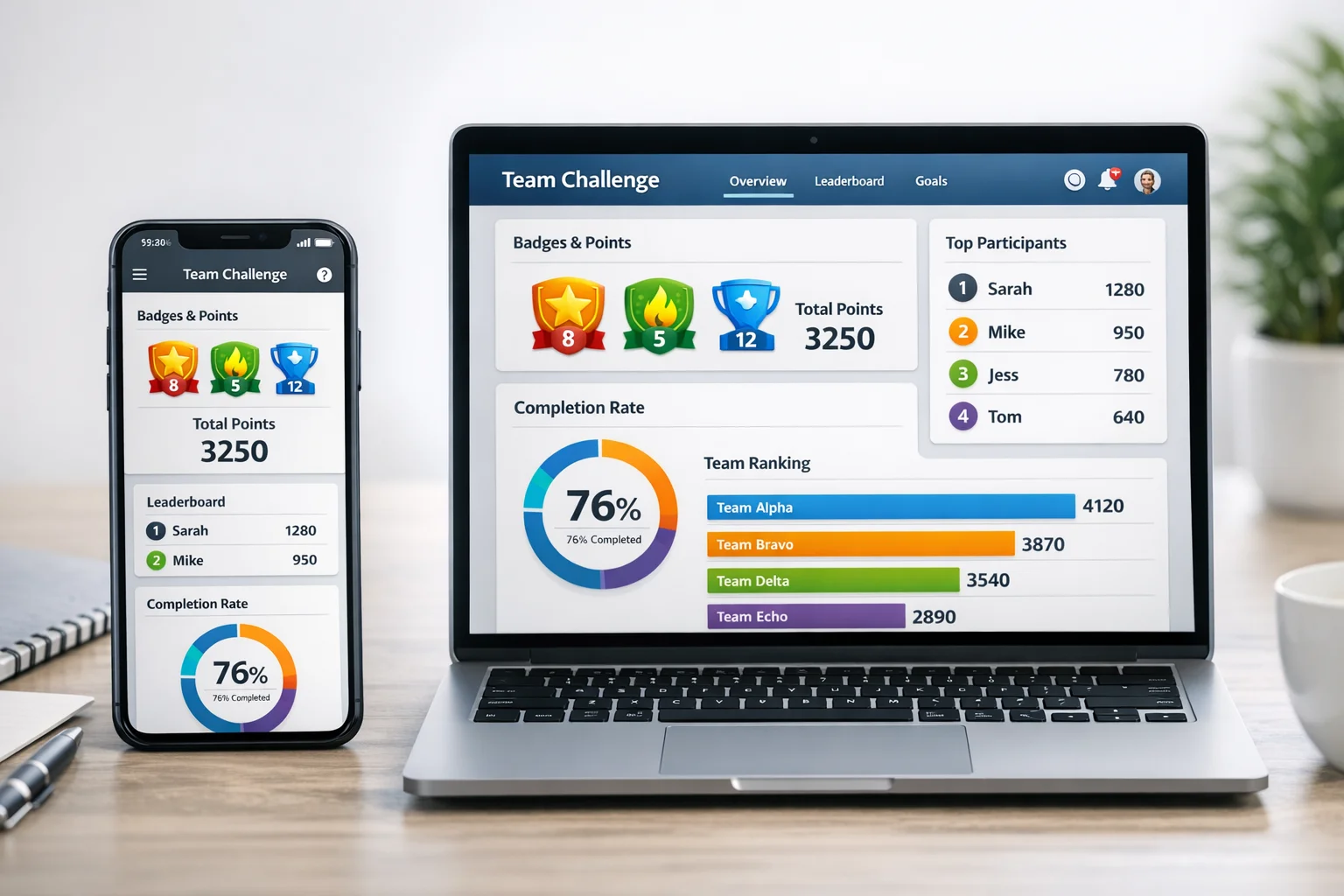
Make progress visible. Live points, a simple map, or a “completed” tally motivates without theatrics.
Set clear boundaries and norms. Define no-go zones, hallway voice levels, device rules, and photo guidelines. Post them where students can reference fast.
Prime for feedback. Build instant answers into MCQs and short reflections. Feedback during retrieval boosts learning. (pubmed.ncbi.nlm.nih.gov)
Collect artifacts for assessment. Design prompts that capture thinking you can review later. Rubric the work product, not the wandering.
Each idea includes a quick premise. Several include ready-to-run challenge examples you can drop into any app or worksheet.
1) Classroom Culture Kickoff Warm up a new class with a values-and-routines hunt that teaches how the room works and who’s in it.
Example challenges: - [Photo | 20 pts]: Show where we submit finished work without asking. - [QR Code | 20 pts]: Scan the code hidden near the class library and answer the routine it reveals. - [Q&A | 25 pts]: Which signal means “pair up quietly” in this class? - [Multiple Choice | 20 pts]: How many minutes is a bathroom pass good for here? - [Video | 30 pts]: Act out the end-of-period cleanup in 10 seconds.
2) Library Literacy Quest Turn the stacks into a search for text features, genres, and call numbers.
Example challenges: - [Photo | 25 pts]: Find a book whose table of contents answers a real question you have. - [Q&A | 20 pts]: What’s the Dewey range for graphic novels here? - [Multiple Choice | 20 pts]: Which source is best for quick background: encyclopedia, atlas, or almanac? - [Photo | 25 pts]: Snap a caption that uses a colon correctly. - [QR Code | 30 pts]: Scan a shelf code to reveal your next clue.
3) Math Patterns Walkabout Search the school for patterns, symmetry, and ratios. Hall tiles, window grids, and bleachers become proofs.
Example challenges: - [Photo | 20 pts]: Capture rotational symmetry and label the order. - [Q&A | 25 pts]: Find a 3:2 ratio in the wild. Explain. - [Photo | 20 pts]: Show parallel lines and a transversal. Mark an angle relationship. - [Multiple Choice | 20 pts]: Which shape here has the greatest perimeter-to-area ratio? - [Video | 30 pts]: Explain a real-life percent increase you spot.
4) Scientific Method Hunt Teams collect examples of variables, controls, and testable questions around the lab or classroom.
5) History Time Capsule Hide primary-source snippets and artifacts. Students piece together a narrative from clues scattered across the room.
6) Art Elements Eye-Spy Color, line, texture, value, space. The building is your gallery.
Example challenges: - [Photo | 20 pts]: Find complementary colors at work and label them. - [Q&A | 25 pts]: Where do you notice implied texture? Describe it. - [Photo | 20 pts]: Capture perspective lines that meet at a vanishing point. - [Multiple Choice | 20 pts]: Which composition here uses the rule of thirds best? - [Video | 30 pts]: Explain how negative space changes the feel of a display.
7) Language Lab Locators In world languages, place labels, idioms, or directions around campus. Students match phrases to locations and record spoken responses.
8) Environmental Stewardship Campus Crawl Map recycling points, identify energy-saving opportunities, and pitch quick wins.
Example challenges: - [Photo | 20 pts]: Document a waste-sorting success or fail and explain. - [Q&A | 25 pts]: Where could a single sign reduce contamination most? - [Multiple Choice | 20 pts]: Which bin does a milk carton go in here? - [Video | 30 pts]: 15-second pitch for a greener hallway. - [GPS Check-in | 25 pts]: Tag the farthest outdoor trash can from the cafeteria.
9) PE Movement Missions Blend fitness circuits with content checks. Movement plus recall keeps energy high, particularly for younger grades. See the CDC’s classroom activity integration guidance. (cdc.gov)
10) Digital Citizenship QR Quest QR checkpoints reveal short scenarios on privacy, passwords, and kindness online. Students choose the best response.
11) Career Exploration Scavenger Fair At a career day, teams collect role facts, pathways, and skills from booths and artifacts rather than passively drifting.
12) School Orientation Amazing Race Incoming students learn spaces, routes, and norms by solving location-based clues.
Example challenges: - [GPS Check-in | 20 pts]: Check in at the office window used for early dismissals. - [Photo | 20 pts]: The fastest route from gym to Room 112. Show three landmarks. - [Q&A | 25 pts]: Where do you go if your Chromebook breaks? - [Multiple Choice | 20 pts]: Which stairwell is one-way during passing time? - [Video | 30 pts]: Introduce yourselves at your advisory’s door.
13) Lab Safety Spot-Check Hidden icons mark safety gear, fume hoods, and hazard disposal. Students demonstrate procedures at each.
14) Book-to-Film Evidence Hunt Teams gather textual evidence to compare a novel with its film adaptation. Screenshots, quotes, and short defenses become the record.
15) Vocabulary in the Wild Find Tier 2 words in signage, newsletters, and announcements. Students photograph and define in context.
16) Cafeteria Fractions & Ratios Menus and trays become fraction stories and unit rate problems.
17) Local History Neighborhood Hunt With permission for a short perimeter walk, teams locate plaques, street names, or architectural eras and tie them to class topics.
18) Makerspace Materials Match Students identify tools by use and safety, then race to assemble a kit for a mini-build.
19) Music Motif Hunt From rhythm patterns in chants to intervals in school bells, students capture sound examples and annotate.
20) Spanish Around School Target language prompts at common locations elicit short spoken clips and written labels.
21) Geometry Photo Proofs Create two-step justifications for angles, triangles, or polygons found around campus.
Example challenges: - [Photo | 20 pts]: Prove two angles are congruent. Mark and justify. - [Q&A | 25 pts]: Identify a pair of similar triangles. State the scale factor. - [Photo | 20 pts]: Capture a polygon and classify by properties. - [Multiple Choice | 20 pts]: Which theorem justifies your conclusion? - [Video | 30 pts]: 20-second proof sketch with your diagram.
22) Debate Evidence Dash In ELA or social studies, teams find credible sources posted around the room, evaluate bias, and build a quick claim-evidence-reasoning chain.
23) Science of Sound Hunt Explore frequency, amplitude, and resonance across instruments, hall spaces, or lab gear. Short clips with annotations become the dataset.
24) Periodic Table, Real-World Edition Match elements to everyday objects and safety symbols. Students locate examples, then connect to properties.
25) Data Detective Gather numeric facts from attendance boards, lunch lines, and hallway counters. Build a 5-minute infographic from your finds.
26) Virtual Home Hunt For remote or hybrid days, students capture examples from home environments using browser-based participation. Include options for students who can’t film at home.
27) End-of-Year Memory Lane A reflective hunt across favorite learning moments. Students revisit artifacts, record what they’d keep, drop, or change, and thank a contributor.
Plan with Universal Design for Learning in mind: multiple means of engagement, representation, and action. CAST’s UDL overview explains how designing for variability removes barriers from the start. (cast.org)
Paper works. Whiteboards work. But once you want auto-scoring, time-boxed releases, GPS/QR, and real-time tallies, an app keeps you from juggling clipboards.
In our experience, teams benefit from: - Challenge variety in one place: Photo, Video, QR, GPS, Multiple Choice, Q&A. - Automation of points, hints, and deadlines so you can circulate and coach. - Ease of launch with templates you can tweak in minutes. - Browser + app flexibility so any student with a device can join quickly. - Scale flexibility from a single class to a campus-wide orientation.
If you’re building hunts regularly across grades or events, a purpose-built platform like Scavify centralizes creation, safety boundaries, and evidence collection so you can focus on outcomes, not logistics.
They create active practice. Great use cases include unit kickoffs, review days, orientation, lab safety, library skills, and campus culture. The payoff is better attention and more usable evidence of learning.
Most classes run well with 20 to 40 minutes and 8 to 15 challenges. That window keeps urgency high and logistics simple without exhausting students.
Assess the artifacts, not the speed. Use a short rubric centered on accuracy, explanation quality, and connection to the objective. Offer resubmission on evidence-based prompts.
Post clear zones on a simple map, limit group size, and make progress visible so groups don’t stall. Use a calm-tone rule and include a quiet bonus task for early finishers.
Design prompts around spaces and objects. Use tight crops, drawings, or typed responses. Make at least one non-camera option available for every challenge.
Yes. Shrink the radius, hide QR codes in plain sight, and build table-based tasks. Video and Q&A prompts carry the load when movement is limited.
Yes. Active formats correlate with stronger performance and lower failure rates in other settings, and classroom movement links to better on-task behavior. See the active learning meta-analysis and classroom physical activity evidence. (www2.math.upenn.edu)
Design with UDL: offer options for how students access instructions, show understanding, and stay motivated. CAST’s UDL guidelines are a practical starting point. (cast.org)
If you want these hunts to run themselves while you focus on feedback, Scavify gives you the mix of challenge types, automation, and cross-device access that makes school scavenger hunts scale without the headache.