Solutions
Your first hunt, live this afternoon.
Free to start · No download for participants
Find high-energy team building ideas with easy instructions and options for different ages, goals, and group sizes.
Big groups are a different beast. Energy spikes, then drops. Instructions get lost. Half the room checks out. The difference between a buzz and a lull usually comes down to structure, pacing, and how quickly you can turn spectators into participants.
We’ve run thousands of large‑group activations. Patterns repeat. Most wins come from short rounds, visible progress, clear roles, and activities that scale without bottlenecks. Below is a field-tested playbook you can run this quarter.
Large groups amplify whatever your design encourages. If you build in lots of simultaneous interactions, you’ll get energy and connection. If you build in turns and speeches, you’ll get silence and phones. Research on high‑performing teams backs this up: teams thrive when communication is energetic and broadly distributed, not centralized. That’s a fancy way of saying more people talking to more people, more often. Harvard Business Review’s analysis of team communication patterns makes this point clearly. (hbr.org)
There’s another lever that consistently changes the room: psychological safety. When people feel safe to speak up, try, fail, and be seen, participation rises and learning sticks. This isn’t a vibe; it’s a research-backed condition for team learning and performance described in Amy Edmondson’s foundational paper, Psychological Safety and Learning Behavior in Work Teams. Design your activities to invite small risks first, then bigger ones. (web.mit.edu)
Finally, engaged teams don’t just feel better—they perform better on meaningful outcomes. If you need to make the business case to the room (or your exec), point to Gallup’s ongoing meta‑analysis on engagement and team performance. The upshot: engagement correlates with better safety, retention, customer outcomes, and productivity across industries. (gallup.com)
If you want proven large‑group formats, the catalog of Liberating Structures is a goldmine of short, structured interactions that scale cleanly in rooms of 30 to 300. Use them as building blocks throughout the list below. (liberatingstructures.info)
Best for: Fast connection across a crowd.
Give everyone a 5x5 card with prompts. The goal: fill squares by finding people who match each prompt. Cap rounds and cue music to keep it moving.
Variations: Theme it to your org, add “wildcards,” or let tables compete on speed.
Best for: Instant energy, zero setup.
Everyone pairs up. Winners advance; non‑winners become superfans who cheer on their champion. Repeat until a final showdown on stage.
Variations: Replace with thumb wars, quick riddles, or “odd/even” finger toss.
Best for: High movement, cross‑team collaboration, unforgettable photos.
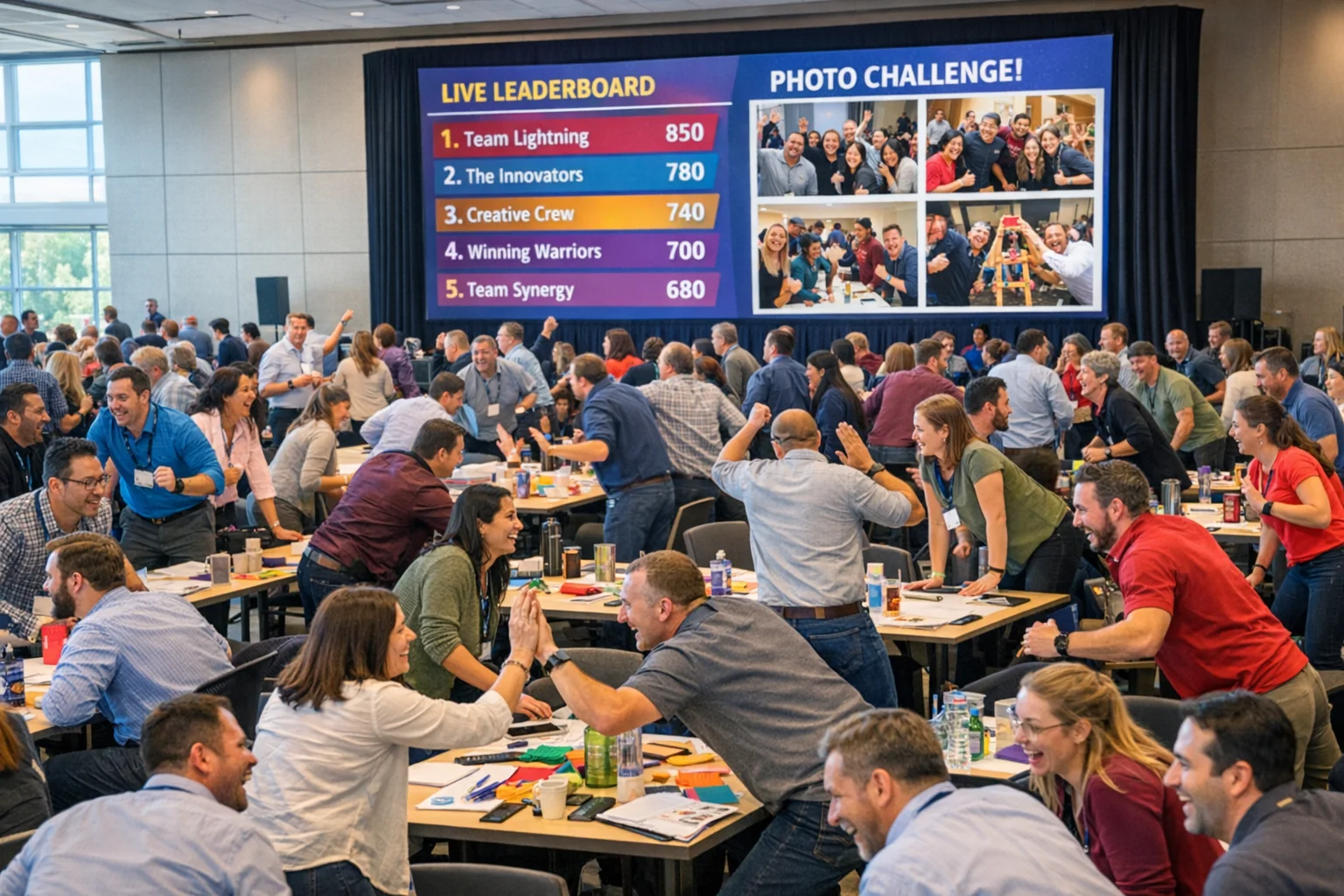
Teams complete location‑based, creative, and knowledge challenges. This scales beautifully because tasks run in parallel and scores update live.
If you run this with a platform like Scavify, automation handles submissions, leaderboards, and proof of completion so facilitators can focus on the room instead of chasing points.
Challenge examples you can drop in immediately:
Variations: Keep it indoors across a convention center, or spread it across a downtown core.
Best for: Big laughs, creative problem solving.
Post a wall of photo prompts. Teams split and sprint to recreate as many as possible before the horn. Fast scoring, fast resets, big energy.
Variations: Add bonus points for originality or difficulty.
Best for: Focused collaboration in short bursts.
Create 6–10 stations with quick puzzles. Teams rotate on a timer. Keep each puzzle solvable in a few minutes to avoid jams.
Variations: Mix logic, physical, and creative stations.
Best for: Spreading ideas through a large crowd.
Small groups rotate through tables with different questions, building on previous insights. Close with a gallery walk of top ideas.
Variations: Seed each table with a short artifact to spark richer discussion.
Best for: Breaking formality and bonding fast.
Project lyric snippets. Each table nominates a singer for micro‑rounds. Crowd votes via noise or a simple poll.
Variations: Use movie quotes, ad jingles, or finish‑that‑line challenges.
Best for: Light movement, fast decision‑making.
Ask the whole room to silently line up by birthday month, years of tenure, or distance from HQ. It gets loud, messy, and fun.
Variations: Add constraints like “no talking” or “only yes/no questions.”
Best for: Idea generation without long monologues.
Teams craft a 60‑second pitch for a prompt. On cue, half the room visits other tables to “shop” for ideas. Quick votes decide winners.
Variations: Give teams a constraint like “no budget,” “seen on a billboard,” or “fits in a pocket.”
Best for: Cross‑functional mingling at scale.
Each person gets a “passport” with stamps they can earn by meeting roles, skills, or interests. Incentivize full completion.
Variations: Add a raffle for completed passports.
Best for: Momentum between agenda blocks.
Drop 10–15 bite‑size tasks the room can do simultaneously: build a paper tower, snap a team selfie with all feet off the ground, teach a table trick. Timebox hard.
Variations: Tie tasks to event themes or values.
Best for: Healthy competition with inclusive roles.
Run fast‑paced trivia using phones or paddles. Mix general knowledge with org‑specific questions. Keep rounds short and scores visible.
Variations: Lightning “table captain” rounds to keep more people on mic.
Best for: Negotiation and collaboration.
Teams get partial kits to build a shared target but must trade to complete it. The catch: information and materials are unevenly distributed.
Variations: Allow one “market open” after round one to accelerate trades.
Best for: Engineering instincts and laughter.
Provide simple materials. Goal: span a set distance and hold a surprising weight for three seconds. Test live. Celebrate collapses.
Variations: Add wind from a box fan for drama.
Best for: Classic fun that scales.
Clusters design protection for a drop. Run heats by zone to keep sightlines clear. Announce a final “drop‑off” from a higher point.
Variations: Swap the egg for a cookie, golf ball, or water balloon outdoors.
Best for: Trust and communication reps.
Create a taped maze. One blindfolded teammate navigates using only specific cue words from a spotter. Short runs keep everyone involved.
Variations: For accessibility, reverse roles: navigator blindfolded, mover sighted.
Best for: Creativity without pressure.
Each team gets a set of emojis to build a 60‑second story relevant to your theme. Performances are quick and hilarious.
Variations: Turn it into a meme caption wall instead of live skits.
Best for: Puzzles without the room constraint.
Transform a hallway or ballroom with envelope puzzles, ciphers, and props. Stations run concurrently; teams collect stamps toward “escape.”
Variations: Hide a final meta‑puzzle that requires sharing intel across teams.
Best for: Visual collaboration and applause moments.
Teams build segments of a Rube Goldberg machine, then connect them. The first successful full run gets the loudest cheer of the day.
Variations: Give each table a different mechanical constraint.
Best for: Storytelling, culture, and morale.
Teams script and shoot a one‑minute video on a shared prompt. Quick edit apps make this easy. Screen a rapid‑fire festival with crowd awards.
Variations: Silent film version or single‑take challenge.
Best for: Turning complex topics into shared understanding.
Post a giant canvas. Prompts: stakeholders, pains, bright spots, dependencies. Teams add notes simultaneously, then cluster patterns.
Variations: Add color‑coded dots for voting.
Best for: Purpose and team pride.
Assemble kits, write cards, or sort donations at parallel stations. Rotate every few minutes. End with a quick impact tally.
Variations: Tie stations to different nonprofit partners.
Best for: Movement without intimidation.
Set up simple stations: balance, coordination, light cardio. Teams collect points by rotating quickly. Keep options inclusive and optional.
Variations: Add brain‑teaser stations for mixed intensity.
Best for: Healthy disagreement and fast learning.
Pose a provocative, safe‑to‑disagree statement. Poll the room, then send pairs to argue both sides for one minute each. Repoll and reflect.
Variations: Use it to surface assumptions before strategy sessions.
Best for: Closing on a high.
Distribute cards. Everyone writes one sincere thank‑you or shout‑out to someone in the room. Exchange quickly, then invite a few to read aloud.
Variations: Create a gratitude wall people can add to all day.
Keep instructions under a minute. Demonstrate with a front‑row table while the room watches. Then release everyone at once. You’ll save time and reduce confusion.
Shrink the room into clusters. Tables, zones, or pods of 4–8 people turn a crowd into many small conversations. This matches what research says about energetic teams: more distributed, frequent interactions win. HBR’s research on team communication patterns is worth a skim if you need a why. (hbr.org)
Design parallel play. Any activity that asks one person to perform for a thousand others will stall. Use formats where 30 things can happen at once and the room still feels connected.
Show progress publicly. Big screens, live leaderboards, or visible scoreboards keep attention centered. That’s where an app helps: submissions, points, and a live feed maintain momentum without manual tallying.
Build in quick debriefs. Thirty seconds here, one minute there. Ask, “What did we do well?” “What would we change?” Micro‑reflections convert fun into learning. For practical facilitation menus you can plug in on the fly, the SessionLab meeting facilitation toolkit is dependable. (sessionlab.com)
Create safety, then stretch. Let early rounds be low‑risk and inclusive. As comfort rises, invite bolder challenges. If you want the research angle for stakeholders, point them to Edmondson’s original framing of psychological safety and team learning. It’s the backbone for sustainable engagement, not just momentary hype. (web.mit.edu)
If you need a catalog of scalable formats, Liberating Structures offers dozens of 5–20 minute patterns that translate well to big rooms and hybrid setups. Start with 1‑2‑4‑All, TRIZ, and 25/10 Crowdsourcing. (liberatingstructures.info)
And if you want app‑based simplicity for hunts and interactive challenges, Scavify’s automation, browser + app flexibility, and challenge variety were built for exactly this scenario: lots of people, limited time, and the need for visible momentum.
Use short, parallel activities with clear visual cues and a shared scoreboard. Cluster people into small teams, demonstrate once, and release everyone together. Rotate quickly to avoid bottlenecks.
Choose formats with multiple ways to contribute: trivia, creative prompts, light movement, and quick discussion rounds. Offer role options inside teams (builder, scout, presenter, recorder) so people can lean into strengths.
Shorter than you think. Fast cycles with visible progress beat long single‑track activities. Two to five minutes per micro‑round creates momentum and keeps attention.
Run circuits that rotate by table, gallery walks, trivia stadiums, and micro‑missions. You don’t need open floor space; you need clarity, pacing, and a visible scoreboard.
Offer movement‑optional roles, provide written instructions and visual demos, use varied challenge types, and allow noise‑free or talking‑free options where helpful. Invite questions before the start.
Use short debrief prompts after each round: what helped us coordinate, where did we get stuck, what would we try next time? Tie observations back to daily workflows and team agreements.
Studies point to the value of energetic, broadly distributed communication and psychologically safe climates. See HBR’s work on communication patterns, Edmondson’s original research on psychological safety, Gallup’s meta‑analysis on engagement and outcomes, and scalable formats like Liberating Structures. (hbr.org)
If you’re planning a conference activation, onboarding wave, or an all‑hands, bookmark this and mix‑and‑match. The right structure turns a massive room into hundreds of active participants in minutes. That’s the whole point.