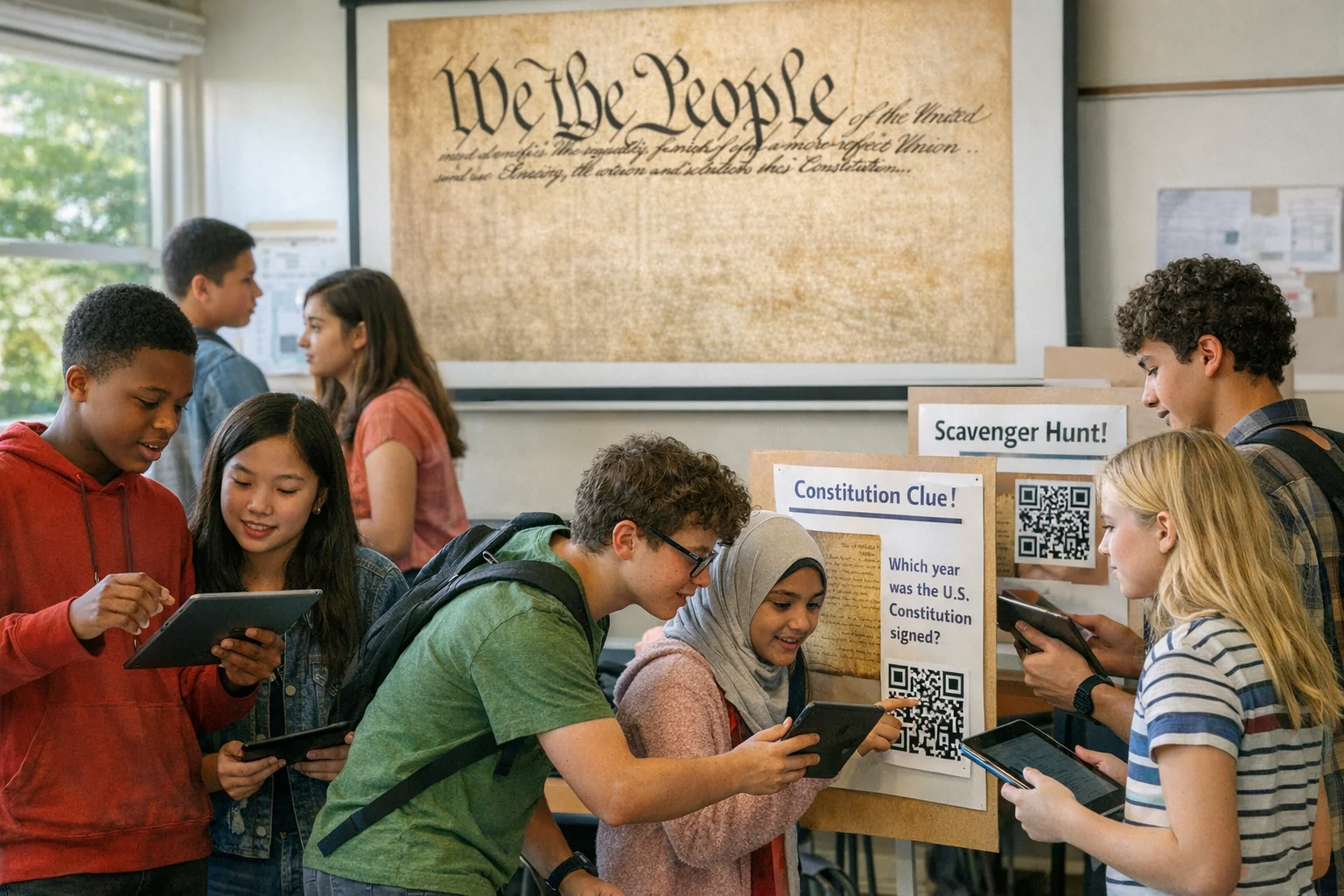
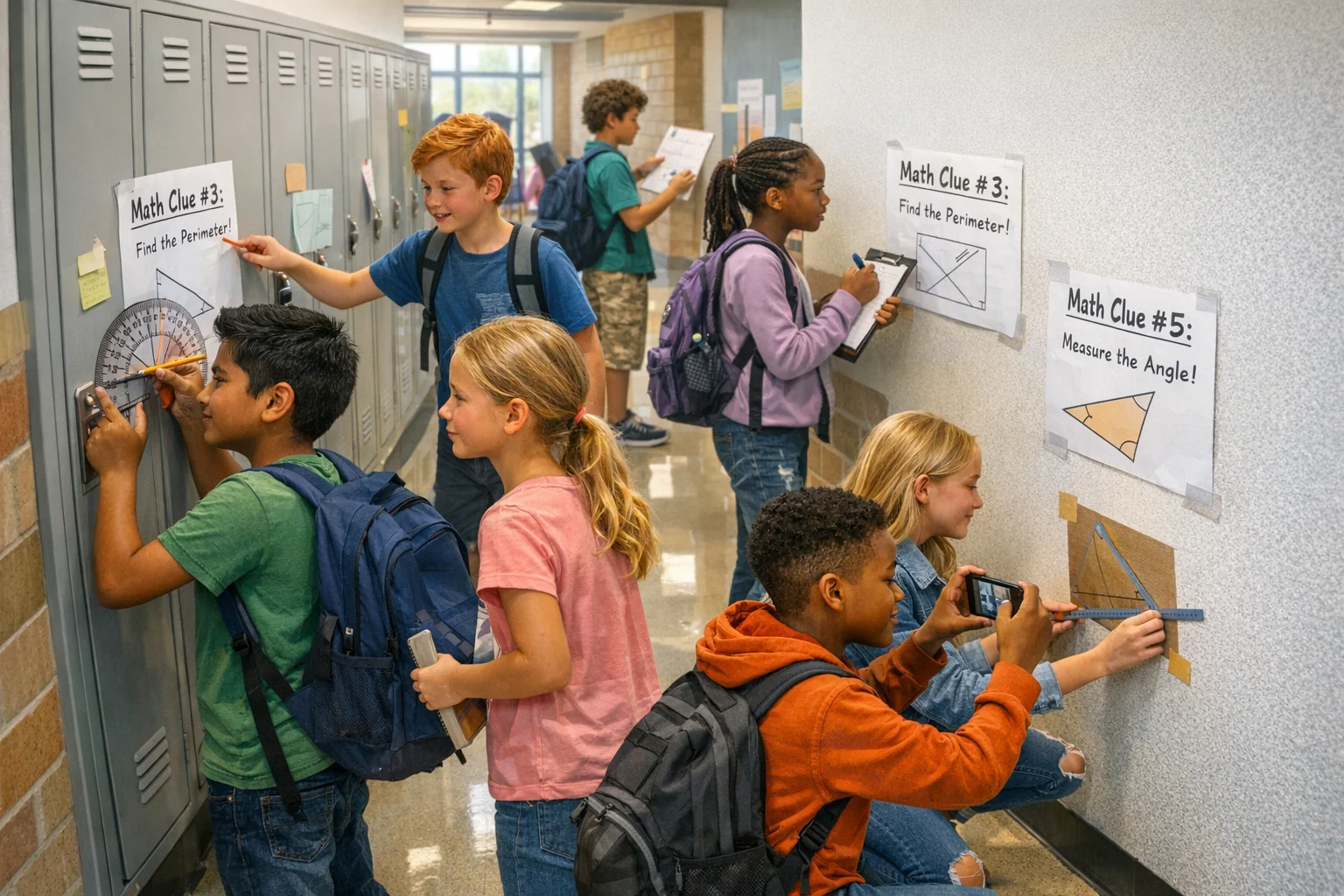
A Constitution scavenger hunt turns passive recall into active discovery. Instead of reading about Article I or the Bill of Rights, participants move, search, compare sources, and make small decisions that stick.
If you teach civics, run campus orientation, or support Constitution Day, this guide gives you field-tested formats and ready-to-use questions. It also shows where primary sources and light game mechanics make learning click.
At a Glance
- Start with sources. Anchor tasks in primary materials and the text itself for durable understanding.
- Mix challenge types. Balance Q&A with photo, QR, GPS, and multiple choice to keep energy high.
- Sequence for thinking. Move from locate-and-identify to connect-and-explain for better retention.
- Use credible anchors. Point students to the Interactive Constitution, DocsTeach, and LOC sets.
- Capture reflection. Short debrief prompts convert motion into measurable learning.
What a Constitution Scavenger Hunt Really Is
A Constitution scavenger hunt is a structured set of short challenges that require participants to interact with the Constitution’s text, context, and applications across multiple stations or prompts.
Good hunts feel like a conversation with the document. Participants find, verify, compare, and explain. Then they show evidence of what they learned.
Why This Works for Learning
Active tasks beat passive listening most of the time. A large meta-analysis across hundreds of college courses found that active learning increased performance and reduced failure rates compared with lecture. The effect was measured in STEM, but the mechanism applies neatly to civics: frequent retrieval, immediate use, and peer discussion drive understanding. See the summary and paper in this open-access writeup of the PNAS study: active learning increases performance.
Inquiry also matters. The C3 Framework’s Inquiry Arc emphasizes questioning, applying disciplinary tools, evaluating sources, and communicating conclusions. In practice, that means your hunt should ask students to find clauses, weigh interpretations, and support claims with evidence, not just memorize. For context and planning language, review the C3 Framework overview from NCSS.
Formats That Fit Your Class or Event
Different rooms, timelines, and group sizes call for different builds. Patterns we keep seeing work:
- Station rotation. Post numbered prompts around the room. Teams circulate, scan QR codes for sources, and record evidence.
- Source sprint. Each team gets a deck of source cards with linked questions. Faster, lighter, great as a Constitution Day warmup.
- Gallery walk. Primary sources and clauses at eye level. Participants annotate with sticky notes, then answer synthesis prompts.
- Hybrid app + print. Use an app to automate point tracking, photo uploads, and hints while keeping printed excerpts for focus.
- Campus version. For orientations or large events, use GPS or location clues tied to campus landmarks named for constitutional ideas.
Question Design Principles That Build Civic Knowledge
Design is the difference between busywork and real transfer.
- Anchor in text. Write prompts that send participants to exact Articles, Sections, Clauses, or Amendments.
- Target big ideas. Separation of powers, federalism, republicanism, rights, due process, judicial review, and amendment process.
- Climb the ladder. Start with locate-and-quote, then compare, then apply to a contemporary fact pattern.
- Use credible tools. Send students to the Interactive Constitution for scholarly explainers across viewpoints, the National Archives’ DocsTeach Constitution page for source sets, and the Library of Congress Constitution Day resources for primary-source teaching supports.
- Build in verification. Require a clause citation, a photo of the source used, or a short justification.
Ready-to-Use Constitution Scavenger Hunt Questions: Elementary
Keep language concrete and tasks short. Mix movement with quick finds. Use visuals and one-sentence answers.
- [Q&A | 20 pts]: Write the first three words of the Preamble.
- [Multiple Choice | 20 pts]: Circle the number of government branches in the Constitution: 2, 3, or 4.
- [Photo | 30 pts]: Take a photo of a classroom rule and connect it to one goal from the Preamble.
- [Q&A | 20 pts]: Name the branch that makes laws.
- [QR Code | 25 pts]: Scan to open the Bill of Rights and find one freedom in the First Amendment.
- [Q&A | 20 pts]: How many Senators does each state have?
- [Multiple Choice | 25 pts]: The President is part of which branch: Legislative, Executive, or Judicial?
- [Photo | 30 pts]: Snap a picture of something in school that shows checks and balances, then explain in one sentence.
- [Q&A | 20 pts]: What do we call a change to the Constitution?
- [Q&A | 25 pts]: Who signs a bill to become a law?
Tips: For sources, print a large-font Preamble and a simplified Bill of Rights page, or point to the LOC overview inside the Constitution Day teacher set.
Ready-to-Use Constitution Scavenger Hunt Questions: Middle School
Middle schoolers can handle citations and short applications. Expect quick quotes and one- to two-sentence explanations.
- [QR Code | 30 pts]: Use the Interactive Constitution to find a plain-language summary of the Necessary and Proper Clause. Write one power it supports.
- [Q&A | 25 pts]: Cite the Article and Section that establishes the House of Representatives.
- [Multiple Choice | 25 pts]: Who can declare war: Congress, the President, or the Supreme Court?
- [Q&A | 30 pts]: Identify one power reserved to the states and name the Amendment that protects it.
- [Photo | 35 pts]: Photograph a local symbol of government and connect it to a constitutional power or limit in one sentence.
- [Q&A | 25 pts]: Which Amendment protects against unreasonable searches and seizures? Provide the number.
- [Q&A | 25 pts]: What fraction of Congress is needed to propose an amendment?
- [Multiple Choice | 25 pts]: Treaties require the advice and consent of which chamber: House or Senate?
- [Q&A | 30 pts]: Name the clause that prevents the government from creating an official religion.
- [QR Code | 30 pts]: Scan to open National Archives DocsTeach and find a primary source related to the Constitutional Convention. Write one detail you learned.
Hint: Preload links to the DocsTeach Constitution topic and the Interactive Constitution in QR codes at stations.
Ready-to-Use Constitution Scavenger Hunt Questions: High School and AP
At this level, send students into clauses, cases, and competing interpretations. Require citations and brief reasoning.
- [Q&A | 40 pts]: Quote the exact text of the Commerce Clause and cite location.
- [Q&A | 40 pts]: Using the Interactive Constitution, identify two scholars who present different readings of the Second Amendment. Summarize one point of disagreement in two sentences.
- [Multiple Choice | 30 pts]: The Supreme Court’s power of judicial review is grounded in which case: Marbury v. Madison, McCulloch v. Maryland, or Gibbons v. Ogden?
- [Q&A | 35 pts]: Cite the exact process for overriding a presidential veto.
- [Photo | 40 pts]: Find a current event headline that reflects federalism in action. Upload a screenshot and connect it to a clause or Amendment.
- [QR Code | 35 pts]: Open the National Constitution Center’s Drafting Table and list one substantive change between an early draft and the final text. Include the draft date.
- [Q&A | 35 pts]: Identify the clause that prohibits bills of attainder and ex post facto laws. Provide location and purpose in one sentence.
- [Multiple Choice | 30 pts]: Which Amendment altered the method of electing Senators: 12th, 17th, or 22nd?
- [Q&A | 40 pts]: Provide the text of the Establishment Clause or Free Exercise Clause and explain one modern debate in two sentences.
- [Q&A | 40 pts]: What constitutional standard applies to searches in schools after New Jersey v. T.L.O.? Explain briefly.
For source work, send students to the NCC’s Drafting Table for historical comparisons and the Archives’ Studying the Constitution with Primary Sources for document analysis.
Primary Sources That Elevate the Hunt
A pattern we keep seeing: when participants handle real text and artifacts, they treat the Constitution less like trivia and more like a living framework.
Running the Hunt: Flow and Logistics That Actually Work
Most teams benefit from a clear rhythm, visible progress, and low-friction verification.
- Kickoff. Set the frame. Explain that each answer needs a citation, photo, or short reasoning.
- Circulation. Stagger start points to avoid crowding. Use visible station numbers.
- Hints. Offer time-released hints on tougher items to keep teams moving.
- Verification. Require a screenshot of the source page, a clause citation, or a short quote.
- Debrief. Close with a whole-group share-out of two surprising finds per team.
Scoring, Reflection, and Evidence of Learning
Points keep energy up but the reflection cements learning.
- Balanced scoring. Weight application and explanation slightly higher than quick recall.
- Evidence bundle. Ask teams to turn in a short portfolio: answers with citations, three screenshots, and one photo task.
- Exit ticket. Two prompts work reliably: What clause did you understand better and why? Where do you see that principle in the world this week?
Turning This Into an App-Based Experience
If you want automation, photo verification, QR codes, and instant scoring, an app-based format helps. In our world, that usually looks like:
- Challenge variety. Mix Multiple Choice, Q&A, Photo, Video, and QR tasks in one flow without juggling papers.
- Automation. Auto-score objective items, time-release hints, and collect photo evidence in one place.
- Flexibility. Run in a browser or app, indoors or around campus, for a single class or a large event.
Scavify happens to do this well, especially when you want GPS or QR tasks plus quick leaderboards. Use it when logistics start to crowd out teaching time.
Answer Key Snapshot
Offer a compact key so facilitators can move fast. Keep the full key with clause citations in your plan. A short sample below:
- Preamble starts with “We the People.”
- Branches of government: 3.
- Legislative branch makes laws. President signs bills.
- Two Senators per state. Changes to the Constitution are Amendments.
- Necessary and Proper Clause: Article I, Section 8, Clause 18.
- War declarations by Congress. Treaties require Senate consent.
- Fourth Amendment protects against unreasonable searches and seizures.
- Amendment proposal threshold: two-thirds of both houses.
- Commerce Clause location: Article I, Section 8, Clause 3.
- Judicial review case: Marbury v. Madison.
- Veto override: two-thirds of both House and Senate.
- Bills of attainder and ex post facto laws prohibited in Article I.
- Direct election of Senators: 17th Amendment.
FAQs
What is a Constitution scavenger hunt?
A Constitution scavenger hunt is a set of short, structured challenges that push participants to find, cite, and apply parts of the U.S. Constitution. Tasks can include Q&A, multiple choice, photo evidence, QR codes, and short explanations.
How long should it take?
One class period is plenty for a concise version. Larger builds can run longer. The key is pacing, visible progress, and time-released hints so no team stalls out.
Do I need devices for every student?
No. Paper stations work fine. Devices expand what is possible, especially for QR, image uploads, and quick citations. A hybrid format with printed excerpts and optional links is often the sweet spot.
Where can I find reliable primary sources?
Start with the National Archives’ DocsTeach Constitution topic, the NCC’s Interactive Constitution, and the Library of Congress Constitution Day classroom materials.
How do I differentiate for younger learners?
Use shorter prompts, concrete language, visuals, and either-or choices. Anchor photo tasks to school life and ask for one-sentence links to Preamble goals or simple rights.
What makes a good high school or AP prompt?
Require a clause citation, a relevant case, and a brief justification. Send students to competing interpretations, like those in the Interactive Constitution, and ask them to summarize a disagreement.
How do I assess without killing the vibe?
Use balanced points, quick verification, and a short exit ticket. Collect a small evidence bundle instead of a long worksheet.
Any research I can point to when pitching this to colleagues?
Yes. A widely cited meta-analysis found that active learning improved performance and reduced failure rates compared with lecture. Share this open-access summary of the PNAS study: active learning increases performance.