Solutions
Your first hunt, live this afternoon.
Free to start · No download for participants
Make learning more active with scavenger hunt ideas, questions, and formats for students, teachers, and classrooms.
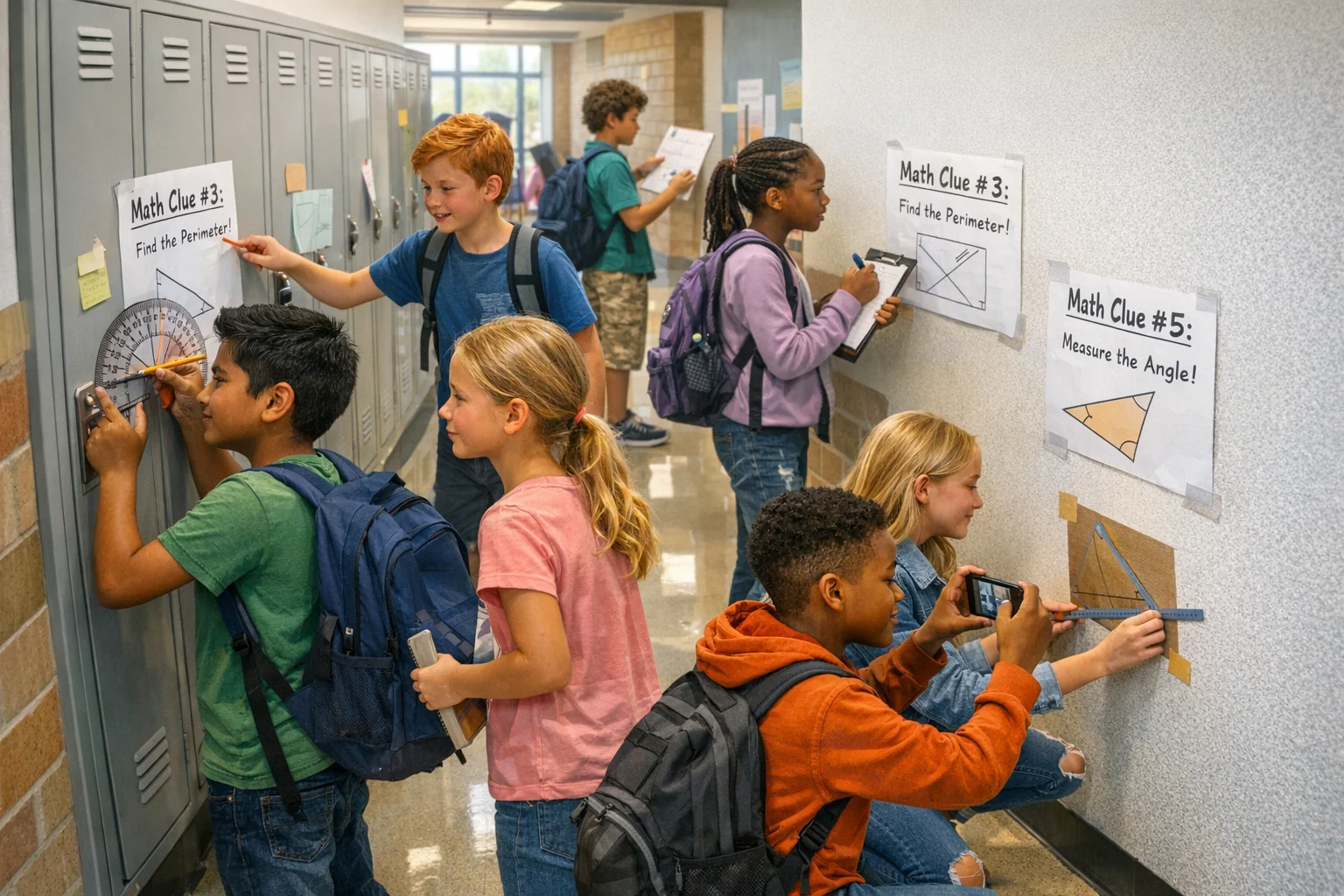
A math scavenger hunt turns static practice into an active search. Students move, find, solve, and show their thinking in short bursts. You get honest evidence of understanding without the groans that come with another worksheet.
A math scavenger hunt is a structured set of short math challenges hidden or posted around a space. Students rotate, hunt for prompts, and submit quick evidence of thinking. Evidence can be a photo of a shape in the wild, a short video explanation, a QR code check-in tied to a correct answer, or a fast multiple-choice scan.
It isn’t a chaotic free-for-all. Good hunts have clear routes, intentional cognitive demand, and quick validation so students know when they’re on track. Great ones balance motion with moments to reason and explain.
Well-run hunts tap three levers.
Movement fuels attention. Classroom-embedded activity is linked with better grades, memory, and classroom behavior. Building small bouts of movement into lessons is a recommended practice, not a gimmick, as summarized by the CDC’s guidance on classroom physical activity and academics.
Retrieval strengthens learning. Short prompts that ask students to recall, explain, or apply ideas produce more durable learning than re-reading. That’s the core of retrieval practice, outlined clearly by The Learning Scientists’ overview of retrieval practice.
It aligns with math practices. Hunts can push students to make sense of problems (MP1), construct arguments (MP3), and model with mathematics (MP4). See the full list on the official Standards for Mathematical Practice.
It invites thinking, not mimicking. Educators often use controlled movement and station hunts to spark genuine problem solving. Practical classroom strategies for movement-based math, including scavenger-style searches, are showcased in Edutopia’s guide to building movement into math lessons.
A few patterns keep hunts tight and effective.
A note on tools: paper works, and so does tech. If you want automation for QR codes, instant scoring, photo/video evidence, and live progress, this is where an app like Scavify naturally fits. But the design choices above matter more than the container.
Use these as-is or adapt by grade band. Each includes two quick, app-friendly challenge prompts in Scavify’s format.
Have students spot real examples of polygons, angles, and symmetry.
Post fraction cards; students match equivalents using visuals or sets.
Tape outlines on floors or tables for quick estimates, then confirm by measuring.
Hide numbers in different forms: standard, word, expanded, base-ten images.
Use labels from a mini “store,” sports stats, or posters to compute unit rates.
Solve linear equations to reveal map coordinates that unlock the next station.
Tag corners, rails, and art. Students classify and measure with a small protractor.
Teams tally quick counts (door types, book genres, shirt colors), then graph.
Place figures for students to reflect, rotate, and translate using landmarks.
Post short problems with common traps. Students annotate the givens and asks.
Match expressions to equivalent forms or to verbal descriptions.
Simple spinners, dice, and cards at stations.
Composite figures taped on the floor; students decompose and compute.
Price tags, discounts, and tax scenarios.
Map tables, graphs, and rules to each other.
Here are three formats that keep setup tight and validation quick.
To cut prep, remix strong tasks you already trust. For conceptual starters, teachers often pull warm-ups like open compares and short explanations from resources similar to those in Edutopia’s movement in math article. Keep prompts short and the thinking visible.
Scoring should encourage accuracy and explanation, not speed alone.
If you’re running hunts regularly, tools that automate check-ins, randomize starting points, and collect media proof help. Scavify’s challenge variety and auto-scoring make it easy to spin up repeatable formats without ballooning prep time.
Any grade can benefit. Primary hunts lean on visuals, models, and measurement. Middle grades thrive on geometry, ratios, and early algebra. High school hunts work well for functions, transformations, and modeling. The key is right-sizing the cognitive demand and validation.
Short and focused usually wins. Plan one or two rounds of about 10–15 minutes each with a brief reset and debrief. Longer hunts can work for special events, but attention and quality of explanation tend to fade past that.
Yes. Indoors offers tighter control and faster transitions. Outdoor hunts are great for geometry, measurement, and modeling, and they bring natural movement. If weather shifts, run the same prompts as posted stations in halls.
Use staggered starting points, duplicate popular stations, and a loop layout. Build in quick checks so groups don’t camp at a station guessing. A live progress view helps you redirect traffic.
Score for accuracy and explanation. Use a short exit reflection: What strategy did you use? Where did you change your mind? Which error did you fix? Tie reflections to MP1 and MP3 from the Standards for Mathematical Practice.
Design alternative routes within close range, bring station prompts to tables, and pair thoughtfully so one student can be the navigator while another is the runner. Accept seated photo builds or virtual annotations as equivalents.
They can. The combination of brief movement, focused prompts, and frequent retrieval is a strong mix for durable learning. See the synthesis on classroom physical activity and academics and the summary of retrieval practice for the underlying mechanisms.
Start with your own curriculum and past assessments. For inspiration on movement-integrated math and station ideas, see Edutopia’s movement strategies. For family-friendly scavenger structures you can adapt, Stanford’s DREME project shares a simple math scavenger hunt activity.
Both work. Paper is fastest to set up. Apps streamline QR codes, photo/video evidence, auto-scoring, and randomized routes. If you plan to run hunts often or at scale, the automation pays off.
Design the hunt around thinking, keep validation fast, and close with reflection. Do those three things and you’ll see the shift: less passive compliance, more visible math reasoning, and students who are genuinely active in their learning.