Solutions
Your first hunt, live this afternoon.
Free to start · No download for participants
Explore practical ideas, real examples, and simple tips to make your next group activity more engaging, useful, and fun.
You want Amazing Race challenges that actually work for team building, not just photo ops. This guide gives you 21 ready-to-run challenges, plus the practical setup, scoring, and facilitation moves that keep energy high and collaboration real.
Clarity plus tension. The best challenges are crystal clear on success criteria, yet create productive tension through time pressure or limited information. That tension should drive conversation, not silence.
Safety fuels contribution. Teams speak up and experiment when they feel safe to risk small mistakes. Psychological safety predicts learning behaviors that you want to surface in a race, as shown in Amy Edmondson’s foundational research on team psychological safety. (dash.harvard.edu)
Movement changes the mood. Light physical activity improves mood and short-term anxiety, which is why a route with purposeful walking often has better energy than a room-only sprint. See the CDC overview of physical activity benefits for adults. (cdc.gov)
Game mechanics help when they fit the goal. Points, timed unlocks, and badges nudge participation when aligned to outcomes. The effect depends on design quality, but is supported across contexts in a literature review of gamification outcomes. (creativegames.org.uk)
Tie the activity to real collaboration. Pure novelty fades fast. Designing tasks that require planning, role switching, and communication makes the time count, echoing critiques that unfocused “team building” wastes resources unless it links to actual work. See Harvard Business Review’s analysis of wasteful team building. (hbr.org)
Each example below names the challenge type and a suggested point value. Write your own versions to match your venue and goals. Keep tasks 8 to 15 words so teams can scan and move.
How to adapt quickly. If your venue lacks statues or murals, shift to internal artifacts. Archives, donor walls, service counters, and architectural quirks make great anchors. If mobility varies, pair GPS or walking tasks with seated puzzles at each stop so roles rotate naturally.
Sequence by cognitive load, not just distance. Place a short win first to build confidence, then alternate between creative, physical, and analytical tasks. The rhythm matters more than shaving a block of walking.
Create meaningful choice. Offer optional detours at two points, for example a longer path with higher points versus a nearby puzzle with fewer points. Autonomy boosts engagement, and it spreads teams across the map so locations do not bottleneck.
Think in clusters. Three to five checkpoints within a zone reduce downtime. If weather turns, you can shift the cluster indoors and keep the same tasks.
Brief the route stewards. A quick script and a visible timer are enough. Their job is clarity, not performance.
Plan redundancy. Every key element needs a backup. Second QR code under a different shelf. Alternate GPS pin 10 paces away. Print one spare clue packet per team cluster. The small redundancies are what save the day when the espresso machine floods your favorite stop.
Points beat place. Scoring by total points within a time window creates more collaboration and fewer all-out sprints across intersections. Bonus points for creativity or helpfulness shape the culture you want to see.
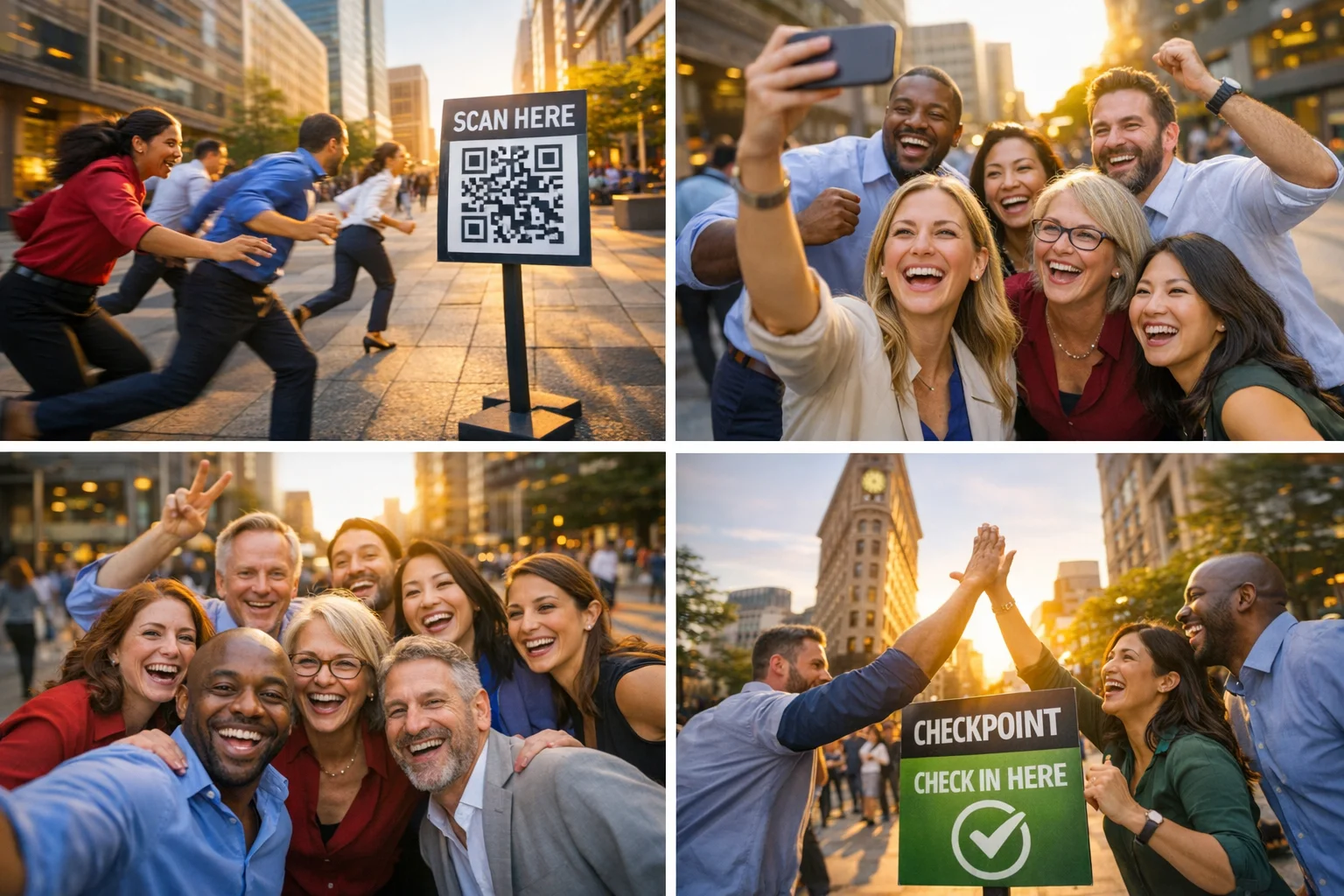
Artifacts make scoring objective. Photos, videos, GPS check-ins, QR scans, and quick answers let you score without debate. This also builds a highlight reel for the debrief.
Hints with light penalties. Structured hints reduce stalls and keep momentum. A small fixed deduction per hint is enough. Do not bury teams for asking.
Live feedback changes energy. A rolling leaderboard and quick acknowledgment when a great submission lands keeps teams pushing. Tools like Scavify make GPS check-ins, QR scans, photo and video uploads, and live leaderboards simple in app or browser, which is especially useful when you are running across multiple locations.
Simple, posted, and enforced. Publish rules on the first screen of your challenge set and on physical cards at the start table. Keep them short.
Fairness checks. If daylight or noise changes difficulty across time, rotate teams so no one hits the hardest version at the end of the window. Keep lighting-dependent tasks indoors if possible. If a location becomes unusable, broadcast a replacement and adjust point values, not just time.
Indoor office. Favor pattern-spotting, micro-builds, and social micro-missions. Hallway noise rules apply, so use QR codes, silent videos, and still photos.
Conference center. Mix sponsor activations with map reading and networking prompts. Build in one challenge that sends teams to a breakout they were not planning to visit, then reward a useful insight captured on video.
Campus or downtown. Lean on public art, historical plaques, and views. Choose wide plazas over narrow sidewalks to avoid congestion.
Hybrid or remote. Use GPS check-ins for local participants and mirrored Q&A or photo prompts for remote teammates. Keep points equivalent and require shared artifacts so remote members are fully in the story.
Inclusive by design. Calibrate tasks so roles switch: navigator, spokesperson, builder, researcher. Offer seated alternatives at each stop. Scaffold creative prompts so camera-shy teammates can contribute off-screen.
Before. Clarify the outcome you want to practice, for example communicating under time pressure or rotating leadership. Set that frame in two sentences during your kickoff. Remind everyone that experimentation beats perfection, which echoes the mechanics behind psychological safety and learning behaviors in teams. (dash.harvard.edu)
During. Watch for stalled teams and offer structured hints. Call out great collaboration moments publicly. Keep the clock visible. Make sure route stewards have water and short breaks. Build a buffer at the end for photo uploads so scoring does not drag.
After. Debrief while the emotion is fresh. Three questions usually land:
Connect the dots to daily work. If you want a deeper link to wellbeing, note briefly that light movement benefits mood and focus, which helps learning stick, as summarized in the CDC’s guidance on physical activity benefits. (cdc.gov)
They are short, location-anchored tasks that teams complete under a time window, usually combining problem solving, light movement, and creative micro-missions. The goal is not spectacle. It is structured collaboration with evidence you can debrief later.
Long enough to complete a balanced route with a clear beginning, middle, and end. In practice, aim for a compact window that keeps urgency high and leaves time to debrief meaningfully.
Small enough that everyone contributes and no one rides along silently. If you are unsure, run a quick pilot with two team sizes and see which version produces more voices in the artifacts.
Design every leg with at least one seated or low-mobility role. Offer parallel tasks of equal value and let teams choose. Rotate roles by intention, not by default.
Use points with clear criteria and require artifacts you can verify. Time can be a tiebreaker. Creativity bonuses nudge better collaboration without turning scoring into a debate.
Create zone clusters and offer optional detours. Stagger team starts, publish alternative locations, and keep stewards empowered to redirect crowds.
Yes. Use QR codes, photos, silent videos, and Q&A tied to artifacts like artwork, directional signage, or archival displays. Keep routes wide and noise-aware.
Anchor challenges to real collaboration patterns, like planning quickly, negotiating roles, or giving feedback under time pressure. That is where team learning happens, a point echoed in HBR’s critique of unfocused team building. (hbr.org)
If you want an easy way to run GPS check-ins, QR scans, photo and video submissions, and live scoring without spreadsheets, Scavify handles it in both browser and app. That lets you focus on the route, the rhythm, and the debrief that makes it stick.