Solutions
Your first hunt, live this afternoon.
Free to start · No download for participants
Discover practical team building ideas, examples, and activities that boost morale, communication, and collaboration.
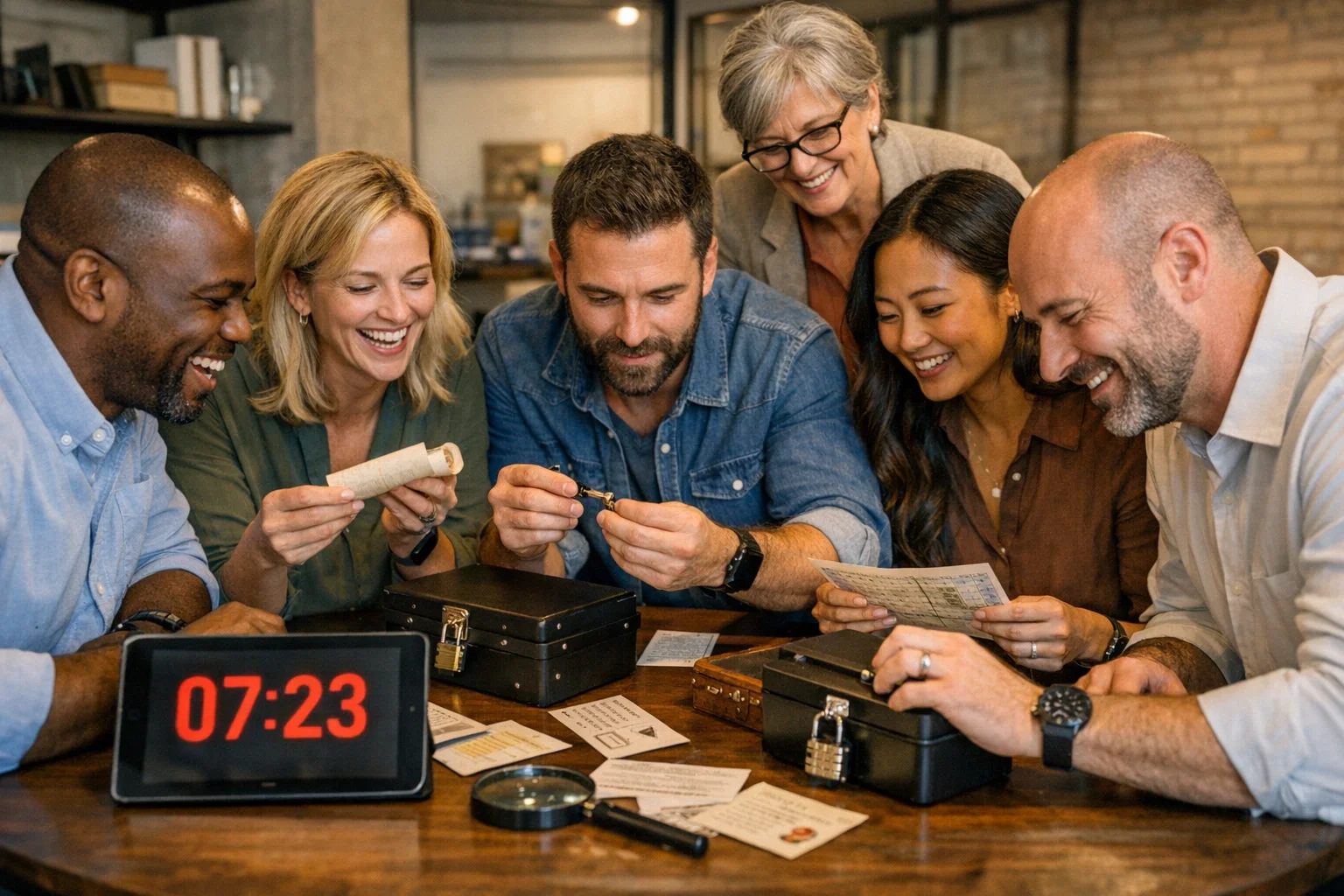
You want a team building escape room that builds trust fast, not just 60 minutes of frantic key‑finding. Here’s the playbook we’ve seen actually change how people talk, help, and make decisions together.
Escape rooms compress what good teams do into an hour: ask for help, speak up when stuck, divide and recombine work, and align quickly under uncertainty. That’s the exact environment where psychological safety turns from theory into behavior. A practical primer from HBR captures the idea simply: people contribute more when it’s safe to ask questions and admit uncertainty. Add time pressure and stakes, and you’ll see the norm take hold or crack. See the HBR conversation with Amy Edmondson on psychological safety for a succinct overview. (hbr.org)
Google’s Project Aristotle documented five dynamics of effective teams, with psychological safety sitting on top of the stack. Their own guide details how they studied 180 teams and made safety, clarity, dependability, meaning, and impact visible, measurable, and coachable. Use those dynamics as your design spec for the room. See Google’s Project Aristotle guide on re:Work for the research summary and tools. (rework.withgoogle.com)
There’s also growing research that escape rooms are legitimate collaborative problem‑solving environments. Reviews and empirical studies in education and healthcare training consistently report increased engagement and useful reflections on communication and teamwork after gameplay. Good news: the format scales beyond entertainment. See a systematic look at escape rooms in science education and a recent scoping review in medical education. (frontiersin.org)
If you want the micro‑view of teams under pressure, researchers have even analyzed in‑room conversation patterns. One study used escape rooms as a live lab and found differences in interaction dynamics between successful and unsuccessful teams. Translation: the format surfaces real behaviors you can coach. See the Scientific Reports paper on escape room social dynamics. (nature.com)
Use this to shape any in‑person, on‑site, or virtual build.
Each idea includes the mechanic, why it builds trust, and a quick variant.
1) Two‑key unlock - Mechanic: Two players must turn keys or press buttons simultaneously in different parts of the space. - Why it builds trust: Requires explicit countdowns and equal participation. - Variant: Virtual version with two codes that must be submitted within 5 seconds of each other.
2) Asymmetry relay - Mechanic: One person can see a pattern; another can manipulate pieces. They can’t see each other’s view. - Why it builds trust: Forces clean instructions and listening. Pair‑switch halfway. - Variant: Use a shared whiteboard screenshot the “viewer” can’t edit.
3) Silent solve - Mechanic: A short puzzle where only gestures are allowed for 60 seconds. - Why it builds trust: Highlights nonverbal clarity and leader turn‑taking. - Variant: In virtual, camera‑on only, chat disabled, use hand signs.
4) Shadow decoder - Mechanic: Align objects to cast a readable shadow message under a light. - Why it builds trust: Encourages experimentation without blame when attempts fail. - Variant: Virtual collage that only makes sense when layered correctly.
5) Chain of custody - Mechanic: Four clues must be combined in a strict order held by different people. - Why it builds trust: Encourages micro‑handoffs and acknowledgment before acting. - Variant: Use timestamped files or QR codes in virtual rooms.
6) Calibration lock - Mechanic: A dial must be tuned while another person reads subtle feedback. - Why it builds trust: Makes “narrate what you see” a team norm. - Variant: Slider puzzle controlled by one, “meter” feedback screen viewed by another.
7) Distributed cipher - Mechanic: Each person holds a different cipher wheel segment; only assembled text decodes. - Why it builds trust: No single hero can brute‑force it. - Variant: Split a Vigenere key across emails sent to different teammates.
8) Map triangulation - Mechanic: Three partial maps overlap to reveal a GPS coordinate. - Why it builds trust: Rewards patient synthesis over speed. - Variant: Virtual layers in a shared canvas with transparency controls.
9) Quality gate - Mechanic: A puzzle that seems solved until a subtle constraint is missed. - Why it builds trust: Normalizes second‑checks and polite challenge. - Variant: Digital form rejects unless two fields match a hidden rule.
10) Conflict‑free merge - Mechanic: Two subteams generate different halves of a code; each must preserve a property when merged. - Why it builds trust: Forces documentation and version control behaviors. - Variant: Spreadsheet formula that only evaluates when both sheets follow agreed naming.
11) Perspective shift - Mechanic: Clue text only reads correctly in a mirror or through a colored filter. - Why it builds trust: Encourages “show, don’t tell” to bring skeptics along. - Variant: Virtual color filter overlay that reveals hidden copy.
12) Hint economy - Mechanic: Teams have a limited hint budget that refreshes when they explain what they’ve tried. - Why it builds trust: Models transparent status updates and help‑seeking. - Variant: In remote play, hints require a 30‑second verbal recap.
Design note: if your puzzles routinely require heavy text instructions, consider adding a short “priming” micro‑puzzle that teaches the mechanic before the real one. It increases perceived fairness and keeps the group’s confidence intact. See the Room Escape Artist primer on priming puzzles. (roomescapeartist.com)
Operational tip: keep tech friction low. Use one shared link hub, require cameras on for short windows during high‑coordination puzzles, and have a backchannel for facilitators.
Safety note: avoid blindfolds, excessive darkness, and physical stunts. People should feel safe taking interpersonal risks, not physical ones.
Don’t stop at “we escaped.” Track a few light signals and check back two weeks later.
For large groups or mixed remote/in‑person teams, a mobile platform removes paper shuffle and lets you automate scoring, hints, timers, and media capture. This is where Scavify naturally fits: app‑based challenges, automated scoring, GPS or QR triggers, and instant photo/video submissions keep 50 or 500 people moving with less herding.
If you’re using an app‑based format, here are example challenges that build trust fast:
They’re good when designed for interdependence and followed by a real debrief. Research across education and training shows the format surfaces communication habits and supports reflection on teamwork, which is what you’re trying to improve.
Small pods work better than big swarms. Aim for pods that allow everyone to touch the puzzle within a few minutes. If you have a large group, run multiple parallel teams with a shared finale.
Most teams do fine in 45–60 minutes of play plus a 10–15 minute debrief. Shorter is possible if you trim the puzzle set and keep signposting crisp.
Keep the artifact set simple, use breakout rooms, and build at least one puzzle that requires screen‑free narration. Use broadcast messages and time boxes to keep pace. Zoom and Teams both have solid breakout room controls when configured correctly. (support.zoom.com)
Start with an early, obvious win. Assign roles that aren’t “solver,” like scribe or verifier. Make asking for a hint a success behavior, not a penalty.
Playtest with fresh eyes. Remove any step that relies on niche trivia. Use clear signposting and avoid unintentional red herrings. The Room Escape Artist resources are a practical reference for puzzle fairness. (roomescapeartist.com)
Trust changes when a behavior repeats. Use the experience to set one concrete team norm, then practice it in existing meetings for two weeks. Teams that intentionally build psychological safety see better collaboration over time. Start with Google’s five dynamics as a checklist. (rework.withgoogle.com)
Yes. Multiple reviews and studies in medical and science education report positive effects on engagement and teamwork reflections following escape room activities, with growing evaluation rigor. See recent reviews in BMC Medical Education and Frontiers in Education. (bmcmededuc.biomedcentral.com)
Ready to make passive participation active? Build for early wins, design real interdependence, and make the debrief do the heavy lifting. That’s how you turn an hour of play into next week’s better handoff.