Solutions
Your first hunt, live this afternoon.
Free to start · No download for participants
Discover practical team building ideas, examples, and activities that boost morale, communication, and collaboration.
HR team building isn’t about manufactured fun. It’s about building the habits that make work easier, faster, and more human. The activities below focus on outcomes HR actually cares about: trust, clarity, collaboration, and momentum.
Most teams don’t need louder icebreakers. They need safer conversations and cleaner handoffs. Google’s multi‑year research on team effectiveness highlights five dynamics that matter most: psychological safety, dependability, structure and clarity, meaning, and impact. That’s a useful lens for selection: choose activities that strengthen one or two of those dynamics on purpose. See Google’s guide for a quick primer. Google re:Work guide on team effectiveness. (rework.withgoogle.com)
A pattern we keep seeing: the way a team communicates in the moment is a stronger predictor of performance than org charts or credentials. Activities that make turn‑taking visible, enforce balanced contributions, and surface nonverbal cues tend to stick. For background, Alex Pentland’s research on communication patterns is a useful anchor. HBR: The New Science of Building Great Teams. (hbr.org)
One more reality check. Engagement and wellbeing trends continue to swing, and leaders are under pressure to show impact. Use activities to create repeatable manager behaviors (clear expectations, frequent connection, fast feedback) rather than one‑off events. Gallup’s global reporting is a sober read and a good reminder to keep things practical. Gallup: State of the Global Workplace (2026 summary). (gallup.com)
Outcome: Connection, momentum, cross‑team visibility.
Best for: New teams, offsites, onboarding weeks, all‑hands.
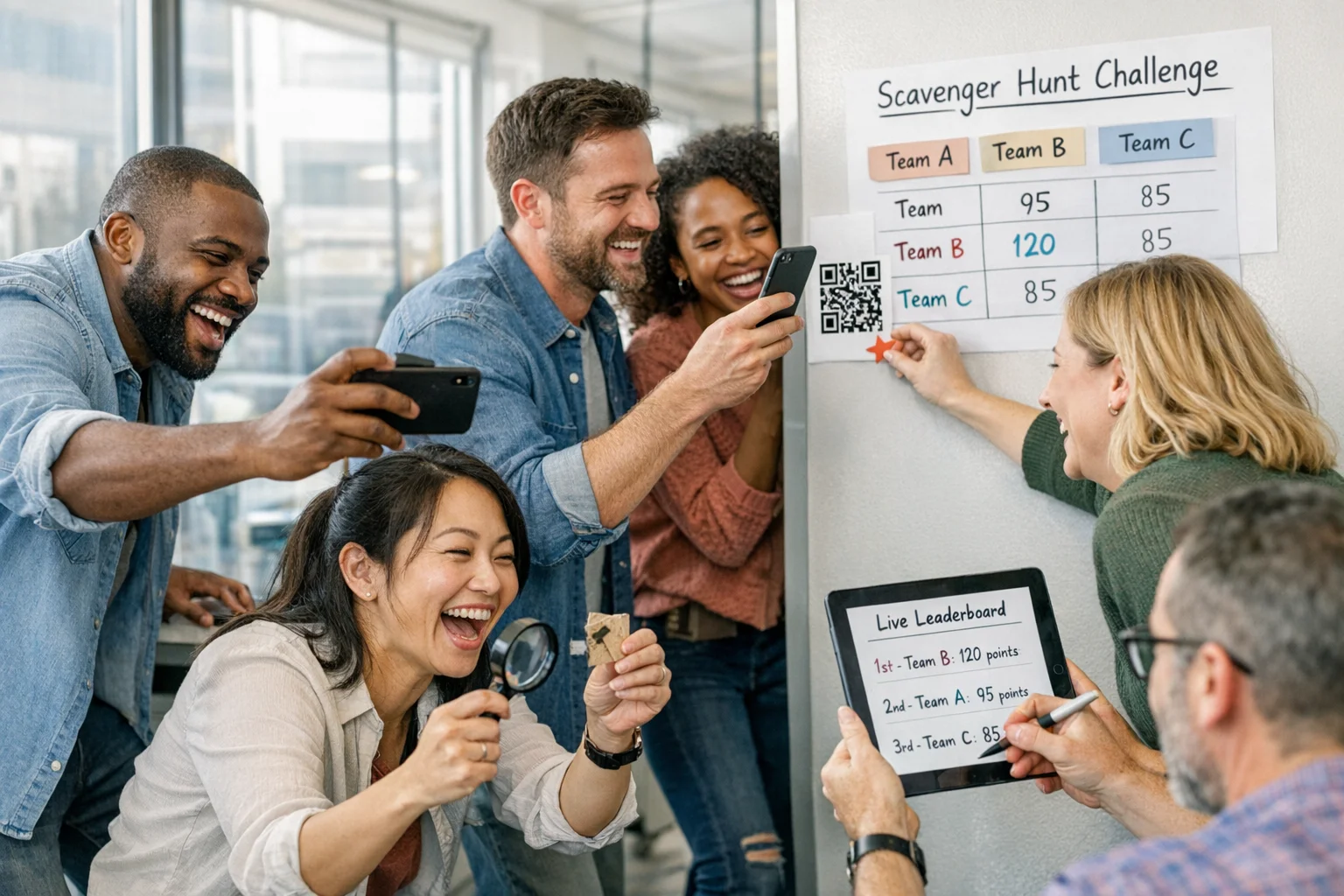
Run it: Create 20 to 30 short challenges that mix photos, videos, GPS check‑ins, and quick Q&A. Keep each challenge doable in 2 to 5 minutes. Run a live leaderboard and celebrate creative completions, not just speed.
Remote/hybrid tip: Allow browser or mobile play so no one’s blocked by device or VPN quirks.
Make it easy: Scavify automates submissions, scoring, and leaderboards, and works in both app and browser for any group size. That keeps facilitation light and the experience consistent.
Debrief prompt: “Which challenge revealed something useful about how we collaborate?”
Challenge examples: - [Photo | 30 pts]: Recreate a famous album cover with your squad. - [Video | 50 pts]: Pitch our product to an 8‑year‑old in 20 seconds. - [GPS Check‑in | 40 pts]: Check in at the spot where a key team decision gets made. - [Q&A | 20 pts]: What does the second letter in our values acronym stand for? - [Multiple Choice | 30 pts]: Which team ships the most releases in a quarter?
Outcome: Balanced participation, clearer handoffs.
Best for: Cross‑functional groups that talk past each other.
Run it: Rotate 5‑minute dialogues in trios: one speaker, one summarizer, one challenger. Swap roles each round. Summarizer must capture the core ask in one sentence; challenger asks for the smallest next step.
Debrief prompt: “Where did summarizing reduce confusion the most?”
Outcome: Nonverbal coordination, role clarity under constraints.
Best for: Teams that default to over‑talking.
Run it: Give a simple build kit (blocks, spaghetti‑and‑marshmallow, or digital whiteboard shapes). No speaking for the first half; only sticky notes or icons. Then a short talk phase to adjust. The contrast teaches more than any lecture.
Debrief prompt: “What did the silence reveal about our default roles?”
Outcome: Faster prioritization, better rationale sharing.
Best for: Backlogs, intake queues, or planning debates.
Run it: Use numbered cards or a simple voting app. Everyone privately picks a score for effort or impact. Reveal at once. Outliers explain first. Cap discussion and move.
Debrief prompt: “Which assumptions changed after the reveal?”
Outcome: Empathy, alignment on what customers actually need.
Best for: Product, support, sales, and ops together.
Run it: Share anonymized customer stories. In pairs, one person retells a story from memory; the other mines it for a “job to be done” and a friction point. Rotate. Capture two small process tweaks you can ship this week.
Debrief prompt: “Which small fix created outsized customer relief?”
Outcome: Safer dissent, better risk thinking before launch.
Best for: Project kickoffs, policy changes, big bets.
Run it: Assume the initiative just failed. In small groups, generate “what went wrong” headlines. Cluster by theme, rank by likelihood/impact, assign one pre‑emptive action each. Gary Klein’s original framing is still the cleanest version, and Atlassian’s templates make facilitation easier. HBR: Performing a Project Premortem and Atlassian pre‑mortem play. (hbr.org)
Debrief prompt: “What truth did we finally say out loud today?”
Outcome: Continuous improvement muscle, faster handoffs.
Best for: Any team drowning in swivel‑chair work.
Run it: Send small teams to “find” wasted steps, duplicate data entry, or unclear SLAs in a chosen workflow. Each find must include a 10‑minute fix and an owner.
Debrief prompt: “Which fix removes pain this week, not next quarter?”
Challenge examples: - [QR Code | 20 pts]: Scan the step with two approvals that never change the outcome. - [Photo | 30 pts]: Show where work waits the longest. - [Q&A | 25 pts]: Which form field gets retyped most often and why? - [Multiple Choice | 20 pts]: Which team touches this process last? - [Photo | 40 pts]: Document the handoff that regularly breaks.
Outcome: Normalize feedback, practice specificity.
Best for: Teams avoiding hard conversations.
Run it: Pairs rotate every 4 minutes. Prompt: “Keep/Start/Stop.” Receivers must paraphrase what they heard before asking one clarifying question. Light, frequent, safe.
Debrief prompt: “Which phrasing made feedback land better?”
Outcome: Turn values from posters into behaviors.
Best for: Culture refreshes, onboarding, town halls.
Run it: Teams capture photos or short clips of values “in the wild” at work. Tag each artifact to a value, write a one‑line caption, and vote on the most credible example. Works great as a rolling monthly micro‑challenge.
Debrief prompt: “Where did we see a value in action that surprised us?”
Challenge examples: - [Photo | 30 pts]: Capture “customer first” happening in a hallway, not a meeting. - [Video | 40 pts]: Show a teammate modeling “own the outcome.” - [Q&A | 20 pts]: Which value is hardest to practice under deadline pressure and why? - [Multiple Choice | 25 pts]: Pick the most value‑aligned response to a tricky scenario. - [Photo | 30 pts]: Find the artifact that best represents “raise the bar.”
Outcome: Better ideas, faster.
Best for: Teams stuck in “we can’t” language.
Run it: Pick a real problem. Add a constraint: only $500, only two people, or shipped in two days. Generate options under that constraint, then relax it slightly and improve the top two ideas. The constraint breaks the inertia.
Debrief prompt: “Which constraint created clarity rather than friction?”
Outcome: Lighthearted collaboration, time‑boxed problem solving.
Best for: Distributed teams wanting a shared win.
Run it: Use a browser‑based puzzle room or build your own set of clues tied to your business. Keep puzzles parallelizable so everyone contributes. Rotate the scribe.
Debrief prompt: “Which signal told you a teammate needed help?”
Outcome: Peer learning, role empathy.
Best for: Cross‑functional orgs with misunderstood processes.
Run it: 15‑minute demos from volunteers on “how we actually do X.” Record them. Questions must start with “show me where” to keep it concrete.
Debrief prompt: “What step will you adopt tomorrow?”
Outcome: Lowered formality, clearer expectations.
Best for: Managers looking to improve connection without adding meetings.
Run it: Convert one weekly 1:1 into a walking call or in‑person walk. Bring one focus question. Capture one decision at the end. Simplicity is the feature.
Debrief prompt: “What felt easier to say while moving?”
Outcome: Perspective taking, reduced friction.
Best for: Functions that routinely block each other.
Run it: Assign pairs to argue the other team’s constraints for 3 minutes before proposing a shared solution. It’s short, disarming, and sticky.
Debrief prompt: “What constraint will you respect more after today?”
Outcome: Purpose and connection without leaving work behind.
Best for: Teams craving meaning but low on time.
Run it: Pick a 45‑ to 90‑minute service activity that maps to your skills: resume reviews, translation, mentoring, or packing kits. Capture one takeaway each about teamwork under time pressure.
Debrief prompt: “Which behavior from today belongs in our day‑to‑day?”
You don’t need a full survey battery to know if an activity worked. Use a two‑step pulse: a 30‑second pre‑check to set a baseline and the same check 1 to 2 weeks later. Focus on outcomes you actually targeted.
If you’re going deeper, Amy Edmondson’s research shows psychological safety predicts team learning and performance. That’s why activities that normalize speaking up tend to pay off beyond morale. Edmondson’s foundational study on psychological safety and team learning. (journals.sagepub.com)
For broader context and executive‑friendly framing, Gallup’s global reporting links engagement, manager behaviors, and performance outcomes. Use it to align HR activities with leadership priorities and to negotiate for ongoing cadence instead of one‑and‑done events. Gallup: State of the Global Workplace (2026 summary). (gallup.com)
Finally, keep an eye on the communication patterns your activities produce. Pentland’s work is clear: frequent, energetic, face‑to‑face (or video‑on) exchanges with equal turn‑taking correlate with stronger team outcomes. Design for that interaction, debrief it, and make a small habit out of it. HBR: The New Science of Building Great Teams. (hbr.org)
To create conditions where better work happens: safer dialogue, clearer roles, faster decisions, and stronger relationships. Activities are just the rehearsal space for those behaviors back on the job.
Light and frequent beats heavy and rare. A short, well‑designed activity monthly or quarterly builds more muscle than a single big offsite.
Tie every activity to a clear outcome, add choice where possible, and debrief tightly. Skip anything that relies on oversharing or physical dares.
Favor app‑based hunts, puzzle rooms, decision poker, and feedback rounds. Keep tools browser‑friendly and phones‑optional. Assume some participants are on low bandwidth and design accordingly.
Pick 1 to 3 items that match your goal (safety, clarity, connection). Pulse before and 1 to 2 weeks after. Also watch leading indicators: faster standups, fewer handoff errors, clearer tickets.
Yes. Show‑Me‑How sessions, Process Treasure Hunts, and Pre‑Mortems double as training. You get skill practice and culture signals in one block.
Use it to accelerate connection at scale, showcase culture through challenges, and surface cross‑team knowledge. Tooling that automates submissions, scoring, and leaderboards keeps HR in facilitation mode instead of admin mode.