Solutions
Your first hunt, live this afternoon.
Free to start · No download for participants
Use 5 minute team building activities to create real participation, with instructions, timing, group-size guidance, low-prep options. Choose confidently.
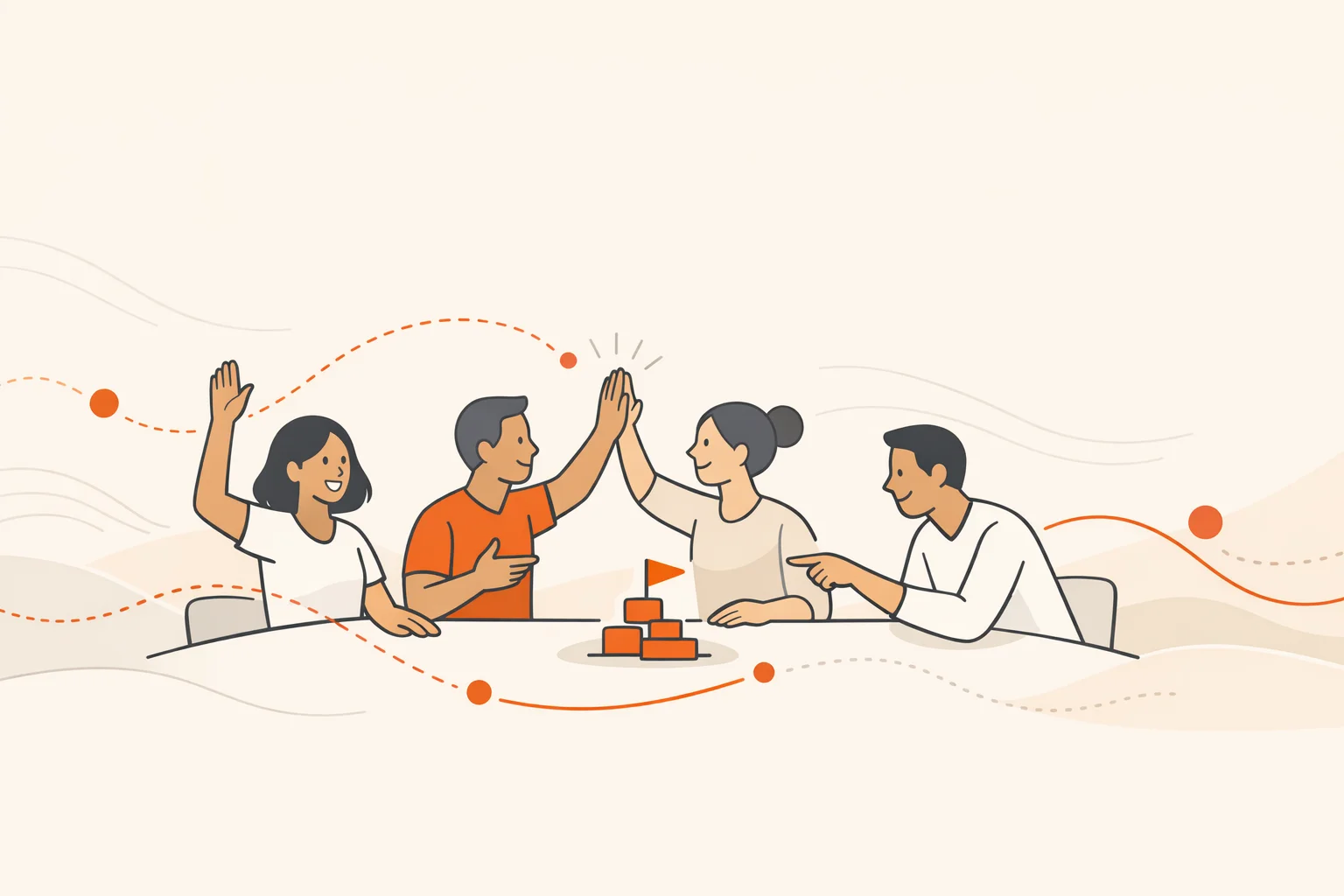
Five minutes is all you get between updates, budget talk, and someone trying to get screen share to work. Use it. A tight, well-run micro‑activity can lift the room, build connection, and prime people to actually talk like humans again. The trick is designing for zero drag: one clear instruction, fast start, visible finish.
We run thousands of short-format activities inside longer experiences. A pattern we keep seeing: the best five‑minute blocks are simple, low‑prep, and inclusive. They trade cleverness for momentum. They end just before anyone wants them to. That’s why they leave a trace.
Below are ten field‑tested five‑minute activities built for real meetings. Each includes purpose, timing, group guidance, low‑prep options, and a quick debrief that turns a fun moment into a useful one.
Short breaks under ten minutes can boost well‑being and perceived energy when used thoughtfully, which is why these tiny activities punch above their weight inside longer meetings. A systematic review of micro‑breaks points the same direction: small resets help people feel more vigorous, with performance benefits rising as breaks get slightly longer. Embed the reset in the meeting itself and you avoid the “wander off and never come back” problem. A systematic review on micro‑breaks and summaries of micro‑break research outline the effect and its limits. (journals.plos.org)
Energy beats clever every time in a five‑minute window.
Purpose: Fast emotional temperature check that improves attention and empathy.
You’ll need: Nothing.
Time limit: 2–4 minutes depending on group size.
Group guidance: Works in any size. In big rooms, sample five to eight voices at random.
How to run: Ask, “In one word, how are you arriving?” Go fast, popcorn style. No commentary, just words. Option: add “and why” but cap at one sentence.
Remote‑friendly: Use chat for a rapid word cloud feel.
Debrief prompt: What pattern did you hear that should shape the next 30 minutes?
Purpose: Recognition that costs seconds, not schedules.
You’ll need: A timer.
Time limit: 3–5 minutes total.
Group guidance: In rooms over 12, pre‑pick 4–6 people. Rotate names each meeting.
How to run: 20 seconds each to appreciate a peer for something specific this week. Keep it concrete: action, impact.
Remote‑friendly: Use reactions to amplify each shoutout.
Debrief prompt: What behaviors just got reinforced that we want more of?
Purpose: Quick cognitive warm‑up and light competition.
You’ll need: 6–10 short questions. Think: company history, product basics, general knowledge.
Time limit: 4–5 minutes.
Group guidance: Small groups can play as one team; larger groups split into pairs or trios and self‑score.
How to run: Read a question. First correct answer gets a point. Ramp difficulty. Finish with a fun bonus worth two points.
Remote‑friendly: People DM the host to answer or use a poll for multiple choice.
Debrief prompt: Which question sparked the best thinking and why?
Purpose: Practice nonverbal coordination and group awareness.
You’ll need: Nothing.
Time limit: 2–5 minutes.
Group guidance: Best with 6–14. Larger rooms, split into two circles.
How to run: As a group, count from 1 to 20 aloud. Anyone can say the next number, but if two people speak at once, restart at 1. No planning, no signaling.
Remote‑friendly: Works on video with mics on. Expect delightful chaos.
Debrief prompt: What helped you hold back or jump in at the right time?
Purpose: Movement, laughter, and fast collaboration.
You’ll need: A short list of playful prompts.
Time limit: 4–5 minutes.
Group guidance: Solo or pairs in small meetings; squads of 3–5 in bigger rooms.
How to run: Reveal 3–5 micro‑prompts. Fastest team to complete them wins. Document with quick photos or scans.
Remote‑friendly: Works perfectly on video. Keep prompts home‑friendly.
Debrief prompt: What did your team do automatically that helped or hurt speed?
Here’s a ready mix you can drop straight into a meeting:
If you want to scale this up beyond five minutes, a scavenger hunt app makes it trivial to run at size while keeping the same energy.
Purpose: Rapid planning under light pressure.
You’ll need: A few sheets of paper and tape per team.
Time limit: 5 minutes build time.
Group guidance: Teams of 3–5. In small rooms, do it individually for laughs.
How to run: Build the tallest free‑standing tower using only the materials. No anchoring to people or furniture.
Remote‑friendly: Ask people to build with whatever’s on their desk. Measure on camera.
Debrief prompt: Where did planning help more than raw speed?
Purpose: Micro‑decisions that reveal preference patterns fast.
You’ll need: A list of 8–12 dichotomies: “Email or chat,” “Morning or night,” “Cats or dogs.”
Time limit: 3–4 minutes.
Group guidance: Any size. Individuals answer by moving left/right, raising hands, or reacting in chat.
How to run: Read each pair. Everyone commits instantly. Optional: ask two people to defend theirs in a sentence.
Remote‑friendly: Use reactions or polls.
Debrief prompt: Which differences actually matter for how we work together?
Purpose: Quick personal context without oversharing.
You’ll need: People’s desks or phones.
Time limit: 4–5 minutes.
Group guidance: In big rooms, sample 4–6 people; rotate next time.
How to run: “Grab an object within arm’s reach. You have 20 seconds to tell us why it’s on your desk.” Keep it moving.
Remote‑friendly: Hold items up to camera. In person, stand to share.
Debrief prompt: What did you learn that changes how you’ll ask for help or give feedback?
Purpose: Fast familiarity without the long anecdotes.
You’ll need: Nothing.
Time limit: 4–5 minutes.
Group guidance: Works best in groups under 12 or in breakout trios for larger rooms.
How to run: Classic format with a constraint: two true facts, one false, each under seven words. Group guesses. Short answers keep pace high.
Remote‑friendly: Put guesses in chat simultaneously to avoid spoilers.
Debrief prompt: What surprised you, and how might it build future rapport?
Purpose: Regulate energy and reduce stress so the next agenda item gets your best.
You’ll need: A timer and your voice.
Time limit: 3–5 minutes.
Group guidance: Universal. People opt in at their own comfort level.
How to run: Lead two minutes of box breathing: inhale 4, hold 4, exhale 4, hold 4. Then one minute of seated stretch or stand and reach.
Remote‑friendly: Works perfectly on video with cameras on or off.
Debrief prompt: What changed in the room’s energy, and how can we protect that focus?
Mindfulness doesn’t require a retreat to have measurable effects. Trials of brief, app‑guided mindfulness in work settings have shown small but meaningful improvements in stress and well‑being, especially when practiced regularly. Use this as a reset, not a cure‑all. See a randomized clinical trial of a brief mindfulness program and related workplace mindfulness findings. (jamanetwork.com)
What if I only have two minutes?
Go even simpler: one‑word check‑in or a single this‑or‑that prompt. The point is momentum, not variety.
How often should I use these?
Rotate weekly or biweekly. Variety matters more than volume. If the room starts predicting the prompt, change it.
How do I make this work with 50 people?
Use pairs or trios. Give one minute for activity, one minute to share one highlight back to the main room.
What if people roll their eyes at team building?
Acknowledge it, then run something that respects time and ends fast. Visible finish lines shift skeptics.
Do these help hybrid and remote teams?
Yes. Favor chat‑first formats, quick polls, and camera‑optional options. Keep props home‑friendly.
Where can I find more ideas and formats?
Libraries like SessionLab’s activity collections and Atlassian’s five‑minute team ideas curate solid building blocks you can adapt. (sessionlab.com)
Do micro‑breaks actually improve performance?
They reliably boost well‑being and perceived energy; performance benefits depend on the task and tend to rise as breaks lengthen slightly. Use five‑minute resets to serve the next agenda item, not as a silver bullet. See the micro‑break meta‑analysis. (journals.plos.org)
If you want to turn five minutes into an hour of high‑energy connection when it counts, scale up with a structured hunt. A purpose‑built scavenger hunt app lets you mix photo, video, QR, GPS, and trivia challenges with a live leaderboard while keeping setup time low. Keep the anti‑boring ethos, just make the canvas bigger.