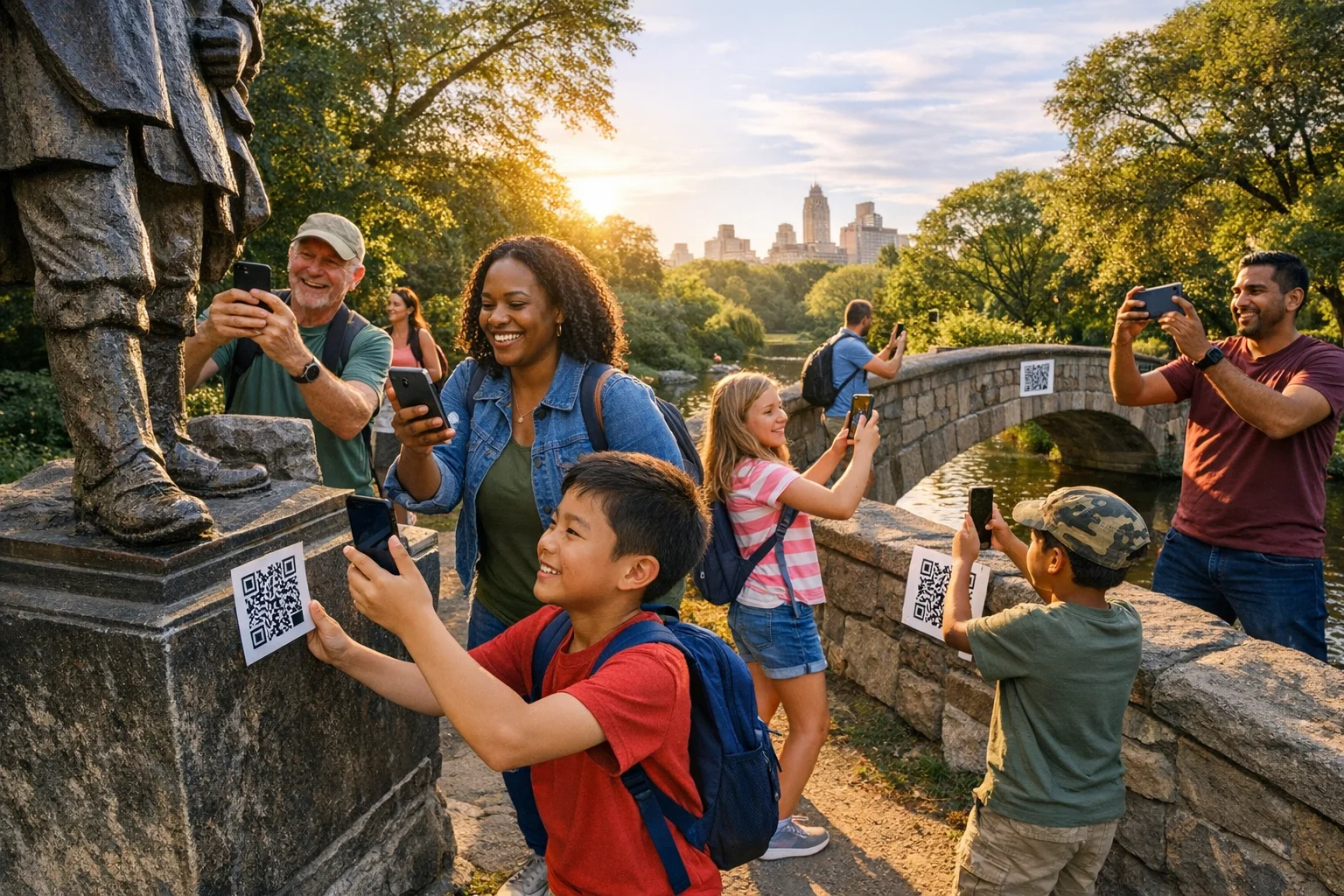
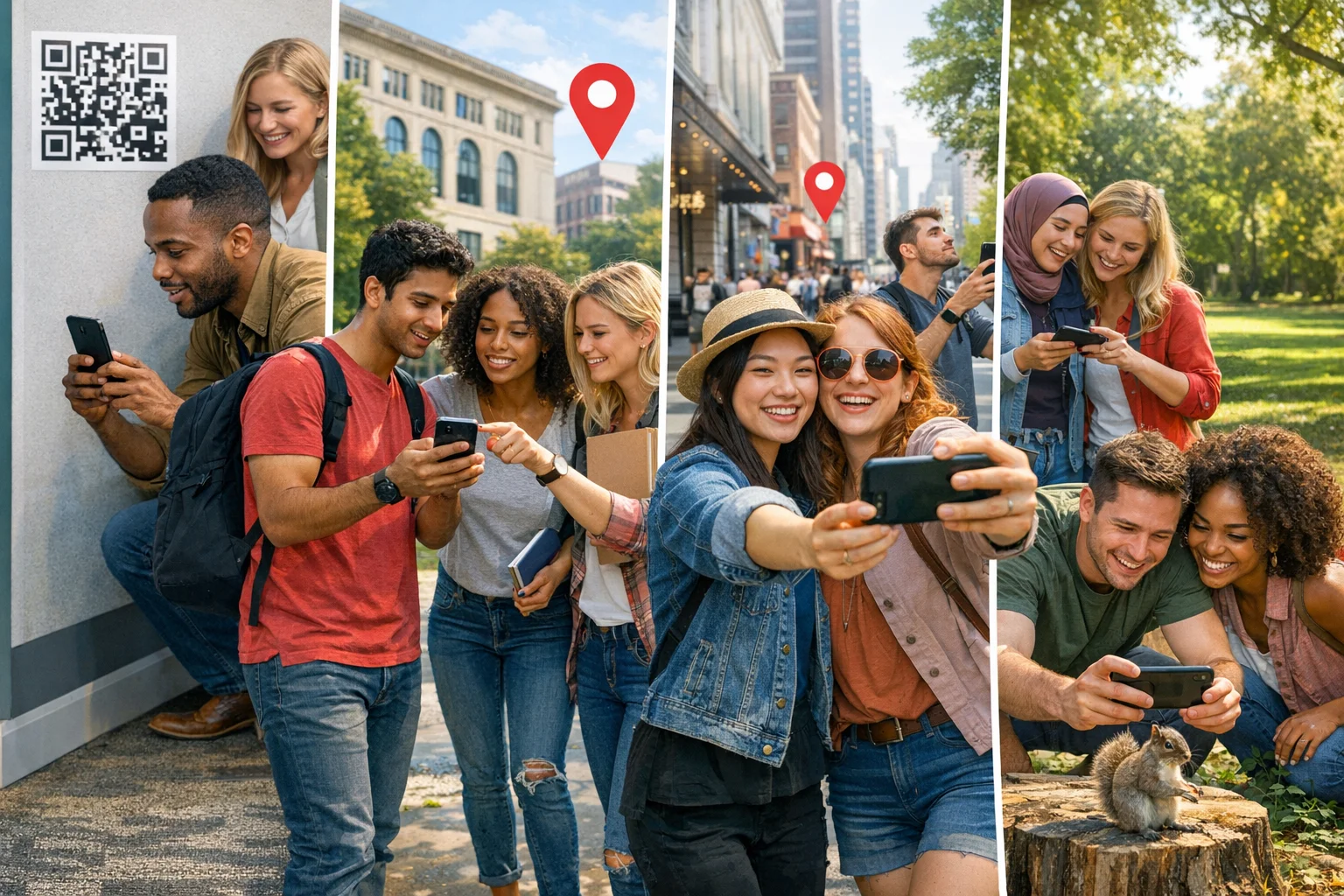
An outdoor scavenger hunt gets people moving through real places with clear prompts, quick wins, and moments that make a group actually look up, look around, and laugh together. It’s part walk, part puzzle, part show‑and‑tell. The emphasis is simple: movement, exploration, and shared experience.
At a Glance
- Outdoor hunts work because they combine light physical activity with social momentum and quick feedback.
- Use short, specific prompts that send people to notice details, not just collect stuff.
- Mix task types: photos, GPS check‑ins, riddles, team mini‑challenges, and quick Q&A.
- Safety is logistics: sun, heat, weather, wayfinding, and permissions. Build them in from the start.
What an outdoor scavenger hunt is
An outdoor scavenger hunt is a sequence of small challenges set across a park, campus, neighborhood, or city area. Teams earn points by completing prompts: finding landmarks, snapping photos, answering questions, or checking in at GPS or QR locations.
Two ingredients make them work:
- Movement with purpose. People go somewhere for a reason, then see something specific when they arrive. That light activity supports well‑being in a way lectures and slides never do. The World Health Organization recommends kids and teens get about 60 minutes of moderate to vigorous activity daily, and adults about 150 minutes weekly. Hunts help you chip away at those minutes without forcing a workout. See the WHO recommendations and CDC overview for context. WHO physical activity recommendations, CDC physical activity basics. (who.int)
- Shared attention. Teams align around a target: a statue inscription, a mural detail, a trail sound. That moment of joint discovery is the engagement engine. Keep tasks fast, clear, and reward‑rich.
In our experience, the best hunts feel obvious to follow, diverse in challenge types, and forgiving on pacing. Most groups don’t need elaborate props; they need crisp prompts and a route that breathes.
30 ready‑to‑run outdoor examples
Use these as plug‑and‑play cards. Each prompt is short on purpose. You’ll see a mix of Photo, Video, GPS Check‑in, QR Code, Multiple Choice, and Q&A. Point values give you a difficulty nudge; adjust to taste.
Park hunt
- [Photo | 20 pts]: Recreate a statue’s pose without touching it.
- [Q&A | 15 pts]: Oldest tree species in this park’s signboard?
- [GPS Check‑in | 25 pts]: Hilltop bench with the widest skyline view.
- [Video | 30 pts]: Team “wave” traveling across a line of benches.
Neighborhood hunt
- [Photo | 20 pts]: House number that’s a perfect square.
- [Q&A | 15 pts]: Name on the smallest mailbox along your route.
- [GPS Check‑in | 25 pts]: Community garden gate facing east.
- [QR Code | 20 pts]: Scan the code under the blue awning.
City hunt
- [Photo | 25 pts]: Find a mural with one unexpected animal.
- [Q&A | 20 pts]: Year the train station cornerstone was laid.
- [GPS Check‑in | 30 pts]: The plaza tile shaped like a compass rose.
- [Video | 30 pts]: Street‑crossing “slow‑mo” in perfect synchronization.
Campus hunt
- [Photo | 20 pts]: Department mascot hidden in a hallway display.
- [Multiple Choice | 15 pts]: Which year was the library dedicated?
- [GPS Check‑in | 25 pts]: Quiet study spot with the best natural light.
- [QR Code | 20 pts]: Scan at the alumni wall inscription.
Nature hunt
- [Photo | 20 pts]: Leaf with more than seven points.
- [Q&A | 15 pts]: Bird call you hear near the water: name it.
- [GPS Check‑in | 25 pts]: Footbridge where the stream narrows.
- [Video | 30 pts]: Ten‑second silent nature scene with motion.
Beach hunt
- [Photo | 20 pts]: Driftwood shaped like a letter of the alphabet.
- [Q&A | 15 pts]: Meaning of the day’s beach flag color.
- [GPS Check‑in | 25 pts]: Lifeguard tower number ending in 2.
- [Video | 30 pts]: “Wave roll call” with each teammate named.
Tip: Rip currents are real. If your hunt involves going near the water, brief teams on safe beach behavior and always keep tasks on sand or boardwalks. NOAA’s explainer on rip currents is a quick primer. What a rip current is and basic safety. (oceanservice.noaa.gov)
Festival hunt
- [Photo | 20 pts]: Best hat you spot that isn’t for sale.
- [Q&A | 15 pts]: Today’s headliner start time at Stage B.
- [Video | 25 pts]: Ten‑second clip of crowd choreography (consent first).
Team‑building hunt (adults)
- [Photo | 20 pts]: All teammates touching three different textures.
- [Multiple Choice | 20 pts]: Which city ordinance covers park hours?
- [Video | 30 pts]: Build a freestanding structure from found sticks.
Amazing‑race‑style route ideas (5 legs)
Use these as route anchors when you want movement across distance with cumulative suspense. Keep legs short and predictable in duration; the “race” is a pacing flavor, not a footrace.
- Leg 1: Clocktower to Courtyard. Decode numbers on the clock face to unlock a QR that reveals the next location.
- Leg 2: Water to Wood. Follow a riddle from a fountain plaque to a wooden footbridge; complete a team balance pose for points.
- Leg 3: Viewfinder. Spot three skyline features from a lookout, answer a micro‑quiz, then GPS check‑in to advance.
- Leg 4: Market Dash. Find a stall selling something round, something green, and something handmade; upload a grouped photo.
- Leg 5: Finish Line Story. Return to a central lawn and record a 20‑second team recap with your best moment and one new detail learned.
Challenge templates you can copy
Build a mixed deck from these categories. Five examples each to keep your set varied.
Landmark clues
- [Q&A | 20 pts]: Latin word carved above the arch’s keystone.
- [Photo | 20 pts]: Bronze figure holding something that isn’t a weapon.
- [GPS Check‑in | 25 pts]: Shadow of the sundial at the marked hour.
- [Photo | 20 pts]: Mural corner where two colors never touch.
- [Q&A | 20 pts]: Number of steps up to the overlook, exactly.
Photo tasks
- [Photo | 20 pts]: Reflection selfie in anything but a mirror.
- [Photo | 25 pts]: Team forms a triangle using everyday objects.
- [Photo | 20 pts]: Letters in the environment spelling a teammate’s name.
- [Photo | 30 pts]: Forced‑perspective shot “holding” a landmark.
- [Photo | 25 pts]: Four textures arranged lightest to darkest.
Physical team challenges
- [Video | 30 pts]: Synchronized jump with all feet off the ground.
- [Video | 30 pts]: Ten‑second plank pyramid that doesn’t collapse.
- [Video | 25 pts]: Human knot undone in under thirty seconds.
- [Photo | 20 pts]: All teammates balance on a curb line together.
- [Video | 30 pts]: Relay: one teammate crab‑walks five paces and back.
Observation tasks
- [Q&A | 15 pts]: First word on the third poster to your left.
- [Multiple Choice | 15 pts]: How many benches face north in this square?
- [Q&A | 20 pts]: Two bird species pictured on this kiosk.
- [Q&A | 20 pts]: Street tree species with the smallest leaves here.
- [Photo | 20 pts]: Shadow shaped like an arrow pointing anywhere.
Riddles
- [Q&A | 25 pts]: “I speak without a mouth at noon; find me.”
- [Photo | 25 pts]: “I never move yet show the world; pose with me.”
- [Q&A | 25 pts]: “Count my rings yet I’m not wood; report the number.”
- [Photo | 25 pts]: “Where books sleep outdoors, capture a candid.”
- [GPS Check‑in | 30 pts]: “Cross me once, cross me twice, I never complain.”
Route‑based checkpoints
- [GPS Check‑in | 25 pts]: Highest public step within your map boundary.
- [GPS Check‑in | 25 pts]: Mid‑bridge marker plaque on the rail.
- [QR Code | 20 pts]: Hidden under the third stair at the amphitheater.
- [GPS Check‑in | 25 pts]: The widest path junction you can find.
- [QR Code | 20 pts]: Back of the park map near the north gate.
Filters by planning need
Design fast. Pick your filter, then use the mixes suggested.
15‑minute pop‑up
- Format: One location, 5 challenges, no moving map.
- Mix: 3 Photos, 1 Q&A, 1 Video. All 15–25 points.
- Tip: Keep prompts hyper‑local to avoid decision time.
30‑minute micro‑route
- Format: 2–3 close checkpoints, 8–10 total tasks.
- Mix: 4 Photos, 2 Q&A, 1 Multiple Choice, 1 GPS, 1 Video.
- Tip: One “aha” landmark in the middle to keep morale high.
Family‑friendly
- Format: Stroller‑friendly paths, obvious crossings, visible facilitators.
- Mix: Photo and Q&A heavy; skip speed‑dependent tasks.
- Tip: Use color hunts, letter hunts, and animal silhouettes.
Adult teams
- Format: Slightly larger map, optional time bonus.
- Mix: Add 1–2 physical mini‑challenges and 1 riddle per leg.
- Tip: Keep the “competitive spice,” not a sprint.
Large group
- Format: Stagger starts by 2–3 minutes; cap teams at 5–7.
- Mix: More parallelizable checkpoints; fewer single‑file bottlenecks.
- Tip: Use a public leaderboard to keep energy visible.
Low‑budget
Urban
- Format: Compact grid, transit‑adjacent, pedestrian‑priority.
- Mix: Murals, plaques, public art, market stalls.
- Tip: Include a courtesy note on private property boundaries.
Nature‑based
- Format: Trails, boardwalks, and picnic areas only.
- Mix: Sound hunts, leaf shapes, water features, sky observations.
- Tip: Teach low‑impact behaviors. The Leave No Trace 7 Principles are the standard. Leave No Trace principles overview. (lnt.org)
High‑energy
- Format: Tight loop with optional sprints kept short and safe.
- Mix: Add timed photo sequences and light coordination tasks.
- Tip: Offer a “no‑run” path so all teams feel included.
Free downloadable tools (templates inside)
Steal these and make them yours. Copy into a doc, or drop into your hunt app.
Outdoor safety checklist (copy/paste)
- Weather plan: Check forecast and set a hard “go indoors” rule for thunder. The National Weather Service’s mantra is simple: “When thunder roars, go indoors.” Build lightning triggers into your run‑of‑show. NWS lightning safety overview. (weather.gov)
- Sun + heat: Shade breaks, water access, and sunscreen reminders. For sunscreen specifics, see the FDA’s consumer guide to sun protection basics. Also consider local heat risk on event day. FDA sun safety tips, CDC heat and your health. (fda.gov)
- Insects: Share repellent guidance ahead of time and add tick checks post‑event if you’re in tick country. CDC’s prevention page covers DEET, picaridin, and permethrin‑treated clothing. CDC tick bite prevention. (cdc.gov)
- Terrain: Mark trip hazards on your route map. Use wide paths for big groups.
- Water proximity: If you’re near surf or lakes, keep all tasks on dry ground and brief rip‑current basics. NOAA rip current explainer. (oceanservice.noaa.gov)
- Permissions: Parks and campuses may require simple permits for organized activities. Check your venue’s policies in advance.
Route‑planning worksheet (copy/paste)
- Map bounds: Corners and “do not cross” lines.
- Start/finish: Visible, shaded, and near restrooms.
- Legs: 2–5 legs; 5–10 minutes travel per leg.
- Checkpoints: One clear visual anchor each (plaque, artwork, bench cluster).
- Mix: 60% photo/observation, 20% Q&A, 10% GPS/QR, 10% physical.
- Flow: Alternate easy wins with one medium puzzle.
- Safety overlays: Shade pockets, water spots, first‑aid location.
If you like digital routes, build a simple map and share the link. Google My Maps makes it easy to drop pins, name layers (legs), and print or share. Create or open a map in Google My Maps. (support.google.com)
Printable clue sheet (copy/paste)
- Hunt name:
- Time window:
- How to score:
- Rules in one minute: Stay on public paths. Be respectful. No running indoors. Ask before photographing people. Obey traffic signals. If you hear thunder, head inside immediately.
- Tiebreaker: Funniest team photo approved by facilitators.
Facilitator guide (copy/paste)
- Before: Walk the route. Test all QR codes and GPS points. Load example photos so teams know what “good” looks like. Pre‑assign team names.
- Briefing: Two minutes on route boundaries. Two minutes on scoring. One minute on safety and weather triggers. One example challenge.
- During: Keep a visible leaderboard. Push one mid‑event bonus task to lift energy.
- After: Quick awards. Ask for one observation each team noticed that they’d never seen before. That reflection locks in the memory.
Prize ideas
- Local treats: Bakery gift cards, coffee tokens, market vouchers.
- Bragging rights: Rotating trophy, photo wall, leaderboard shout‑outs.
- Experiences: Discounted museum passes, trail‑day invites, guided tour.
Run this outside with Scavify
If you want all of this to feel effortless on event day, Scavify handles the mechanics while you focus on route and prompts.
- GPS‑style flow: Set precise check‑ins so teams must reach the right spot.
- QR checkpoints: Plant codes at safe locations to anchor legs.
- Photo and video uploads: Review and approve in real time.
- Live leaderboard: Keeps big groups energized without megaphones.
- Branded outdoor experiences: Make the hunt feel like your organization, not a template.
- Real‑time event management: Pause, add, or retire challenges instantly if conditions change.
We’ve seen the same pattern across parks, campuses, and waterfronts: clear prompts, a route with breathing room, and a little showmanship in the brief make even quiet groups come to life.
FAQs
How long should an outdoor scavenger hunt take?
Short formats run 15–30 minutes. A classic hunt lands around 60–90 minutes with 20–30 prompts. Longer than that, energy dips unless you build in water, shade, and an obvious midpoint “win.”
What group size works best?
Teams of 4–6 hit the sweet spot. Small enough for everyone to participate, big enough for momentum and photography without awkwardness.
Do we need permits?
Often no for casual use of public spaces, but larger events, amplified sound, or equipment setups may require permission. Always check local rules for your venue or park system in advance.
What about safety in summer heat or strong sun?
Plan shade breaks and water access. Encourage sunscreen, hats, and lightweight clothing. For heat‑risk context and protective actions, see the CDC’s heat guidance and your local forecast. CDC heat and your health. (cdc.gov)
Can kids do these challenges?
Yes, with family‑friendly filters. Keep routes stroller‑friendly, avoid road crossings when possible, and bias toward observation and photo prompts. Kids get natural movement and discovery without pressure. For overall activity guidance, WHO recommends about 60 daily active minutes for ages 5–17. WHO physical activity recommendations. (who.int)
How do we handle lightning or sudden storms?
Set a hard rule: if you hear thunder, you’re done. Move everyone indoors or into hard‑topped vehicles and wait it out. The NWS line is memorable and right: “When thunder roars, go indoors.” NWS lightning safety overview. (weather.gov)
Any tips for bugs and ticks on nature routes?
Share repellent guidance beforehand and remind teams to check for ticks after. The CDC lists DEET, picaridin, and other EPA‑registered options, plus permethrin for clothing. CDC tick bite prevention. (cdc.gov)
Can we do this near the beach?
Yes, with boundaries on dry sand and boardwalks. Remind teams to swim only near lifeguards and never to fight a rip current. Keep hunt tasks out of the water. NOAA’s rip‑current basic is a fast read. NOAA rip current overview. (oceanservice.noaa.gov)
What equipment do we need?
Phones with cameras, a shared map, and a clear rule sheet. Optional: QR codes, clipboards, and a few lightweight props. The rest is good route design and crisp prompts.
How far should teams walk?
Design routes by time, not distance. A compact loop with frequent wins beats long slogs. If you want more movement, add legs rather than stretching one leg too far.
If you want this playbook as an interactive experience with GPS, photos, QR codes, and a live scoreboard, Scavify runs it cleanly outdoors so facilitators can actually enjoy the event too.