Solutions
Your first hunt, live this afternoon.
Free to start · No download for participants
Explore how to gamify learning through useful examples, proven mechanics, implementation steps, measurement ideas, and pitfalls to avoid. Choose confidently.
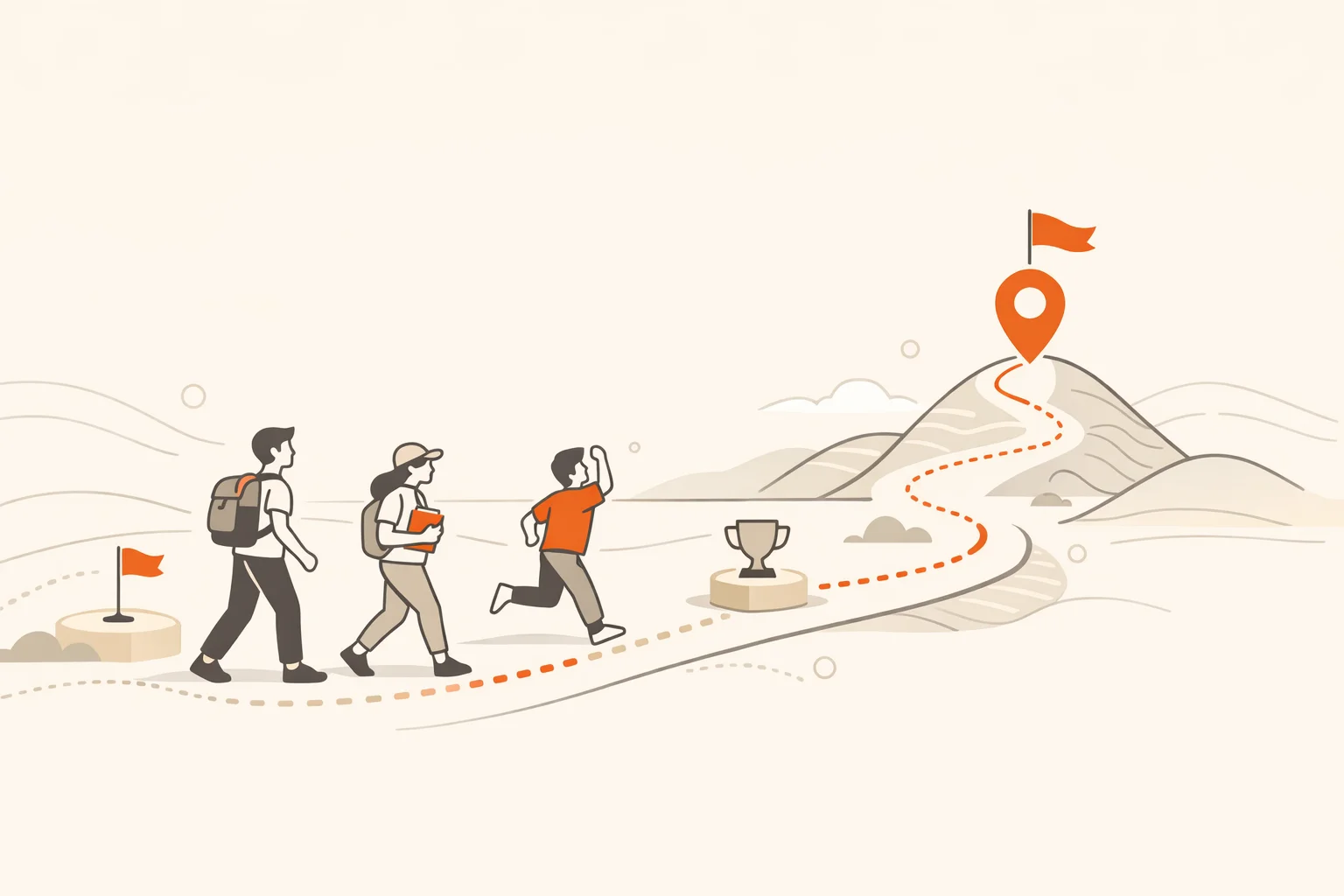
Most “gamified” courses bolt points onto a fuzzy learning goal and hope engagement shows up. That’s decoration, not design. The approach that actually works starts with the learning outcome, then uses game design to make the right practice feel winnable, social, and worth repeating. The steps below are the playbook we keep returning to across classrooms, onboarding, orientations, and events.
The core idea is simple: use selected game elements to make real learning behaviors happen more often. Not simulations of learning. The behaviors themselves. Answer a concept check. Explain a choice. Demonstrate a skill. Connect with a peer. Share evidence. Make those actions obvious, rewarding, and trackable.
Do this well and you’ll see momentum instead of compliance. Learners know what winning looks like, progress is visible, and the next step feels within reach. That’s the point.
Gamification uses selected game design elements to create game-like experiences in non-game contexts. The move that matters is aligning elements to the outcome you want, not copying a leaderboard because it looked fun in another app. Meta-analyses consistently find positive, context-dependent effects on learning when mechanics are tied to sound pedagogy and motivation theory. See the 2020 synthesis in Educational Psychology Review and a 2023 Frontiers meta-analysis for patterns and caveats. Educational Psychology Review meta-analysis; Frontiers in Psychology meta-analysis. (link.springer.com)
Nobody quits a game they are winning. Design the first minutes so everyone can win.
Write the outcome as a verb you can count. Then list 3–5 learner behaviors that, if observed, would prove progress. Examples:
Keep each behavior small enough to complete in a few minutes. Momentum beats magnitude.
Ground your design in autonomy, competence, and relatedness. Offer real choice (paths, order, teams), show skill growth, and make participation feel socially worthwhile. This is Self‑Determination Theory 101 and the anchor under most successful programs. Foundational meta-analysis on rewards and intrinsic motivation. (selfdeterminationtheory.org)
Pick the experience you want learners to feel (dynamics) before you choose elements. Examples:
Then choose mechanics that trigger those dynamics: retrieval quizzes, progress bars, team checkpoints, timed windows, streaks, or co-op goals. Reviews consistently suggest effects depend on this alignment, not on any single mechanic. Hamari, Koivisto, & Sarsa (2014). (doi.org)
Front-load an easy first win, then escalate challenge. Use short levels with one idea per level. Gate advancement with a visible bar or tier labels learners recognize. Reserve “hard mode” for opt‑in side quests so novices aren’t punished.
Short, repeatable paths beat giant campaigns. Think two‑week arcs with a fresh twist in week two, not quarter‑long marathons that run out of steam.
Design challenges to produce evidence you can see: a correct recall, a justified choice, a short demonstration, presence at a place, or a peer interaction. Mix formats so no one skill dominates.
If you want a ready format for multi‑modal, on‑the‑move challenges, an app‑based approach like Scavify’s scavenger hunt app makes it easy to combine GPS, photo/video, and concept checks with live progress and leaderboards.
Feedback drives learning when it is timely, task‑focused, and tells learners what to do next. Pair every challenge with instant confirmation, a nudge, or a short rationale. The research on feedback’s impact is clear: quality and immediacy matter far more than volume. Hattie & Timperley (2007). (journals.sagepub.com)
Use early items as calibration. If 90 percent ace the first checks, increase complexity or reduce cues. If fewer than half can clear level one, lighten the load and add hints. Difficulty should climb like steps, not spikes. Save timed items for later once confidence builds.
A practical rule: two “green lights,” one “yellow,” then a “red” that forces a re‑attempt with guidance. Confidence first, then stretch.
Make rewards informational, not controlling. Celebrate progress, skill unlocks, and helpful contributions. Tie any tangible perk to milestones that reflect learning or verified behavior change, not just participation. Decades of research caution that poorly framed rewards can crowd out intrinsic motivation; used well, they can mark mastery without doing harm. Deci, Koestner, & Ryan (2001) review; 1999 meta-analysis. (journals.sagepub.com)
Use pairs or small teams with shared checkpoints. Rotate “teach‑back” moments so wins are social, not just numeric. Light narrative helps when it clarifies context and purpose; it should guide decisions, not bury content in fiction.
Evidence trends suggest collaboration and healthy competition can strengthen effects when designs support intrinsic motivation and clear goals. Frontiers 2023 meta-analysis on educational gamification. (frontiersin.org)
Ship in short arcs. For a two‑week sprint, release micro‑quests on days 1, 3, 5, 8, and 12. Add a twist late in the run (new rule, co‑op bonus, time‑boxed double points) to refresh attention. Use small unlocks to change strategy, not just the skin.
If it’s ongoing (e.g., semester‑long), break it into seasons with a short reset between them. Resets stop runaway leads and let more people feel “back in it.”
Track three layers:
Research syntheses point to moderate, context‑sensitive gains when mechanics align with pedagogy and motivation. Treat analytics as signals to improve your design, not as proof of virtue. Educational Psychology Review meta-analysis. (link.springer.com)
Start with one outcome, one cohort, and two weeks. Observe, refine, and only then scale. Put someone on operations: content updates, support, timing, and reporting. Success depends as much on cadence and care as it does on clever mechanics.
Document what you’ll stop, start, and keep before the next season. Then tune difficulty, feedback, and social structures accordingly.
| Design choice | Effective use | Common failure |
|---|---|---|
| Progress indicators | Map to meaningful milestones and skill tiers | Generic bars divorced from outcomes |
| Quizzes | Single‑concept checks with instant rationale | Long, mixed‑topic exams at the end |
| Leaderboards | Near‑neighbor ranks, tiered leagues, periodic resets | Global, permanent top‑10 that never changes |
| Rewards | Informational badges, mastery unlocks, peer recognition | Controlling perks that drive compliance only |
| Story/theme | Light fiction that clarifies why choices matter | Heavy cosplay that obscures content |
| Teams | Small groups with shared goals and peer boosts | Large groups where passengers can hide |
Between the lines: design for decisions, not just decor. A leaderboard is a UI. The learning happens in the choices it nudges.
Gamification adds selected elements (points, progress, feedback, quests) to real tasks so practice becomes active and visible. Game‑based learning builds or uses a full game to teach content. Both can work; gamification tends to fit when you need quick, scalable practice inside existing courses. Reviews emphasize choosing based on context and learning goals. Hamari et al., 2014. (doi.org)
Sometimes. They can signal progress and invite the next action. They can also backfire if they become the point. Make them informational (what improved, what unlocked) and tie them to meaningful milestones. The literature on rewards and intrinsic motivation explains the risk of crowding out when rewards feel controlling. Deci, Koestner, & Ryan (2001). (journals.sagepub.com)
Yes, with caveats. A 2020 meta‑analysis reports overall positive, moderate effects on learning when design aligns with pedagogy and context. A 2023 meta‑analysis in Frontiers also found positive effects and highlighted moderators like design features and environment. Translation: it works when done thoughtfully. Educational Psychology Review 2020; Frontiers 2023. (link.springer.com)
As close to the action as possible. Immediate, specific feedback changes the next attempt. If you can’t make it instant, provide a short hint and a fast retry path. Research consistently links high‑quality, timely feedback with improved learning. Hattie & Timperley (2007). (journals.sagepub.com)
No. Use them when competition supports the goal and won’t bench late starters. Prefer tiered leagues, periodic resets, and near‑neighbor views that let more people feel in the game. Many teams get better outcomes with small co‑op goals and peer recognition instead of public ranks. Frontiers 2023. (frontiersin.org)
Light story helps when it frames decisions and provides meaning, especially for scenario work. Heavy fiction that hides the content usually hurts. Keep the narrative in service of the outcome: clarity, not cosplay. Reviews note mixed results that depend on design fit. Educational Psychology Review 2020. (link.springer.com)
Short. Two weeks is usually enough to learn what works, fix difficulty, and show early impact. Then tune and extend. Shorter runs reduce risk, keep energy high, and make iteration painless.
If you’re building this for orientations, onboarding, or campus programs, multi‑modal challenges, automation, and live progress views make the difference between “cute idea” and “we’d do this again.” That’s why app‑based formats are popular: you can blend GPS check‑ins, quick concept checks, and short video teach‑backs without a pile of tools.