Solutions
Your first hunt, live this afternoon.
Free to start · No download for participants
Learn how gamification works with clear examples, practical use cases, and tips for education, work, and engagement.
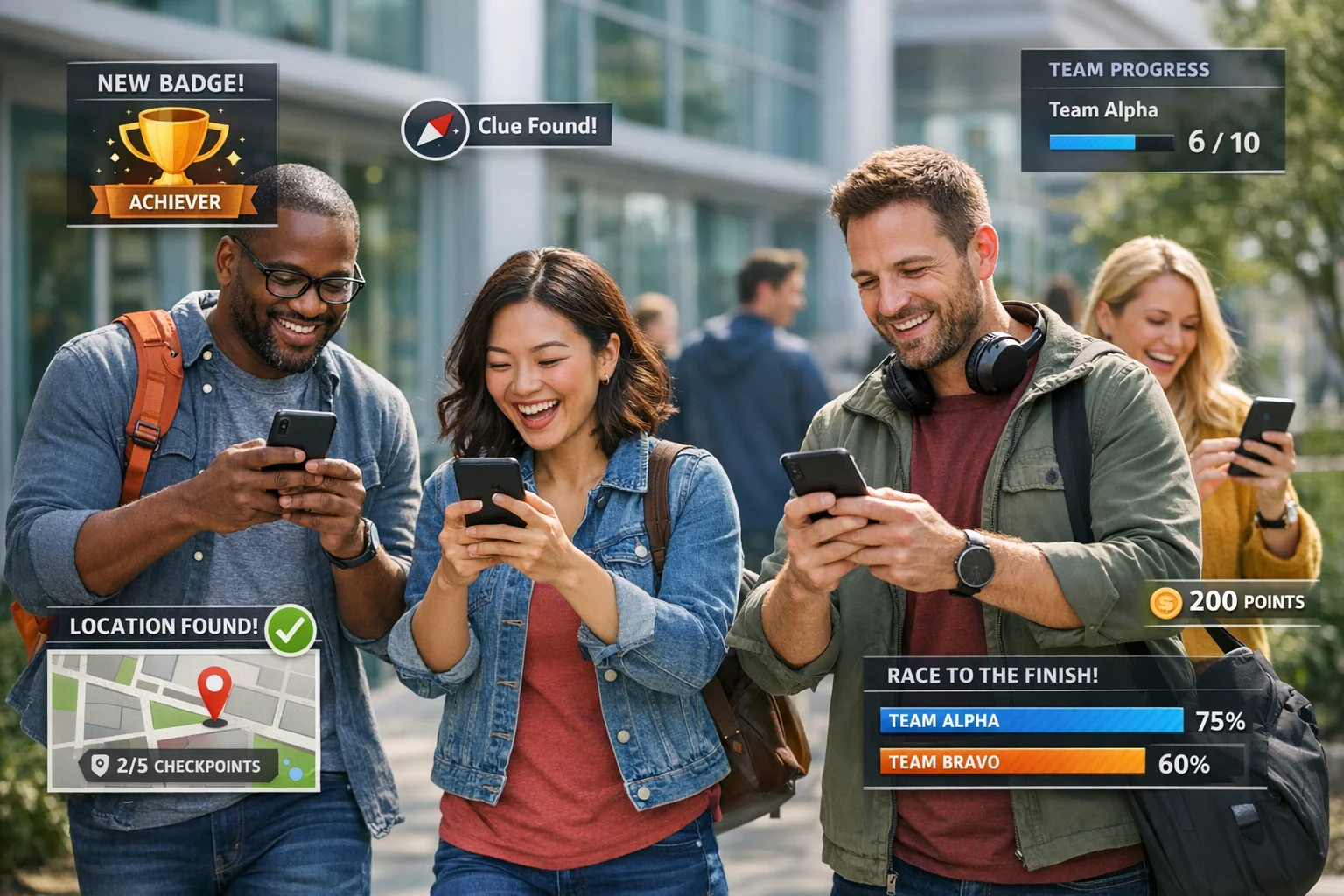
Most articles treat gamification like a bag of tricks: points, badges, leaderboards, done. That’s the quick way to get shallow participation and eye rolls. Gamification, done well, is about aligning meaningful goals with human motivation and then designing the feedback loops that keep people moving.
If you want participation that actually sustains, here’s what that looks like in practice.
“Gamification” means using selected game design elements to create game‑like experiences in non‑game contexts. That’s the concise definition most scholars now use, anchored by the field’s seminal paper clarifying scope and boundaries. See the authors’ own framing in the ACM record of the paper defining gamification. the seminal definition of gamification. (cir.nii.ac.jp)
Two notes that keep teams out of trouble: - Elements, not full games. You’re applying mechanics like goals, feedback, progress, and voluntary challenges to an existing workflow or experience. Not building Fortnite for HR. - Outcomes first. Pick elements that change a behavior you care about: attend, explore, contribute, practice, connect, complete.
And yes, gamification can work. A widely cited literature review concluded that effects are typically positive but heavily context‑dependent. Translation: design matters more than the label. a meta‑review of empirical studies. (researchportal.tuni.fi)
Game mechanics are the visible parts. The engine under the hood is motivation. The pattern we see across successful programs is simple: make the goal clear, make action easy, make progress visible, and make participation feel socially worthwhile.
Self‑Determination Theory points to three needs that correlate with durable motivation: autonomy (I choose), competence (I’m getting better), and relatedness (I’m part of this). When gamification supports these, engagement lasts; when it undermines them, it fades fast. If you want the source material, it’s here. foundational SDT overview in American Psychologist. (selfdeterminationtheory.org)
A caution worth underlining: tangibly rewarding people for things they already like to do can crowd out intrinsic interest. This “undermining” effect shows up across many experiments. Use tangible rewards sparingly and in ways that reinforce mastery or contribution, not mere compliance. meta‑analysis on extrinsic rewards and intrinsic motivation. (selfdeterminationtheory.org)
Reinforcement schedules matter. Immediate, specific feedback speeds learning. Variable reinforcement can keep exploration interesting, but it must never feel random or unfair. For plain‑English definitions, the APA’s dictionary entries on reinforcement schedules are a good anchor. APA overview of reinforcement schedules. (dictionary.apa.org)
Behavior change usually needs three things at once: motivation, ability, and a prompt. Push when people are able and already slightly motivated; don’t nag when they’re busy or stuck. The Fogg Behavior Model is the useful mental model here. Fogg Behavior Model (B = MAP). (behaviormodel.org)
Gamification isn’t a silver bullet; it’s a force multiplier when the work already matters. These are the settings where we see it unlock real participation.
Most organizations already have meaningful goals: collaborate, share knowledge, spot risk, practice skills. Gamification makes those behaviors concrete and visible, then rewards the right kind of effort. Do it because engagement correlates with better outcomes and because participation rarely improves by memo. Global engagement has hovered around the low‑20s percent in recent years; it dipped after 2022 and remains a stubborn drag on performance. The full picture is in Gallup’s latest report. Gallup’s State of the Global Workplace. (gallup.com)
Practical patterns that keep showing up: - Blend solo and squad goals. Individual wins build confidence; small‑team targets build belonging. - Reward behaviors, not just outcomes. Celebrate documenting the process, helping a peer, or closing the loop with a customer. - Rotate the spotlight. Avoid permanent “top‑ten or bust” leaderboards. Use tiers, personal bests, streaks, and peer nominations.
If you’re running this inside a scavenger‑style experience, design challenges that reflect real work and relationships, not random busywork. For example:
A note on tools: this is where an app like Scavify naturally helps. You can mix challenge types, capture proof, automate scoring, and run it with a distributed team without babysitting spreadsheets. No theatrics, just smoother ops.
People retain more when practice is spaced, feedback is quick, and progress is visible. Convert policies and procedures into short, goal‑directed challenges with immediate checks. Keep the cadence tight for the first week, then taper. Use streaks and personal bests to keep the flywheel turning without turning the experience into a quiz show.
Useful patterns: - Micro‑quests that mirror real tasks: “Create a ticket with the three‑field template,” “Escalate a mock issue correctly,” “Tag the knowledge base article you actually used.” - Mastery markers instead of points alone: “First resolution,” “No‑assist solve,” “Customer thank‑you.” - Peer boosts: short “teach‑back” videos or shadow‑and‑share moments that earn recognition rather than pure score.
Conferences are classic “burst engagement” environments. Gamification turns wandering into purposeful discovery and chance encounters into intentional networking. The key is to align challenges with the event’s outcomes: meet people, learn something useful, give feedback, explore the expo, and keep energy up between sessions.
Example challenge set that balances discovery, contribution, and connection:
Orientation weeks need motion, not speeches. Gamification gets small groups moving, finding resources, and meeting people they’ll actually interact with later. Keep difficulty low at the start, then layer in optional paths that reward curiosity.
Try a mix like this to make the campus feel navigable and alive:
City trails and brand pop‑ups work when they turn casual curiosity into movement and story sharing. Reward exploration, highlight local partners, and let visitors unlock perks that feel like discoveries, not coupons. GPS check‑ins plus photo prompts and light quizzes keep it flowing without slowing the walk.
Some failure modes are painfully consistent:
If you’re considering traditional PBL (points, badges, leaderboards), remember this critique from workplace collaboration research: PBL alone often ignores how motivation works and can even depress performance if misapplied. Use PBL as seasoning, not the main course. critical review of gamifying employee collaboration. (arxiv.org)
When we design or rehab a gamified experience, we keep coming back to four anchors. Call it MAPS:
Run your design through MAPS before you build. It prevents 80 percent of avoidable mistakes.
You don’t need a 40‑page strategy deck. You need clarity, a good canvas, and tight feedback.
1) Define the behavior and the boundary. Name the single behavior that matters most. Draw a polite line around everything else.
2) Know the moments that matter. Map where motivation is naturally highest and where ability is easiest. That’s where your prompts belong. A helpful primer on why timing matters is the Fogg model. behavior model reference. (behaviormodel.org)
3) Draft the challenge set. Mix formats (photo, video, GPS, QR, Q&A, multiple choice) to match the behavior. Start easy, then offer optional depth for the eager.
4) Plan your reinforcement. Immediate, specific feedback beats generic scoring. Remember: variable reinforcement can be engaging, but keep it fair and transparent. APA reference on reinforcement schedules. (dictionary.apa.org)
5) Design for autonomy and competence. Offer choices, let people opt into side quests, and show skill growth. This aligns to the SDT basics. SDT overview. (selfdeterminationtheory.org)
6) Instrument it. Decide what you’ll measure (see next section). Wire in analytics before launch.
7) Pilot, then tune. Run a small test with real participants, not volunteers who love you. Cut the cute stuff nobody uses. Promote what spreads.
8) Launch with intent. Send the right prompts at the right time. In our experience, the first 48 hours set your slope. Get quick wins visible fast.
9) Close the loop. Share outcomes. Thank contributors. Archive the best artifacts (how‑tos, examples, maps) so the effort keeps paying dividends.
If you can’t tell whether the experience changed behavior, you didn’t finish the design. Keep metrics simple, comparable, and behavior‑tied.
Avoid vanity numbers like raw points earned or logins without context. Where possible, pair engagement metrics with outcome metrics (faster onboarding milestones hit, higher first‑call resolution, more cross‑team matches at a conference).
For education use cases, there’s good evidence that interactive quiz‑style platforms increase classroom participation when used thoughtfully. One broad review of a popular classroom tool found consistent engagement benefits across many studies, with caveats about thoughtful design and alignment. literature review of classroom game‑based quizzing. (sciencedirect.com)
You can run light gamification with paper passports and stamps. You can also run large‑scale, data‑rich programs across multiple locations and weeks. The right tool is the one that matches your ops and ambition.
Experience has a way of humbling theory. These patterns show up again and again:
Applying specific game design elements to non‑game goals to increase motivation and participation. The term’s tighter, research‑backed definition is captured in the ACM record of the original paper clarifying scope. scholarly definition reference. (cir.nii.ac.jp)
Often, yes, but design and context decide the outcome. A broad review of empirical studies found generally positive effects with significant variation by audience and application. evidence summary. (researchportal.tuni.fi)
Clear goals, immediate feedback, visible progress, and small‑team collaboration. Add streaks, personal bests, and peer recognition before you add public leaderboards.
They’re not bad; they’re incomplete. Use them to mark meaningful progress and mastery, not to decorate trivial tasks. Beware reward structures that replace interest with chasing trinkets. The extrinsic‑reward research is instructive here. meta‑analysis of reward effects. (selfdeterminationtheory.org)
Time‑box them, segment by experience level, and emphasize personal improvement (PBs) alongside rank. Consider rotating, opt‑in, or private boards. A critical review of enterprise gamification elements outlines the risks when leaderboards are overused. leaderboard pitfalls in enterprise settings. (arxiv.org)
Prompts work when motivation and ability are already present. Poorly timed nudges feel like spam. The Fogg Behavior Model is the right mental model to align timing with readiness. model reference. (behaviormodel.org)
Use short, purposeful challenges with rapid feedback and visible progress. Classroom quiz‑games and micro‑challenges often boost participation when aligned to learning goals, as summarized in a literature review of a well‑known platform. classroom engagement review. (sciencedirect.com)
Tie design to a single behavior that matters, show quick pilot data (activation, completion, artifacts created), and connect engagement to outcomes leaders already track. If you need a macro data point for context, Gallup’s current engagement report outlines why participation still deserves attention globally. global engagement context. (gallup.com)
Gamification isn’t a trick. It’s a disciplined way to turn passive attendance into active participation. When the mechanics fit the mission and the people in the room, you don’t have to manufacture excitement. You create the conditions where people choose to show up, contribute, and keep going.