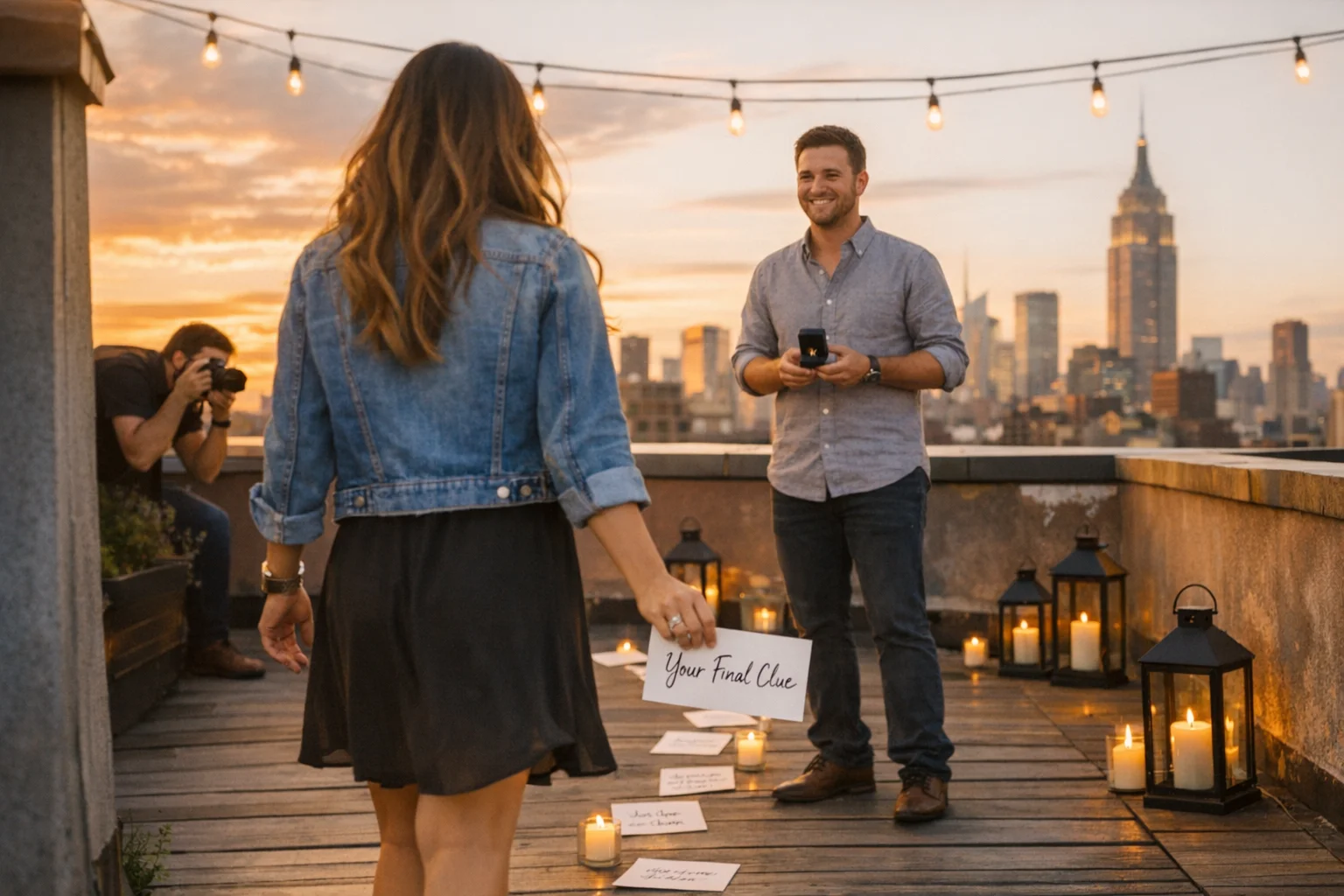
You know how a great story pulls you forward without shouting about it? A good scavenger hunt proposal works the same way. It turns your shared history into a path your partner follows because they want to, not because you forced it. The puzzle is the wrapper. The core is the two of you.
At a Glance
- Personal beats elaborate. Anchor clues to real memories and in-jokes only you share.
- Design for the ending. A satisfying close outshines perfect riddles.
- Keep it humane. Short, paced, accessible, and pressure-free wins.
- Plan like a producer. Ring, photos, permits, weather, backups.
Why a scavenger hunt proposal works
A pattern we keep seeing: when proposals feel like a performance, people freeze. When they feel like discovery, people light up. A scavenger hunt proposal turns passive anticipation into active participation. Your partner gets to relive key moments, notice your thoughtfulness, and arrive at a finish that already feels true.
If you want a quick primer with practical examples, The Knot’s guide to planning a scavenger hunt proposal that actually lands is a solid baseline. Use it for inspiration, then tailor ruthlessly.
Start with the person, not the puzzle
Most teams tend to over-index on clever clues before asking simple questions:
- Energy style. Introvert or extrovert? Public attention can thrill one person and drain another.
- Challenge tolerance. Do they like wordplay, or will a riddle feel like homework?
- Mobility and sensory needs. Stairs, crowds, loud spaces, flashing lights. Avoid friction.
- Nostalgia triggers. First apartment, a dog’s favorite bench, a badly cooked anniversary dinner you still tease each other about.
What usually shifts the dynamic is designing for comfort first and cleverness second. The most “you” moments win over the most “impressive” ones.
Choose the right format (private, with friends, public, or remote)
Think of format as a spectrum, not a binary.
- Private. Just the two of you, at home or along quiet stops. Easiest to control. Best for camera-shy partners.
- Friends-and-family reveal. They help place clues or appear at the end. Great if community matters and your partner likes shared milestones.
- Public. Parks, rooftops, museums. This adds bystander energy and potential pressure. Calibrate carefully to your partner’s comfort.
- Remote/long-distance. Ship a box of clues, trigger timed messages, or hopscotch across cities with helpers. Works shockingly well with simple tech.
In our experience, the best indicator you picked the right format is how naturally the ending fits your partner’s style.
Pick locations with meaning and low friction
Map 4 to 6 stops that matter. More can feel like a victory lap with tired feet.
- Make navigation obvious. Don’t force app juggling at every step.
- Minimize transit. Cluster within a short walk or quick rideshare.
- Pre-test access. Restrooms, shade, quiet corners, winter wind blocks. Small comforts keep energy up.
- Check permissions when needed. Some venues are fine with casual photos; others are not. Parks and rooftops can have rules about tripods, drones, or blocking paths.
If any stop feels like a stretch, cut it. The route should feel inevitable, not clever for clever’s sake.
Clue writing that feels personal, not cheesy
Skip generic rhymes. Write mini-mysteries from your shared life.
- Use “only we’d get this” details. Misheard lyrics, pet nicknames, that pizza order you both defend.
- Vary clue types. A quick riddle, a simple cipher, a GPS pin, a QR tucked in a book.
- Keep the reading easy. Short lines, warm tone, zero SAT words.
- Seed anticipation, not stress. Hints should feel solvable without Google.
Pro tip: read clues out loud. Anything that sounds stiff in your mouth will land stiff in the moment.
The peak–end blueprint: design the moment they’ll remember
Memory favors two moments: the emotional high point and the way it ends. This is the peak–end rule, documented in classic research by Daniel Kahneman and colleagues showing people judge experiences largely by their most intense point and the finale, not the average of everything in between. Designing for a clear high and a clean closing pays off disproportionately. If you want the source, here’s the original paper: When More Pain Is Preferred to Less: Adding a Better End.
How to use this without overthinking it:
- Create one peak. A voice note from a loved one. A place that always hits. A line they once said back to them.
- Stage a calm ending. Space to breathe, say yes, hug, cry, and laugh before anyone rushes in.
- Then celebrate. Add the cheering section or champagne after you’ve had your moment.
Timing, length, and pacing that don’t drag
Most hunts feel best when they’re short, steady, and fail-safe.
- Window. Target “a leisurely hour,” not a half-day trek.
- Clue count. Four to six is the sweet spot. Enough to feel like a journey, not a gauntlet.
- Pacing. Alternate quick wins with one slightly trickier clue. Let momentum breathe.
- Breaks. A coffee stop or a bench with a view. Oxygen for the story.
Safety, accessibility, and privacy
Well-designed experiences are inclusive by default. If a stop might exclude or exhaust your partner or guests, it doesn’t belong.
- Accessibility. The ADA National Network’s temporary events guide offers practical checklists on routes, signage, rest areas, and communication. Worth a skim even for small gatherings.
- Outdoor ethics. If you’re using trails or parks, the Leave No Trace Seven Principles are a simple filter. Avoid trampling fragile areas, litter, or blocked paths.
- Photographers and permits. Casual photos are usually fine. If you’re bringing lighting, staging, or filming in sensitive areas, rules can change by site and season. Call ahead and be a good guest.
- Public pressure. If in doubt, keep the actual question private, then celebrate publicly. It gives your partner room to answer in their own way.
Logistics: ring, photos, weather, backups
The unglamorous details make the day feel effortless.
- The ring. Assign one trusted handler until 5 minutes before the ask. Carry in a pocket that doesn’t print.
- Photos/video. Align on “candid only,” “posed after,” or both. Show the shooter a map and exact sightlines.
- Weather plan. Have a nearby indoor alternative and a rain delay script. Don’t fight nature.
- Backups. Spare pens, batteries, tape, water, umbrella, safety pins. Small kit, big calm.
Example clues and challenges to steal
Short, personal, and solvable at a glance. Mix formats to keep it lively.
- [Photo | 30 pts]: Recreate our first selfie spot, same grin required.
- [GPS Check-in | 40 pts]: The bench where your shoe broke mid-laugh. Ping when seated.
- [QR Code | 25 pts]: Scan the dog-eared page that made us both snort-laugh.
- [Q&A | 20 pts]: The spice we argued about for an hour. Type its name.
- [Multiple Choice | 30 pts]: Our worst movie date: A) Sequel B) Remake C) Reboot.
- [Video | 50 pts]: Teach the camera our two-step from that kitchen night.
- [Photo | 40 pts]: Find the sign with a typo we refuse to correct.
- [GPS Check-in | 30 pts]: The corner where we missed our stop telling stories.
- [Q&A | 20 pts]: The code to our inside joke: ________ forever.
- [QR Code | 35 pts]: Last clue: a note from someone who loves you almost as much as I do.
If you’re building the hunt digitally, QR and GPS keep things tidy. If you’re going analog, index cards and tape work beautifully. Perfection isn’t the point. Recognition is.
A simple planning timeline
Use this as a directional rhythm, not a rigid schedule.
- 4–6 weeks out. Align on format and route. Quietly confirm any friend or family roles.
- 3–4 weeks out. Write clues. Scout each stop at the right time of day. Test cell service.
- 2 weeks out. Confirm photographer and any site policies. Pocket backup plans.
- 1 week out. Print clues or load them in your app. Pack the small kit. Rehearse the last 10 minutes.
- 2–3 days out. Place any non-risky props. Reconfirm timing with helpers.
- Day of. Place final clues. Breathe. Follow your own instructions.
Using tech without killing the magic
Tech should disappear into the story. When it does, logistics melt away and your partner only sees you thinking three steps ahead.
- Automation. Timed releases, geofenced unlocks, scheduled messages that hit exactly when they should.
- Flexibility. Browser-based for low-friction access, app-based for richer media and offline points.
- Scale. Works for intimate two-person journeys or larger surprise reveals with friends joining late.
Scavify exists for this exact kind of experience design. It handles GPS check-ins, QR scans, photo/video submissions, and automated hints so you can focus on the moments, not the mechanics.
Common mistakes we see (and how to avoid them)
- Overcomplicating clues. If you have to explain them, they’re not ready. Simplify until they feel obvious to your partner.
- Dragging the route. Long gaps drain energy. Keep transit short and varied.
- Forgetting the ending. Build in space after the ask before any crowd appears.
- Ignoring accessibility. Stairs, noise, lighting, and rest spots matter more than décor.
- Making it about the audience. Viral is a poor design goal for a life decision. Design for the two of you.
FAQs
How many clues should a proposal scavenger hunt have?
Four to six clues usually feel like a meaningful journey without fatigue. The right count is the one that preserves energy for the final moment.
How long should the whole thing take?
An unhurried hour tends to land well. Short enough to feel crisp, long enough to build anticipation.
Should a proposal be public or private?
Match your partner’s comfort. Public settings add energy and pressure; private moments add safety and focus. Many people blend the two: private ask, public celebration.
How do I make the ending unforgettable without being over the top?
Plan one emotional high point and a clean, calm close. The peak–end rule suggests the high and the ending shape memory most. Put your effort there.
How do I keep the ring safe and hidden?
Assign one trusted handler until minutes before the ask. If you’re solo, use a secure pocket that won’t show a box outline.
What about accessibility for a partner or guest with mobility or sensory needs?
Plan routes with smooth surfaces, quiet spaces, seating, and clear signage. The ADA National Network’s temporary events guide has simple, practical checklists you can adapt.
Do I need permits for photos or filming?
Casual phones are fine most places, but staging, pro gear, or sensitive locations can trigger rules. Call the site. If you’re in parks or protected areas, start with posted guidance and be considerate.
Any reputable resources to sanity-check my plan?
For baseline inspiration, The Knot’s scavenger hunt proposal guide is useful. For inclusive logistics, lean on the ADA National Network’s temporary events guide. For outdoor settings, the Leave No Trace Seven Principles keep you kind to the place you love. And if you like design psychology, Kahneman’s paper on the peak–end rule helps you stage a better ending.