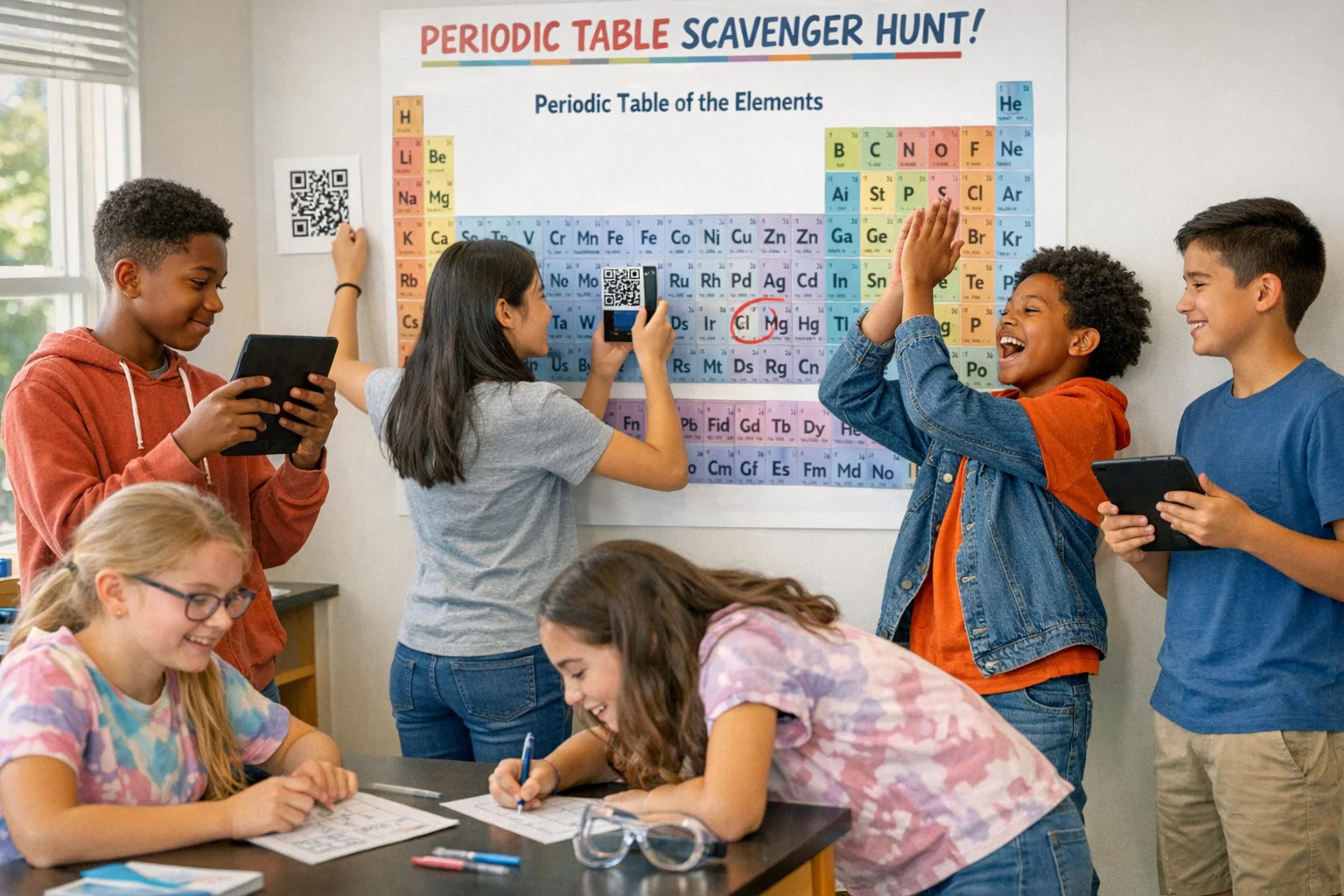
Make the periodic table move. A well-built scavenger hunt turns a wall chart into a live map students chase, question, and remember. This guide gives you ready-to-run formats, classroom-tested challenges for every grade band, and practical tips that keep the room engaged instead of politely pretending.
At a Glance
- Fast launch: Use stations or an app, timebox to 20–30 minutes, and score visibly to keep momentum.
- Grade-banded prompts: Elementary fuels curiosity; middle school nails structure; high school applies trends; AP/college pushes explanation quality.
- Mix challenge types: Photo, GPS/room check-ins, QR, multiple choice, and short responses keep different brains in play.
- Assess on evidence, not speed: Quick exit slips or one synthesis prompt turns play into learning you can grade.
- Lean on trusted tools: Pair your hunt with the RSC interactive periodic table and PhET’s Build an Atom to deepen exploration. (periodic-table.rsc.org)
Quick-start: a 10-minute setup that actually works
What you need: a projector or printouts, numbered stations or posted QR codes, and a visible scoreboard.
- Pick a focus. Trends, atomic structure, families, or real-world uses. Don’t try to do everything in one round.
- Choose 8–12 challenges. Mix difficulty and response types so more students get quick early wins.
- Place stations. Spread them so movement is real, not a traffic jam. Corners and door frames are underrated.
- Set scoring rules. Clear points, 1–2 optional “stretch” items, and a tie-breaker. Announce them out loud.
- Timebox. 20 minutes plays fast. Add a 3-minute “last call” so teams make choices, not laps.
- Debrief. 5 minutes of show-and-tell or one reflection prompt converts activity into understanding.
Formats that fit your class period and room
Station rotation (paper or QR). Post prompts around the room. Groups rotate on a timer. Great when devices are scarce.
App-based hunt. Challenges, auto-scoring, photos, and leaderboards in one place. Useful for evidence capture and easy resets across sections. Tools like Scavify make this simple without turning the lesson into a tech setup moment.
Hybrid. Use stations for movement plus 2–3 digital challenges that need data or media.
Hallway or campus map. Short walks change the energy fast. If you step outside, pre-brief on safety and time boundaries.
Remote/virtual. Assign table-based riddles, quick screen-capture evidence, and a shared scoreboard. Pair with PhET’s Build an Atom when modeling structure. (phet.colorado.edu)
Elementary ideas (Grades 3–5): curiosity first
Short, clear clues that nudge observation. Emphasize patterns students can see: names, symbols, and simple properties.
- [Photo | 20 pts]: Find the element whose symbol hides a full English word. Snap it on our classroom table.
- [Q&A | 30 pts]: Which element shares its name with a planet’s Roman god? Write symbol and square color.
- [QR Code | 30 pts]: Scan to watch a 30-second clip on helium. Record two balloon facts you hear.
- [Multiple Choice | 25 pts]: Which group number is labeled “noble gases” on our poster?
- [Photo | 40 pts]: Spot three elements named after places. Circle them on a printout and submit a pic.
Tip: Work in pairs. One pointer, one recorder. Switch halfway. It prevents the “one kid does everything” pattern.
Middle school ideas (Grades 6–8): structure starts to click
Students can start linking table position to atomic structure and properties.
- [Q&A | 40 pts]: Find an element with 3 valence electrons. Show your reasoning using its group.
- [Multiple Choice | 35 pts]: Which family reacts most vigorously with water: alkali metals or halogens?
- [Photo | 30 pts]: Snap a color-coded example of a metalloid and name two neighbor metals.
- [QR Code | 45 pts]: Scan a PhET station and build an atom with 7 protons, 7 neutrons, 7 electrons. Submit isotope symbol. (phet.colorado.edu)
- [Q&A | 50 pts]: Pick two adjacent elements in a period. Predict which has a larger atomic radius and why.
Pattern to watch: early finishers usually over-hunt. Give them a “stretch” challenge that requires an explanation, not speed.
High school ideas (Grades 9–12): trends, ions, and reactions
Bring in electronegativity, ion formation, periodic trends, and basic reaction reasoning.
- [Q&A | 60 pts]: Use the table to predict the charge of a stable ion of sulfur. Explain electron movement.
- [Multiple Choice | 50 pts]: Which has the higher first ionization energy: Mg or Al? State your rule.
- [Photo | 40 pts]: Find an element commonly used in semiconductors. Show symbol and one device example.
- [QR Code | 60 pts]: Scan the prompt: “Choose a halogen and alkali metal that could form a salt.” Submit formula and naming.
- [Q&A | 70 pts]: Across a period, why does atomic radius generally decrease? Write a two-sentence explanation.
Good twist: Seed one purposely tempting wrong answer on a station. During debrief, ask what made it look right and how to catch it next time.
AP/College ideas: depth without the drag
Push students to justify with evidence and models, not just pick the right square.
- [Q&A | 80 pts]: Compare effective nuclear charge for P vs. S and predict which forms the smaller atomic radius. Justify with electron–proton attraction language.
- [Multiple Choice | 70 pts]: Which element would you expect to have the highest electron affinity in Period 2? Defend if you disagree with the “textbook” pick.
- [Photo | 60 pts]: Submit a screenshot highlighting a d-block trend of your choice and annotate what changes across the series.
- [QR Code | 85 pts]: Pull up the IUPAC table and identify a recently named heavy element. Note symbol and year. (iupac.org)
- [Q&A | 90 pts]: Pick any anomaly where a measured trend bucks the simplified rule. Explain the deeper cause.
What usually shifts the dynamic here is letting students argue with the model. Reward defensible reasoning, not just conformity to a mnemonic.
Question bank: ready-to-use clue prompts
Steal these as-is or adapt them to your level. Mix types to keep the pace unpredictable.
- [Multiple Choice | 25 pts]: Which period contains the most elements?
- [Q&A | 40 pts]: Name an element after a scientist and one after a place. Provide symbols.
- [Photo | 30 pts]: Capture an element used in batteries. Add a one-line “where you see it” note.
- [Q&A | 45 pts]: Why are noble gases largely unreactive? Tie to valence electrons.
- [Multiple Choice | 35 pts]: Which has greater electronegativity: Cl or Br?
- [QR Code | 50 pts]: Scan to open the RSC interactive periodic table. Find an audio or video segment for any element and note one new fact. (periodic-table.rsc.org)
- [Photo | 40 pts]: Show two neighbors across a period with different metallic character.
- [Q&A | 50 pts]: Using the table, explain why Na forms Na+ more readily than Mg forms Mg2+.
- [Multiple Choice | 30 pts]: Which block (s, p, d, f) contains the lanthanides?
- [QR Code | 55 pts]: Open PhET’s Build an Atom. Create an isotope that stays neutral when you change neutrons. Submit symbol with mass number. (phet.colorado.edu)
- [Q&A | 60 pts]: Choose two elements in the same group. Predict a property that increases down the group and why.
- [Photo | 35 pts]: Snap an element named for a celestial body and share the connection.
Scoring, pacing, and classroom management that keep energy high
Scoreboard visibility changes behavior. A small live leaderboard pushes focus better than shouting reminders.
Point spread matters. A few higher-value items create catch-up potential. Avoid a flat 10-points-for-everything scheme.
Roles reduce chaos. Runner, reader, recorder. Rotate mid-activity so everyone touches the content.
Artifacts beat memory. Require a photo, symbol annotation, or one-sentence justification per challenge. Your debrief becomes simple: show evidence, discuss pattern, move on.
Assessment alignment: connect to standards without killing the vibe
Keep the evidence simple and standards-linked.
- Exit prompt (2 minutes): “How does group number help predict valence electrons? Cite one example from today’s hunt.” Ties to NGSS PS1.A on structure and properties of matter. See the official PS1.A progression for wording and endpoints. (nextgenscience.org)
- Short synthesis (5 minutes): “Explain one periodic trend you used to make a prediction. Include a model or annotated element square.”
- Quick check grid: List 4 outcomes you care about: identifies families, applies trends, models ions, defends reasoning with evidence. Check once during the hunt, once during debrief.
If you want students exploring authoritative data tables, point them to the International Union of Pure and Applied Chemistry’s concise resource on the elements for up-to-date reference. (iupac.org)
Helpful resources to plug in immediately
When the goal is active learning, the right external tools save time and legitimize your content.
Paper vs. app-based hunts: choosing the right tool
Paper/QR stations shine when devices are limited or you want maximum movement with minimal setup. They’re easy to tweak between class periods.
App-based hunts shine when you need automatic scoring, photo/video evidence, and repeatable runs across sections or events. This is where platforms like Scavify help: build once, run many times, and capture everything in one place. Use browser mode if your device mix is unpredictable.
Practical rule: if you’re running this for multiple sections or a school event, go app-based. If it’s a single class on a tight schedule, stations are perfectly fine.
Common pitfalls and easy fixes
- Everything feels same-y. Mix challenge types and point values. Add exactly one “mystery” prompt students unlock after submitting any three.
- Pileups at one station. Stagger starting points by team color. Shorten text on the high-traffic prompt.
- Answers without reasoning. Require a one-sentence “because” for any Q&A worth 40+ points.
- Dead silence at the end. Plan the debrief as intentionally as the hunt. Ask, “Which clue forced you to change your mind?”
- Unclear evidence. Model one perfect submission up front. Students imitate what they see.
FAQs
How long should a periodic table scavenger hunt take?
Most classes run well at 20–30 minutes of active hunting plus a 5-minute debrief. Shorter bursts work if you narrow the focus to one trend or family.
What class sizes does this work for?
Small groups to large sections. With 30+ students, use 6–8 stations with duplicated prompts to prevent traffic jams or switch to an app-based format that distributes tasks.
Do I need devices for everyone?
No. Station formats work with zero devices. If you use an app, a 1:2 or 1:3 device-to-student ratio is plenty because roles rotate.
How do I grade it quickly?
Score participation live, then collect learning with a one-question exit ticket that targets your objective. A 4-box check grid (families, trends, ions, evidence) is fast and fair.
How do I connect this to standards?
Build prompts that require using the table to predict or explain properties. That aligns directly with NGSS PS1.A language on structure and properties of matter. (nextgenscience.org)
Any safety concerns?
If you extend the hunt to lab spaces or demos, give a one-minute safety brief and keep movement clear of equipment. For classroom-only table work, standard movement norms are enough.
What if students finish early?
Have one or two “stretch” prompts ready that demand an explanation or real-world connection, not just a lookup.
In our experience, the best indicator your hunt worked is the debrief: students argue (politely) about answers using the table as their evidence. That’s the win. If you want to scale the experience to a grade-wide event or orientation, an app-based format keeps it organized without adding busywork. And whenever you can, pair the hunt with an authoritative explorer like the RSC table or a quick PhET build so the patterns feel earned, not memorized. (periodic-table.rsc.org)