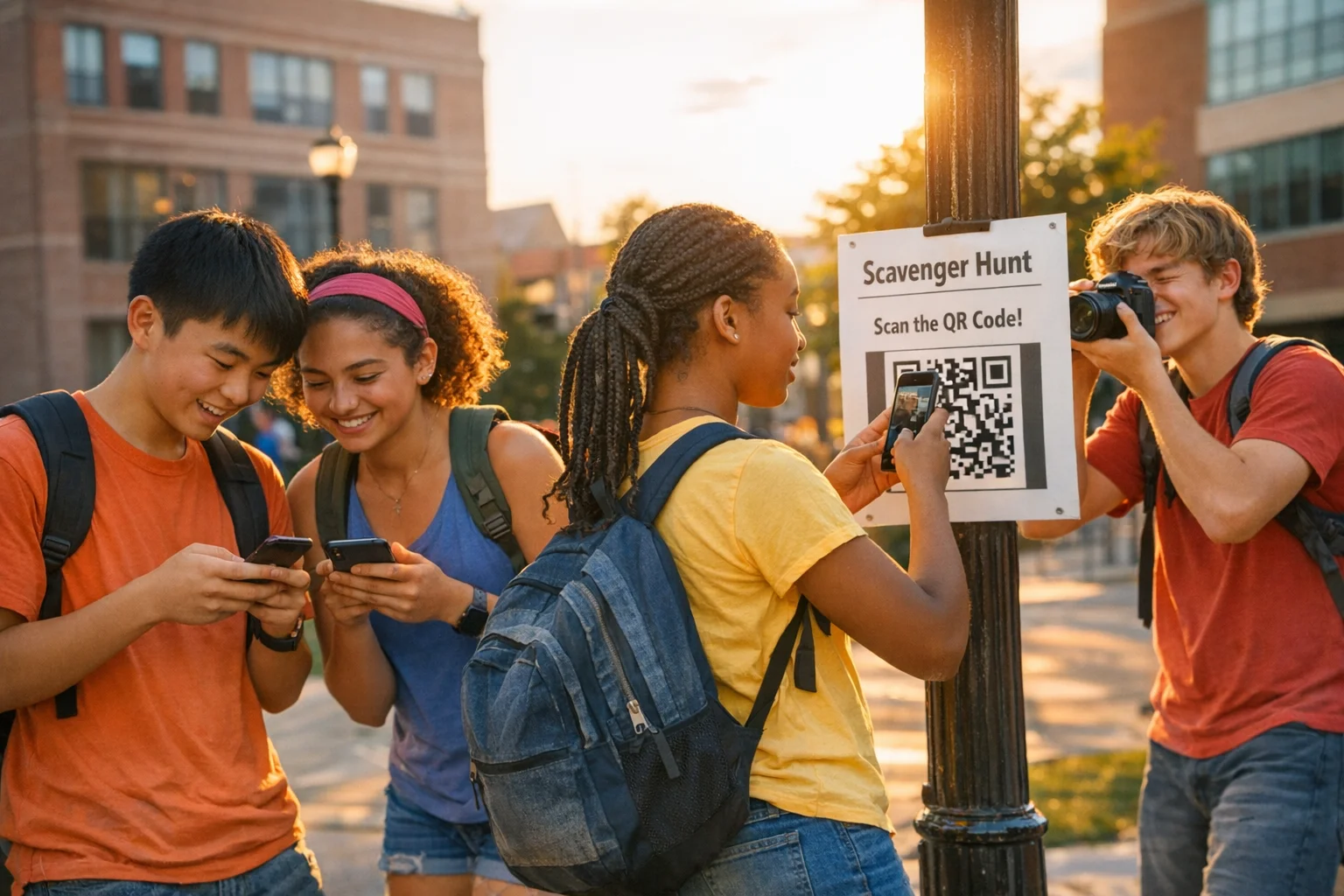
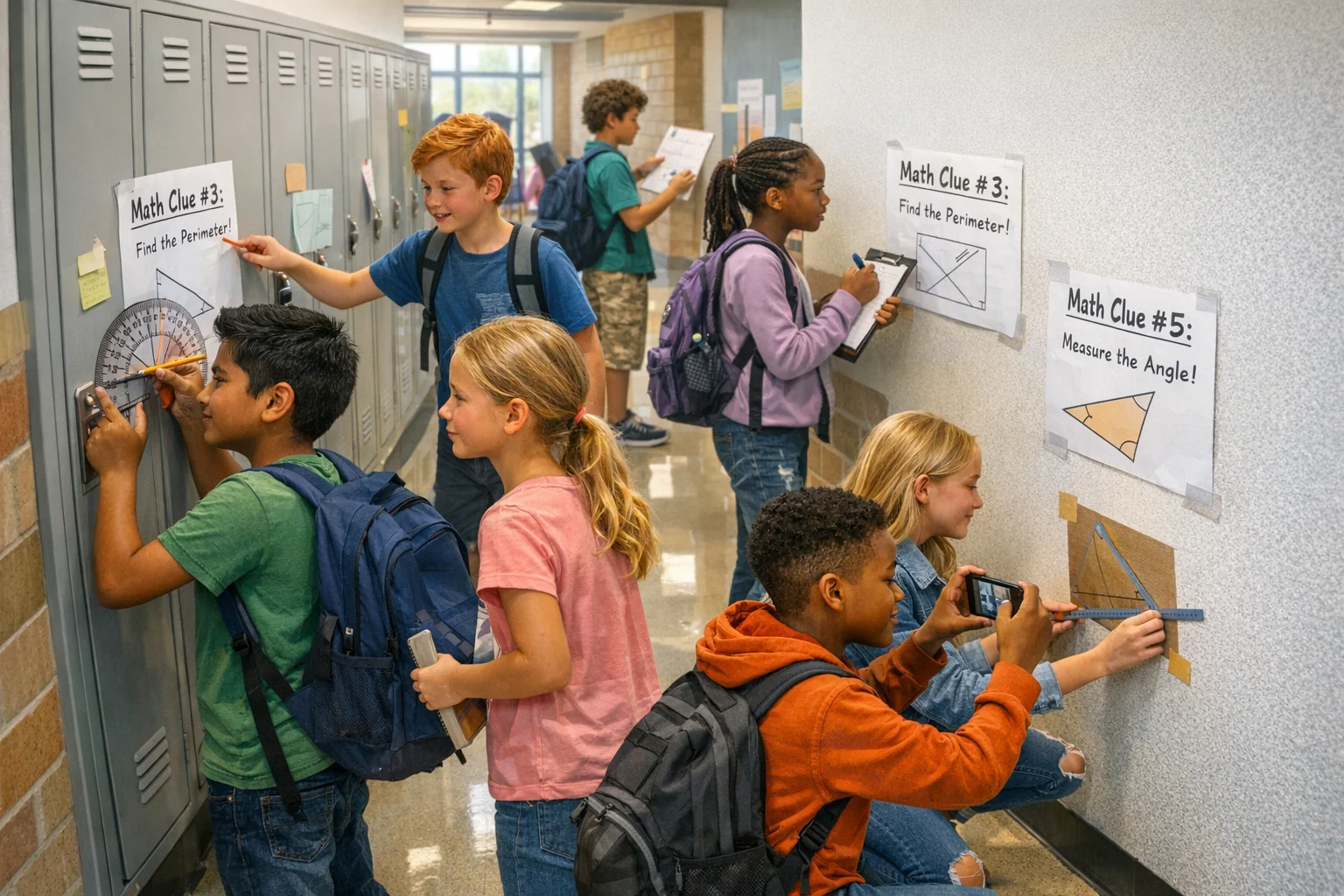
Teens can smell forced fun from a mile away. The quickest way to lose them is with cheesy clues, over-explained rules, and tasks that feel like homework in disguise. The flipside is also true: give them real choice, a little friendly chaos, and challenges that feel made for their world, and they’ll run the show for you.
At a Glance
- Design for autonomy, not control. Offer choices and optional paths so teens can own the experience.
- Keep tasks short, visual, and social. Photo, video, GPS, and quick puzzles beat long riddles.
- Use live momentum. Real-time scoring and time-boxed sprints keep energy high.
- Build for movement. A good hunt quietly delivers 30 to 60 minutes of active time.
- Protect privacy and safety. Clear boundaries and transparent consent keep things smooth.
What actually makes a teen scavenger hunt work
A pattern we keep seeing: teens engage when the experience gives them room to choose, show competence, and connect with their friends. It’s basic psychology, not hype.
- Autonomy matters. Environments that offer genuine choice boost intrinsic motivation, which is why “pick any three of five” tasks consistently outperforms “do everything on the list.” That’s straight from motivation research on student choice and engagement, summarized in a practical way by the Harvard Graduate School of Education.
- Competence shows up when tasks have the right-sized challenge curve. Quick wins early, a few stretch goals later.
- Relatedness is the social glue. Team roles, inside jokes, and creative proofs reward belonging as much as outcomes.
On the practical side, nearly every teen has a smartphone, which means a hunt can live where they already are. The Pew Research Center’s latest deep dive on teens and tech is clear: mobile-first is reality. Use that to make participation easy, not to police it.
One more benefit: movement sneaks in naturally. That matters. The CDC’s physical activity guidelines recommend at least 60 minutes of daily moderate-to-vigorous activity for ages 6 to 17. Well-designed hunts can rack up meaningful minutes without feeling like PE.
Plan the format teens actually want
Pick a hunt shape that matches your space, group size, and time window.
- Sprint format 30 to 60 minutes. Fast, high-energy. Great for assemblies, retreats, youth nights.
- Circuit format 60 to 90 minutes. Multiple zones or stations with distinct vibes.
- Open world 90 minutes to 2 hours. Big campus, park, or downtown. More autonomy, more exploration.
- Hybrid or remote 30 to 60 minutes. Photo, video, and quiz tasks that work anywhere.
Group size and roles
- Teams of 4 to 6 hit the sweet spot. Big enough for variety, small enough for everyone to act.
- Rotate light roles: Navigator (map and GPS), Strategist (points and priorities), Hype (morale and proof quality), Archivist (submits proofs).
Boundaries that feel fair
- Clear map borders or geofenced zones.
- Respectful photography rules: consent for close-ups, public spaces only, opt-out options.
- Time-box the whole thing and the hardest tasks. Scarcity drives focus.
Themes that don’t feel childish
Keep it specific, not cutesy. A great theme suggests locations, visuals, and inside jokes.
- Neighborhood legends - features, murals, oddities, and hyperlocal lore.
- School spirit remix - teams reinterpret traditions with modern proofs.
- Eco-engineers - upcycling, zero-waste sprints, and nature IDs.
- Street art study - patterns, colors, and styles become the clue language.
- Mystery boxes - QR codes in unexpected spots unlock branching tasks.
How to write challenges teens will actually do
Most teams tend to stall when clues are vague or lecture-y. What usually shifts the dynamic is short prompts with a single crisp action and a proof that’s fun to capture.
Use this simple checklist:
- One action per task. “Recreate this statue’s pose” beats “Find and study the statue, then write a paragraph.”
- 8 to 15 words per prompt. Mini-mysteries, not essays.
- Visible, verifiable proofs. Photo, video, GPS check-in, QR scan, or a quick choice question.
- Branching choice. Offer two or three prompts per location so teams self-differentiate.
- Points match effort. 10 to 100 points. Higher points signal stretch.
If you care about social and emotional skills, you can map tasks to the CASEL framework’s five competencies: self-awareness, self-management, social awareness, relationship skills, and responsible decision-making. It’s a quiet way to teach teamwork without a lecture.
Ready-to-run challenge banks
Below are modular, non-cringe prompts. Each list mixes formats and difficulty so you can grab and go. Edit names to match your campus, park, or neighborhood.
School or campus sprint
- [Photo | 20 pts]: Recreate a yearbook pose by the main entrance.
- [Video | 40 pts]: Silent 5-second chant at a campus landmark.
- [GPS Check-in | 30 pts]: Mark the noisiest spot at lunch hour.
- [QR Code | 20 pts]: Scan the mascot code hidden near the gym.
- [Q&A | 30 pts]: Which hallway has the most lockers per meter?
- [Photo | 50 pts]: Shadow-twin pose with a campus statue.
- [Multiple Choice | 20 pts]: The library opened in which decade?
- [Video | 60 pts]: Elevator pitch for a new school club - 10 seconds.
- [Q&A | 40 pts]: Three words on the oldest trophy you can spot.
- [Photo | 80 pts]: Team selfie from the “highest legal point.”
Park or neighborhood explorer
- [Photo | 20 pts]: Something older than everyone on your team.
- [Video | 40 pts]: Leap a shadow line in perfect sync.
- [GPS Check-in | 30 pts]: The best view that isn’t a view.
- [Q&A | 30 pts]: Street name with the fewest letters.
- [Photo | 50 pts]: Four textures in one frame - nature edition.
- [QR Code | 20 pts]: Code hidden near a bench with initials.
- [Video | 60 pts]: Whispered compliment chain - one take.
- [Photo | 80 pts]: Perfect circle found in the wild.
Mall or rainy-day hunt
- [Photo | 20 pts]: Team reflection in anything not a mirror.
- [Multiple Choice | 20 pts]: Which floor has the fewest trash cans?
- [Video | 40 pts]: Escalator statue - freeze for two steps.
- [Q&A | 30 pts]: Longest single word on a storefront.
- [Photo | 50 pts]: Color-match your outfits to a product display.
- [QR Code | 20 pts]: Hidden code near a directory map.
- [Video | 60 pts]: One-take mannequin runway - 8 seconds.
- [Photo | 80 pts]: Symmetry shot that would please a perfectionist.
After-dark glow edition (well-lit areas only)
- [Photo | 20 pts]: Team halo using phone lights.
- [Video | 40 pts]: Synchronized flashlight blink - Morse initials.
- [GPS Check-in | 30 pts]: Brightest safe landmark in bounds.
- [Q&A | 30 pts]: Number of bulbs in the biggest visible sign.
- [Photo | 50 pts]: Neon or LED color gradient - no filters.
- [Video | 60 pts]: 5-second silhouette dance by a wall.
- [Photo | 80 pts]: Long-exposure light trail spelling your team name.
Hybrid or remote-friendly set
- [Photo | 20 pts]: Two items that shouldn’t match - perfect match.
- [Q&A | 30 pts]: First sentence on page 42 of any book.
- [Video | 40 pts]: Five-object Rube Goldberg knockdown - one try.
- [Multiple Choice | 20 pts]: Which emoji best describes today’s weather?
- [Photo | 50 pts]: Forced perspective - make something tiny look huge.
- [Video | 60 pts]: Ten-second music-free hype speech for your team.
Scoring, prizes, and real-time energy
Points that mean something
- Tier your board: lots of 20 to 40 point quick wins, a smaller set of 50s, a few 60 to 80 point swings.
- Cap submission attempts on stretch tasks to keep them meaningful.
Live leaderboard or it didn’t happen
- Real-time scoring is rocket fuel. It creates urgency and smart risk-taking. If you use an app, make sure points and proof feeds update on the fly so teams see momentum shifts instead of waiting on a judge’s table.
Prizes that aren’t cringe
- Pick rewards teens actually value: first pick at pizza, early bus boarding, pick-the-playlist rights, small gadgets, or simple bragging rights backed by a photo wall.
- Celebrate creativity, not just points. Best photo. Funniest fail. Cleanest speed-run. Judges’ choice.
Safety, inclusion, and privacy without killing the vibe
Safety and trust keep everything fun. Keep it simple and transparent.
- Boundaries and briefings. Define in-bounds areas. Share examples of safe, respectful proofs. Spell out what’s off-limits.
- Consent and photos. No posting others without permission. Public spaces only for close-up shots. Clear opt-out for anyone who doesn’t want their face shown.
- Accessibility. Offer alternatives for tasks that involve heights, stairs, or sprinting. You can mirror every movement task with a creative prompt.
- Adult presence without micromanage. Visible, roaming adults as helpers, not hall monitors. One contact number per team.
- Movement with intent. Remember the activity upside. The CDC guideline target can be supported with brisk walking between zones, fast photo ops, and quick physical micro-challenges.
If you want to language your goals beyond fun, you can point to SEL outcomes using the CASEL competency framework. Just design for them, don’t sermonize.
Run-of-show: a simple playbook
Here’s a lean schedule we’ve used across schools, camps, and youth groups. Adjust to fit your context.
- T minus 7 to 10 days Finalize zones, theme, and 30 to 50 mixed-difficulty tasks. Walk the route. Plant any QR codes.
- T minus 3 to 5 days Form teams, share guardrails, gather any permissions if needed based on your organization’s standard practice. Confirm adult helpers and check-in spots.
- Day-of -30 minutes Staging. Test QR codes and GPS pins. Print or upload the map. Open the live board if you’re using one.
- Kickoff 10 minutes Welcome, boundaries, proof rules, and a single demo submission. Give teams 2 minutes to pick roles.
- Hunt 45 to 90 minutes Unlock one mid-hunt bonus for momentum if needed. Announce time remaining at 15, 5, and 2 minutes.
- Wrap 10 to 15 minutes Quick highlights reel via photo feed. Announce winners. Hand out prizes. Optional reflection cards tied to your goals.
Where Scavify naturally fits
If you want app-based structure without the clipboard shuffle, Scavify makes this format dead simple. Teams submit photo and video proofs, GPS check in, scan QR codes, and answer quick questions. You can build branching lists, auto-score, and run a live leaderboard in a browser or the app. It’s built for the way teens already use phones, which is exactly why participation climbs instead of stalling.
Most teams tend to appreciate that you can scale up or down without rewriting the whole playbook. Small retreat or whole grade. Inside a gym or across a district. Same setup, different mix of tasks.
FAQs
What’s the ideal length for a teen scavenger hunt?
Aim for 45 to 90 minutes. Shorter sprints keep energy spiky. Longer formats work if the space is large and teams have clear choices so they don’t bottleneck.
How many challenges should we include?
For a 60-minute hunt, 25 to 40 prompts is a reliable range. Mix a majority of quick 20 to 40 point tasks with a handful of 50 to 80 point swings. Most teams will complete 12 to 20 tasks.
Do we need to separate age groups?
Not strictly. Mixed-grade teams can work well if roles are clear and stretch tasks are optional. If there’s a big maturity gap, create parallel leaderboards or theme variations so comparisons feel fair.
How do we handle phones and privacy?
Set simple rules: public spaces only for close-up photos, get verbal consent for face shots, no posting others to personal accounts during the event. Collect proofs inside the hunt platform so they don’t scatter.
What if the weather changes last minute?
Keep a backup list for indoor spaces or switch to hybrid tasks you can run anywhere. The mall or community center set above works in a pinch. You can also flip to remote-friendly prompts without canceling.
How do we keep things safe without making it boring?
Define the map, ban risky spots, require crosswalks, and put adults where decisions happen - entrances, intersections, and endpoints. Keep one hotline number visible. Clarity builds confidence and speed.
What’s the best prize structure for teens?
Status privileges beat trinkets more often than not: playlist control, first slice rights, early dismissal from the next study hall if your policy allows. Add a couple of creative awards so more teams get recognized.
How do we align this with learning or SEL goals?
Map a few prompts to teamwork, planning, and perspective-taking. If you need a shared language, use the CASEL competencies. Short reflection prompts after the hunt can make the learning legible without undercutting the fun.
If you want to move fast, you can build these hunts in Scavify in minutes, run them from phones, and watch the live board do most of the heavy lifting. The more you design for choice, short proofs, and visible momentum, the more teens will bring the energy to you.
References used in this guide: the Pew Research Center’s overview of teen device use, Harvard’s synthesis on student choice and motivation, the CDC’s physical activity guidance, and the CASEL SEL framework.