Solutions
Your first hunt, live this afternoon.
Free to start · No download for participants
Use these activities to spark problem-solving, creativity, communication, and stronger group collaboration.
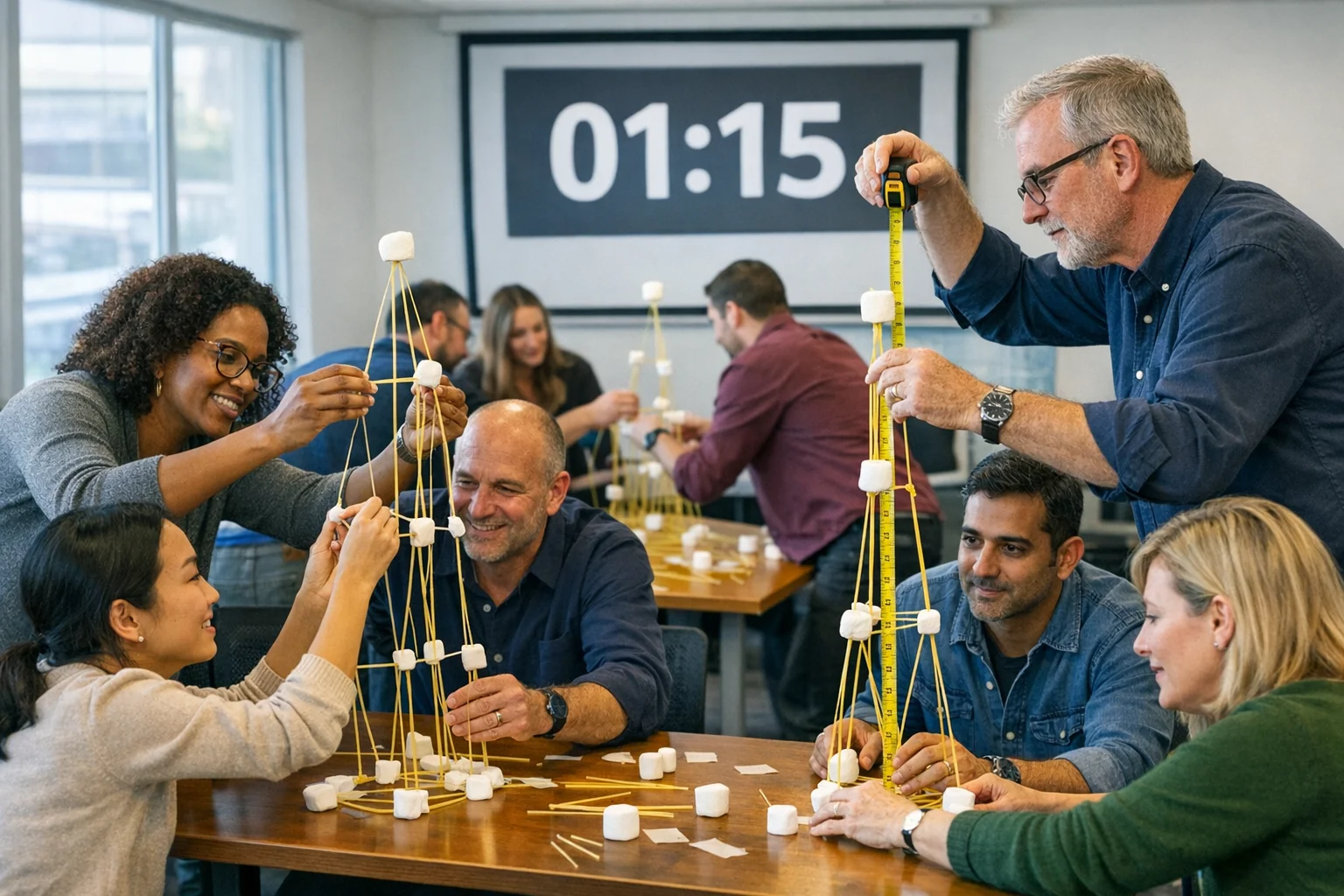
The Marshmallow Challenge is a fast, high‑energy build exercise that reliably exposes how teams plan, communicate, adapt, and make decisions under mild pressure. It takes 18 minutes, a handful of simple materials, and a facilitator who cares about learning more than theatrics.
Designer Tom Wujec popularized the challenge to demonstrate how iteration, clarity, and teamwork shape outcomes. Teams get spaghetti, tape, string, and a single marshmallow. Their goal: build the tallest freestanding structure with the marshmallow on top in 18 minutes. The setup looks playful; the learning is not. It spotlights assumptions, communication patterns, and how quickly teams test reality instead of debating it. (ted.com)
In his widely viewed talk, Wujec contrasts groups that plan at length with groups that start building and iterating. The latter usually finish with taller, more stable towers because they surface constraints early and adjust before the clock runs out. Use that framing to focus your debrief on process, not spectacle. (ted.com)
Use a consistent kit per team and state the rules up front, without ad‑libs. Small “gotchas” or surprise twists trade short‑term drama for long‑term confusion.
Standard kit (per team): - 20 sticks of dry spaghetti (not spaghettini; uncooked only) - 1 yard/metre of masking tape - 1 yard/metre of string - 1 standard marshmallow (whole, placed on top) - 1 paper bag or envelope for the kit (not for building)
Rules to say verbatim: - Build the tallest freestanding structure measured from tabletop to the top of the marshmallow. - The entire marshmallow must be on top. Cutting or eating any portion disqualifies the team. - Use as much or as little of the spaghetti, string, and tape as you want. You may break/cut them. - Don’t use the bag/envelope as a component. - Time limit: 18 minutes. When time’s up, hands off. If it falls, it doesn’t count.
These specifications are straight from Wujec’s facilitator guidance and keep outcomes comparable across rooms and events. Treat them as non‑negotiable unless you’re running a declared variation. (tomwujec.com)
A simple room, enough flat surfaces, and a visible countdown do most of the work. Tight timing is a feature, not a bug.
Before participants enter - Lay one kit per team at stations with space to move. - Stage a visible timer or projected countdown set for 18:00. - Keep measuring tape and a notepad for final heights.
Minute‑by‑minute rhythm - 0:00 to 1:30 State the goal and rules exactly. Point to the visible timer. - 1:30 to 18:00 Build time. Resist coaching the design. Observe behaviors instead. - 18:00 to 20:00 Measure structures. Declare a winner by height. - 20:00 to 35:00 Debrief. Height is the hook for a conversation about process.
That cadence aligns with facilitator recommendations from Wujec and d.school repositories: keep instructions crisp, the timer visible, and the measurement procedure consistent. (tomwujec.com)
1) Form teams of 3–5. Enough voices for diversity without creating bystander seats.
2) Deliver the rules once, cleanly. No side comments. Write “Tallest freestanding, marshmallow on top, hands off at 18:00” where all can see.
3) Start the timer and step back. Your job is to watch patterns, not to fix towers. Capture quotes, turning points, and pivots for the debrief.
4) Call time and measure. Measure from tabletop to marshmallow top. If hands are needed to steady it, it doesn’t count.
5) Announce winners and debrief immediately. Energy is highest right after measurement. Use it.
The 18‑minute cap isn’t arbitrary; it’s the sweet spot Wujec recommends for surfacing tradeoffs without letting analysis sprawl. (tomwujec.com)
Keep the core rules intact. Change only the logistics or constraints.
Large groups (50+ people): - Run multiple heats, then a final with the top few teams. - Use color‑coded tape rolls or table tents to keep stations identifiable.
Short on tables: - Painter’s tape on the floor to mark build zones. Measure from floor.
Remote teams: - Ship micro‑kits in advance. Use the same 18‑minute clock on a shared screen. - Require a 360‑degree photo or quick turntable video at time for validation.
Hybrid rooms: - Pair remote participants with in‑room “hands.” Remote partner calls strategy; in‑room partner executes. Rotate roles across iterations.
Advanced constraints (declare up front): - Fixed budget of tape/string “credits.” - No triangles (forces different structural thinking). - Mid‑build “client change”: marshmallow must overhang 2 inches without external support.
Stanford’s d.school archive has facilitator notes and reflection prompts you can adapt for education, onboarding, or cross‑functional workshops. (dschool.stanford.edu)
Most rooms show the same arc: a burst of planning, a cautious start, a late scramble to crown the tower with the marshmallow, and gravity teaching the final lesson. Good debriefs connect those moments to daily work.
Use prompts like: - Assumptions: What did you assume about the marshmallow’s weight and your structure’s strength? When did you test that assumption? - Process: Where did you iterate? Where did you lock in too early? - Communication: Who spoke when stakes rose? Who held back? What signals helped you change course? - Timing: How did the visible clock change your decisions? - Learning: What would you do differently with the same kit and 18 minutes?
If you want to ground the conversation in established research, bring in psychological safety: teams learn faster when people can voice concerns, admit mistakes, and try small tests without fear of embarrassment. Google’s Project Aristotle and decades of work by Amy Edmondson both highlight that link. Keep it crisp, keep it practical. (rework.withgoogle.com)
Prototype beats plan. Teams that place a marshmallow on something early learn faster. They adapt before their tape budget and time vanish. This is the essence of iterative design and rapid prototyping: test reality sooner, then improve. (ted.com)
Constraints clarify. Limited tape, brittle spaghetti, and the weight of a marshmallow create a clean lab for tradeoffs. People see how incremental tests reduce rework.
Communication under a clock. The timer pressures teams into exposing how they coordinate: who frames the problem, who takes initiative, and whether roles shift as information changes. Psychological safety makes this fluidity possible; without it, people go quiet when feedback would help most. (rework.withgoogle.com)
Assumptions are invisible until tested. Many teams only confront the marshmallow’s weight with 60 seconds left. The lesson is not “think longer.” It’s “test earlier, then think with evidence.”
The last‑minute topple. A team stacks height first, saves the marshmallow for last, and watches it collapse.
Tape everywhere, strength nowhere. Overuse of tape makes joints flexible and heavy.
One loud architect. A single voice assigns tasks without feedback. Others disengage until the finale.
Analysis stall. Endless sketching while the timer bleeds.
Height names a winner; learning makes the activity worth the time. Capture process indicators you can actually reuse: - Number of distinct prototypes before minute 10. - When the first marshmallow test happened. Early tests correlate with fewer end‑game collapses. - Role shifts observed as new information arrived. - Language used when things broke: blame, humor, inquiry, or silence.
This turns a novelty game into a mirror. Record what you see. Reference it in your next sprint or orientation.
When you want to keep energy moving between build, measure, and debrief, an app layer helps. In our world, teams often pair the build with short, in‑app challenges that document learning and keep quieter voices in the mix. For example:
Scavify’s challenge variety, automation, and browser/app flexibility make it easy to run these alongside the build without stealing time from the main event.
Build the tallest freestanding structure using 20 sticks of spaghetti, 1 yard/metre each of tape and string, and a single, whole marshmallow placed on top. Don’t use the bag as a component, and stop after 18 minutes. Hands off for the measurement. These specifications come directly from Tom Wujec’s facilitator guidance. (tomwujec.com)
Eighteen minutes is the tested sweet spot: long enough to attempt multiple prototypes, short enough to force decisions. It’s the timing Wujec recommends and uses in his facilitation materials. (tomwujec.com)
Designer Tom Wujec popularized it through his TED Talk, where he shares what the exercise reveals about iteration, assumptions, and teamwork under light constraints. (ted.com)
If two towers measure the same height, look at process tiebreakers you care about: earliest successful marshmallow test, number of prototypes, or clarity of stated design choices. Declare these tiebreakers before you start.
No. The entire marshmallow must sit on top of the structure, uncut, and the tower must be freestanding. No anchoring or suspending from other objects. (tomwujec.com)
Small teams of 3–5 tend to balance contribution and speed without creating spectators. If you must go larger, assign explicit roles and time‑box discussions so everyone contributes in cycles.
Ship micro‑kits in advance, run a shared 18‑minute timer, and require a quick 360‑degree photo or short video at time for validation. Keep the debrief live so teams can reflect while the experience is fresh.
Prototype early, test assumptions, communicate visibly, and make it safe to adjust course when evidence changes. This links cleanly to research on psychological safety and iterative design as drivers of team learning and performance. (rework.withgoogle.com)