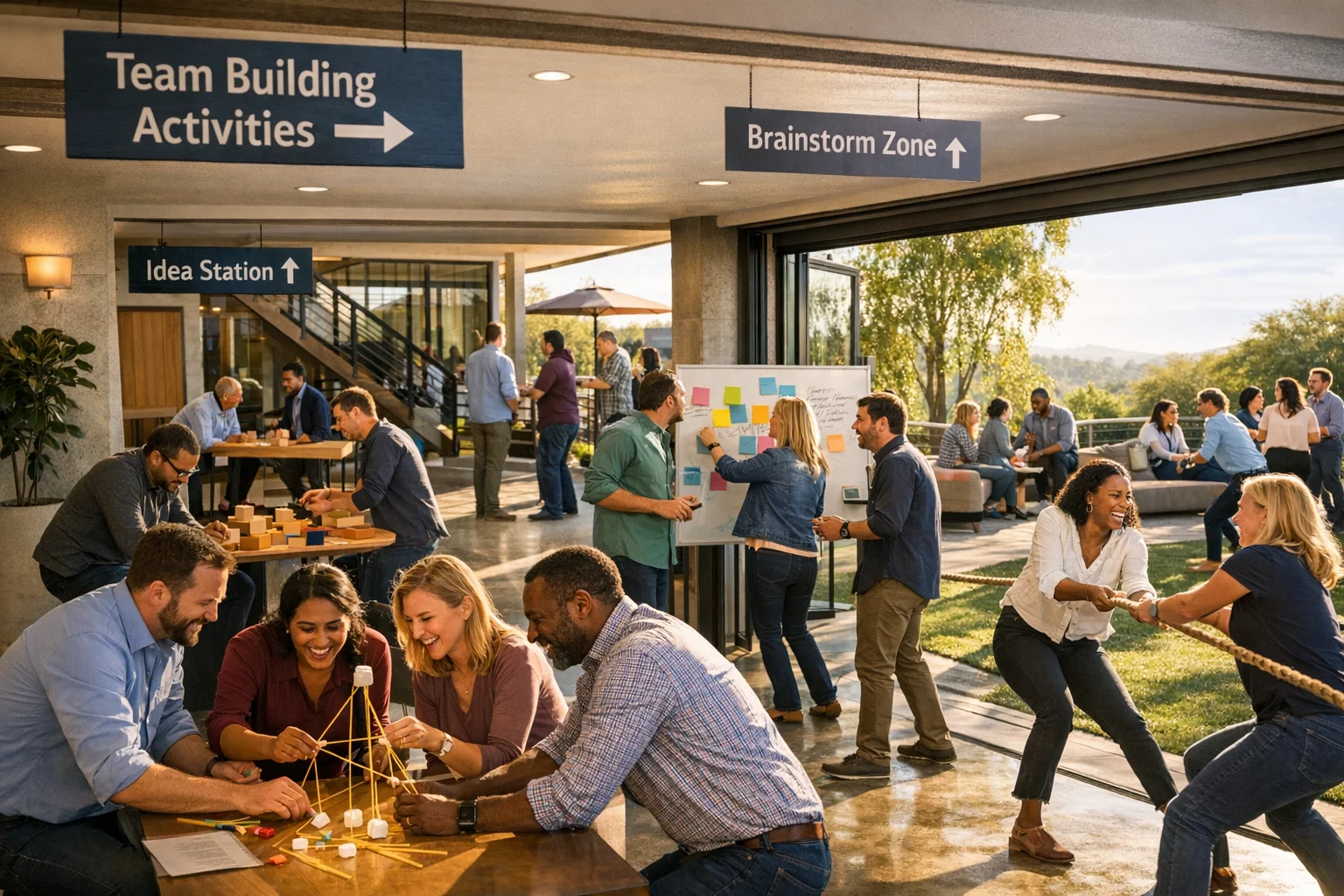
People don’t attend venues. They attend experiences the venue either unlocks or suffocates.
Pick the right space and participation climbs without you having to cheerlead it. Pick the wrong one and you’ll fight friction all day: dead acoustics, nowhere to move, line jams, and the slow fade of energy you can feel from the stage.
This is a practical guide to choosing team building venues people actually want to show up for. Clear criteria. Real tradeoffs. What to look for on a site visit. And staging plans you can borrow tomorrow.
At a Glance
- Start with purpose. Match the venue to the behavior you want: alignment, trust, collaboration, or celebration.
- Decide with constraints. Accessibility, flow, acoustics, weather plan, and flexible layouts beat glossy photos every time.
- Design for movement. Short, intentional walk-and-work cycles keep energy and creativity up.
- Test reality. Site-visit the Wi‑Fi, power, noise, and wayfinding like an attendee, not a planner.
- Have a Plan B. Weather, backup rooms, and communication trees turn hiccups into non‑events.
Start with outcomes, then pick the venue
Most teams work backward: shortlist spaces, then try to wedge the agenda into the footprint. Flip it.
Write the two or three outcomes you need. Examples: align on next‑quarter priorities, rebuild trust after a reorg, or strengthen cross‑team collaboration.
Now translate each outcome into behavior the room must enable:
- Alignment needs sightlines, clarity, and quiet moments to synthesize. Think tiered seating or clean ballrooms with strong AV and nearby breakout rooms.
- Trust needs face‑to‑face time in small groups and psychological safety. You’ll want semi‑private nooks and sound‑absorbing surfaces so voices don’t carry.
- Collaboration needs motion and shared artifacts. Favor open floors, writable surfaces, and zones for build‑test‑iterate cycles.
Short walking intervals consistently help idea generation. Venues with safe, easy walking loops or campus paths make it simple to add 5–10 minute walk‑and‑talks between segments. See the Stanford research on walking and creative ideation for why this matters. (aaalab.stanford.edu)
The non‑negotiables checklist for any team building venue
Photos will seduce you. The checklist saves you.
- Accessibility: Ramps, elevators that work, unobstructed routes, accessible restrooms, and seating choices. Confirm against the ADA Standards for Accessible Design. Don’t guess. (ada.gov)
- Capacity with margin: Not just headcount. Usable square footage after staging, sponsor tables, and food stations.
- Acoustics: Carpeting, panels, or baffling to keep speech intelligible. If you need to shout, the room is wrong.
- Lighting: Natural light for energy, controllable artificial light for screens. Beware of glare.
- Power & charging: Outlets along walls and columns. Extension policy. Floor pockets if you’re running stations.
- Wi‑Fi reality: Test with multiple devices in corners, not just near the router closet. Ask for the network use from a similar event.
- Layout flexibility: Can furniture move quickly? Are there storage rooms for resets? Can you zone the space without killing flow?
- Transit & parking: Under an hour door‑to‑door for most attendees beats marble lobbies. Every time.
- Food & water: Hydration visible and close. Food lines that don’t block entrances. Dietary needs pre‑collected.
- Weather plan: Indoor backup or tenting reserved, plus clear decision times. More on this below.
- Permits, insurance, alcohol policy: Know the venue’s rules before you promise anything.
Venue archetypes with real pros and cons
Picking a category first narrows the field fast. Here’s how these play in practice.
Hotels & conference centers
- Pros: Turnkey AV, breakouts on‑demand, weather‑proof. Staff used to corporate rhythms.
- Cons: Bland rooms, strict catering, can feel like “just another meeting.”
- Works for: Alignment and training days where predictability beats novelty.
Museums & cultural spaces
- Pros: Built‑in wonder, conversation starters, varied nooks.
- Cons: Noise bleed, limited furniture movement, after‑hours fees.
- Works for: Cross‑team connection and creative sprints.
Parks, campuses, and botanical gardens
- Pros: Space to move, fresh air, natural energy reset.
- Cons: Weather risk, sound control, power and Wi‑Fi scarcity.
- Works for: Collaboration games, trust building, wellness‑tinted programs.
Industrial lofts and warehouses
- Pros: Big canvases, flexible layouts, memorable vibe.
- Cons: Echo chambers without treatment, loading quirks, limited restrooms.
- Works for: Build‑something challenges, maker‑style activities.
Arenas, stadium suites, and sports facilities
- Pros: Novelty, built‑in wayfinding, private boxes for breakouts.
- Cons: Spread out, union rules, premium pricing.
- Works for: Celebration plus light team activities.
Retreat centers and offsites
- Pros: Immersive, nature access, lodging on site.
- Cons: Travel time, limited tech, fixed meal windows.
- Works for: Trust‑heavy work and multi‑day alignment.
Your own HQ
- Pros: Free, familiar, easy logistics.
- Cons: Habit traps, interruptions, no novelty halo.
- Works for: Short, focused sprints if you can really control the space.
Match activities to the room
A pattern we keep seeing: the activity is fine, the room kills it. Avoid that by mapping format to footprint.
- Movement‑based games: Need perimeter space, minimal chairs, and safe walking routes.
- Small‑group problem solving: Round tables or pods with 4–6 seats. Visual surfaces within reach.
- Build‑and‑demo cycles: Central plaza for pitches, zones around the edges for work time.
- Reflection and commitment: Quiet lighting, softer seating, and a clear ritual for capturing decisions.
Mix standing work, short walks, and sit‑downs. A 90‑minute block with two 5‑minute walk‑and‑talks does more than another slide. The creativity boost from walking isn’t magic; it’s giving brains a change of state at the right moment, which the Stanford walking study quantified clearly. (aaalab.stanford.edu)
Plan flow people actually follow
Great venues die on bad flow. A few field‑tested rules:
- Shorten the first line: Registration tables plus a visible “help” lane. Staff the door before the desk.
- Push refreshments forward: If snacks sit at the back, people pile up at the entrance later. Put water where people already are.
- Post real‑world wayfinding: Simple arrows on stands at eye level beat branded banners at knee height.
- Create decompression zones: A couple of high‑tops away from the crowd let folks reset, then re‑engage.
- Bathrooms within 90 seconds: If they’re farther, plan breaks longer and stagger dismissals.
Tech readiness without the headaches
You don’t need a spec sheet that reads like a network certification. You need dependable basics.
- Wi‑Fi that holds under load: Ask for performance data from a similarly sized event. Then test with multiple devices and a speed check in the furthest corner of your layout.
- AV you can actually run: One handheld and one headset mic backup, confidence monitor if presenting, and a spare HDMI cable coiled under the lectern.
- Power without tape jungles: Use floor pockets or cord covers. Confirm the venue’s policy on gaffer’s tape versus cable ramps.
- Hybrid‑friendly options: If remote folks join, choose rooms with clean sightlines, controlled windows, and stable uplink. Keep the setup simple and predictable rather than chasing specs you can’t guarantee.
Conference venues increasingly design for flexible furniture, tech reliability, and experience creation. That’s not hype; it shows up in planner priorities summarized in the IACC Meeting Room of the Future. (iacconline.org)
Weather, safety, and contingency planning
Outdoor or indoor‑adjacent venues need adult supervision from the weather desk.
- Decision thresholds: Agree on go/no‑go times with the venue for moving inside, tenting, or rescheduling.
- Shelter and shade: Map where people go fast if the sky flips. Don’t learn during the first raindrop.
- Heat and hydration: More water than you think, shade where queues form, and lighter programming during the hottest windows.
- Lightning and wind: Know where the alerts come from, who calls it, and how you’ll communicate in 30 seconds or less.
If you don’t have an internal safety lead, borrow brains from pros who think this way every day. The Event Safety Alliance curates weather and life‑safety guidance built for event producers. Worth the bookmark. (eventsafetyalliance.org)
Budget levers that keep quality high
What usually shifts the outcome isn’t a bigger budget; it’s smarter allocation.
- Shift from decor to flow: One extra registrar and visible signage beat another greenery wall.
- Buy flexibility: Pay for rooms you can flip quickly instead of more square feet you don’t use.
- Choose off‑peak windows: Sunday nights, weekday mornings, or shoulder seasons stretch budgets.
- Feed smarter: Staggered food stations, labeled dietary options, and water everywhere reduce waste and grumpiness.
- Trade on audience: If the venue gets exposure or content from your event, ask for value adds in AV or space.
Your 60‑minute site visit game plan
Show up with a plan and the venue will treat you like a pro.
- 00:00–00:10 Arrivals and routes: Park where attendees will. Time the walk. Check signage from the lot.
- 00:10–00:20 Room reality: Clap test for echo, check sightlines from back corners, and measure usable space after stage and stations.
- 00:20–00:30 Power and Wi‑Fi: Find outlets, floor pockets, and run a quick connectivity check at the edges.
- 00:30–00:40 Back of house: Loading dock, elevators, storage rooms, green room, trash route.
- 00:40–00:50 Restrooms, water, and noise bleed: Count fixtures, test doors, listen during real‑world activity if possible.
- 00:50–01:00 Neighbors and rules: Ask about quiet hours, union constraints, confetti bans, open flame, and reset times. Take photos of everything.
Two quick staging plans that work
Venue‑ready challenge ideas you can run anywhere
- [Photo | 20 pts]: Recreate a famous painting using only people and props you find.
- [Video | 40 pts]: Capture a 10‑second slow‑motion celebration in front of a venue landmark.
- [GPS Check‑in | 30 pts]: Find the spot where the view changes your perspective the most.
- [QR Code | 25 pts]: Scan the hidden code that reveals a two‑line riddle about this place.
- [Q&A | 35 pts]: What detail here most people miss on their first visit?
Where Scavify fits naturally
Scavify was built for this. When you need people moving, noticing, and collaborating, a flexible challenge format lets the venue do its best work without heavy setup.
- Challenge variety: Photo, video, GPS check‑ins, QR codes, multiple choice, and Q&A let you match the space.
- Ease of launch: Build once, reuse again. Swap a museum for a campus without rewriting everything.
- Automation: Schedule content drops, auto‑score, and spotlight moments on screens so momentum never dips.
- Scale flexibility: Works for 20 or 2,000 without you micromanaging every station.
FAQs
How much space do I need per person for team building?
Think in zones, not square feet. If your format includes movement and small groups, prioritize open floor area and breakout nooks over raw capacity numbers. During a site visit, simulate your densest moment and see if people can pass each other without turning sideways.
What’s the best indoor vs. outdoor mix?
Hybrid spaces win. Aim for an indoor base with fast outdoor access so you can add brief walk‑and‑talks and fresh‑air resets. Keep a weather‑tight Plan B for any outdoor block.
How do I make a standard hotel ballroom not boring?
Break the rectangle. Cluster tables into pods, add writable surfaces, use perimeter stations, and run short movement interludes. Lighting zones and a simple soundtrack during working blocks change the feel more than decor.
What accessibility checks matter most?
Routes, restrooms, and seating. Confirm step‑free paths, working elevators, door widths, and accessible seating with clear sightlines. Validate against the ADA Standards rather than assumptions, and publish accessibility info before people register. (ada.gov)
The venue’s Wi‑Fi is unpredictable. Now what?
Design offline‑tolerant activities. Cache materials locally, keep hybrid tech minimal, and request a dedicated SSID if possible. Test at the edges of the room during your site visit and plan a non‑network backup for any critical piece.
Should we serve alcohol during team building?
If the purpose is connection, light and late usually beats heavy and early. Know the venue’s policy, card everyone, and keep plenty of visible non‑alcoholic options. Don’t tie core activities to drinking.
How loud is too loud for activities?
If people lean in or repeat themselves, lower the music and add soft surfaces. You don’t need a meter. You need normal‑voice conversations across a table.
Any resources to guide venue selection trends?
Planners continue to emphasize flexible layouts and experience‑forward design. The IACC Meeting Room of the Future is a useful snapshot of those priorities. (iacconline.org)
Venues don’t create energy. They either make it easier or harder for you to create it. Choose for behavior, not brochure shots. Test reality. Keep people moving and connected. The rest takes care of itself.