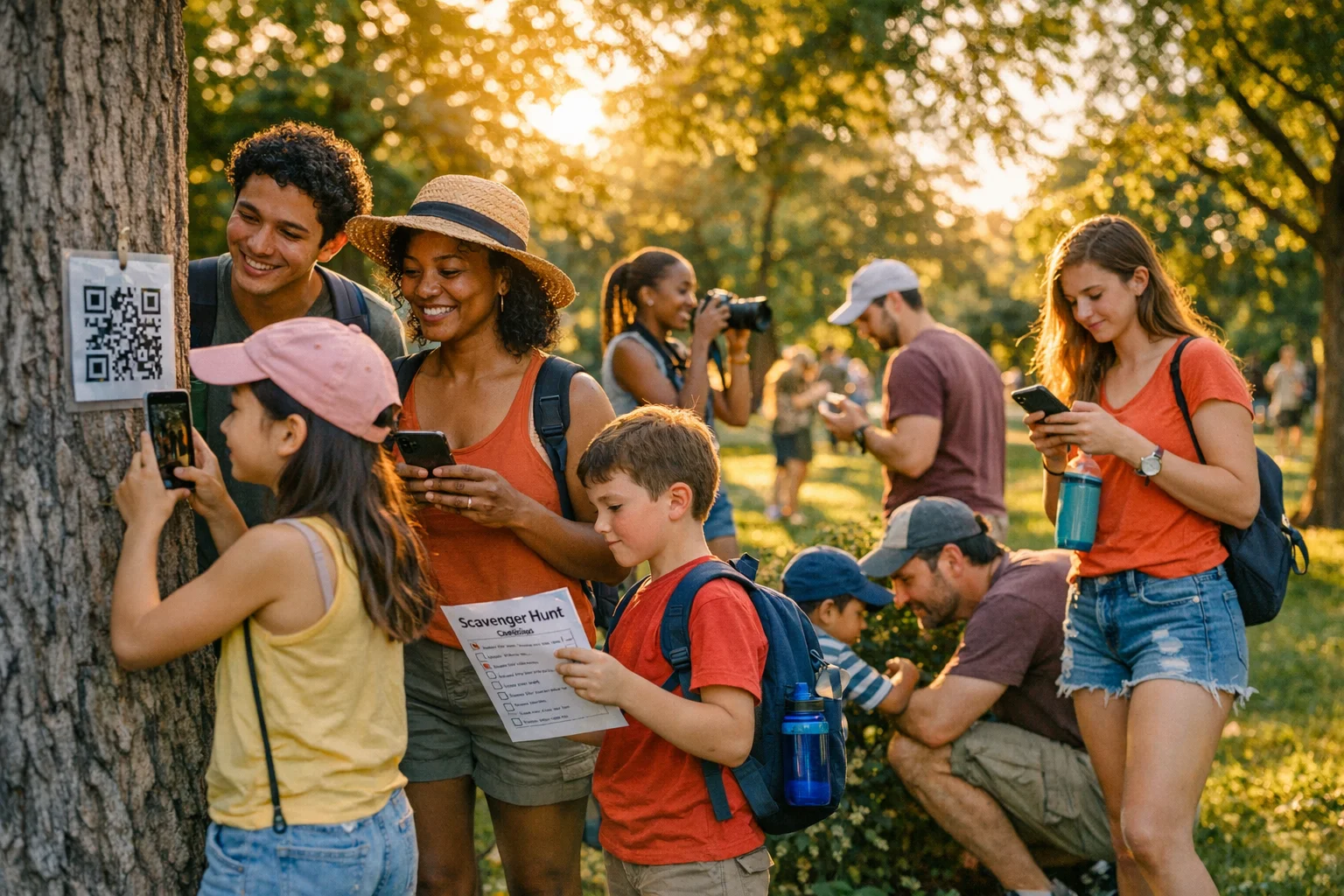
Summer is the season when participation either comes alive or melts. A good summer scavenger hunt tilts the odds in your favor: short bursts of movement, crisp prompts, obvious wins, and just enough mischief to make people forget they’re “doing an activity.”
Below is the playbook we use for backyards, public parks, and camps. It’s built from patterns we’ve watched succeed under blazing sun, lukewarm enthusiasm, and everything in between.
At a Glance
- Design for momentum. Mix quick wins with a few stretch challenges. Keep people moving and finishing.
- Respect the weather. Check the UV Index scale and the CDC’s HeatRisk guidance before you schedule.
- Make boundaries obvious. Maps, cones, tape, or GPS check-ins prevent accidental wanderers.
- Right-size logistics. Fewer props, more clarity. Use app automation when groups get large.
What makes a summer scavenger hunt actually work
- Small bursts, not marathons. Summer energy spikes, then dips. Short challenges keep the room (or field) alive.
- Choice beats force. Offer challenge variety so different personalities can contribute without stalling the group.
- Visible progress. Points, streaks, or a live leaderboard nudge even the quiet teams to take one more shot.
- Place-aware prompts. Write clues that reward noticing the environment, not just racing across it.
- Clear edges. Everyone should know exactly where they can and cannot go.
In our experience, the biggest unlock isn’t clever clues. It’s pacing. Most teams stall when they can’t find “the big one.” Give them three other ways to score while someone chases the masterpiece.
Quick planning checklist (heat, safety, gear, roles)
- Heat & sun: Review the local UV Index scale. If HeatRisk is elevated per CDC guidance, shift to morning/evening and increase shade, water, and rest prompts.
- Boundaries: Mark a safe perimeter. Use a simple map, cones, tape, or GPS check-ins at corners.
- Leave No Trace basics: Preview the 7 principles and adapt language for kids using these NPS-backed Leave No Trace activities for young learners.
- Light gear: Clipboards or phones, water, hat, sunscreen, basic first aid. For park/camp routes, skim REI’s primer on the Ten Essentials for hiking and camping to cover your bases.
- Roles: A short briefing beats long rules. Assign 1–2 floaters to answer questions and nudge pace. App admin (optional) runs timing, hints, and scoring.
Designing fair scoring and momentum
- Point tiers: Use a simple ladder like 10 / 30 / 50 / 100. Most tasks should be 10–30. Save 1–2 “wow” moments at 100.
- Wildcards: Add 1 creative wildcard worth mid-tier points to unstick teams.
- Tie-breakers: Fastest to submit the final task, or a live 60-second team challenge.
- Hints: Offer one free hint per team for any challenge. Second hints cost points. It keeps the energy moving.
Backyard scavenger hunt: fast, flexible, wildly fun
Backyards shine for family parties and neighborhood nights. Keep the radius tight and the props minimal. Use household objects and familiar landmarks, then write prompts that twist the obvious.
Here’s a ready-to-run backyard set:
- [Photo | 20 pts]: Balance three summer colors in one creative frame.
- [Q&A | 10 pts]: Which plant here “drinks” through big leaves? Name it.
- [Video | 40 pts]: Recreate a lawn game in ten seconds, no ball.
- [Multiple Choice | 10 pts]: Which bird calls at dusk from this yard?
- [QR Code | 30 pts]: Scan the hidden code taped under something that waters.
- [GPS Check-in | 50 pts]: Pinpoint the shadiest corner at 5 p.m. exactly.
Backyard tips:
- Keep it sprinty. Aim for many small completions. People want to chat and snack between wins.
- Use the clock. A short countdown adds urgency without needing harder clues.
- Respect neighbors. Keep audio tasks volume-smart and inside the boundary.
Public park scavenger hunt: bigger canvas, clearer boundaries
Parks invite movement and scenery. They also introduce ambiguity. Make the play zone unmissable and write clues that don’t require rangers to become referees.
Park-friendly challenge set:
- [Photo | 20 pts]: Frame three textures nature made, no repeats.
- [GPS Check-in | 30 pts]: Check in at the spot where two paths meet.
- [Q&A | 20 pts]: Which native tree drops the smallest leaves here?
- [Video | 50 pts]: Team human-sculpture of a trail sign, no words.
- [Multiple Choice | 10 pts]: This park opened in which decade?
- [QR Code | 40 pts]: Find the code near where wheels slow down.
Park tips:
- Boundary beacons. Mark corners with flags or digital check-ins so no one drifts into parking lots or off-trail zones.
- Shade strategy. Rotate “cool-down” tasks under trees or shelters when HeatRisk is elevated per CDC guidance.
- Leave it better. Include one micro task that models ecological care without performative cleanup.
Camp scavenger hunt: cabins, counselors, and multi‑day play
Camps are built for friendly rivalry. Cabin vs. cabin. Counselors as cheeky gatekeepers. Add arc challenges that span days while keeping daily wins bite-sized.
Camp challenge set:
- [Photo | 20 pts]: Team spell the camp motto using only bodies.
- [Video | 40 pts]: Teach a 5-second knot trick to a counselor.
- [GPS Check-in | 30 pts]: Check in at the loudest spot at lunchtime.
- [Q&A | 20 pts]: What safety rule appears most around the water?
- [QR Code | 50 pts]: Scan the code hidden near a morning bell.
- [Multiple Choice | 10 pts]: Which trail color starts closest to cabins?
Camp tips:
- Stations, not chaos. A few staffed stations prevent gridlock and keep things safe near water and roads.
- Cabin arcs. Run a small daily hunt and a longer weeklong storyline that pays off at closing campfire.
- Counselor cameos. Use them as clue-keepers and bonus-quest judges. Morale goes up, not just points.
Themed variations that keep energy high
- Summer classics: Water balloons, popsicles, sunscreen, flip-flops as visual anchors.
- Nature detective: Bark textures, bird calls, leaf shapes, cloud types.
- STEM outside: Shadows at different times, simple compasses, angles in playground gear.
- Local history: Statues, plaques, street names, founding dates.
- Photo safari: Composition prompts that teach framing, light, and perspective.
A pattern we keep seeing: themes work when they’re light seasoning, not a choke point. The clue should still be solvable without a degree in the topic.
Heat, sun, and water adaptations for hot days
- Schedule smart. Use the CDC’s HeatRisk guidance to decide whether to move play to morning or evening.
- Check UV quickly. The EPA’s UV Index scale helps set expectations on hats, sunscreen, and shade.
- Design cool-downs. Add shady “brain break” tasks so teams rest without feeling benched.
- Hydration as gameplay. Make water bottle refills a quick-scoring task to normalize breaks.
- Mist and shade. Pop-up shade, damp towels, and spray bottles keep spirits up when the sun insists otherwise.
Accessibility from the start
- Route choice. Always include low-mobility paths and ground-level finds.
- Multi-sensory prompts. Sound, touch, and observation tasks reduce reading load.
- Clear alternatives. Any physically intense task should have an equal-point swap.
- Short briefings. Fewer rules and larger text win. Visual examples beat paragraphs.
Simple run‑of‑show templates
- Backyard (short burst): Quick welcome, boundary demo, 20–30 minutes of play, rapid tally, photo collage reveal.
- Park (standard set): Welcome at shade, safety check, handoff map/app code, play block, wrap at a landmark with quick awards.
- Camp (arc model): Daily micro-hunt plus a long-form thread. Reveal big-picture clue fragments at morning assembly.
What usually shifts the dynamic is how quickly teams see a first win. Start with one ultra-obvious challenge everyone completes in the first two minutes. It jump-starts participation without a pep talk.
Using an app (like Scavify) to make it smooth
When groups scale, paper slows you down. An app keeps momentum: automated scoring, GPS or QR code verification, photo/video submissions, leaderboards, and timed unlocks. It also reduces prop scatter and lets you push hints quietly when the heat (literal or social) starts to sap energy. Scavify was built for exactly this kind of summer play: flexible challenges, browser or app access, and easy launches without a production crew.
Ready-to-use challenge banks
Use these banks as plug-and-play modules. Mix across settings to fit your space and group.
Backyard summer bank
- [Photo | 10 pts]: Three objects making the loudest color combo here.
- [Video | 30 pts]: Invent a 5-step backyard handshake, no words.
- [Q&A | 20 pts]: Which herb smells like pizza when rubbed?
- [Multiple Choice | 20 pts]: Which insect is most active at dusk?
- [QR Code | 40 pts]: Find the code hiding near the quietest door.
Park summer bank
- [Photo | 20 pts]: Circle, triangle, square found in natural shapes.
- [GPS Check-in | 30 pts]: Exact center where shade meets sun.
- [Q&A | 20 pts]: Name a plant with a protective adaptation.
- [Video | 40 pts]: Team becomes a statue from local history.
- [QR Code | 50 pts]: Scan at the safe view of moving water.
Camp summer bank
- [Photo | 20 pts]: Cabin initials spelled with found sticks only.
- [Video | 50 pts]: Teach a safety tip in under eight seconds.
- [Q&A | 20 pts]: What’s the first thing posted on the bulletin?
- [Multiple Choice | 30 pts]: Which whistle pattern means gather now?
- [GPS Check-in | 40 pts]: Quiet place used for reflective moments.
Water-friendly twists (sprinklers, splash pads, lakeshores)
- [Photo | 20 pts]: Catch a water droplet midair, no burst mode.
- [Video | 40 pts]: Team-conducted shade test with hat or towel.
- [QR Code | 30 pts]: Hidden near sun safety supplies, ask first.
- [Q&A | 20 pts]: Two signs of too much sun exposure.
- [Multiple Choice | 30 pts]: Best spot to refill water bottles here.
Night glow edition (cooler temps, high vibe)
- [Photo | 20 pts]: Long-exposure light trail spelling team name.
- [Video | 30 pts]: Silent charades under glow, one take only.
- [QR Code | 40 pts]: Code hides where lantern shadows cross.
- [Q&A | 20 pts]: Which nocturnal sound do you hear first?
- [GPS Check-in | 30 pts]: Safest lit path midpoint after dark.
FAQs
How long should a summer scavenger hunt last?
Most work best in a compact block that keeps energy high without heat fatigue. For backyards, think short sessions. Parks and camps can stretch longer with built-in shade breaks and water refills.
What ages do these ideas fit?
The formats scale. Use simpler language and bigger visual cues for younger kids. Offer choice-based challenges so mixed ages contribute without bottlenecks.
How do I set safe boundaries in a park or camp?
Show the perimeter physically and digitally. Use cones, tape, or GPS check-ins at corners. Keep a visible basecamp in shade where questions and water live.
What if the day is hotter than expected?
Check the CDC’s HeatRisk guidance the morning of your event. If risk is elevated, move to cooler hours, add shade and rest prompts, and keep water tasks frequent. The EPA UV Index helps set sun-safety expectations.
Do I need prizes to make this work?
Small, immediate recognition beats big, delayed rewards. Quick shoutouts for creativity or teamwork keep momentum without turning it into a prize chase.
Can we run this without phones?
Absolutely. Use printed cards, clipboards, and a simple scoreboard. Phones unlock photos, GPS check-ins, and instant tallies, which helps with larger groups.
How do I prevent teams from bunching up?
Offer parallel options in each point tier. Stagger any single-location tasks and add a few roving wildcard prompts so there’s always something open.
How many challenges should I write?
Enough to keep teams busy with choice, not so many that no one finishes anything. Most groups thrive when they can always see two easy options and one stretch goal.
If you want the admin side to feel breezy, use an app to automate timing, scoring, and submissions. It keeps the fun parts front and center and the logistics invisible.
References you can trust for planning and safety: review the UV Index scale, CDC’s HeatRisk guidance, NPS-backed Leave No Trace activities for young learners, and REI’s overview of the Ten Essentials for hiking and camping.