You're planning an Easter scavenger hunt for teens and don't want it to feel like a kids' egg dash with taller participants. Good. Below is a practical playbook with ready‑to‑use clues, challenge sets, scoring that actually drives momentum, and an easy way to run it from phones without the privacy headaches.
At a Glance
- Design for autonomy and choice. Let teens pick paths, roles, and challenges.
- Mix competitive sprints with collaboration. Short timers, team combos, and assist bonuses.
- Use modern clue formats. QR, GPS, short video, social-style prompts, not just riddles.
- Keep sharing private by default. Set clear rules; use controlled spaces for photos.
- Points that matter. Tiered difficulty, streaks, and small surprises beat one giant prize.
Why teen Easter hunts flop (and how to fix them)
Most teen hunts fail for the same three reasons: the clues feel kiddie, the game locks players into one linear path, and the only currency is plastic eggs. A pattern we keep seeing: once teens sense they're being managed, participation drifts.
What usually shifts the dynamic is simple: build for autonomy, competence, and relatedness. That’s straight out of self‑determination theory, which consistently shows engagement increases when people can choose, demonstrate skill, and connect with others. You don’t need the textbook to see it in a gym or school courtyard, but the research backs it up. For context, see this overview of autonomy, competence, and relatedness in youth settings. (peer‑reviewed overview) (pmc.ncbi.nlm.nih.gov)
Gamification research points the same direction: points and leaderboards help a bit, but the real lift comes when you combine them with collaboration and meaningful feedback loops. Meta‑analyses in education repeatedly find better outcomes when competition is augmented with social elements. (meta‑analysis, Educational Psychology Review) (link.springer.com) and (systematic review/meta‑analysis, IJERPH) (pmc.ncbi.nlm.nih.gov)
A quick planner: the pieces that actually matter
Build around these decisions. They handle 90 percent of the friction later.
- Location: One contained area (campus, church grounds, park, mall) keeps movement fast and supervision light. Add a “roaming zone” only if you have enough adults to monitor.
- Format: Team‑based play with 3–6 per team usually balances energy, ideas, and speed without sidelining quieter players.
- Challenge mix: Aim for roughly 50 percent quick wins, 30 percent creative mid‑range tasks, 20 percent harder puzzles or multi‑step objectives. Variety beats volume.
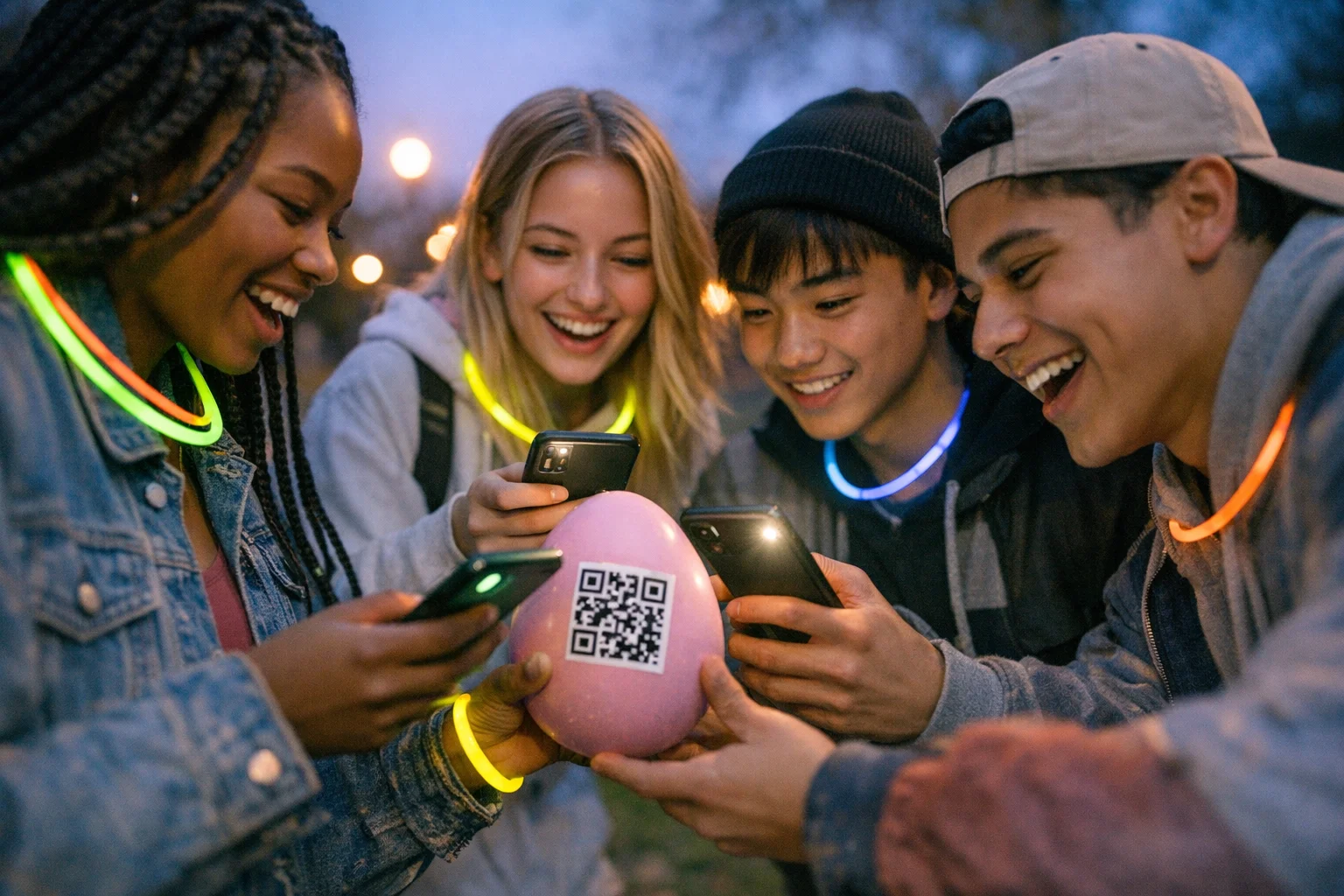
- Props: A handful of QR codes, a few glow items, and one or two simple ciphers travel far. Eggs become containers for QR codes, clue fragments, or small power‑ups, not just candy.
- Photo/video rules: Decide what can be shared publicly and what stays private at the start. More on privacy below with concrete guardrails.
- Adults’ role: Stationed as Judges/Guides at choke points, not shadows trailing teams.
Teen‑proof clue styles that feel modern
Riddles still work, but lightweight, visual, and location‑smart formats land best with teens. Rotate these in.
- QR ping: Scan to unlock a micro‑task or a map pin. Great for indoor corridors and rain plans.
- GPS check‑in: A pin unlocks points only within a small radius. Teens get the satisfaction of “we found it” without needing staff at each stop.
- Short‑form video prompt: 8–12 seconds, vertical, one take. Humor beats polish.
- Duet/Remix: Recreate a pose, lyric, or angle from a provided photo or clip.
- Cipher lite: A 1‑line substitution or acrostic that points to a place or person.
- Chain clue: A clue that only makes sense once you’ve collected two others.
Ready‑to‑use challenge sets
Pick a set or mix across them. Keep distances short, timers present but not oppressive, and instructions tight.
Outdoor park or neighborhood
- [Photo | 20 pts]: Mirror a statue’s pose with exactly three teammates.
- [GPS Check‑in | 30 pts]: Stand where shadows form an X at noon.
- [Video | 40 pts]: Bunny‑hop relay across chalk “lily pads” without touching lines.
- [QR Code | 25 pts]: Scan the sticker hiding under a bench that faces east.
- [Q&A | 35 pts]: The sign with rules mentions wheels twice. What two words?
Indoors: school, church, or community center
- [Photo | 25 pts]: Recreate a yearbook pose in front of the oldest hallway.
- [QR Code | 30 pts]: Find the code where today’s announcements become yesterday’s news.
- [Multiple Choice | 20 pts]: Which room number is a palindrome near the gym?
- [Video | 40 pts]: Silent lip‑sync to a 5‑word Easter phrase in the stairwell.
- [Q&A | 30 pts]: What object hides behind glass but rings when freed?
Night glow hunt (dusk or gym lights down)
- [Photo | 30 pts]: Spell “EGG” with glow sticks, letters floating in air.
- [Video | 35 pts]: Glow‑trail follow: one teammate traces, others guess the word.
- [GPS Check‑in | 25 pts]: Meet at the brightest non‑streetlight on the field.
- [QR Code | 30 pts]: Blacklight ink code under the scoreboard ledge.
- [Q&A | 40 pts]: Count lit windows on the south side. Submit the total.
Youth group or campus ministry set
- [Photo | 25 pts]: Find a symbol older than everyone here. Recreate it with hands.
- [Video | 35 pts]: Three‑word gratitude chain, each person adds a word.
- [QR Code | 30 pts]: Code hides where announcements meet coffee.
- [Q&A | 30 pts]: Which mural square shows a sunrise? Row and column.
- [Multiple Choice | 25 pts]: Which door color changes by season?
Mall or town center
- [Photo | 30 pts]: Capture something “pastel” that isn’t clothing.
- [Video | 35 pts]: One‑take escalator wave: high‑five a teammate in motion.
- [QR Code | 30 pts]: Code near a directory without a map.
- [Q&A | 25 pts]: Which store name would make a great band? Justify in 10 words.
- [Photo | 40 pts]: Team pyramid with a stranger photobomb (ask first).
Virtual or hybrid
- [Q&A | 25 pts]: Decode: “Uijt sppn lopxt pme tupsjft.” What’s the place?
- [Photo | 30 pts]: Find three objects that make a perfect pastel gradient.
- [Video | 35 pts]: 8‑second stop‑motion: egg becomes something unexpected.
- [Multiple Choice | 25 pts]: Which emoji is not an egg: 🥚 🥚 🥚 🍡?
- [Q&A | 40 pts]: Who first cracks the cipher gets a bonus code word.
Phones, photos, and privacy done right
Teens will want proof of glory. Give them safe rails.
- Default to private. Keep sharing inside a closed app or private album. If you use social, make the hashtag private and clarify what can’t be posted: faces of non‑participants, visible addresses, school logos, and geotags. See these practical privacy‑by‑default tips for families and teens for easy settings to review. (Common Sense Media guide) (commonsensemedia.org)
- No location trails. Disable live location and strip metadata on shared media.
- Consent is a rule, not a vibe. Always get a yes before featuring someone.
- One safe public outlet. If you want a highlight reel, collect clips inside the game, then post a curated recap.
A quick reality check on platforms teens actually use helps when you design prompts (vertical video, quick takes, remix culture). The latest U.S. snapshot still puts YouTube on top with heavy teen use, followed by TikTok, Snapchat, and Instagram. (Pew Research Center, Teens, Social Media & Technology 2023) (pewresearch.org)
Scoring that keeps momentum without forcing cringe
Points should reward speed, creativity, and teamwork without turning the whole thing into a grind.
- Tiered difficulty: Quick wins at 20–30 pts, skill challenges at 30–40, multi‑step tasks higher. Publish the ranges, not every value, so you can nudge live.
- Streaks: 3 completes in a row within 8 minutes earns a small bonus.
- Assist bonuses: Helping another team unlocks a one‑time “ally” bonus. Research suggests pairing competition with collaboration increases engagement and learning outcomes. (meta‑analysis) (link.springer.com)
- Creative scoring: Judges can mark standout submissions with a small “style” bonus to keep artistry alive.
- Hidden power‑ups: A few eggs hold codes that double the next task’s points.
For the theory‑minded: broader reviews show that elements like clear goals, feedback, progress indicators, and challenges are the gamification pieces most associated with better motivation and behavior change in learning contexts. It maps neatly to hunts. (IJERPH review) (pmc.ncbi.nlm.nih.gov)
A sample 60–75 minute flow that runs smooth
Time boxes keep energy high. Use this as a flexible model.
- Arrival and setup (about 10 minutes): Welcome, team formation, rules, privacy note, and a 2‑challenge practice round so everyone learns the submission flow.
- Main play (about 40–50 minutes): Open the full challenge list with a soft midpoint reminder. Rotate a roaming Judge to hotspots. Trigger one surprise mini‑challenge halfway.
- Final sprint (about 5 minutes): Announce “last task counts double.” The room snaps back to attention.
- Wrap (about 10 minutes): Tally, highlight five great submissions, announce winners, hand out prizes, and release the curated recap plan.
Using an app to make it effortless (and better)
You can run hunts with paper and group texts, but tooling helps with scale, scoring, and privacy.
In our world, app‑based hunts cut the friction: you load challenges once, teams submit photos/videos/GPS check‑ins in one place, judging and scoring happen live, and the leaderboard keeps everyone oriented without you yelling over the din. Scavify is built for exactly this: challenge variety, automation, real‑time scoring and leaderboards, and browser + app flexibility so anyone with a smartphone can play without downloads if needed. It also scales from one youth group to a multi‑site event without becoming your full‑time job.
Prizes teens actually want
Skip kiddie baskets. Think choice and experiences.
- Flexible rewards: Snack run gift cards, late pass for a school event, music or app credits, or a “song DJ” slot at the next rally.
- Micro‑awards: Fun superlatives with small tokens: Best One‑Take, Quiet Assassin, Most Creative Fail.
- Experiences: Early access to a space teens actually care about, or a “build the next hunt” invite with real influence.
FAQs
How do I make an Easter scavenger hunt feel age‑appropriate for teens?
Build for choice, speed, and social proof. Use modern formats (QR, GPS, short video), add creative prompts, and keep rules light but clear. Aim for team‑based play and publish a few example submissions so teens see what “good” looks like.
What’s a good number of challenges for a one‑hour hunt?
Offer abundance so teams can choose. Around 20–30 bite‑size options usually works for a 60‑minute window, with a few higher‑value multi‑steps that only some teams will pursue.
Should we still use eggs?
Yes, but as containers. Hide QR codes, cipher fragments, or power‑up codes in eggs. Candy is optional. Surprise utility beats sugar.
How do we handle photos and privacy with teens?
Default to a closed system for submissions and set public‑sharing rules up front: no geotags, no faces of non‑participants, and consent for every featured person. If you need a primer, these practical privacy tips for families and teens are solid. (Common Sense Media) (commonsensemedia.org)
Do leaderboards kill creativity?
Not if you balance them. Keep a leaderboard for momentum, then add style bonuses and collaboration points. Research shows competition plus collaboration outperforms competition alone. (Educational Psychology Review) (link.springer.com)
What if the group is mixed ages or abilities?
Make difficulty obvious with point values and give multiple ways to earn: pure speed tasks, creative prompts, and one or two puzzles where a quiet solver can shine.
Any data‑backed tips on what formats teens enjoy?
Short, visual, remix‑able tasks align with where teens spend time. Current national data shows YouTube at the top, with TikTok, Snapchat, and Instagram also heavily used by teens, which maps to vertical video and photo‑forward prompts. (Pew Research Center, 2023) (pewresearch.org)
How do we keep the vibe high without constant announcements?
Use in‑app nudges: a midpoint push, a surprise mini‑challenge, and a “last task counts double” alert. Show a live leaderboard on a screen so energy self‑sustains.
Designing for teens isn’t about louder themes or bigger baskets. It’s about autonomy, visible progress, and the thrill of making something together. Build that, and even the too‑cool crew sits up and plays.
For deeper context on why these mechanics work, see the research on gamification elements tied to motivation (IJERPH review) and how collaboration augments competition in learning games (Educational Psychology Review meta‑analysis), plus a quick refresher on autonomy, competence, and relatedness for youth engagement (peer‑reviewed overview) and current teen platform habits to inform prompt formats (Pew Research Center). (pmc.ncbi.nlm.nih.gov)