Solutions
Your first hunt, live this afternoon.
Free to start · No download for participants
Explore scavenger hunt ideas, clues, and formats for every age group, occasion, and setting, with simple planning tips.
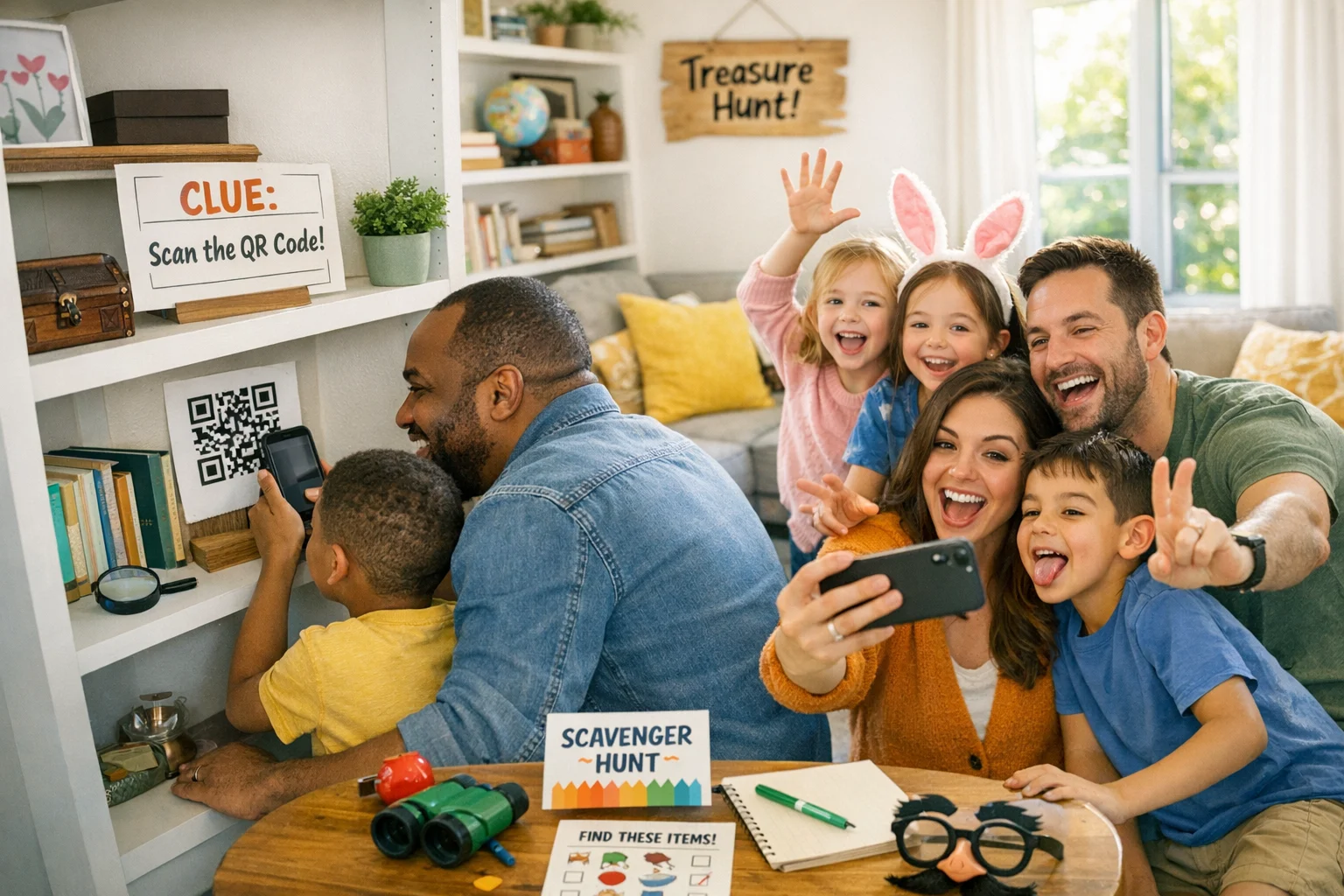
If you’ve got four walls and a willing crowd, you’ve got everything you need for a memorable indoor scavenger hunt. The best ones don’t feel like a worksheet with a timer. They feel like a story you get to step into, with just enough friction to make a win feel earned.
An indoor scavenger hunt is a guided search through a home, office, classroom, or venue using prompts to find items, unlock clues, or complete creative photo/video challenges. Done right, people stop spectating and start participating.
Two reasons it works nearly everywhere:
In our experience, great indoor hunts share a few patterns.
Over time, a pattern keeps showing up: variety drives attention. Mix 3–5 of these.
When you want external inspiration or printable formats, the Smithsonian has approachable examples you can adapt at home: the Luce Center’s scavenger hunts and the I See Wonder hunt are simple, clear, and flexible. (americanart.si.edu)
Pre-readers need pictures, colors, and immediate wins. Keep paths short and visible. Place clues at eye level. If there’s decoding, it’s matching shapes or colors, not letters.
Challenge examples: - [Photo | 20 pts]: Find something round and red. Snap it smiling. - [QR Code | 30 pts]: Scan the sticker near the tallest plant. - [Multiple Choice | 20 pts]: Which bin has blocks? Blue, yellow, or green? - [Q&A | 20 pts]: What animal is on the fridge magnet by the handle? - [Photo | 30 pts]: Recreate the stuffed bear’s pose with your team.
Readers can handle short riddles, simple ciphers, and multi-step prompts. Build a story thread across 3–4 clues and end with a reveal.
Challenge examples: - [Q&A | 30 pts]: Count stairs. Use the number to open lockbox code: _ _. - [Photo | 40 pts]: Everyone in a hat that isn’t a hat. Be creative. - [Multiple Choice | 30 pts]: The kitchen clock shows 3:15. Where’s the next clue? - [QR Code | 40 pts]: Scan the code hiding near the “coldest” place. - [Video | 40 pts]: Act out a thunderstorm using only props from one drawer.
Most teen groups light up when there’s a visible leaderboard, a twist that forces collaboration, and at least one clue that feels “unsolvable” until it suddenly isn’t. Add optional side quests for bonus points so nobody stalls.
Challenge examples: - [Q&A | 50 pts]: Decode the acrostic’s initials to reveal the hiding room. - [Photo | 60 pts]: Symmetry hunt: capture three perfect reflections in one shot. - [Multiple Choice | 50 pts]: Which book title hides the next clue: Voyage, Static, Echo? - [QR Code | 60 pts]: Code splits into two halves across rooms. Combine to proceed. - [Video | 60 pts]: Film a 6‑second Rube Goldberg action using only kitchen items.
The grown-up sweet spot: witty phrasing, callbacks to shared jokes, and tasks that create social artifacts people will later send to each other. You want brainy more than sweaty.
Challenge examples: - [Q&A | 70 pts]: Cryptic clue: “Spare change hides under cover.” Where is it? - [Photo | 70 pts]: Album cover recreation using only items in this room. - [Multiple Choice | 60 pts]: Two truths and a lie about the host. Pick the lie. - [QR Code | 60 pts]: Scan to receive a pun that points to the wine rack. - [Video | 80 pts]: 10‑second heist trailer set in the pantry. Title card included.
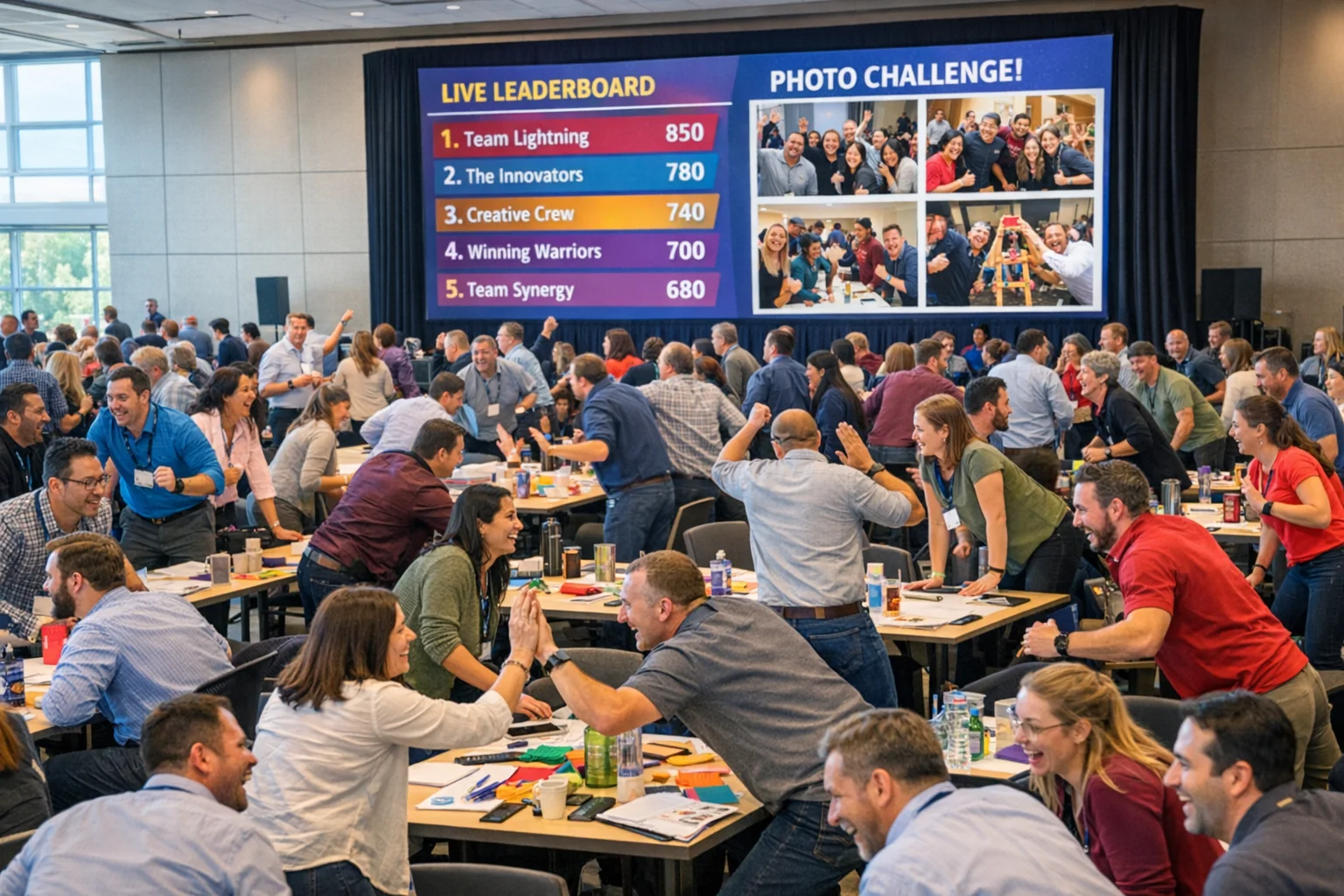
Most teams don’t need forced trust falls. They need light structure, quick feedback, and chances for different people to lead moment to moment. A well-built office hunt surfaces how a team communicates under time pressure while keeping stakes low and humor high.
Patterns that work:
Challenge examples: - [Q&A | 80 pts]: Policy puzzle: match each value to its poster’s hidden word. - [Photo | 80 pts]: “Things arranged by color” still life in the break room. - [Multiple Choice | 70 pts]: Which meeting room name is an acronym? Find why. - [QR Code | 70 pts]: Scan the sticker by the oldest office artifact. - [Video | 90 pts]: 8‑second “handoff drill” showing flawless cross-team baton passing.
You don’t need a mansion. Small apartments and single-room venues actually force cleaner design.
Challenge examples: - [Photo | 30 pts]: Find three textures in arm’s reach. Compose a close-up. - [Q&A | 30 pts]: riddle: “I’m where things start hot, end cold.” - [Multiple Choice | 30 pts]: Which plant pot has a hidden mark? Left, center, right? - [QR Code | 40 pts]: Under something that opens but isn’t a door. - [Video | 40 pts]: 5‑second silent film: “Escape from the Sofa.”
Design for different bodies, senses, and comfort levels from the start.
For family and classroom hunts, remember the aim isn’t just winning; it’s movement, curiosity, and participation. That aligns neatly with public health guidance on activity and with how museums scaffold discovery using simple prompts, as seen in the Luce Center’s scavenger hunts and the I See Wonder activity. (americanart.si.edu) And yes, short, lively movement bursts can support daily activity targets for kids per the CDC’s guideline. (cdc.gov)
A rhythm that rarely fails:
Scoring can be points per challenge or first-to-finish with penalties for missed tasks. What usually shifts the dynamic is a brief debrief. Ask: What clue stalled you and why? Who noticed something others missed? That’s where the real team-building lives.
If you’re designing for kids, keep stakes playful. The AAP’s perspective on child-led play is a good gut-check: let them lead inside clear boundaries. (publications.aap.org)
Paper works beautifully for tiny groups and simple spaces. An app shines when you want:
Scavify was built for this exact use case: flexible challenge types, quick setup, browser or app access, and automation that removes the clipboard work. Use it when you care about smooth orchestration more than hand-cutting clue cards.
Most land well between 20 and 45 minutes. Shorter for very young kids or tight rooms. Longer if you’re adding multi-step puzzles or a storyline.
Aim for 8–15 total prompts. That gives you room for variety without overwhelming the space or attention span.
Think recognition over expense. Photo wall of “best moment,” tiny trophies, themed snacks, or a team privilege coupon. The memory usually beats the prize.
Use phones for photo/video challenges, write clues on sticky notes, and place a few QR codes on screen-only devices if you’re using an app. You can also mirror a scoreboard to a TV.
Create two micro-routes and alternate groups. Hide clues in containers rather than on surfaces. Use table-top puzzles to avoid crowding.
Set clear boundaries. Mark no-go zones, avoid high shelves, skip hiding in appliances, and use painter’s tape. Keep at least half of clues reachable without climbing or bending.
Borrow from museum practice: clear, simple prompts that direct attention and spark conversation. The Smithsonian’s at-home and on-site examples are clean models you can adapt. (americanart.si.edu)
It can contribute. Short bursts of movement across a session add up. See the CDC’s 60‑minute guidance for ages 6–17. (cdc.gov)
Dial up deduction over collecting. Use layered clues, visible leaderboards, and optional side quests. Give them one “impossible” clue that pays off with teamwork.
When you want automation, media challenges, and live scoring without a moderator juggling everything. For tiny groups and simple spaces, analog still works great; for mixed ages, photos and QR codes inside an app keep it smooth.
If you want a ready-to-run indoor hunt with photo/video challenges, QR unlocks, and live scoring, Scavify can host the whole experience without you babysitting a spreadsheet. Or borrow the structures here and make your own. Either way, make it active, varied, and just clever enough to earn a grin.