Solutions
Your first hunt, live this afternoon.
Free to start · No download for participants
Discover practical team building ideas, examples, and activities that boost morale, communication, and collaboration.
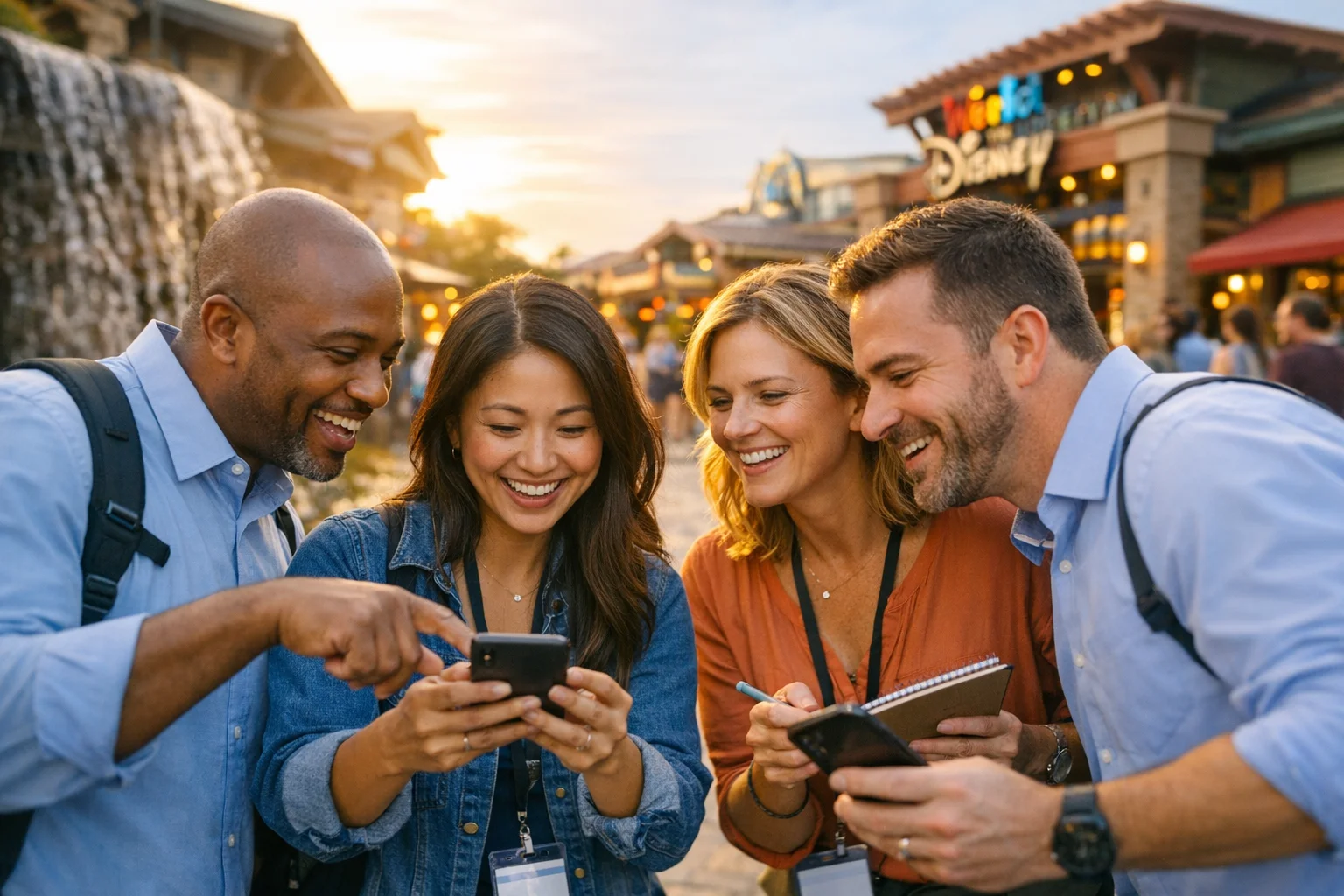
If you’re planning a meeting or incentive trip at Disney, you don’t need more glitter. You need activities that wake people up, create honest collaboration, and still play nicely with Disney’s operational reality. This guide delivers the creative ideas, formats, and run‑of‑show details that actually work on Disney property.
Disney is built for immersion, storytelling, and logistics at scale. Done right, those ingredients translate into team experiences that feel memorable and still move the needle on trust and collaboration.
Disney’s meetings arm actively supports planners with spaces, production resources, and even curated team‑building sessions. Their current lineup emphasizes play‑based learning and purposeful networking to increase retention and ROI, which aligns well with corporate objectives. See the official overview of corporate event formats and team‑building sessions at Walt Disney World. (disneymeetingsandevents.com)
If you’re on the West Coast, Disneyland Resort’s meetings footprint includes three hotels and extensive meeting space, with access to specially priced tickets for attendees and guests. It’s walkable, compact, and efficient for tight agendas. (disneymeetingsandevents.com)
For executive education elements, the Disney Institute offers facilitated leadership courses you can weave into a program for an added dose of culture and service excellence. (disneyinstitute.com)
A pattern we keep seeing: the best Disney team events work with Disney’s systems, not around them.
Different trip purposes call for different structures. These formats consistently land.
These are practical, field‑tested concepts tuned for Disney environments. Mix and match based on purpose, time, and mobility needs.
1) Storyboard Sprint (in‑room). Teams translate a business challenge into a 6‑panel “guest journey” comic using sticky notes and markers. Quick share‑outs, then a facilitator ties patterns back to CX principles.
2) Props & Pivots (in‑room). Each table gets a bag with odd props. Solve mini challenges that require fast role clarity and iteration. Think playful, not corny.
3) Hotel Grounds Quest. A light competitive hunt across your resort’s public areas. Wayfinding, observation, and short video tasks. Keep navigation tight and safe.
4) Disney Springs Collaboration Loop. Rotating teams complete culinary tastings, brand observation prompts, and short interviews with willing cast (where appropriate). Cap at a central plaza with a scoreboard reveal. Reference the Disney Springs event footprint. (disneymeetings.wdprapps.disney.com)
5) EPCOT Overlay: DuckTales + Debriefs. Teams play DuckTales via the Play Disney Parks app. Your overlay asks for one insight per pavilion about communication under constraints, then a 20‑minute debrief back at your base. Link to the official DuckTales World Showcase Adventure. (disneyworld.disney.go.com)
6) Seasonal Hunt Booster. During EPCOT festivals, layer a reflection prompt onto an official scavenger hunt like Remy’s Hide & Squeak. Keeps logistics simple and still generates team artifacts for your recap. (disneyworld.disney.go.com)
7) Photo Ethics Challenge (anywhere). Give teams ambiguous photo prompts that require negotiation: “Capture ‘shared ownership’ in one frame.” Review choices and reasoning.
8) The Five Minutes. Mid‑day, your app drops a surprise five‑minute challenge. Short, high‑energy spikes beat one long, exhausting gauntlet.
9) Resort Riddle Run. A puzzle path using signage, art, and architectural details around the hotel. End at a private reception for a natural transition.
10) Leadership Lens Walk. Small groups take a 30‑minute observation lap through a themed area with one focused lens (e.g., “on‑stage vs. backstage”). Quick huddles capture what to steal for your own CX.
11) Creative Studio Session. If your venue offers an activation space, run a prototyping workshop tied to your strategy. Keep outputs light and tactile.
12) Recognition Rally. Turn a celebration into a mission: teams collect peer‑nominated kudos and surprise‑and‑delight moments, then present a “highlight reel” at dinner.
13) Service Secrets Debrief. After a shared experience, deconstruct the service choreography: queue design, wayfinding, load balancing, recovery moments. Tie to your ops.
14) Bridge Builders. Teams must span a fixed distance with limited materials to carry a small object. Debrief on assumptions, leadership, and testing cadence.
15) At‑Sea Collaboration Cards. On a Disney cruise, drop card‑based missions between ports: micro‑interviews, observation prompts, and quick celebrates. Use lounges for meet‑ups. (disneycruise.disney.go.com)
When a scavenger format fits, specificity matters. Keep paths compact, use courtesy as a design rule, and schedule around crowds and heat. Below are sample prompts tuned for Disney environments.
Disney Springs, collaboration‑first
[Photo | 40 pts]: Capture teamwork happening in plain sight without staging it.
[Q&A | 30 pts]: Which Springs location hides a nod to Florida’s industrial past?
[Video | 60 pts]: Teach a 20‑second “service cue” you observed to future new hires.
[Multiple Choice | 20 pts]: How many pedestrian bridges connect across the water?
[QR Code | 50 pts]: Scan the code at a pre‑approved partner venue to unlock a bonus clue.
EPCOT overlay, using official activities
[Q&A | 30 pts]: What communication tactic helped your team solve a DuckTales puzzle fastest? Cite a moment. (disneyworld.disney.go.com)
[Photo | 40 pts]: One image that represents “constraints breed creativity” during Remy’s hunt. (disneyworld.disney.go.com)
[Video | 60 pts]: 15‑second pavilion debrief: one insight you’d apply to your next launch. (disneyworld.disney.go.com)
[Multiple Choice | 20 pts]: Which pavilion’s task required the most cross‑team coordination? (disneyworld.disney.go.com)
[Q&A | 30 pts]: What did you notice about guest flow that reduced friction? Name the location. (disneyworld.disney.go.com)
Disney’s Animal Kingdom, light‑touch learning
[Q&A | 30 pts]: After a Wilderness Explorers stop, what’s one behavior your team will borrow? (disneyworld.disney.go.com)
[Photo | 40 pts]: Document “quiet leadership” in the park without disrupting anyone. (disneyworld.disney.go.com)
[Video | 50 pts]: 10‑second clip teaching a badge lesson to a future teammate. (disneyworld.disney.go.com)
[Multiple Choice | 20 pts]: Which habitat station sparked the best debate? (disneyworld.disney.go.com)
[Q&A | 30 pts]: What conservation message translated most clearly, and why? (disneyworld.disney.go.com)
Disneyland Resort / Downtown Disney
[Photo | 40 pts]: Capture a design detail that guides guests without words.
[Q&A | 30 pts]: Which landmark best supports natural team meet‑ups and why? Reference sightlines.
[Video | 50 pts]: 20‑second “CX teardown” from a check‑in or queue you observed.
[Multiple Choice | 20 pts]: How many distinct seating clusters are in your assigned plaza?
[QR Code | 50 pts]: Scan a pre‑arranged code to unlock your group’s food pickup time.
What usually shifts the dynamic is proof. Capture:
We exist to make passive participation active. For Disney programs, planners lean on Scavify for:
When your program includes official in‑park activities, Scavify layers reflection and collaboration prompts on top, keeps everything compliant, and gives you the receipts: participation data, content galleries, and clean exports for your recap.
Yes, with the right approach. Use official activities (DuckTales in EPCOT, seasonal hunts) and layer your own prompts in an app rather than staging custom stops or group gatherings that could disrupt operations. Coordinate with Disney if anything touches controlled spaces and follow park rules. (disneyworld.disney.go.com)
Resort properties like Disney’s Coronado Springs are designed for conventions and make movement‑based activities easier between sessions. The convention center offers extensive meeting space and outdoor patios for flexible routing. Reference the Coronado Springs meetings pages and resort amenities details. (disneymeetings.wdprapps.disney.com)
The campus is compact and walkable, which is great for tight schedules. You can host meetings at the hotels and look at private or custom events through Disneyland when appropriate. See Disneyland meetings and private events. (disneymeetingsandevents.com)
Pair a short, high‑signal workshop with a field activity. For the workshop, consider a Disney Institute session focused on culture or service, then run a 45‑minute observation walk where teams map Disney tactics to your reality. (disneyinstitute.com)
It’s pedestrian‑friendly with abundant venues and several dedicated event spaces, which keeps logistics smooth for rotational teams. See the Disney Springs meetings overview. (disneymeetings.wdprapps.disney.com)
Yes, when the format fits. For recognition trips, design optional, low‑pressure activities at resorts or Disney Springs so plus‑ones can join without complicating transportation or park access. Coordinate ticketing separately if you add in‑park overlays. See Disneyland’s guidance on group tickets for meetings. (disneymeetingsandevents.com)
Have parity prompts ready indoors and stagger release times to avoid crowding lobbies. Good hunts score thinking and observation, not mileage. Keep water and shade in the plan by default.
Design for flow: no fixed checkpoints in busy walkways, no stunts, and no solicitation. Use asynchronous challenges, time‑boxed drops, and official activities when in parks. When in doubt, align with property policies and your Disney events contact. (disneyworld.disney.go.com)