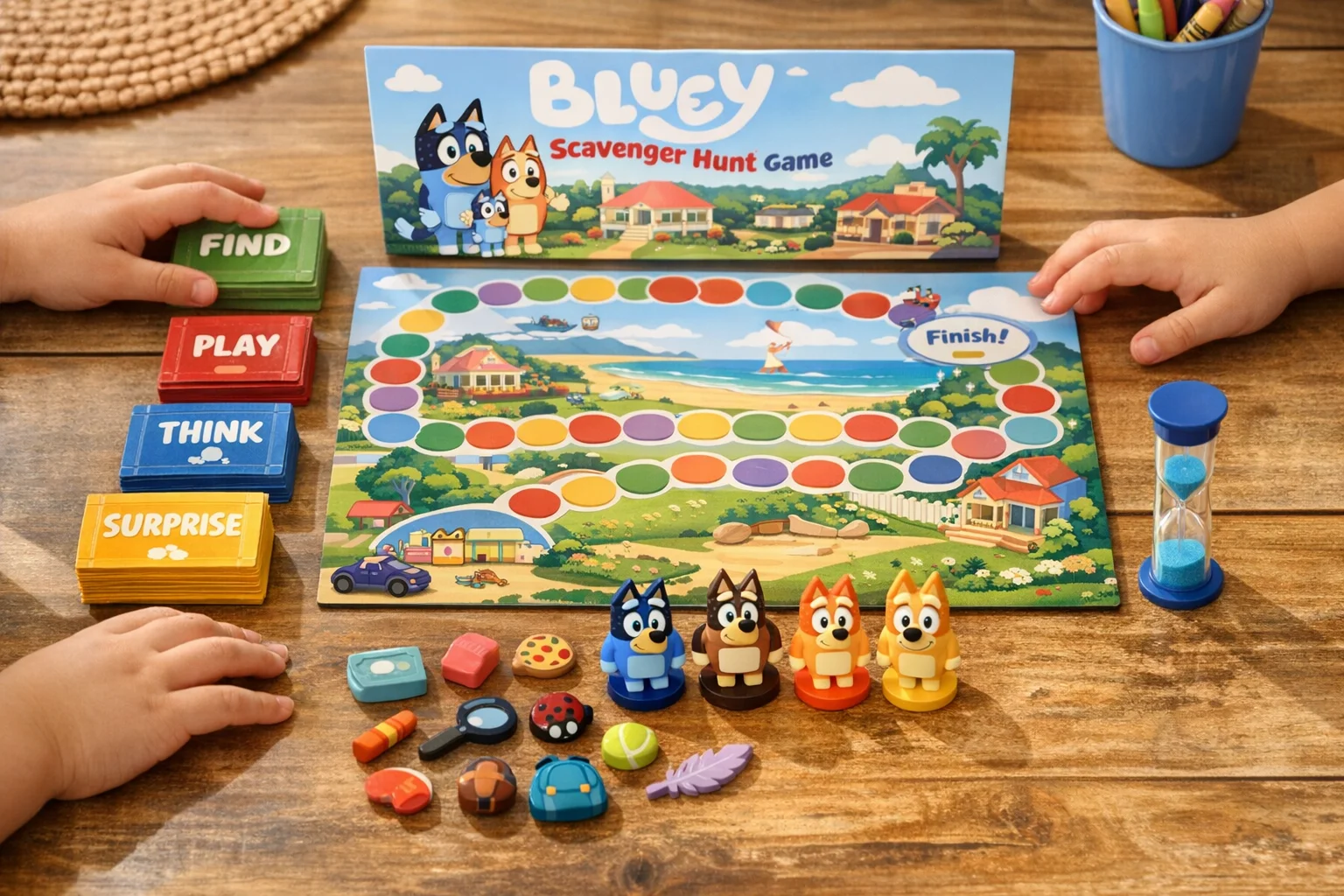
Thinking about the Bluey Scavenger Hunt Game as a gift or a weekend activity? Here’s the parent-tested, classroom-approved look at what it does well, what to tweak, and when it shines.
At a Glance
- Cooperative, movement-friendly game for ages 3+, best with 2–4 players for about 20 minutes.
- Components are simple and durable enough for preschool hands; setup is fast; rules are intuitive once you’ve seen a round. (content.cmpl.org)
- Engagement comes from variety across four card types: Find, Play, Think, Surprise. Keeps little attention spans moving. (content.cmpl.org)
- Best fit: family play with mixed ages, party warmups, and quick classroom brain breaks. Not a strategy game for older kids.
Who this review is for and the short verdict
If you’re a parent, educator, or gift giver deciding whether the Bluey Scavenger Hunt Game earns space on the shelf, here’s the take: it’s a cheerful, low-friction cooperative game that gets kids up, searching, and giggling. It’s at its best with preschoolers and early elementary kids who love the show. For older kids, treat it as a warmup or remix it with house rules to dial up challenge.
What’s in the box and what ages it fits
- Ages: 3 and up. Players: 2–4. Playtime: roughly 20 minutes. (content.cmpl.org)
- Components: a board, four decks of cards (Find, Play, Think, Surprise, 15 each), 12 toy tokens, a time token, a die, a sand timer, and 4 character pawns with bases. (content.cmpl.org)
The physical bits feel made for small hands. Nothing tiny enough to stress about, and the iconography is loud and clear.
A neat design note: the game is credited to collaboration with Ludo Studio, produced by Moose, with noted family-game designer Phil Walker-Harding involved as a design consultant. That pedigree shows in how smoothly very young players can join without constant rule correction. (philwalkerharding.com)
How Bluey Scavenger Hunt actually plays
Players work together to collect 12 toy tokens before bedtime. On your turn you roll, move, then draw from the space you land on. The Find cards send kids hunting for real-world objects. Play cards cue simple actions. Think cards ask Bluey-themed questions. Surprise cards add little twists. If you complete the prompt, you take a toy token. Beat the clock, everyone wins. That cooperative loop keeps the temperature friendly and the energy light. (content.cmpl.org)
In practice, a round flows quickly. Kids love the visible progress of token collection and the quick shifts between thinking, moving, and pretending.
What works especially well
- Built-in variety prevents stalls. Switching among four prompt types reduces boredom and lets different kids shine.
- Movement is baked in. The Find and Play prompts get kids off the floor and into the room. You’ll see more wiggles satisfied and fewer “is it my turn yet?” sighs.
- Bluey knowledge is optional. Think cards reward fans, but the rest of the deck carries the load. Non-fans still have fun.
- Cooperative pacing reduces tears. Young kids handle loss poorly. Racing the clock together is a smarter structure at this age. The official rules position it this way. (content.cmpl.org)
- It supports good parenting science. Short, playful back-and-forths are the engine of early development. The American Academy of Pediatrics has long pointed to play as a driver of social, cognitive, and self‑regulation skills. This game creates easy “serve and return” moments in bite-size turns. (publications.aap.org)
Where it can wobble and easy fixes
- Trivia skew. Some Think prompts can outpace preschoolers. Fix: let kids confer with a helper or swap a Think for a Play when frustration shows.
- Timer tension. The sand timer adds urgency some kids don’t need. Fix: save the timer for older kids or use it only on Surprise cards.
- Board friction. If your table is busy, turns can get scattered. Fix: declare a staging spot for decks and tokens so kids see the flow.
House‑rule tweaks we’ve seen work
A pattern we keep seeing: mild tweaks extend the shelf life.
- Two-success rule: require 2 successes to earn 1 token for older kids. Keeps difficulty gentle but meaningful.
- Earn-or-trade: if a Think is too hard, trade it for a Play after one guess.
- Reverse bedtime: if you’re short on time, set a token target lower than 12 and celebrate at 8 or 10.
- Roles rotate: one child is “card reader,” another is “token captain.” Everyone gets a job.
Great use cases: birthdays, classrooms, rainy days
- Birthday parties: Use one game as the warmup. It’s great for early arrivals and shy kids. Keep it to 10–15 minutes, then pivot to cake or crafts.
- Classrooms and camps: Treat a single deck as a micro-activity. Draw three cards between centers. Cooperative format prevents sore winners and losers.
- Rainy days: The light movement takes the edge off cabin fever without rearranging furniture.
Outdoor and movement‑friendly variations
Most teams tend to underestimate how well this game moves. Take it outside:
- Backyard edition: Restrict Find cards to outdoor-safe items and let kids roam within sight lines.
- Hallway relay: Put tokens across the hall. On a success, kids jog to retrieve them. One at a time keeps it orderly.
- Bluey soundtrack mode: Play a Bluey track softly. Kids try to complete prompts before the song ends rather than using the sand timer.
Durability and storage notes
The cards hold up decently, but preschoolers are expressive shufflers. Sleeves are overkill; a couple of snack-size bags to split decks by type keeps edges from fraying. The sand timer is fine, but set it upright between turns so it doesn’t become a maraca.
How it compares to DIY printables and app‑based hunts
- Versus printables: Printables can be fantastic, especially for themes. The tradeoff is prep and wrangling. Bluey Scavenger Hunt wins on ready-to-play convenience and the balance of prompts.
- Versus full digital hunts: If you want to scale a Bluey‑inspired hunt across a school, neighborhood, or event, an app-based format can automate scoring, photos, and GPS check-ins while keeping the Bluey flavor through your custom prompts. That’s where platforms like Scavify tend to fit: bigger groups, mixed ages, and a need for easy launch and automated tracking. Use the board game for home. Use an app when you need structure at scale.
Five Bluey‑inspired challenge prompts you can run in an app
- [Photo | 20 pts]: Recreate a Heeler family pose using anything blue.
- [Video | 40 pts]: Keep a balloon up for 10 seconds without hands.
- [GPS Check-in | 30 pts]: Check in at a place that starts with B.
- [Q&A | 25 pts]: What are the Grannies’ alter‑ego names?
- [Play | 50 pts]: Balance a “featherwand” on your finger for 5 seconds.
Buying pointers and sensible alternatives
- Look for Moose branding and the four-deck component list to confirm you’ve got the cooperative scavenger hunt version. Product descriptions that list 15 cards in each of four categories and 12 toy tokens are the tell. Retailer listings often include the full counts. (target.com)
- If you want a designer touch: It’s a small thing, but knowing a veteran family-game designer consulted on the product is a nice confidence bump. (philwalkerharding.com)
- If your players are 7+: Consider this Bluey game as a warmup, then move to something with more decisions. Or use the house rules above.
- If you want pure movement: Use the Find and Play decks only, skip the board, and set a 10-token goal.
Verdict
As a quick, cooperative, movement-forward game for preschoolers and early elementary kids, Bluey Scavenger Hunt earns its place. Setup is easy, the variety keeps it lively, and the show’s warmth comes through without requiring deep Bluey lore. Gift it confidently for ages 3–6. Tweak it for 7–8. Use it as a fast group warmup. And when you need to scale the idea for a larger event, switch to an app-based hunt and keep the spirit intact.
FAQs
What ages is the Bluey Scavenger Hunt Game best for?
It’s listed for ages 3+, and that’s accurate. The mix of simple actions, quick questions, and object-finding fits preschool and early elementary kids. Older kids can still enjoy it with house rules. (content.cmpl.org)
How long does a game take?
About 20 minutes with 2–4 players, sometimes faster once kids know the flow. (content.cmpl.org)
What exactly is in the box?
A board, 4 decks of 15 cards each (Find, Play, Think, Surprise), 12 toy tokens, a time token, a die, a sand timer, and 4 character pawns with bases. (content.cmpl.org)
Is it competitive or cooperative?
Cooperative. Players work together to collect all toy tokens before time runs out, which reduces frustration for younger kids. (content.cmpl.org)
Do kids need to know Bluey to play?
No. Bluey fans will enjoy Think card references, but the Find, Play, and Surprise prompts carry plenty of fun on their own.
Any educational value beyond fun?
Yes. Short, playful back-and-forths support language, self‑regulation, and social skills. The American Academy of Pediatrics highlights play as a uniquely powerful driver of development in early childhood. (publications.aap.org)
Who makes the game?
Moose produces the Bluey toy line, with this game developed in collaboration with Ludo Studio. Designer Phil Walker-Harding consulted on the design. (filecache.vporoom.com)