Solutions
Your first hunt, live this afternoon.
Free to start · No download for participants
Find easy scavenger hunt ideas, clues, and challenges for kids, families, classrooms, parties, and outdoor fun.
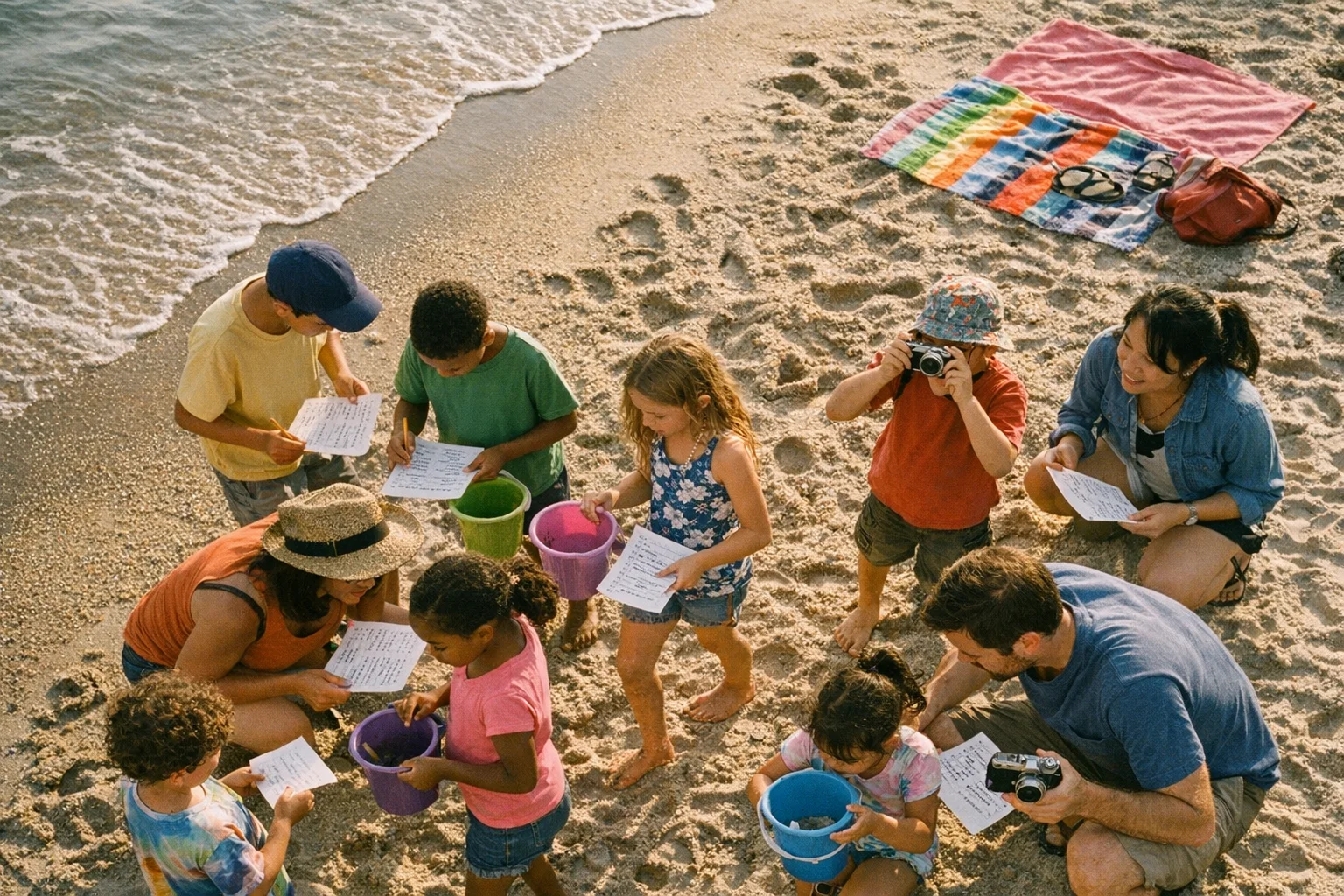
A great beach scavenger hunt doesn’t rely on luck or loud whistles. It runs on clear structure, irresistible prompts, and simple safety guardrails so kids and families can explore without drifting into chaos.
This guide gives you the full playbook: setup, adaptable rules, age-appropriate twists, and ready-to-use challenges. Pack it, open it, run it.
A beach has built‑in variety: textures, landmarks, tides, and people. That creates natural pacing and discovery.
Hunts fall flat when everything becomes a sprint for shells, when boundaries are fuzzy, or when the sun melts attention. The fix is simple: clear zones, mixed challenge types, and a timebox that respects heat and tide.
Supplies - Clipboards or a phone per team, pencils, and a simple score sheet. - Buckets or reusable bags for approved collectables only. - Bright bandanas or stickers for team ID. - Sunscreen, hats, water, small first-aid kit.
Setup in 10 minutes - Mark a home base with shade. Establish a visible finish line. - Define hard boundaries: “From the lifeguard stand to the jetty; no deeper than ankles unless an adult is holding your hand.” - Post a mini safety card with rip-current basics and “ask a lifeguard first.” For families that want a quick primer, the NOAA overview explains what rip currents are and the basics for spotting and escaping them in plain language, as in this concise rip current explainer.
Safety guardrails that keep it fun - Swim near lifeguards when any water play is allowed. The American Red Cross distills beach and ocean safety into practical guidance on supervision, flotation, and swimming near guarded areas; it’s worth a skim before you start: beach and ocean safety basics. - Sun strategy: shade breaks every 20–30 minutes and reapply sunscreen on a timer. The CDC’s sun safety guidance covers SPF, protective clothing, and timing around peak UV: sun safety facts. - Brief the rip-current plan even if no one’s swimming. Know the “don’t panic, float, swim parallel, signal for help” sequence described in NOAA materials; share the simple version with kids.
Zones keep groups distributed and reduce pile‑ups: - Dry Sand Zone: footprints, dunes, boardwalk edges. - Tide Line Zone: seaweed lines, driftwood, shells. - Rock/Jetty or Tide Pool Zone: only if it’s stable and supervised. - People & Service Zone: snack bar, lifeguard chair vicinity.
Modes balance energy: - Find/Observe: quick wins that keep momentum. - Create/Perform: short videos, sand art, teamwork. - Learn/Ask: micro‑interviews, signage facts. - Navigate: GPS or landmark riddles to specific spots.
Scoring that actually works - Give small points for quick finds, bigger points for creative proof (photos, videos), and a bonus for teamwork (e.g., whole team in frame). - Use a soft cap on collectables. Prefer photos over taking natural items. Deduct points if rules or boundaries are ignored. - Include one tie‑breaker: best single photo selected by an impartial adult.
Toddlers (with adults): Big visuals, short distances, hands on buckets. Think color hunts and textures.
Early readers (5–8): Simple rhymes, single-step tasks, show‑and‑tell at base.
Tweens (9–12): Light riddles, short video tasks, basic navigation to a landmark.
Teens: Story prompts, peer interviews, timeboxed creative builds, and optional GPS check‑ins.
Use these as-is or as a seed for your own list. Keep proof methods consistent per team.
For little kids (with an adult) - [Photo | 20 pts]: “Find something bumpy and smile beside it.” - [Photo | 20 pts]: “Match your hat to something you spot here.” - [Find | 10 pts]: “One smooth stone that fits your palm.” - [Q&A | 20 pts]: “What color is the tallest flag you see?” - [Video | 30 pts]: “Jump over a wavelet without getting wet.”
For big kids - [Photo | 20 pts]: “Three shell shapes lined up smallest to biggest.” - [Q&A | 20 pts]: “Name on the nearest lifeguard stand.” - [Find | 10 pts]: “Driftwood that looks like a letter.” - [Video | 40 pts]: “Team does a 3‑pose beach animal parade.” - [Multiple Choice | 20 pts]: “Which is heavier when wet: cotton or polyester?”
For tweens and teens - [Photo | 30 pts]: “A rip‑current sign or hazard flag, framed clearly.” - [Video | 50 pts]: “Teach the ‘float, then swim parallel’ move in 10 seconds.” - [GPS Check‑in | 40 pts]: “Tag the furthest safe boundary point.” - [Q&A | 20 pts]: “Snack stand hours posted today.” - [Photo | 40 pts]: “Shadow letters spelling BEACH with your team.”
Family collab set - [Photo | 30 pts]: “Whole team + a stranger giving a thumbs‑up.” - [QR Code | 30 pts]: “Scan the code hidden under a beach umbrella.” - [Video | 40 pts]: “Pass a beach ball overhead down the line.” - [Q&A | 20 pts]: “How many steps on the closest access stair?” - [Photo | 30 pts]: “Something shaped like a heart that isn’t a heart.”
Eco‑friendly set (no collecting) - [Photo | 20 pts]: “A footprint erased by a wave.” - [Q&A | 20 pts]: “One Leave No Trace principle in your own words.” - [Video | 40 pts]: “Team removes three micro‑litter bits safely.” - [Photo | 30 pts]: “A plant you won’t step on; show the buffer.” - [Multiple Choice | 20 pts]: “Seaweed line is closest to: high tide, low tide, or both?”
Timeboxed circuit. 30–45 minutes, teams must score at least one task in each zone.
Bingo grid. Five‑by‑five of mixed modes. Any line wins; full card gets a bonus.
Story chain. Each task adds to a beach‑day narrative; last photo ties the story together.
Golden shell. One rotating high‑value challenge appears at minute 15 and minute 30.
Time of day. Late afternoon keeps heat manageable and crowds calmer. Heat plus glare drains focus faster than any clue.
Tides. If your location has a pronounced tide, place the tide‑line tasks early. Wet rocks become slick when the tide turns; avoid late‑game jetty runs.
Boundaries. Use visible anchors: lifeguard chairs, jetties, volleyball lines. Keep any water tasks in ankle‑deep areas and only with adult contact.
UV and hydration. Build shade breaks into the rules. The CDC guidance on SPF, clothing, and UV timing is a reliable shorthand for outdoor programs; plan around it with alarms: UV protection basics.
Rip‑current awareness. A one‑minute demo at kickoff helps. Reference NOAA’s plain‑language visuals so kids know what those signs mean: rip current overview. If you allow any swimming, keep it within guarded zones and follow American Red Cross beach safety tips.
Leave No Trace mindset. Favor photos and Q&A over collecting. If you do collect, keep it to common, non‑living items and return them. The Leave No Trace Center for Outdoor Ethics offers a simple seven‑principle framework you can reference with kids: seven principles overview.
For small family groups, paper is fine. As headcount grows, tracking proofs, scores, and time becomes a job.
This is where an app like Scavify is practical, not flashy. Teams see live tasks, submit photos/videos, check in at GPS points, and watch points update automatically. It runs in a browser or an app, flexes to any size, and removes the clipboard pileup at the end.
Keep prizes simple: popsicles, first pick of shade chairs, a goofy beach trophy. The point is momentum and shared stories, not shopping.
End with a 3‑minute “what surprised you” debrief and a quick shoreline sweep. Count micro‑litter as bonus points if you want to make it stick.
Forty‑five to sixty minutes hits the sweet spot for families. Shorter for toddlers; a bit longer works for teens if you add creative tasks and a mid‑game twist.
Water, hats, sunscreen, a small first‑aid kit, wipes, and a phone or camera for proof. Buckets or reusable bags only if you’ve approved specific items to collect.
Prefer photos. If you allow collecting, keep it to common, non‑living items and return natural items before you leave. Use the seven principles at Leave No Trace as your north star.
Set a clear waterline rule, keep the hunt within sight of a lifeguard, and post the simple rip‑current plan. The American Red Cross has straightforward guidance on supervision and guarded areas: beach safety basics. Pair that with NOAA’s rip current explainer.
Start later, rotate shade breaks, and use sunscreen reapply timers. The CDC’s sun safety page is a helpful checklist: UV and SPF guidance.
Mix icons with short text, pair older kids as “readers,” and add photo‑first tasks. Family sets and collaborative videos keep everyone involved.
Yes with boundaries, visible team IDs, and a home base out of foot traffic. Avoid tasks that involve strangers’ personal space unless you ask politely and accept “no” instantly.
Call it early. Award points for completed tasks and run a two‑challenge indoor finale using photos and Q&A when you’re home or under shelter.
Planning a birthday, camp day, or school field trip? The same structure works. Add your theme, keep the safety guardrails visible, and let the beach do the rest.