Solutions
Your first hunt, live this afternoon.
Free to start · No download for participants
Plan smarter team experiences with ideas that improve alignment, trust, communication, and collaboration.

Executives don’t need icebreakers. They need shared clarity, real debate, and faster, cleaner decisions. The most useful executive team building activities create those conditions on purpose. The nine below are the ones we see consistently move senior teams from polite updates to collective ownership.
Most executive offsites quietly fail because they mistake togetherness for progress. The energy is high in the room, but nothing changes on Monday. A better approach treats the session like a strategy lab: run working sessions that tighten focus, make tradeoffs explicit, and commit to a visible operating rhythm.
Two research threads are worth keeping in view. First, teams that feel safe to surface dissent and risk ideas perform better. Amy Edmondson’s work on psychological safety is foundational, and her guidance in creating psychological safety at work translates well to senior rooms. Second, engagement and clarity correlate with business outcomes. Gallup’s multi-decade Q12 meta-analysis links engagement to a range of performance measures at scale.
Alignment is not unanimous agreement. It’s shared direction, explicit decision rights, and interlocked execution. In practice, we look for three visible signals:
McKinsey’s perspective on top-team drivers points to dependability, clarity, and decision effectiveness as recurring levers, along with trust and feedback behaviors that keep the system healthy over time. Their data-backed lens in Demystifying top-team performance is directionally consistent with what we observe in the field.
Each activity is built for working, not theater. Use two or three in a day, or run a series across a quarter. The goal isn’t a perfect deck. It’s shared, testable decisions that change what happens next week.
Most strategy stories are too long to remember and too vague to execute. Fix both.
Why it works: forcing the story onto one page creates sharp edges executives can align around. MIT Sloan’s take on aligning KPIs to strategy is a useful companion to keep measures from drifting into vanity territory.
Alignment dies when decisions bounce. Map your top ten recurring decisions and assign who Recommends, Agrees, Performs, Inputs, Decides. Then test two stress scenarios: high-speed and high-disagreement.
In our experience, the act of writing down decision rights unclogs months of passive gridlock in a single afternoon.
Run a pre-mortem on a critical initiative: assume it failed badly six months from now. List reasons. Then assign a Red Team to argue the strongest case for each failure mode while the Blue Team defends the current plan. Swap sides and repeat.
This format protects dissent without spiraling. It’s a practical way to operationalize psychological safety for senior debates.
Executives often see customer signals through filters. Remove one layer.
Grounding strategy in unvarnished customer input reduces armchair certainty. It also aligns well with Gallup’s findings on engagement’s connection to customer outcomes in their meta-analysis.
Most senior teams have implicit rules. Make them explicit.
This is where you bake psychological safety into the team’s mechanics. HBR’s guide on creating psychological safety offers language that pairs well with this exercise.
Pick a plausible market shock: a competitor price move, a regulatory change, a platform partner failing. Split into squads representing you, key competitors, regulators, and customers. Run two short rounds.
End with three pre-approved “break glass” plays you could authorize fast if the scenario appears.
McKinsey’s long-running work on top-team effectiveness notes decision speed and external orientation as differentiators. See the historical lens in Teamwork at the Top for patterns that still show up today.
Senior teams underinvest in subtraction. Map your top risks by likelihood and impact, then name three things you will intentionally stop doing to fund attention and capacity.
Gallup’s 2026 brief on leadership communication highlights how inconsistency from the top erodes trust; simplifying the portfolio reduces mixed signals. Their current view is summarized in Employee Engagement Strategies for 2026.
OKRs can align or confuse. Use them to thread the needle.
If you need a clean primer with templates and practical examples, the official site for John Doerr’s book curates pragmatic resources at WhatMatters.com. For team dynamics that make OKRs stick, Google’s archived guidance on team effectiveness remains useful.
Nothing beats fresh exposure. Pair executives, drop them into frontline contexts, and give them small, structured prompts.
This resets assumptions and often unlocks high-ROI fixes hiding in plain sight.
Short bursts of action help heavy conversations breathe. We often drop these into breaks to keep attention sharp and capture moments that matter. Examples sized for an executive offsite:
Remote senior teams can be sharper than in-person ones if you tighten the mechanics.
If you’re aligning a distributed top team, Innosight’s practical framing in Unite Your Senior Team maps well to virtual contexts, and their virtual tactics in Building senior team alignment virtually are straightforward to apply.
Skip vanity metrics. Look for directional shifts you can feel and see.
If you need a sanity check on whether alignment is reaching the edges, pulse trust and clarity questions from Gallup’s science-backed Q12 set, then revisit in 60 to 90 days. Their meta-analysis explains why these items tie to performance outcomes across thousands of teams.
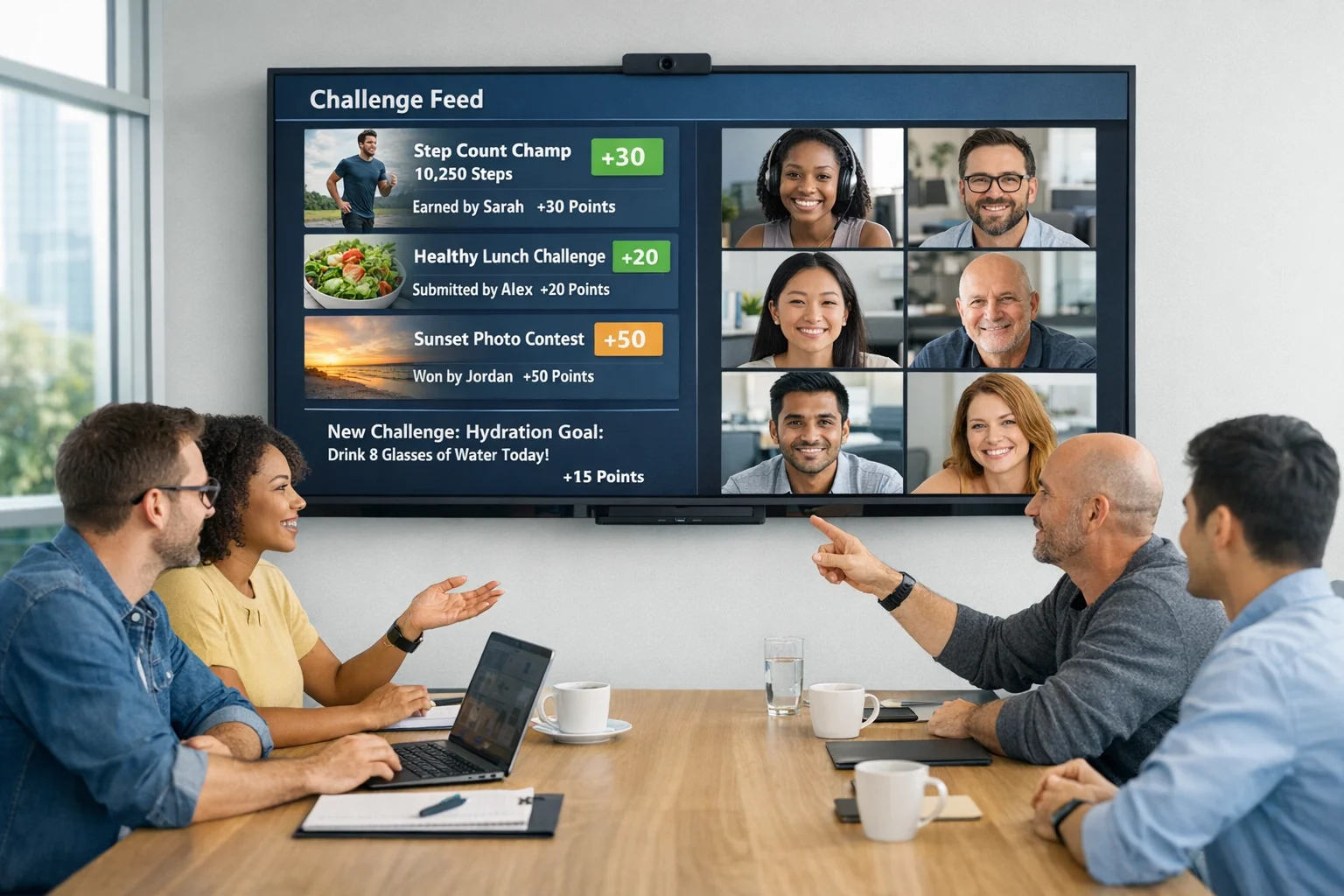
When the goal is real participation, a platform helps. Many executive teams use Scavify to structure short challenge loops between heavier working blocks, collect artifacts (photos, videos, check-ins) from field visits, and run quick knowledge checks that expose misalignment before it spreads. The mix of challenge types, automation, and browser-plus-app flexibility makes it easy to keep momentum high without creating admin overhead. If your executive sessions need more doing and less talking, that’s where we naturally fit.
Executives don’t need icebreakers. They need clarity, decision rights, and visible interlocks. Useful sessions look like working labs with short sprints, explicit tradeoffs, and decisions recorded in writing. Activities that sharpen the story, map decision ownership, and test plans under pressure create real alignment.
Treat them as part of the operating rhythm rather than special events. Most teams benefit from a quarterly alignment cycle with smaller monthly tune-ups to review decisions, OKR interlocks, and risks. The cadence matters less than sticking to it.
Watch cycle time on major decisions, escalation volume, and the clarity of cascades into OKRs and plans. You should see fewer status meetings, faster choices, and cleaner handoffs. A brief pulse on trust and clarity helps confirm whether downstream teams feel the change.
Impose constraints: written pre-reads, 10-minute maximums for context, then working sprints. Rotate facilitators and assign a scribe. End each block with a decision, owner, and next visible move.
Set fewer objectives, make key results unambiguously outcome-based, and publish interlocks so functions see how their work moves enterprise outcomes. Use resources like WhatMatters.com for templates, and pair them with Google’s team effectiveness guidance so the human system supports the mechanics.
Safety isn’t about being nice. It’s about candor with respect. Use pre-mortems, Red Teams, and written decision logs to normalize dissent and learning. Edmondson’s HBR guidance on creating psychological safety offers language leaders can adopt directly.
Shorter, more frequent sessions beat one heroic block. Use written pre-reads, asynchronous comments, and crisp decision records. Keep a consistent ritual for publishing decisions and interlocks so nothing depends on who could attend live.
Yes, if it serves a working purpose. Use brief challenges that surface real insights, test strategy clarity, and pull executives into the customer and frontline reality. The point is to catalyze sharper decisions, not to entertain.