Solutions
Your first hunt, live this afternoon.
Free to start · No download for participants
Discover practical team building ideas, examples, and activities that boost morale, communication, and collaboration.
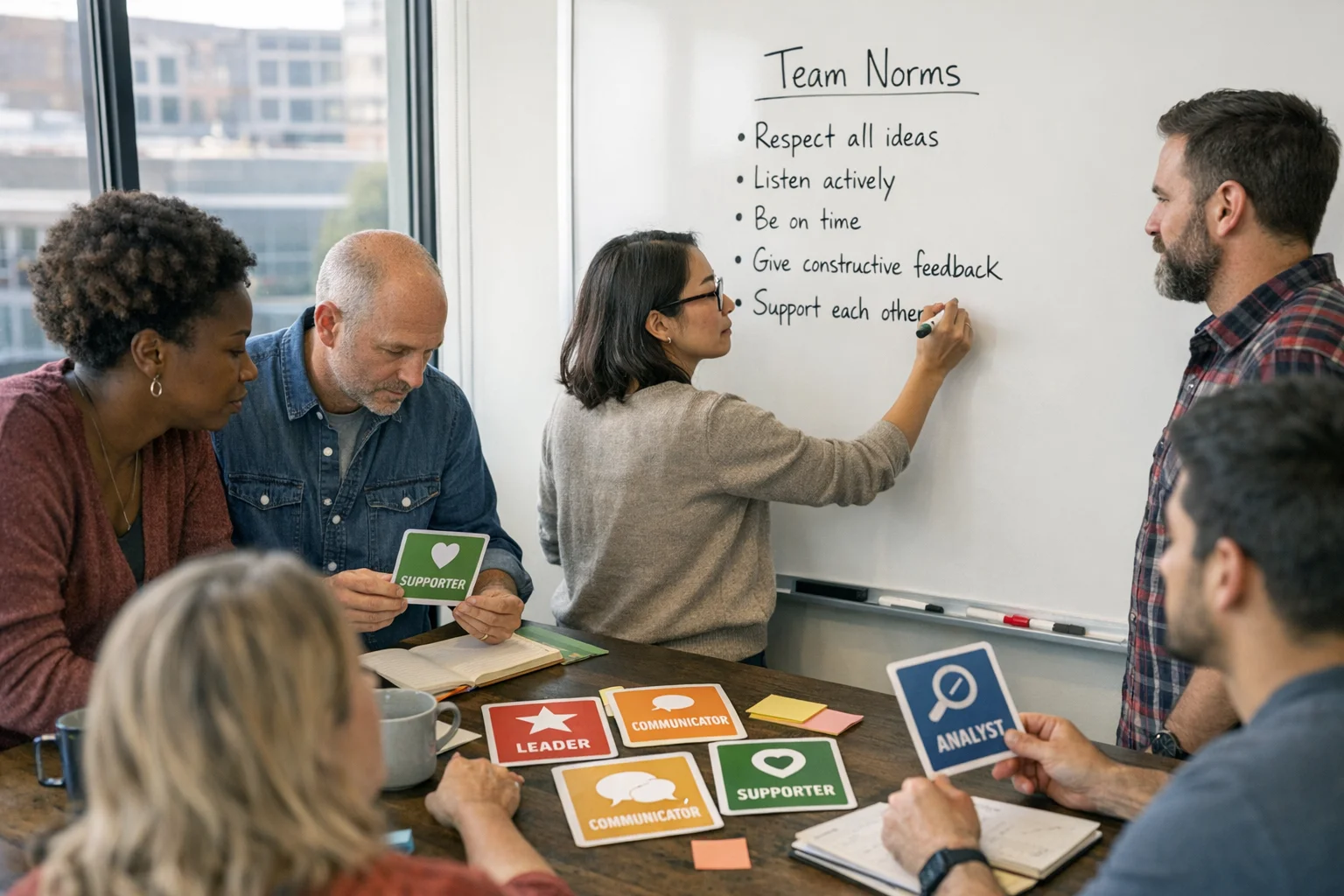
Personality tests can lift a team conversation from vague to specific. Used well, they create shared language for how people communicate, make decisions, and get work done. Used poorly, they become labels, excuses, and awkward icebreakers.
Here’s the operator’s guide to picking a personality test that actually helps teamwork, running a session that feels human, and turning insights into day-to-day habits.
The list below balances research signal with practical utility. None of these should be used for hiring. Use them to create shared language, reduce friction, and design better ways of working.
What it is. A trait model that measures five broad tendencies: openness, conscientiousness, extraversion, agreeableness, and emotional stability.
Why teams like it. It keeps people out of boxes and focuses on typical tendencies. Helpful for norms around focus time, feedback tone, risk appetite, and planning detail.
Evidence snapshot. The Big Five is the dominant, empirically supported framework in personality science. Team-level patterns in traits like conscientiousness and agreeableness show modest, context-dependent links to team performance, especially on coordination-heavy work. (dictionary.apa.org)
Facilitation tip. Ask each person to pick one trait they flex up or down by context. Build a simple team charter from those flex points.
What it is. A four-quadrant model focused on behavior and communication style: Dominance, Influence, Steadiness, Conscientiousness.
Why teams like it. It gives quick language for meeting dynamics and feedback preferences. Easy to remember. Useful for sales, service, and cross-functional collaboration.
Best use. Calibrating communication. Set norms like “match detail level to receiver” or “call preferences at the top of a meeting.”
Watch out. It’s descriptive, not a clinical instrument. Treat it as a conversation starter, not identity truth.
What it is. A strengths-based inventory that surfaces your most used talent themes.
Why teams like it. Shifts the energy to “where each person naturally adds value.” Great for assigning project roles and designing peer support.
Best use. Map top themes to responsibilities, then pair complementary themes for tricky work.
Watch out. Strengths can still overplay. Debrief what “too much of a good thing” looks like in your context.
What it is. A work-cycle lens with six “geniuses” from ideation to implementation: Wonder, Invention, Discernment, Galvanizing, Enablement, Tenacity.
Why teams like it. It reveals where projects stall. You can see missing steps or overrepresented modes instantly.
Best use. Post-mortems and project kickoff design. Ensure every phase has an owner and a handoff rule.
Watch out. People flex across phases. Avoid hard-assigning someone to a single mode forever.
What it is. Nine natural contribution roles like Plant, Coordinator, Implementer, and Completer-Finisher.
Why teams like it. Makes role clarity concrete without rewriting job descriptions.
Best use. Complex, multi-month initiatives. Clarify who brings ideas, who scrutinizes, who keeps cadence, and who closes loops.
Watch out. It’s a lens, not a limit. Rotate roles to build range and avoid rutting.
What it is. A measure of conative preferences focused on how people take action when free to choose. Profiles include Fact Finder, Follow Thru, Quick Start, and Implementor.
Why teams like it. Useful for designing workflows and reducing friction in planning vs experimenting.
Best use. Balance Quick Starts with Follow Thrus on high-change projects. Pair Fact Finders with Quick Starts for decision memos.
Watch out. Don’t confuse method preference with ability. People can and do adapt.
What it is. A narrative style framework with nine core types and typical patterns under stress and security.
Why teams like it. Strong for self-reflection, empathy, and de-escalation language.
Best use. Team trust building and coaching conversations where stories matter as much as scores.
Watch out. Treat it as reflective, not scientific. Keep it voluntary and avoid type-boxing.
You’ll notice MBTI isn’t in the seven. It’s popular and can spark useful conversations, yet it carries limited credibility among research psychologists. If you use it, position it as a communication style prompt, not a scientific personality measure or decision tool. (dictionary.apa.org)
A pattern we keep seeing. Teams get a rush of clarity, then default habits swallow it. The fix is visible experiments you can’t ignore.
If you want to turn profiles into small actions people enjoy doing, translate your norms into quick challenges. Scavify’s app-based format makes this painless to launch and track across hybrid or large groups without adding facilitation overhead.
Here are sample challenges that turn personality insights into team behaviors:
There isn’t a universal best. If you want more scientific footing and flexible language, the Big Five family is a strong option. If you need fast, shared language for meetings and communication, DiSC works well. Choose based on the behavior you want to change. (dictionary.apa.org)
Validity varies by instrument and use. The Big Five has strong empirical support and is widely accepted in psychology. Many popular workplace tools are helpful conversation lenses but not scientific measures. Treat them as guides for development, not diagnostics. (dictionary.apa.org)
No. Personality tests are not designed for selection and can create fairness, legal, and validity issues. Use job-relevant assessments for hiring and keep personality tools for team development and coaching. (hbr.org)
At the team level, certain trait patterns like higher conscientiousness and agreeableness often show small to moderate links with performance, moderated by task and context. Treat this as directional insight to shape norms, not destiny. (sciencedirect.com)
Big enough for real dynamics, small enough that everyone speaks. Many teams run sessions intact, then compare patterns across teams in a separate managers’ forum.
Language matters. Use phrases like “tends to” and “in this context.” Invite people to name their flex behaviors and preferred working conditions rather than declaring fixed types.
Plan a short follow-up within 30 days to keep what worked and drop what didn’t. Recheck annually or when team composition or work type changes.
After the debrief. Convert two or three norms into short challenges the team can complete asynchronously in the app. You’ll get proof of behavior change without adding meeting time.
The right personality test turns fuzzy interpersonal friction into fixable operating agreements. Keep it practical. Keep it ethical. Focus on behaviors your team can try this week, not labels they’ll wear for years.