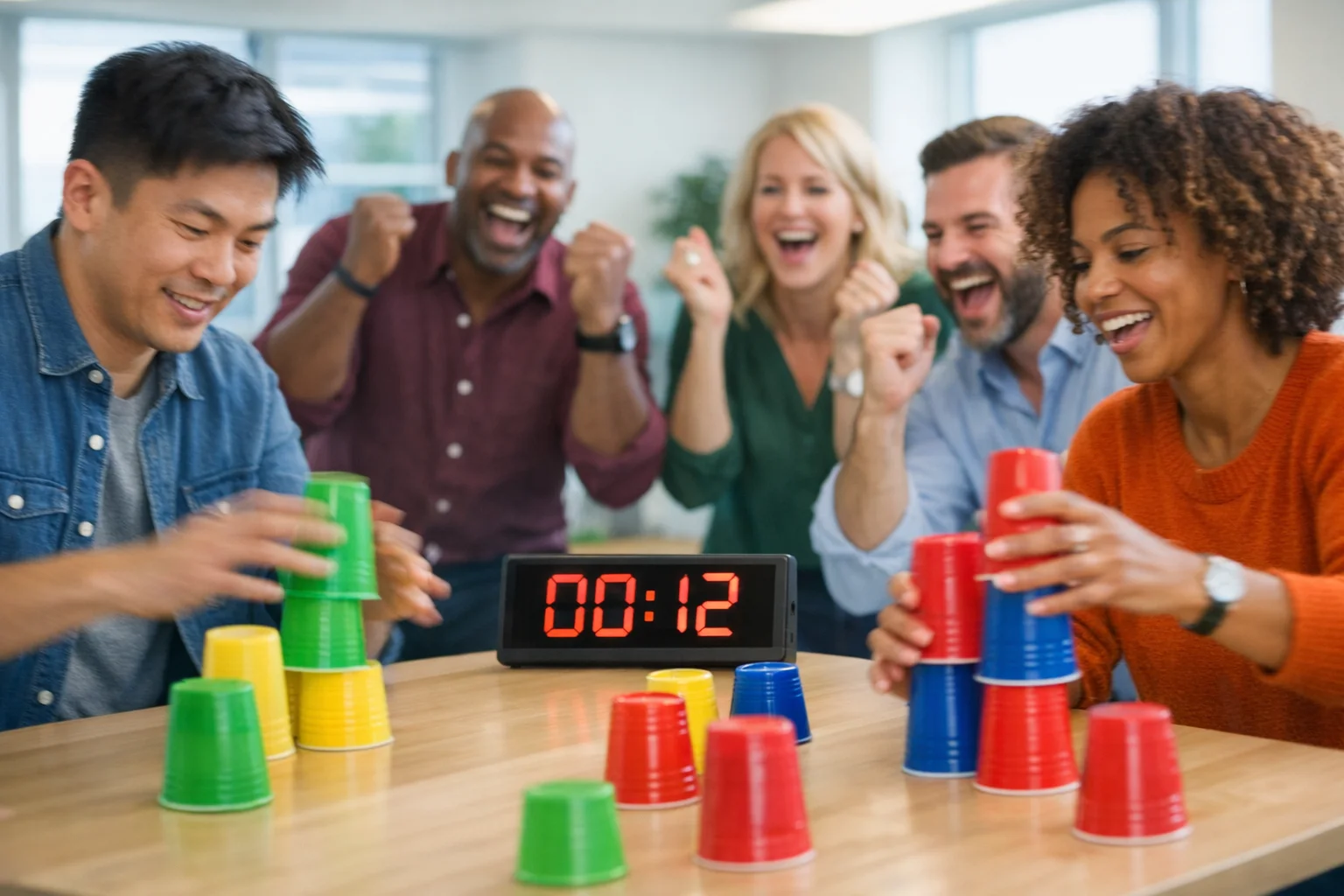
Most groups don’t need another forced “trust fall.” They need short, funny, low-prep moments that spark energy and loosen people up without derailing the agenda. That’s exactly what Minute to Win It games do: 60-second, easy-to-run challenges that make adults laugh, compete, and connect.
The original TV show popularized the 60-second format, and it’s endured because short time pressure creates just enough urgency to be exciting without dragging on. The result is a reliably lively room. The show’s format of quick, household-object challenges is documented in the franchise’s history of 60-second levels and “blueprints.” See the concise overview of the format in this background on the Minute to Win It concept.
At a Glance
- Build your set from cheap, everyday supplies and run 60-second rounds.
- Mix solo, head-to-head, and relay formats to keep variety high.
- Use simple, visible scoring. Laughter plus light pressure is the winning combo.
- Plan 6 to 10 games for a 45–60 minute block with quick resets.
- Keep safety and accessibility in view; offer alternatives where needed.
Why these 60-second games work for adults
A pattern we keep seeing: adults loosen up fastest with short, playful constraints plus visible progress. Sixty seconds sits in a sweet spot. There’s just enough pressure to feel like a challenge, not so much that it becomes stressful. That aligns with research showing performance often peaks at moderate arousal and then drops when pressure gets too high, especially for complex tasks. See clear explanations of this curve in the Yerkes–Dodson principle overview.
These games also prompt shared laughter, which helps social bonding. There’s growing evidence that laughing together engages the brain’s endorphin system and strengthens social ties. For a digestible, research-backed angle, see findings on how social laughter is linked to bonding via endogenous opioids and a broader review of laughter as a mechanism for reinforcing social bonds.
How to run a smooth Minute to Win It session
- Pick 6–10 games. Blend easy warm-ups with one or two “spectacle” moments. Rotate mechanics: stacking, tossing, balancing, breath/balloon, quick sorting.
- Decide your format. Solo attempts for fast throughput. Head-to-head for rivalry. Team relays for shared wins. Mix formats within one session.
- Set your stations. One table per game with supplies, clear printed rules, and a visible 60-second timer.
- Assign roles. One host to keep pace. One scorekeeper. One reset helper floating between stations.
- Run tight intervals. 60 seconds of play, 30–45 seconds to reset, then move. Keep the rhythm crisp so energy never dips.
- Mind safety and access. Avoid allergy triggers in food games if needed. Offer seated alternatives for balance-heavy challenges. Keep floors clear.
Scoring models that keep energy high
- Points per win: 2 points for a win, 1 for completing the task, 0 otherwise. Simple and fast.
- Bracket battles: Head-to-head knockouts for showcase games. Quick brackets work best with 8–16 players.
- Station totals: Everyone cycles through all stations. Highest cumulative score wins.
- Relay bonuses: In team relays, award a small bonus for finishing under 40 seconds to reward coordination.
35 Minute to Win It games for adults (organized for flow)
Pick your mix. Every entry includes what you need, how to win, and one facilitation tip.
Tabletop dexterity classics
Cookie Face
Slide a cookie from forehead to mouth using only face muscles. It’s impossible to do without laughing, which is exactly the point.
- You need: Sandwich cookies.
- How to win: First to eat one hands-free, or most in 60 seconds.
- Tip: Provide napkins and a no-retry rule if a cookie hits the floor.
Stack Attack
Build a 10-cup pyramid then return to a single stack. Fast resets make this a perfect opener.
- You need: 36 plastic cups per station.
- How to win: Fastest full up-and-down cycle.
- Tip: Mark a start/finish zone so stacks are comparable.
Movin’ On Up
Move the single colored cup from bottom to top by transferring one cup at a time.
- You need: 39 same-color cups plus 1 marked cup.
- How to win: First to return the marked cup to the top wins.
- Tip: Use a contrasting color for visibility to the crowd.
Tilt-a-Cup
Bounce a ping pong ball into a cup, then quickly stack a new cup on top and repeat.
- You need: Ping pong balls, 8 cups per player.
- How to win: First to complete the stack with successful bounces.
- Tip: Use a firm table; soft surfaces kill the bounce.
A Bit Dicey
Balance dice on a tongue depressor held in your mouth.
- You need: 6 dice, 1 tongue depressor per player.
- How to win: Most dice stacked at 60 seconds, or first to 6.
- Tip: Seated attempts reduce wobble and keep things safe.
Speed Eraser
Bounce pencils so they land eraser-end in cups.
- You need: Pencils, cups.
- How to win: Most successful bounces in 60 seconds.
- Tip: Start closer for round one, then increase distance for finals.
Rapid Fire
Shoot rubber bands to knock down a line of cups.
- You need: Rubber bands, 10 lightweight cups.
- How to win: First to clear the line.
- Tip: Angle cups so they topple instead of sliding forever.
Back Flip
Place pencils on the back of your hand, flip and catch them. Add pencils each successful flip.
- You need: A handful of pencils.
- How to win: First to catch a set target (e.g., 8) or most caught by time.
- Tip: Count aloud so the room tracks progress.
Balloon, breath, and air-power games
Defying Gravity
Keep three balloons in the air for a full minute. Looks easy. Isn’t.
- You need: 3 balloons per player.
- How to win: Survive 60 seconds without any balloon touching the ground.
- Tip: Give each player a clear zone to avoid collisions.
Cup Blower
Inflate a balloon and release air to push a cup across a finish line.
- You need: Balloons, plastic cups, tape line.
- How to win: First cup fully over the line.
- Tip: One balloon per attempt keeps it fair and sanitary.
Keep It Up (feather edition)
Use only breath to keep a feather aloft for 60 seconds.
- You need: Craft feathers.
- How to win: Longest continuous airtime within the minute.
- Tip: Mark a standing spot so players don’t chase endlessly.
Sticky Statue
Balance three balloons at once on different body parts without hands.
- You need: 3 balloons per player.
- How to win: Longest time all three stay put within 60 seconds.
- Tip: Demonstrate legal positions to avoid debates mid-round.
Office-supply specials
Sticky Note Sprint
Cover a teammate’s shirt with sticky notes.
- You need: Sticky notes, one volunteer per team.
- How to win: Most notes still attached at the buzzer.
- Tip: Agree on eligible zones and disallow faces.
Separation Anxiety
Sort a mixed pile of small items by color or type using one hand.
- You need: Mixed buttons/beads/paper clips, bowls.
- How to win: Most correctly sorted items in 60 seconds.
- Tip: Pre-count equal piles so stations reset fast.
Rapid Roll
Roll marbles into a taped-off scoring zone on the table.
- You need: Marbles, painter’s-tape target.
- How to win: Highest total points from where marbles stop.
- Tip: Score concentric rings like a tiny curling sheet.
Thread the Needle
Thread as many needles as possible, or run string through stacked pasta pieces.
- You need: Needles and thread, or dried pasta and string.
- How to win: Most successfully threaded at 60 seconds.
- Tip: Offer the pasta alternative for a safer, faster reset.
Penny Tower
Stack as many pennies as you can with one hand.
- You need: Pennies.
- How to win: Tallest stable stack at the buzzer.
- Tip: Count only freestanding stacks, not pinched piles.
Movement and balance crowd-pleasers
Junk in the Trunk
Shake ping pong balls out of a tissue box tied around your waist.
- You need: Empty tissue box, belt, 8 ping pong balls.
- How to win: First box emptied.
- Tip: Create a “shake zone” and warn nearby bystanders.
Elephant March
Wear pantyhose on your head with a tennis ball in one leg and knock down bottles with the swinging weight.
- You need: Pantyhose, tennis ball, empty bottles.
- How to win: First to clear a set row.
- Tip: Helmets not required, but space is your friend.
Elbow Cup Relay
Pass a cup down the line using only elbows.
- You need: 1 cup per team.
- How to win: Fastest full-team pass and back.
- Tip: Require a reset if the cup drops to keep it honest.
Paper Dragon
Unroll two party streamers using only your hands and arms.
- You need: 2 rolls of crepe paper per player.
- How to win: First to fully unspool both rolls.
- Tip: Tape starter ends to the table so rolls don’t escape.
Nose Dive
Move cotton balls from one bowl to another using petroleum jelly on your nose.
- You need: Cotton balls, bowls, tiny dab of petroleum jelly.
- How to win: Most transferred in 60 seconds.
- Tip: Offer disposable wipes for cleanup.
Food games (check allergies and preferences)
Suck It Up
Transfer M&M’s or Skittles using a straw.
- You need: Straws, candies, two bowls per player.
- How to win: Most candies moved in a minute.
- Tip: Consider color-specific rounds for variety.
Marshmallow Toss
One player tosses, the other catches mini marshmallows in a head-mounted cup.
- You need: Mini marshmallows, plastic headband cup.
- How to win: Most caught in 60 seconds.
- Tip: Mark a minimum throw line.
Chip Shot
Flick a potato chip off a bottle top into a cup.
- You need: Chips, bottles, cups.
- How to win: First to 3 successes or most in 60 seconds.
- Tip: Thicker chips survive more attempts.
Bottle to Bottle
Pour beans from one bottle to another by connecting their mouths.
- You need: 2 plastic bottles, dry beans.
- How to win: First to transfer all contents.
- Tip: Cut a small funnel if you need to tame chaos.
Candelier
Stack alternating cans and paper plates into a wobbly tower.
- You need: 5 empty cans, 4 paper plates per player.
- How to win: Tallest stable tower at the buzzer.
- Tip: Require hands-off for the final 3 seconds.
Precision and fine-motor challenges
Nutstacker
Use a chopstick to stack metal hex nuts vertically.
- You need: Chopstick, 6–8 hex nuts, flat surface.
- How to win: Tallest free-standing stack.
- Tip: Put phones away; vibrations sabotage towers.
Penny Hose
Fish out two pennies from the ends of a pair of pantyhose using only your hands.
- You need: Pantyhose, 2 pennies.
- How to win: First to remove both pennies.
- Tip: Players can’t brace the hose against their bodies.
Water Bottle Flip Count
Classic bottle flip, counted. Adults get seriously invested.
- You need: Partially filled plastic bottles.
- How to win: Most upright landings in 60 seconds.
- Tip: Standardize fill lines to keep it fair.
Office Pong Run
Bounce or roll ping pong balls into a sequence of labeled cups.
- You need: Ping pong balls, 6 labeled cups in a row.
- How to win: First to complete the sequence.
- Tip: Missed cups must be retried in order.
Rapid Match (Blind Draw)
Draw a simple prompt with eyes closed; teammates must correctly guess.
- You need: Cards with prompts, markers, paper.
- How to win: Most correct guesses in 60 seconds.
- Tip: Use unmistakable prompts like “giraffe” or “sailboat.”
Bounce, toss, and flick variety
Chip-to-Cup Ricochet
Bounce a ping pong ball off a chip bag or book into a cup.
- You need: Ball, angled surface, cup.
- How to win: First to 3 successful ricochets.
- Tip: Mark the bounce spot to compare attempts.
Speed Stack Transfer
Two stacks of cups; transfer all cups from one stack to the other using only the top cup to move the next.
- You need: 2 equal stacks of cups.
- How to win: First to complete the transfer.
- Tip: Clear instructions avoid accidental two-cup moves.
Flip Tac Toe
Flip water bottles to claim squares on a floor tic-tac-toe grid.
- You need: Tape grid, 2 bottles, X/O markers.
- How to win: Three in a row via successful flips.
- Tip: Unclaimed squares stay open if flips fail.
Paper Plate Shuffle
Slide paper plates across a table to land on taped scoring zones.
- You need: Paper plates, taped target zones.
- How to win: Highest total points in a minute.
- Tip: Quick judge with a handheld tally counter.
Chopstick Pickup
Move as many small candies as possible using chopsticks.
- You need: Chopsticks, bowl of small candies, target bowl.
- How to win: Most moved in 60 seconds.
- Tip: Offer tongs as an accessible alternative.
App-ify it (optional): running games inside Scavify
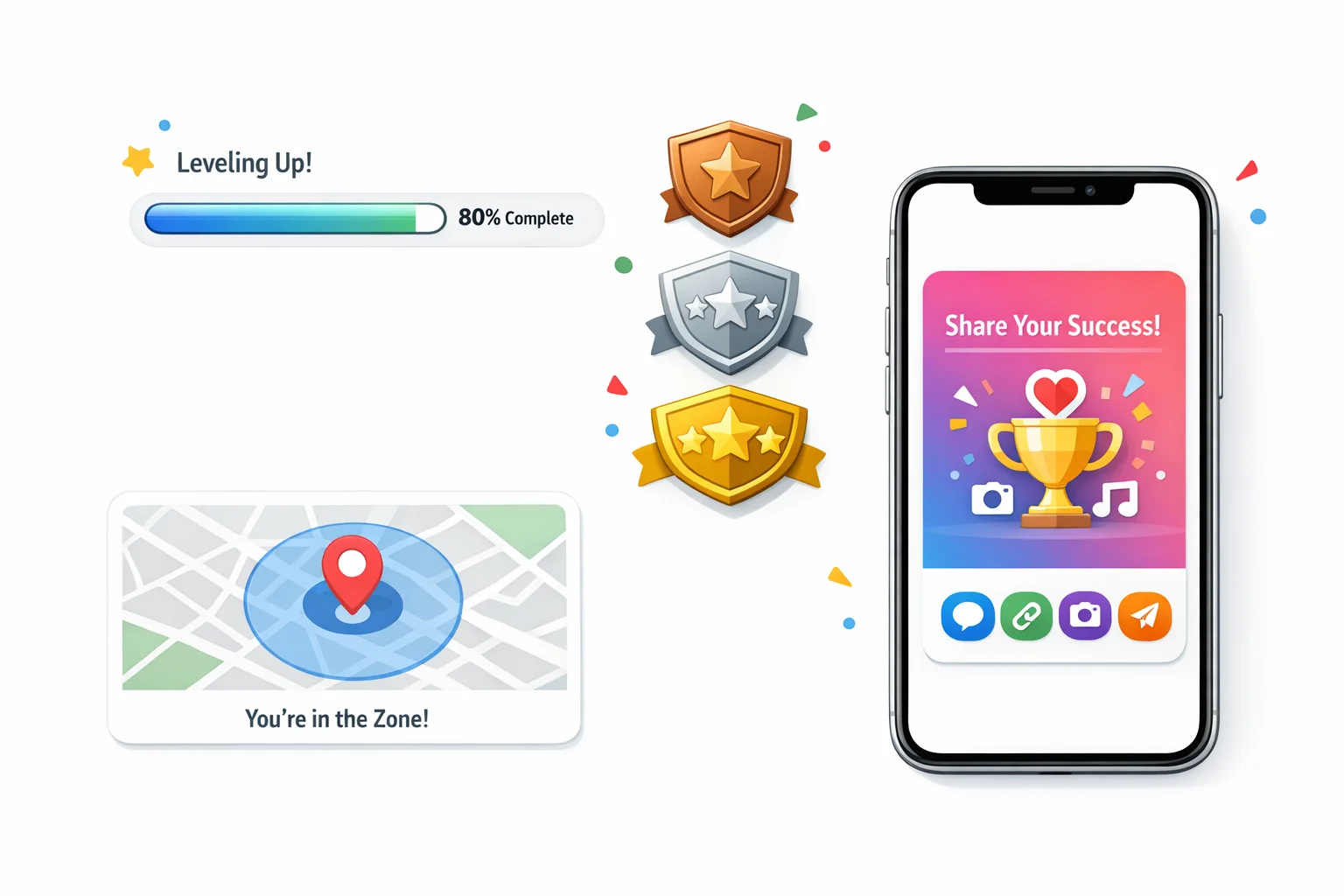
If you want automatic timing, instant photo/video capture, and live scoreboards, running a few rounds inside Scavify keeps everything in one place while the in-person energy stays front and center. You can mix physical stations with in-app prompts and real-time points. For example:
- [Video | 50 pts]: Capture a 10-second clip of your teammate’s winning Cookie Face finish.
- [Photo | 40 pts]: Pyramid complete: document your team’s tallest Stack Attack tower.
- [Photo | 30 pts]: Three balloons, one hero. Prove your Defying Gravity.
- [Video | 60 pts]: Show the final 5 seconds of an Elephant March bottle sweep.
- [Q&A | 20 pts]: How many flips did your team land in Water Bottle Flip?
Facilitator tips from the field
- Open easy, close cinematic. Start with a low-skill, high-laughter game (Cookie Face), end with a spectacle (Elephant March or Junk in the Trunk). The arc matters.
- Show, don’t over-explain. A 10-second demo beats a minute of rules. Keep it moving.
- Visibility wins. Put showcase games where everyone can watch. Laughter spreads.
- Standardize edges. Same distances, fill lines, or counts wherever it affects difficulty. It prevents debates you don’t want to referee.
- Offer opt-ins. Provide non-food variants and seated options without making a show of it.
- Measure the room. If competitiveness spikes, switch to team relays. If energy dips, go head-to-head on a short table game.
Why short, funny challenges help teams
Teams don’t bond through lectures about bonding. They tend to bond through doing small things together, under light time pressure, with a visible finish line. That combination nudges focus and creates just enough challenge to be interesting. It’s consistent with the idea that performance and engagement often rise with moderate arousal then fall off when tasks become too hard or stakes feel too high, summarized in the Yerkes–Dodson research line. And because laughter is part of the experience, you get the social glue benefits documented in work linking shared laughter and endorphin-driven bonding.
If you’re using these for workplace team building, design still matters. Keep activities relevant, voluntary, and dignified. Even the Harvard Business Review has cautioned against empty exercises that miss the point of real collaboration; the critique lands because it’s true. Skim a classic perspective on avoiding cringe in team-building exercises that actually help and then apply the spirit here: short, high-agency, no one’s dignity on the line.
FAQs
What are the best Minute to Win It games for large groups of adults?
Prioritize fast-reset stations like Stack Attack, Tilt-a-Cup, and Speed Eraser. Run them in parallel so multiple people play each minute. Use a posted scoreboard and rotate teams through stations on a whistle.
How many games should I run for a 60-minute block?
Six to ten games usually hit the sweet spot with quick resets between rounds. Plan one or two backup games in case something takes longer than expected.
What supplies should I buy first if I’m starting from scratch?
A bulk sleeve of plastic cups, a bag of ping pong balls, balloons, sticky notes, dice, and painter’s tape will power most of this list. Add cookies, marshmallows, and rubber bands if you want food and knockdown games.
How do I score quickly without slowing the event?
Use simple counts (first to three, most in 60 seconds) and visible targets. App timers or a projected 60-second countdown help keep pace. Assign one scorekeeper with a clipboard or live scoreboard.
What about safety and accessibility?
Offer seated variants for balance games, avoid allergy triggers for food tasks, and keep walkways clear. Provide wipes and hand sanitizer for any face or food contact games. When in doubt, give people an alternate path to points.
Can these games work on video calls for remote teams?
Yes. Favor camera-friendly options like Cookie Face, Water Bottle Flip Count, Chopstick Pickup, and Blind Draw. Have players position cameras before the countdown and submit quick photos or 10-second clips for verification.
How do I keep things from getting too competitive?
Set the tone upfront: it’s about laughs first, scores second. Mix team relays with solo moments so different strengths show up. Smaller prizes or bragging rights keep stakes friendly.
If you’re building a larger team event, these 35 games slot neatly between agenda blocks, inside a campus orientation, or alongside a city scavenger hunt. Short, funny, and surprisingly effective at turning passive people into active participants. Exactly the point.