Solutions
Your first hunt, live this afternoon.
Free to start · No download for participants
Find high-energy team building ideas with easy instructions and options for different ages, goals, and group sizes.

Kids bring energy. The trick is pointing it at something shared. The best team building for kids turns noise into coordination, sprinting into collaboration, and giggles into problem-solving. It also respects real limits: attention spans, mixed abilities, limited space, weather, and time.
Below are 27 high-energy activities designed for elementary through middle grades, with variations to dial intensity up or down. Every one builds real teamwork skills without sounding like a lesson. They just feel like play.
Pick for the situation, not the catalogue.
Most school-aged kids benefit from about 60 minutes of moderate to vigorous movement daily. High-energy team games can help meet that target while building social skills, as the CDC’s school-age activity guidelines note.
A pattern we keep seeing: the right micro-adjustments make a game safer and more inclusive without slowing it down.
Each activity includes quick setup notes, how to play, why it works, and easy switches. Use variations to match age, space, or group size.
Ages: 6–12
Space: Medium–large, indoors or outdoors
You’ll need: Cones optional
How to play: Two taggers link arms to form a “blob.” When they tag someone, that player links on. When the blob reaches four kids, split into two blobs. Last few free runners become the next starting blob.
Why it works: Constant movement, simple rules, and quick alliances.
Switch it up: Add safe zones or “un-freezers” who can free runners with a high-five.
Ages: 6–10
Space: Small–medium
You’ll need: One hoop per line of 6–10 kids
How to play: Teams hold hands in a line. Pass the hoop from one end to the other without letting go. First team to cycle it down and back wins.
Why it works: Coordination and laughter without running.
Switch it up: Make it cooperative: one big circle, time yourselves, beat your record.
Ages: 6–10
Space: Medium
You’ll need: 20–40 cones
How to play: Half the kids are Builders (stand cones up); half are Bulldozers (tip them). After 90 seconds, count. Switch roles and repeat.
Why it works: Short sprints plus instant feedback.
Switch it up: Give Builders one “shield cone” they can protect together.
Ages: 8–13
Space: Large outdoor field
You’ll need: Two flags, field markers
How to play: Classic rules with a twist: add “medics” who can rescue jailed teammates via handshake, or “builders” who erect a small safe zone with cones that lasts 30 seconds.
Why it works: Team roles and strategy keep everyone involved.
Switch it up: Switch to “treasure tokens” scattered across midfield to reduce camping.
Ages: 8–13
Space: Small–medium
You’ll need: None
How to play: Teams of 6–8 form a knot and untangle to a circle without letting go. Relay style: when Team A finishes, they tag Team B to start.
Why it works: Communication under mild chaos.
Switch it up: Allow one “time-out release” if totally stuck.
Ages: 5–9
Space: Medium
You’ll need: Parachute, soft balls
How to play: Everyone lifts and lowers the parachute to bounce balls off. Team goal: keep all balls moving without any rolling off for 20 seconds.
Why it works: Shared rhythm, instant teamwork.
Switch it up: Add roles like “callers” who cue “up” and “down.”
Ages: 7–12
Space: Medium
You’ll need: Spot markers or paper plates
How to play: Teams must cross a space using a limited number of “stones.” Stones can’t be left unattended. If they are, they “float away.”
Why it works: Planning, pacing, and trust.
Switch it up: Give one “builder” the power to move a stone already placed.
Ages: 7–13
Space: Small–medium
You’ll need: Cups, spoons, balloons, tape
How to play: Create four quick stations. Teams rotate every 60–90 seconds, earning points for completing mini-challenges together.
Why it works: Short bursts, lots of variety.
Switch it up: Make it cooperative: team chases a shared point target.
Ages: 9–13
Space: Medium
You’ll need: Cones, blindfolds or closed eyes
How to play: One blindfolded runner moves through a cone maze guided only by teammates’ verbal directions. Rotate runner each round.
Why it works: Trust and precise communication.
Switch it up: Use whisper-only or hand-signal rounds for older kids.
Ages: 6–12
Space: Small–medium tables
You’ll need: Plastic cups
How to play: Teams build and collapse designated cup towers as fast as possible. Add a “runner” to fetch missing pieces.
Why it works: Fast coordination, low risk indoors.
Switch it up: Require silent building, or one-hand-only rules.
Ages: 6–11
Space: Medium
You’ll need: Colored objects or cones
How to play: Teams collect one item of each color from the far end, one runner at a time. They can only bring back a color their team still needs.
Why it works: Strategy beats speed.
Switch it up: Add a “trader” who swaps colors between teams for a price.
Ages: 6–10
Space: Medium
You’ll need: None
How to play: Call commands like “port,” “starboard,” “swab the deck,” each with a movement. Last to respond joins the “crew” helping call commands.
Why it works: Listening plus movement.
Switch it up: Let kids invent two new commands together.
Ages: 7–12
Space: Medium–large
You’ll need: Flags or fabric tails
How to play: Teams line up holding waists; last player has a tail. Teams try to snatch other teams’ tails without breaking their own chain.
Why it works: Team coordination under speed.
Switch it up: Shrink the space to encourage strategy over sprinting.
Ages: 6–10
Space: Medium
You’ll need: Spoons, ping-pong balls, buckets
How to play: Relay style, transport “treasure” without dropping. Add obstacles or teamwork rules like two people to one spoon.
Why it works: Gentle chaos and shared focus.
Switch it up: Use paper plates and a ball for balance walking.
Ages: 7–12
Space: Medium
You’ll need: Hoops or floor spots
How to play: Move the whole team across the “ocean” using limited islands. If someone touches water, everyone returns to the last island.
Why it works: Planning, patience, and cheering each other on.
Switch it up: Add a “lifeguard” with one rescue per round.
Ages: 8–13
Space: Medium–large
You’ll need: Foam balls, cones or blocks
How to play: Each team builds a small tower. One or two defenders shield it with their bodies (no hands) while others retrieve balls and throw from a line. Rotate roles.
Why it works: Role balance and rapid teamwork.
Switch it up: Cooperative mode: all teams defend one shared mega-tower from a countdown of incoming throws.
Ages: 6–9
Space: Medium
You’ll need: None
How to play: Teams form lines, hands on shoulders. Move together to navigate cones, pick up objects, or cross a finish line without breaking.
Why it works: Group rhythm and patience.
Switch it up: Add “reverse gear” or silent mode.
Ages: 7–12
Space: Small–medium
You’ll need: Simple jigsaw puzzles
How to play: Pieces start across the room. Runners fetch one piece per trip. Builders stay at the table assembling.
Why it works: Non-runners have vital roles.
Switch it up: Scramble multiple small puzzles together for a swap-and-trade twist.
Ages: 6–11
Space: Small–medium
You’ll need: Balloons
How to play: Keep team balloons off the ground using only allowed body parts (elbows, heads, knees). Add a “coach” who calls switches.
Why it works: High heart rate, low risk.
Switch it up: Cooperate to keep one giant balloon up for a time goal.
Ages: 7–12
Space: Small
You’ll need: None
How to play: In pairs back-to-back, sit and stand together without using hands. Scale up to fours, then eights, then a whole circle.
Why it works: Trust and timing.
Switch it up: Count synchronized stands to set and beat a team record.
Ages: 6–10
Space: Small–medium
You’ll need: Music
How to play: While the music plays, teams copy their DJ’s moves. On “freeze,” any mover joins the DJ team. Switch DJs every song.
Why it works: Leadership rotates, joy stays high.
Switch it up: Add themes like animals or sports.
Ages: 9–13
Space: Small–medium
You’ll need: Printed symbol keys
How to play: Teams sprint to collect coded strips from around the room, then decode a message only by sharing pieces.
Why it works: Strategy plus movement.
Switch it up: Place strips at skill stations they must complete first.
Ages: 8–13
Space: Tables
You’ll need: Straws, tape, books as supports
How to play: Build a bridge that spans two stacks of books and supports a small object. Quick test, then iterate.
Why it works: Collaboration under a playful deadline.
Switch it up: Add a delivery task: transport a marble across.
Ages: 7–12
Space: Medium–large
You’ll need: Cones
How to play: Taggers can only tag players standing inside lit “spotlights” (marked circles). Players must cross spotlights to reach safety.
Why it works: Safer, smarter tag with bursts of speed.
Switch it up: Let teams move a spotlight two steps between rounds.
Ages: 7–11
Space: Small
You’ll need: Paper, markers
How to play: Teams run to a board and add one sentence or drawing at a time, building a story within a time limit.
Why it works: Creative teamwork with movement.
Switch it up: Require using three given words or a theme.
Ages: 8–13
Space: Medium–large
You’ll need: Cones, QR codes or symbol cards
How to play: Teams race to locate codes, then solve a final riddle using collected clues. Running matters, but collaboration finishes the job.
Why it works: High-energy search plus brains.
Switch it up: Use picture symbols for younger kids.
Ages: 7–13
Space: Indoors or outdoors
You’ll need: A device per team (or a caller)
How to play: Teams complete safe, specific photo prompts. Keep rounds short, points simple, and regroup to show top shots.
Why it works: Shared purpose, creativity, and movement.
Switch it up: Make it cooperative with one shared checklist for all teams.
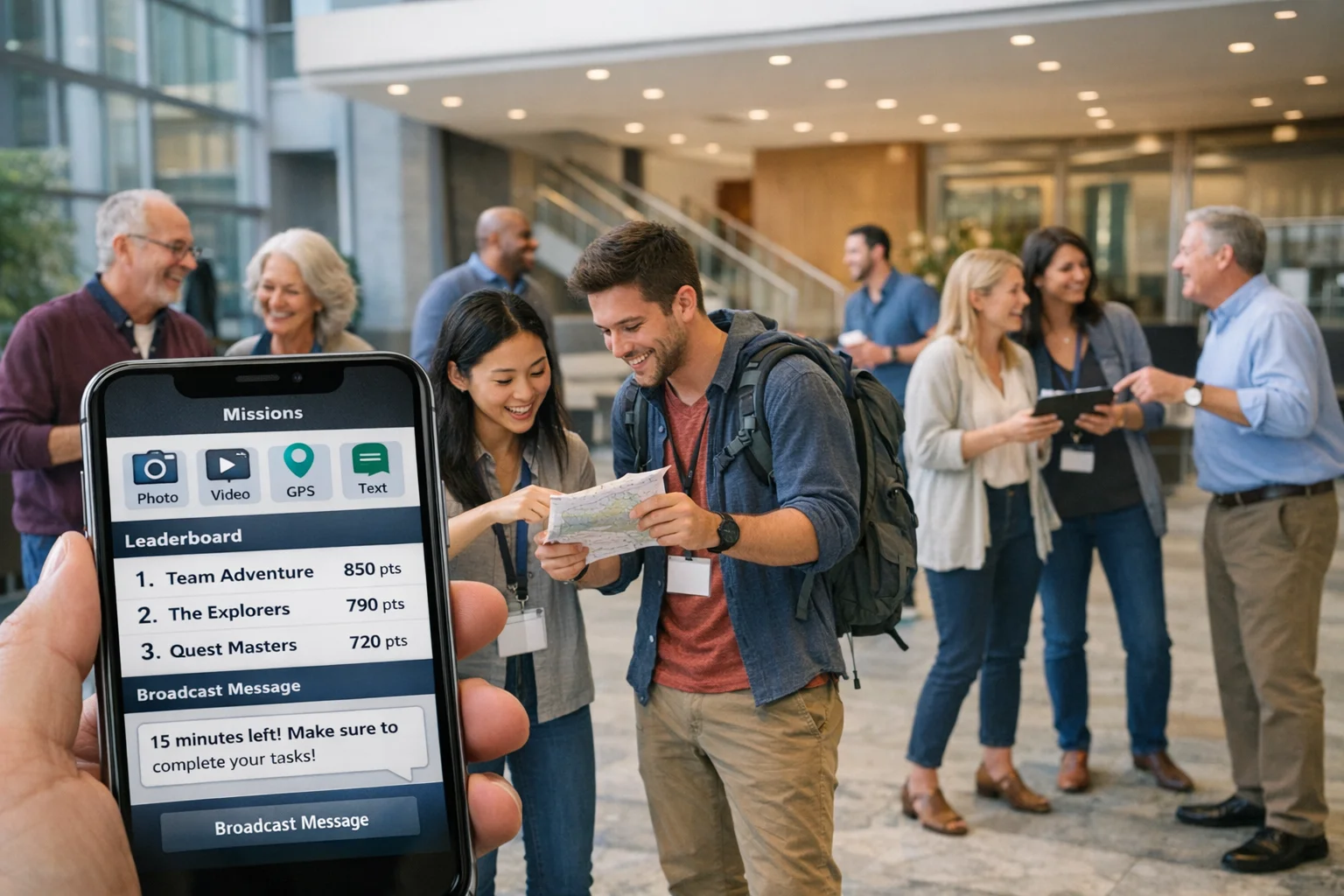
Scavenger hunts are a natural fit for high-energy teamwork. They move fast, scale to any space, and reward observation, not just speed. If you use an app, you can mix photos, videos, check-ins, and quizzes so every kid finds a way to shine. We build Scavify to make that mix dead simple to run, with browser or app access and automated scoring when you want it.
Try these kid-friendly prompts as a five-minute round or a full session:
Most teams tend to over-explain and under-rotate. What usually shifts the dynamic is a cleaner run order and smaller rule sets.
Stick to simple, repeatable rules and short rounds: Builders vs. Bulldozers, Hula-Hoop Pass, Parachute Popcorn, and Balloon Keep-Up. Keep instructions under 20 seconds and demonstrate the movement once.
Shorter than you think. Two to five minutes of action with a quick reset keeps focus and safety high. Run two or three rounds with small twists rather than one long stretch.
Use roles. Runners, callers, builders, defenders, scorekeepers. Give each role real impact, then rotate. Scale movement by distance, not by rules. Keep joining rules generous so no one sits out long.
Prioritize stationary or small-radius games: Hula-Hoop Pass, Cup Stack Speedway, Puzzle Relay, Codebreakers, and Story Build Relay. Shrink team sizes and use lines or zones to control traffic.
Score teams against a shared target or a personal best, not only against each other. Praise strategy and collaboration out loud. Add comeback mechanics like medics or rescuers so kids rejoin quickly.
Shorter rounds, more shade, and planned hydration breaks. Swap sprints for bursts with longer rests. The AAP’s parent site offers practical hydration guidance for families in its water-first tips, and the CDC provides youth heat-safety adaptations.
Communication, role clarity, and shared problem-solving are the big three. If you map to SEL, you’ll see relationship skills, social awareness, and responsible decision-making on display. For a shared vocabulary, reference the CASEL competencies.
Playworks’ practical game and variation library is a strong resource for inclusive, high-energy games that translate well to schools, camps, and youth programs.
A final note: High-energy doesn’t have to mean loud or chaotic. When roles are clear and rounds are short, kids do the rest. That’s where the best teamwork shows up without you having to announce it.