Solutions
Your first hunt, live this afternoon.
Free to start · No download for participants
Plan a more engaging group experience with crowd-pleasing ideas, practical tips, and options for different budgets.
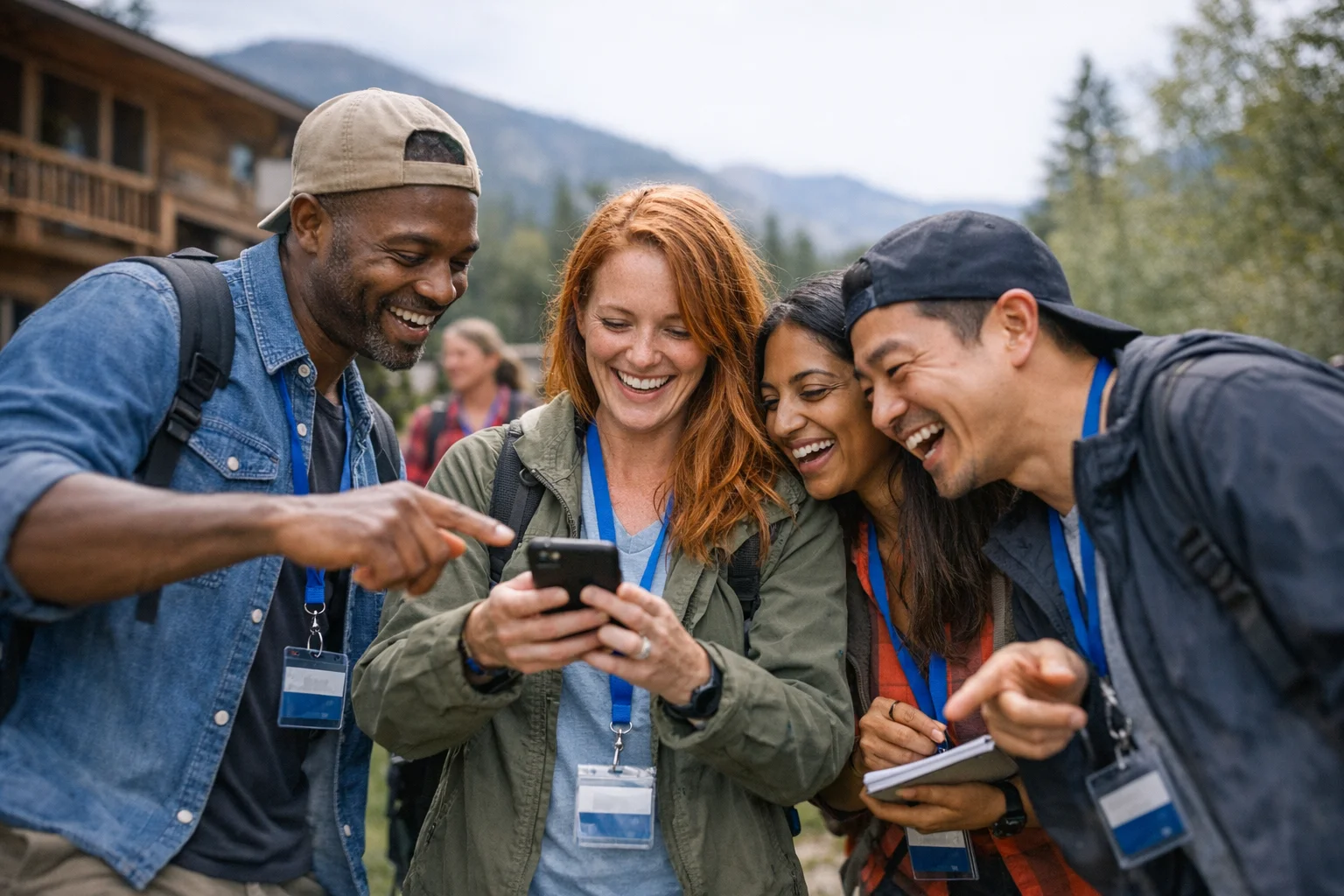
Every team has a retreat story that starts strong and fizzles by lunch. Too many slides. Not enough oxygen. The ideas below fix that. They’re built to create real connection, spark useful thinking, and leave people feeling like the time was well spent.
Retreats work when they build the conditions teams need every day: psychological safety, structure and clarity, meaning, and impact. Google’s multi-year Project Aristotle flagged psychological safety as the strongest dynamic of effective teams. If your retreat doesn’t support that, it’s theater. See the principles in Google’s own material on team effectiveness. (rework.withgoogle.com)
If you want business outcomes, engagement isn’t fluff. A recent Gallup Q12 meta-analysis spanning hundreds of organizations links higher employee engagement with better results across multiple measures. Your retreat should be one lever in that system, not a standalone spectacle. Skim Gallup’s 2024 Q12 meta-analysis brief for the performance connection. (gallup.com)
A pattern we keep seeing: the best days blend movement with thinking. Even a short walk can lift creative ideation, which is why walk-and-talks often unlock better conversation than boardroom chairs do. Stanford researchers documented this effect in a well-cited study on walking and creativity. If you’re planning brainstorms, plan some steps. Read the Stanford summary of the walking-and-creativity finding. (news.stanford.edu)
Nature also helps. Brief exposure to green space is associated with short-term gains in attention and mood, which makes outdoor blocks more than a nice-to-have. The Canadian Psychological Association’s digest on benefits of nature exposure summarizes the research. (cpa.ca)
Design tips that reliably improve retreats: - Start with the afters. Name 2–3 behaviors you want to see more of next month. Choose activities that rehearse those behaviors. - Mix formats. Rotate between movement, small-group making, and whole-group reflection. - Avoid stage time bloat. Cap monologues. Use short briefings with clear calls to action. - Design for inclusion. Offer alternatives to high-intensity competition and consider accessibility in venues and activities. - Close the loop. Capture decisions in the room and assign owners before people leave.
Example challenge mix for a downtown hunt:
Make it work: Set a clear theme, mix quick wins with a few stretch challenges, and end with a highlight reel.
If you want a platform built for this, Scavify runs hunts on phones or browsers with automated scoring and flexible challenge types. It’s our home field.
Why it works: Shared narrative beats pure puzzles for memorability.
Pro tip: Cap sessions at 15 minutes, rotate fast.
Keep it honest: Ban vanity projects.
Make it work: Measure output and invite the partner to the debrief.
Evidence assist: Walking boosts divergent thinking, which helps idea generation. (news.stanford.edu)
Photo safari with constraints Give each group a creative constraint: symmetry, reflection, or “our value in the wild.” End with a quick gallery and peer voting.
Culinary lab challenge Teams get a mystery basket and a constraint like “no heat” or “regional twist.” Judges score on taste, teamwork, and story.
Accessibility tip: Offer non-food roles like plating, photography, or emcee.
Maker workshop Provide kits for small builds: planters, simple electronics, or signage for the office. The point isn’t the artifact, it’s building together.
Checkpoint race across campus “Amazing Race” style. Light tasks at each station. Include a mix of physical, creative, and knowledge challenges to keep everyone engaged.
Silent start brainstorm + fast converge Start with solo idea generation. Move to pairs, then small groups, then the room. Keep markers moving. End with 3 decisions, not 30 ideas.
Campfire failure stories After dinner, volunteers share a 3-minute story: what failed, what changed. Leaders go first. Protect the tone.
Why it matters: Psychological safety grows when leaders model real learning moments. Link back to the team effectiveness factors. (rework.withgoogle.com)
Customer audio lab Play anonymized customer calls. Teams note friction, then draft two experiments to test next quarter. Assign owners now, not later.
Low-rope trust course or facilitated challenges Focus on communication and planning, not strength. Debrief explicitly into daily work.
Pop-up escape room Convert a ballroom with modular puzzles tailored to your products. Keep puzzles parallel so no one watches others solve.
Wellbeing reset block Guided breathwork, stretch, and optional quiet time. Keep it opt-in. The point is recovery so the next workshop lands.
Kill-a-meeting clinic Each team picks one recurring meeting to eliminate. They design an async replacement and a 30-day trial. Document decisions on the spot.
Culture micro-documentary Teams film 60-second stories that answer “What we do better than we admit.” Screen them before dinner.
Coffee roulette Spin up cross-department 15-minute coffees. Provide prompt cards. Keep rounds tight so energy stays high.
Strategy sketching On big paper, draw how the next six months actually work. Name dependencies and risks. Ask, “What would make this easier to ship?”
Innovation fair Internal teams demo tools, prototypes, or scripts. Short pitches, real use cases, and a shared backlog of “steal this next.”
Geocache adventure Hide caches around the venue with riddles that tie back to your product or values. Include a few red herrings for joy.
Sustainability challenge Set a measurable eco-objective for the day. Track progress live. Celebrate the smallest clever hack.
Camp-style mini-olympics Low-intensity relays, lawn games, logic puzzles, and creative contests. Score for spirit and inclusion as much as points.
Live customer panel Invite a few real users. Prep them well. Ask what you should stop, start, and continue. Translate answers into one change per team.
Lightning talks Five-minute talks with time boxes that actually hold. Topics: “one tool that saved me hours,” “how we really make decisions,” “one metric I watch.”
Playbook sprint Pick a recurring scenario. In 60 minutes, write the minimum viable playbook. Ship it to your internal wiki before the session ends.
Use these as starting points. Swap any block with an idea above. Keep the energy arc: move, make, reflect.
One-day offsite - Morning: Welcome, goal-setting, and silent-start brainstorm into 3 clear decisions. - Late morning: Walk-and-talk problem clinics, then share-outs. - Lunch: Unstructured with optional prompt cards. - Early afternoon: App-based scavenger hunt around the venue; highlight reel on return. - Late afternoon: Playbook sprint for one scenario; assign owners and dates. - Evening: Campfire failure stories (opt-in), light games.
Two-day retreat - Day 1 morning: Strategy sketching in cross-functional groups. - Day 1 afternoon: Maker workshop or culinary lab; exhibit and tastings. - Day 1 evening: Lightning talks and social time. - Day 2 morning: Internal pain-point sprint; pick and assign experiments. - Day 2 afternoon: Innovation fair; live customer panel; close with commitments.
Half-day on-site - First block: Coffee roulette with prompt cards to break silos. - Middle: Kill-a-meeting clinic to reclaim time. - Close: Culture micro-documentary screening with next steps.
A clear purpose, formats that involve everyone, and time to translate insights into decisions. Blend movement, small-group work, and whole-group alignment. Close the loop with owners and next steps so progress doesn’t evaporate.
Most teams do well with one to two days. One day forces focus. Two days add spaciousness for deeper work and social connection. Go longer only if you have clear objectives for the extra time.
Offer varied roles in each activity, design for multiple energy levels, and provide opt-in alternatives for high-intensity segments. Share agendas early, consider sensory needs, and use spaces that are easy to navigate.
Aim for work that feels real and fun that invites participation without pressure. A useful ratio is to pair every social block with a block that produces a concrete decision or artifact.
Use facilitation that levels airtime: silent starts, timed rounds, and rotating reporters. Ask leaders to speak last in debriefs and to model curiosity in Q&A.
Coffee roulette, walking clinics, lightning talks, and a DIY scavenger hunt around your own office or campus are all low-cost. The value comes from structure and debriefs, not fancy venues.
Define 2–3 behaviors to track before you start. After the retreat, look for movement in those behaviors and in engagement indicators you already monitor. Gallup’s research connects improved engagement with better performance, which is where you ultimately want to see the effect. (gallup.com)
If an app-powered scavenger hunt fits your agenda, Scavify makes launch easy, scales to big groups, and automates the unglamorous parts so you can watch the team dynamics you actually came to build.