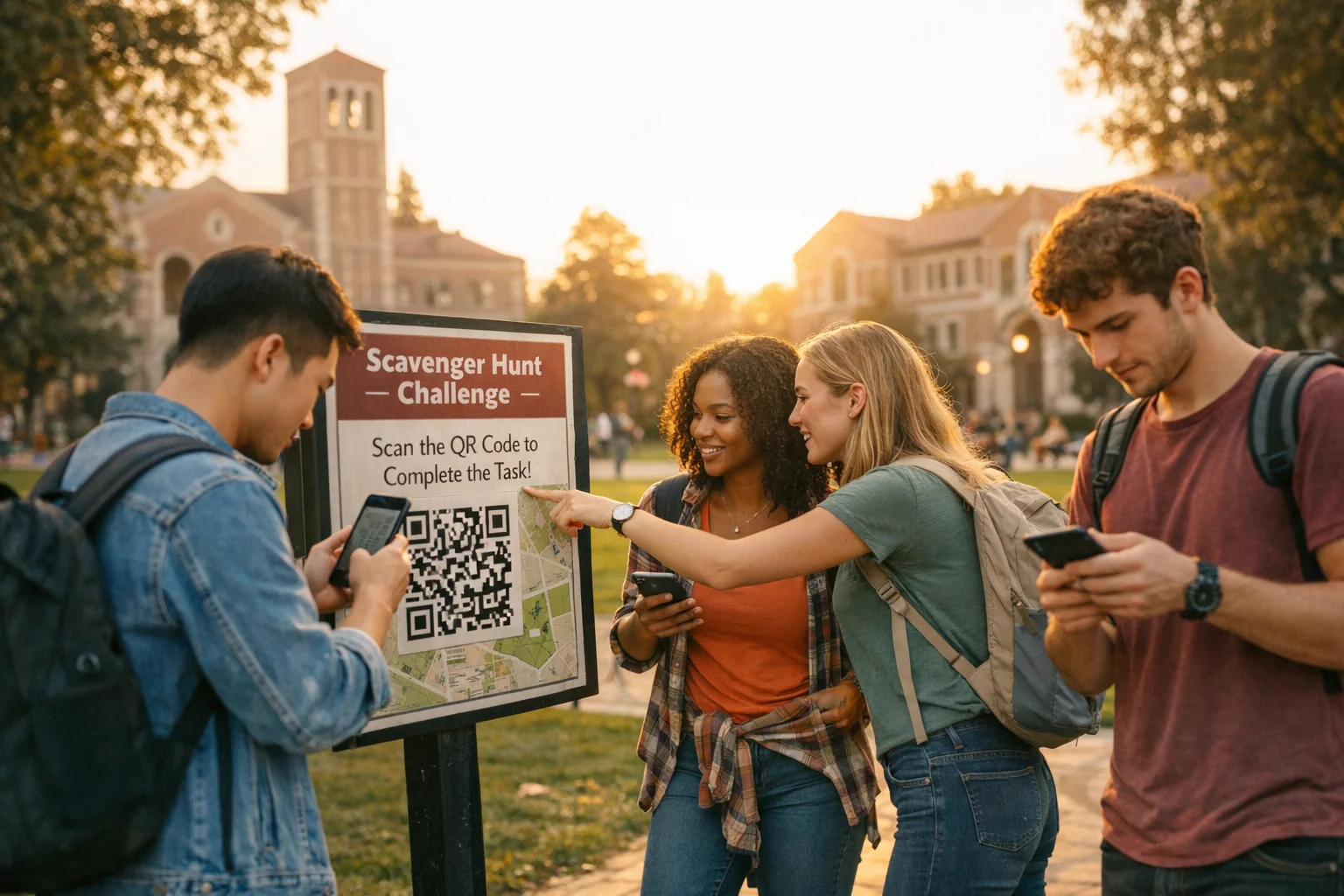
College campus energy runs on momentum. A well-built scavenger hunt turns awkward hellos into shared wins, teaches the map without the lecture, and gives new groups a reason to explore together instead of drifting apart. This guide delivers the playbook and 24 field-tested ideas you can use as-is or tweak for your campus.
At a Glance
- Design for outcomes. Pick 1–2 goals (belonging, wayfinding, services awareness) and build every task to serve them.
- Mix task types. Blend fast wins with a few anchor challenges to keep motivation steady.
- Keep it inclusive. Offer multiple ways to complete tasks and avoid single-path physical barriers.
- Use real-time feedback. Live leaderboards and progress pings keep groups moving without micro-managing.
Why campus scavenger hunts work for college students
A pattern we keep seeing: when students move, decide together, and create artifacts (photos, short videos, quick answers), they remember more and feel like they belong faster. That’s not wishful thinking. Large-scale research on active learning shows students perform better when they participate versus passively receive information. The classic meta-analysis across 225 undergraduate courses found higher performance and lower failure rates with active formats. That same principle powers a good hunt. (pubmed.ncbi.nlm.nih.gov)
There’s also the engagement piece. Years of work from the National Survey of Student Engagement link participation in educationally effective activities to stronger learning and persistence. Translation: give students authentic, participatory moments early and you’re stacking the deck for success later. (nsse.indiana.edu)
Finally, blended or app-supported orientation formats improved convenience, access, and follow-through during the shift to digital. Many campuses kept the best of those practices: flexible access to content with live, social moments layered on top. Scavenger hunts fit cleanly into that model. (er.educause.edu)
How to plan a campus hunt that actually engages
Skip the novelty factor. Build for behavior.
- Start with the outcome. Choose one primary goal and one secondary: belonging, campus fluency, services discovery, or traditions education. If everything is a goal, nothing is.
- Pick a realistic route. Aim for a 30–60 minute footprint that stays within a walkable cluster. Long treks feel like errands.
- Mix task difficulty. Stack the first 10 minutes with obvious wins. Add 2–3 anchor challenges that require thinking or collaboration.
- Use varied formats. Photo, video, QR code, GPS check-in, multiple choice, and quick Q&A all earn their place. Variety keeps attention.
- Make it inclusive by design. Offer alternatives for any task that depends on stairs, speed, or specific senses. Universal Design for Learning principles favor multiple means of engagement, representation, and action. That mindset removes barriers without diluting challenge. (cast.org)
- Right-size teams. Trios or quads usually hit the sweet spot: enough roles to share, few enough to decide.
- Communicate the clock. Visible countdowns increase pace without pressure from staff.
- Automate verification. App-based hunts with auto-scoring, time-stamps, and GPS/QR checks cut judging overhead and reduce disputes.
In our experience, the cleanest ops come from modern, app-based formats. Scavify is built for this: flexible challenge types, automation, real-time leaderboards, and the option to run in the mobile app or a browser. If you’re coordinating across residence halls, orientation teams, or a city-adjacent campus, the orchestration lift stays light.
24 scavenger hunt ideas for college students
Each idea includes a few ready-to-run challenges. Use them directly or as prompts to build your own. Point values assume a short, high-energy format.
1) Orientation Landmarks Quest
Help new students internalize the “mental map” they’ll actually use by week two.
- [GPS Check-in | 40 pts]: The building every first-year eventually finds at 8:55 a.m.
- [Photo | 30 pts]: Where the campus tour said to rub for good luck.
- [QR Code | 20 pts]: Scan at the office that replaces lost IDs.
- [Q&A | 20 pts]: Which floor has the fastest printers after 5 p.m.?
2) Residence Hall Rivalry
Friendly competition, fast bonding. Keep routes within a few buildings.
- [Photo | 30 pts]: Capture your floor’s unofficial mascot in the wild.
- [Video | 50 pts]: Thirty-second elevator etiquette skit everyone agrees on.
- [QR Code | 20 pts]: Scan near the quiet-hours sign most people miss.
3) Library Mastery Hunt
Teach spaces, services, and norms without a tour speech. NC State’s library team has run mobile, game-based orientations for years; it works. (lib.ncsu.edu)
- [Photo | 30 pts]: The seat with the best outlet-to-sunlight ratio.
- [Q&A | 20 pts]: What tool lets you borrow a DSLR for class projects?
- [GPS Check-in | 40 pts]: Check in at the floor with group study booths.
- [QR Code | 20 pts]: Scan near the 24-hour space entrance.
4) Campus History Time-Capsule
Traditions anchor identity. Use archives and plaques to make them tangible.
- [Photo | 30 pts]: The oldest brick still in daily use.
- [Q&A | 20 pts]: Year the mascot first appeared at halftime.
- [Video | 50 pts]: Recreate a 10-second version of a campus legend.
5) First-Gen Insider Track
Surface the offices and people who matter most early.
- [QR Code | 20 pts]: Scan at the academic success center welcome desk.
- [Q&A | 20 pts]: Where do fee waivers live online for textbook alternatives?
- [Photo | 30 pts]: A flyer that mentions first-generation resources.
6) Sustainability Circuit
Point out green infrastructure and everyday choices that add up.
- [Photo | 30 pts]: The building with a visible green roof.
- [Q&A | 20 pts]: Which bins accept battery recycling on campus?
- [GPS Check-in | 40 pts]: Check in at the bike-fix station closest to housing.
7) Health & Wellness Walkabout
Normalize help-seeking and show stress relief spots before midterms hit.
- [Photo | 30 pts]: The quietest bench within 2 minutes of the library.
- [Q&A | 20 pts]: What number reaches on-call mental health support after 5?
- [GPS Check-in | 40 pts]: Check in where group fitness sign-ups happen.
8) Arts & Performance Crawl
Give students a reason to step into venues they’ll pass a hundred times.
- [Photo | 30 pts]: A poster for an event that’s free with student ID.
- [Video | 50 pts]: Five-second silent choreography in an empty lobby.
- [Q&A | 20 pts]: Which space hosts student open-mic nights monthly?
9) Student Services Speedrun
Turn bureaucratic to-dos into achievable, quick tasks.
- [QR Code | 20 pts]: Scan at the bursar’s after-hours drop slot.
- [Q&A | 20 pts]: Deadline to waive the default health insurance.
- [Photo | 30 pts]: The office where emergency grants are requested.
10) Tech Setup Sprint
Get everyone LMS-ready and synced. Digital scavenger hunts aren’t just for events; EDUCAUSE highlights how online orientation components improve access and readiness. (er.educause.edu)
- [Q&A | 20 pts]: Which app sends campus alerts to your phone?
- [Photo | 30 pts]: A screenshot of Duo/MFA confirming it’s active.
- [QR Code | 20 pts]: Scan on a poster with classroom Wi‑Fi tips.
11) Inclusion & Belonging Pathway
Design choices shape who participates. Offer options so no one’s boxed out. CAST’s UDL frame is a helpful gut-check. (cast.org)
- [Photo | 30 pts]: A gender-inclusive restroom near your primary classrooms.
- [Q&A | 20 pts]: Where can students request captioning for events?
- [Video | 50 pts]: 15-second welcome in two languages represented on campus.
12) Town/Gown Explorer
Nudge students off-campus to the places they’ll actually return to.
- [GPS Check-in | 40 pts]: Check in at a safe late-night study cafe.
- [Photo | 30 pts]: A community board with volunteer listings.
- [Q&A | 20 pts]: Which bus line runs latest back to campus?
13) Spirit & Athletics Circuit
Make cheering a scavenger-able action, not just a schedule date.
- [Photo | 30 pts]: The loudest seat in the student section.
- [Video | 50 pts]: A respectful 10-second chant rehearsal.
- [Q&A | 20 pts]: Where do ticket lotteries post winners?
14) Study Spaces Sampler
Every campus has the nooks nobody finds until November.
- [Photo | 30 pts]: A study spot under a stairwell with natural light.
- [Q&A | 20 pts]: Which building has reservable whiteboard walls?
- [GPS Check-in | 40 pts]: Check in at a late-night laptop bar.
15) Foodie Forage
From dining hall hacks to off-menu items students share like folklore.
- [Photo | 30 pts]: A sign for allergen-friendly options.
- [Q&A | 20 pts]: Which station serves breakfast after noon?
- [Video | 50 pts]: Create a 10-second recipe using two vending items.
16) Faculty & Office Hours Bingo
Reduce the psychological distance early; names and places matter.
- [Photo | 30 pts]: A door with posted office hours after 5 p.m.
- [Q&A | 20 pts]: What’s the fastest way to schedule advising this term?
- [Video | 50 pts]: A mock 15-second “first question” you’d ask a prof.
17) Getting Around: Transit & Bikes
Show the invisible network that makes a big campus feel small.
- [GPS Check-in | 40 pts]: The shuttle stop with real-time arrival screens.
- [Q&A | 20 pts]: Where to register a bike for theft recovery.
- [Photo | 30 pts]: The safest after-dark path between two hubs.
18) Safety Essentials Loop
Confidence beats fear. Teach routes, resources, and expectations.
- [QR Code | 20 pts]: Scan next to the blue light phone nearest housing.
- [Q&A | 20 pts]: Non-emergency campus police number.
- [Photo | 30 pts]: A well-lit path entry point after sunset.
19) Career Kickstart Trail
Make the career center real before internship season sneaks up.
- [QR Code | 20 pts]: Scan at the resume review sign-up kiosk.
- [Q&A | 20 pts]: Where to find paid campus jobs this term.
- [Photo | 30 pts]: A flyer for a fair in your major area.
20) Clubs & Orgs Live Hunt (Fair Edition)
Turn tabling chaos into purposeful exploration.
- [Photo | 30 pts]: A club you’d try once outside your comfort zone.
- [Q&A | 20 pts]: Which org hosts weekly “come-as-you-are” meetups?
- [Video | 50 pts]: 10-second pitch from a club you didn’t expect to like.
21) Makerspaces & Labs Tour
Hands-on spaces convert curiosity into projects.
- [Photo | 30 pts]: The tool wall you’ll actually borrow from this term.
- [Q&A | 20 pts]: What training unlocks 3D printer access?
- [GPS Check-in | 40 pts]: Check in at a lab that welcomes all majors.
22) Finals Week Micro‑Hunt
Short, restorative, and delightfully unserious.
- [Photo | 30 pts]: A campus spot that forces a deep breath.
- [Q&A | 20 pts]: Where free coffee appears on reading days.
- [Video | 50 pts]: 10-second study tip from someone new.
23) Alumni Weekend Throwback
Create low-stakes intergenerational moments that feel natural.
- [Photo | 30 pts]: A place that didn’t exist five graduating classes ago.
- [Q&A | 20 pts]: What tradition started the year you (or your alum) arrived?
- [Video | 50 pts]: A 10-second “then vs. now” side-by-side.
24) Story of Campus (Photo Essay)
Teams become tour guides by the end. Have them curate.
- [Photo | 40 pts]: “This is where I’ll spend the most time.”
- [Photo | 40 pts]: “Where I’ll decompress when plans go sideways.”
- [Photo | 40 pts]: “A door I want to open this year.”
Scoring, safety, and logistics that keep the energy high
- Points that pace. Weight a few anchor challenges at 50–100 points, then keep most tasks 20–40. More points aren’t better; better pacing is.
- Live leaderboard, silent staff. Real-time scores scratch the competition itch so facilitators can watch flow instead of shouting updates.
- Clear rules, real boundaries. Ban rooftops, moving vehicles, and classrooms-in-session. Give an explicit perimeter and a time cap.
- Privacy-aware media. Keep public-facing posts optional. Make it clear that photos and videos live in the game environment by default. Provide opt-out alternatives for every media task.
- Accessibility is planned, not patched. For any location-specific task, offer a non-physical alternative worth equal points. UDL’s “multiple means” principle is the simplest litmus test. (cast.org)
- Battery and bandwidth. Suggest low-power mode, offline maps, and letting one teammate upload on stable Wi‑Fi post-hunt if needed.
- Small print, simple words. Use plain-language rules. If you have to explain it twice, rewrite it.
Real-world signals that hunts belong on campus
- Library orientations that stick. NC State’s Libraries documented a mobile, game-based hunt that improved navigation and confidence using everyday tools students already use. It’s a repeatable pattern. (lib.ncsu.edu)
- Conference-scale validation. EDUCAUSE ran an official scavenger hunt at its 2021 Annual Conference using Scavify. If it scales at that level, your campus can handle it. (events.educause.edu)
- QR codes and weeklong quests. Even house-competition models show up in student-built orientation apps like CMU’s O‑Quest, which time-releases challenges and uses QR scans to encourage exploration. (apps.apple.com)
- Active beats passive. If you need a nudge for skeptics, point to the research base on active learning’s impact on outcomes. Then let the first 10 minutes of your hunt prove the rest. (pubmed.ncbi.nlm.nih.gov)
FAQs
How long should a college scavenger hunt last?
Most campus hunts run well between 30 and 75 minutes. Shorter sprints fit tabling events; longer windows fit orientation blocks. The right length is the one that ends with teams wanting one more task.
What’s the ideal team size for student hunts?
Trios or quads usually work best. Pairs can rush; groups of five start splitting. If you expect uneven turnout, allow teams to flex between three and five.
Do we need an app, or can we do it on paper?
Paper works for very small groups, but app-based hunts reduce friction: automated scoring, GPS and QR validation, and a live leaderboard that keeps energy high without heavy staffing. Browser access helps students with older phones participate.
How do we make the hunt inclusive for all abilities?
Offer multiple ways to complete every task. Avoid single-path routes that require stairs or speed. Provide alternatives for media tasks. UDL’s principles are a practical lens: multiple means of engagement, representation, and action. (cast.org)
Can this replace a campus tour or orientation session?
Not entirely, but it can carry the parts a tour struggles with: wayfinding that sticks, names-to-places memory, and low-stakes social interaction. Many campuses blend hunts into orientation weeks because it pairs well with structured advising or info sessions. (er.educause.edu)
How do we prevent unsafe behavior?
Spell out red lines clearly (no vehicles, no off-limits areas, no classroom disruptions), set a firm boundary and time limit, and prefer tasks that reward observation over stunts. Make staff contact info visible in-app.
What prizes work without overshadowing the experience?
Keep it simple: campus swag students will actually use, small experience perks, or a scoreboard shoutout. Participation certificates for org points or housing competitions add meaning without cost.
How can Scavify help without making this a heavy lift?
Scavify’s challenge variety, auto-verification, and live leaderboard handle the time-consuming parts. You focus on picking outcomes and writing on-brand tasks. It runs in the app or a browser, so access stays flexible.