Solutions
Your first hunt, live this afternoon.
Free to start · No download for participants
Discover 24 scavenger hunt event ideas for corporate teams, birthdays, campus events & more - plus tips to plan and run each one without the stress.
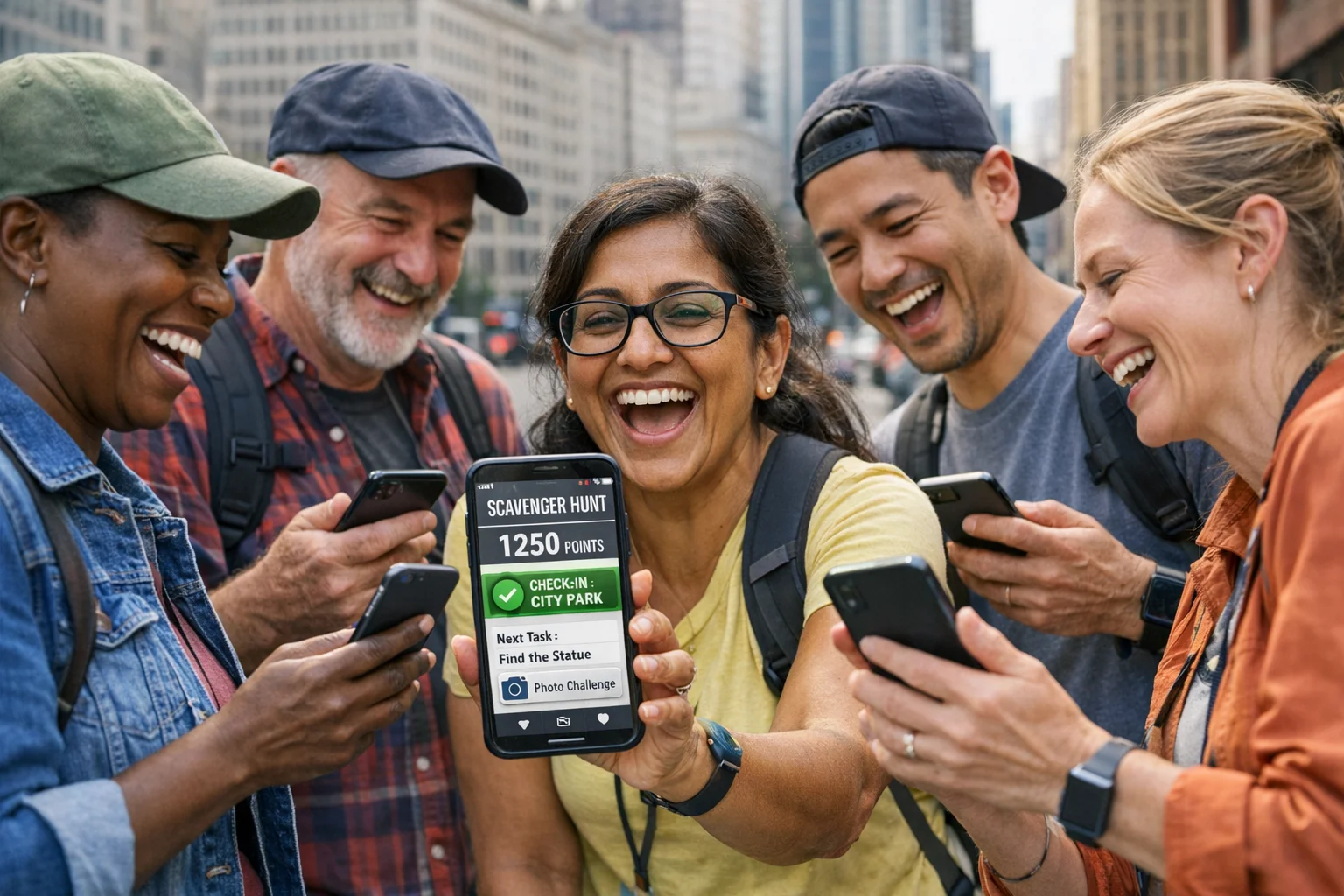
Scavenger hunt events do two jobs when they’re designed well: they spark energy fast and they create purposeful interaction. This guide gives you 24 proven ideas you can run for corporate teams, conferences, campus life, onboarding, tourism activations, and parties, plus the practical structure that makes them land.
Most hunts fail in the same two ways: the route drags or the content is random. The fix is simple: define the outcome first, then let format follow.
Start with the outcome. Are you trying to accelerate new-hire connections, move attendees across an expo floor, teach campus wayfinding, or create city buzz for a sponsor? Write that in one sentence. Use it as a filter for every challenge.
Mix challenge types on purpose. Use a blend of photo, video, GPS check-in, QR code, multiple choice, and Q&A challenges so different brains contribute. A steady mix prevents the “one person does it all” dynamic and keeps teams moving.
Right-size the arc. Aim for a route that feels brisk. Shorter, denser hunts usually outperform sprawling odysseys. It’s better to leave people wanting one more challenge than to watch enthusiasm slide at the 70 percent mark.
Show progress. Real-time scoreboards, streaks, and unlocks create gentle urgency. The research on gamification consistently links points, feedback loops, and badges to higher engagement when they reinforce meaningful tasks, not fluff, as summarized in a meta-analysis on gamification and learning outcomes. (link.springer.com)
Build for safety and access from the start. Check routes for crossings, crowds, and lighting. Offer clear alternatives for mobility, vision, and hearing needs. Practical guidance lives in the ADA planning guide for temporary events, the UK HSE’s crowd safety risk assessment guidance, and OSHA’s succinct Crowd Management Safety Guidelines. (adata.org)
Close with a debrief. A quick after-action conversation cements learning and morale. Meta-analytic research links structured debriefs to improved team performance, and practical healthcare guidance shows they can be brief and powerful. See the meta-analysis on team/individual debriefs and the AHRQ debrief guidance. (journals.sagepub.com)
Expect positive effects when the work matters. Team-building interventions have measurable benefits, particularly for goal-setting, role clarity, and interpersonal processes, when tied to real tasks. That’s the headline from a broad meta-analysis on team building effectiveness. Keep your hunt connected to the work or community at hand. (journals.sagepub.com)
Each idea includes a short setup and a few sample challenges. Use them as building blocks, not scripts.
Turn the workplace into a discovery map. Great for reconnecting hybrid teams and surfacing underused spaces.
Teams trade knowledge through lightweight tasks that reveal who does what and why it matters.
Blend volunteering with game mechanics to make service vivid and trackable.
Turn values into behaviors by finding and documenting real examples.
Zero-gloss safety audit that engages eyes and brains across facilities.
Short, energizing tasks that break up a long offsite or retreat.
Move attendees between booths with purpose, not swag grabs.
Drive better session selection and knowledge capture.
Make sponsor value real through narrative tasks.
Not a flimsy icebreaker. Real prompts that spark useful conversations.
Map the places new students actually use by Week 2.
Teach resources, not just stacks and silence.
Get students through admin hurdles faster by making discovery fun.
Campus myths and rituals. Memory makers with a wink.
Map the org, tools, and rituals in days, not weeks.
Turn must-do training into scenarios people remember.
Short tasks that create real first wins in your core systems.
A locals-and-visitors mix that hits icons and oddities.
Slow down to see what most people miss.
Drive foot traffic and cross-promotion on main streets.
Big energy, zero awkward mingling. Make the guest of honor the thread.
A light narrative with gatekeeper clues that unlock in sequence.
Fully online with webcams and webcams-off tasks. Keep it snappy.
Half the team in the city, half online. Both matter.
Here’s the backbone we keep coming back to. Adjust for your reality.
Two to four weeks out - Outcome: write the one-sentence purpose and 3 measures of success. - Route: map hotspots, access needs, and backup options for weather. - Content: draft 20 to 40 challenges; tag each to your outcome. - Safety: confirm crossings, permissions, and alternatives for mobility, vision, and hearing. Use the ADA temporary events guide as a checklist. (adata.org)
One week out - Tech check: verify QR codes, GPS pins, notifications, and scoreboard. - Brief captains: clarify tie-breakers, boundaries, and help channels. - Swag/prizes: simple, meaningful, on-theme. Recognition beats trinkets.
Day of - Kickoff: one-page rules, one-minute demo, then start. Keep it tight. - Live ops: watch the feed, add bonus challenges to even the pace. - Finish: hard stop, quick scoring, immediate recognition.
After - Debrief: 10 to 20 minutes. What surprised you? What would we repeat? What changes Monday? Research-backed debrief frameworks show performance gains when teams align on lessons and next steps; see the team debrief meta-analysis. (journals.sagepub.com) - Share: highlight reel within 24 hours. Let people relive the best bits. - Measure: did your 3 success measures move? Keep what worked.
Paper checklists can run a simple hunt. Once you add real-time scoring, photos/videos, GPS, QR, hints, and moderation, a platform helps.
Scavify exists for exactly this use case: app- and browser-based challenges, automated scoring, live feeds, flexible routes, and scale from a single team to a campus or city activation. The point isn’t bells and whistles. It’s removing the friction so you can focus on content that drives the behavior you want.
A quick note on psychology: points and badges by themselves won’t save a bland task list. When rewards reinforce meaningful actions, they amplify engagement, as echoed in a broad gamification research synthesis. (link.springer.com)
Shorter is usually stronger. A tight window keeps energy high and leaves time for a fast debrief. If you’re pairing with a larger event, run multiple short rounds instead of one marathon.
Small squads encourage contribution from everyone and shorten decision loops. The exact number depends on your venue and goals. If teams feel stuck, they’re too big; if they feel rushed, the route is too long.
Recognition, great photos, and bragging rights travel further than expensive stuff. Layer small on-the-spot bonuses (first to a location, best caption) with a simple final award.
Design with access and crowd flow in mind from the start. Provide alternatives for mobility, hearing, and vision tasks, mark clear boundaries, and plan crossings and queues. The ADA temporary events planning guide and HSE’s crowd safety guidance are practical references. (adata.org)
Define three outcomes tied to your context: e.g., cross-team intros logged, booths visited, campus services discovered, onboarding tasks completed. Track completion data, submissions quality, and post-event behavior changes.
Blend quick wins (photos, QR scans) with thinking tasks (Q&A, riddles) and place-based challenges (GPS). The right mix aligns to your outcome: more Q&A for training, more GPS/QR for wayfinding or expo movement.
Use plain language. Avoid inside jokes. Offer equivalent alternatives for any physical or audio-heavy task. Test with a small, diverse group and adjust.
Because it turns activity into improvement. Even a short, structured debrief improves team performance and retention of lessons, supported by the team debrief meta-analysis and AHRQ’s practical guidance. (journals.sagepub.com)
If you want templates, automation, and a live feed that keeps the room buzzing, Scavify was built to make passive participation active without turning you into a full-time game master.