Solutions
Your first hunt, live this afternoon.
Free to start · No download for participants
Explore standout local team building ideas with indoor, outdoor, and low-lift options for company events and offsites.
Minneapolis rewards planners who think in seasons and neighborhoods. You can keep a group buzzing along the riverfront one month, then move the whole experience indoors through the skyways the next. The throughline: make it active, local, and a little unexpected.
A fast-moving, photo-forward hunt across warehouses-turned-boutiques, murals, and river views. Short walking distances keep energy high while small teams chase points and bragging rights.
Best for: Mixed groups, offsites based downtown.
Make it better: Finish at a casual spot within a short walk to keep the debrief social, not formal.
Here are sample challenges that play well in the area:
Turn the connected walkways into a climate-proof course with checkpoints, riddles, and quick creative tasks. The route weaves through second-floor corridors and pocket plazas, great for winter or rain.
Why it works: It’s unexpected, comfortable in any weather, and naturally time-boxed.
Pro tip: Set a shared meeting point near transit, then branch teams along different legs to reduce bunching. Downtown’s 10-plus miles of enclosed walkways linking roughly 80 city blocks are mapped in the official Minneapolis Skyway guide. (minneapolis.org)
Build a choose-your-own-adventure around Bde Maka Ska, Lake of the Isles, and Cedar Lake. Mix short walks, scenic photo prompts, and optional rental stops.
Best for: Spring through fall, groups that value movement without endurance.
Pro tip: Keep the core loop tight, then offer optional detours for speedier teams. Map choices around the Minneapolis Chain of Lakes Regional Park. (minneapolisparks.org)
Set a creative hunt among iconic public art next to the Walker. Teams capture perspective shots, mimic poses, and solve mini art riddles before regrouping for a picnic-style debrief.
Why it works: The space invites play without feeling childish, and the art naturally prompts conversation.
Preview the grounds via the Walker’s official Sculpture Garden page. (walkerart.org)
Cross-country ski basics for newcomers, snowshoe micro-courses, and a tubing dash for pure grin value. Rotate small groups across stations to keep lines short and legs warm.
Best for: January team weeks and winter offsites.
Pro tip: Anchor comms, rental info, and updates from the MPRB winter activities hub. It consolidates current offerings and conditions for park locations, including Wirth. (minneapolisparks.org)
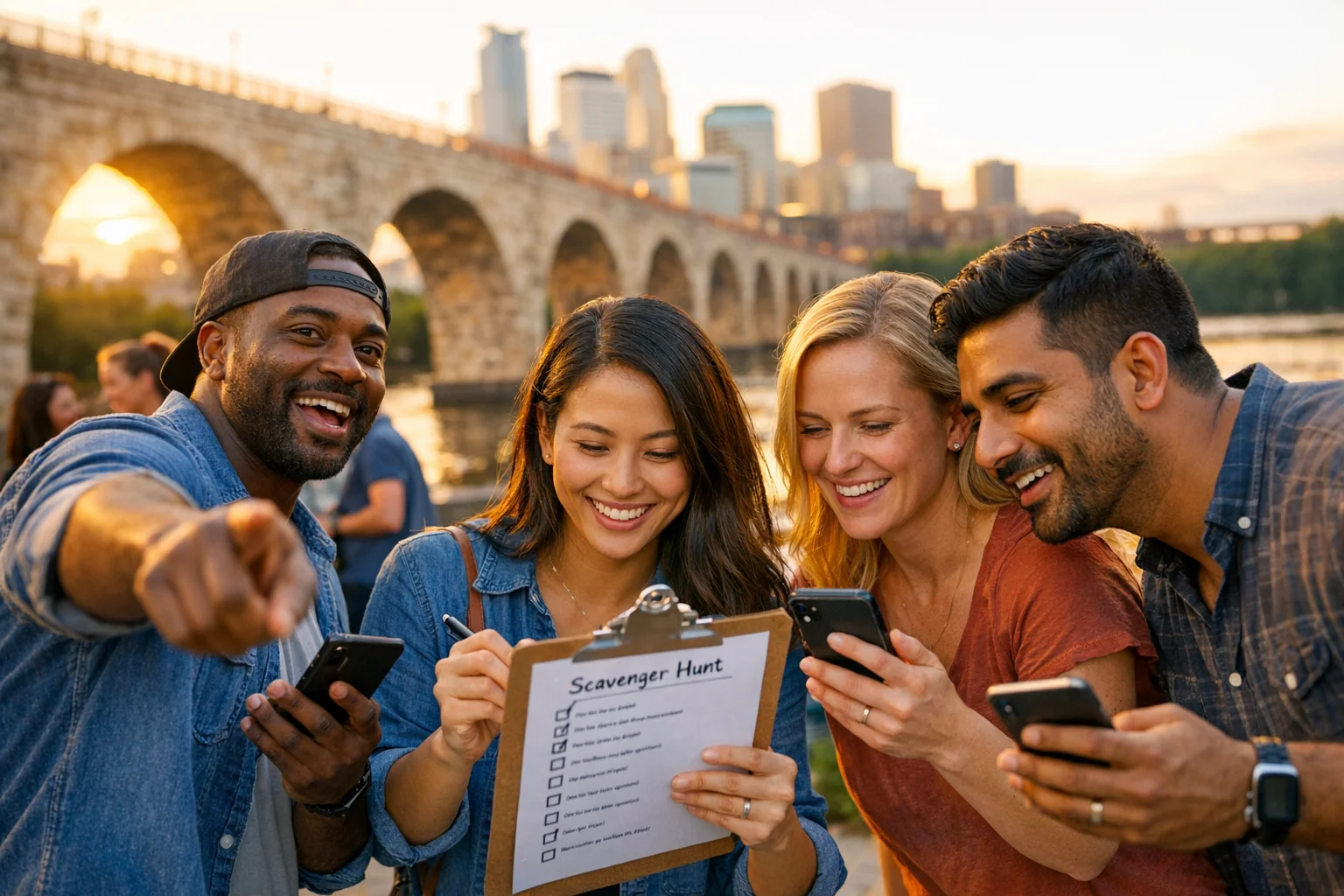
Start near Mill Ruins Park and Stone Arch Bridge. Blend history clues, skyline photo prompts, and quick-build challenges using limited materials. Wrap at Water Works for an easy, central finish.
Why it works: High scenery per step, easy access, minimal transfers.
Issue teams a shared punch card: three vendors, two cuisines, one sweet finish. Add cultural trivia, chef selfie bonuses, and a “new-to-you” dish requirement to nudge people out of food ruts.
Best for: Food-motivated teams and afternoon slots.
Make it better: Seat-mix the group between stops so conversations naturally shuffle.
Northeast’s warehouse streets and side alleys hide a dense set of murals and maker spaces. Create a route of color-splash backdrops and include one quick collaborative art prompt on paper or tablet.
Why it works: It’s visual, fast, and easy to scale across multiple teams.
Book multiple time slots or rooms and rotate teams. Score isn’t just finish time; award points for communication style, creative leaps, and positive post-mortems.
Pro tip: Debrief immediately while the “aha” moments are fresh.
Short instruction, head-to-head brackets, and a light round-robin. Keep the playlist upbeat but not blaring so spectators can actually trade tips.
Why it works: Quick wins, shared laughs, and visible progress.
A focused workshop with local improv instructors that emphasizes listening, offers, and building on others’ ideas. Skip performance pressure and aim for fast, low-stakes reps.
Make it better: Capture a few debrief phrases on a whiteboard and reference them in the next day’s meeting to lock the learning.
Use Nice Ride or your own bikes for a mellow lap on the Grand Rounds. Layer in photo prompts, nature-spotting bonuses, and one café checkpoint.
Best for: Active groups in late spring through early fall.
Short hike, big payoff. Build a compact route with photo and Q&A prompts, then hold a reflection circle at the end so the moment doesn’t just vanish into camera rolls.
Pro tip: Keep teams staggered to avoid crowding the stairs and overlooks.
Two hours of park or river cleanup in small teams, then a simple scoreboard for bags filled, oddest find, and best teamwork. Add a closing circle that names one teammate’s contribution out loud.
Why it works: Shared service bonds quickly without forced icebreakers.
Build a route across campus landmarks with alumni trivia, hidden-history prompts, and lightweight prototyping tasks using pocket supplies. End near a café cluster for easy warm-up in colder months.
Keep it friendly: short instruction, shallow water practice, and a slow loop. Non-paddlers can run a shoreside challenge crew with spotting, timing, and photo roles.
Pro tip: Wind matters more than temperature. Keep routes tucked and short.
Rented gym, rotating stations: logic relay, balloon architecture, team charades, and a quiet-focus puzzle table for those who think best sitting down.
Why it works: Movement without exposure, and something for every energy level.
Hands-on menu with a collaborative plate-up challenge. Judge on flavor, plating, and “best pivot” when something goes sideways.
Make it better: Pre-assign roles so everyone gets a lane: lead, sous, plating, story.
Three short stops, one shared tab. Between venues, slip in micro-challenges that ask teams to notice a piece of public art, trade stories, or snap a themed group photo.
Why it works: Natural conversation beats contrived prompts, and the walking resets energy between courses.
If you want the hunt format without the admin lift, Scavify gives you challenge variety, automation for scoring and photo review, and easy browser-plus-app access so guests don’t fumble with downloads. We run these across North Loop, the riverfront, the Sculpture Garden area, and the skyways with equal ease.
If you’re mapping your own route, these official resources help shape strong courses:
Skyway hunts, escape room leagues, improv workshops, cooking classes, and gym-based field days all keep people moving and talking without stepping outside. Downtown skyway routes are especially useful for weather pivots.
Ninety minutes to two hours tends to be the sweet spot. It leaves time for kickoff, play, and an unhurried debrief without draining the day.
The riverfront around Stone Arch Bridge and Water Works offers high visual payoff in a short distance. The Chain of Lakes provides flexible loops with plenty of places to regroup.
Design mixed routes with alternative roles at each station. Choose clusters with nearby indoor seating and limit required distances. Score creativity and collaboration so contributions aren’t tied to speed.
Yes. Downtown, North Loop, and the Sculpture Garden area all support walkable hunts and missions. The skyways add an all-weather option linking many hotels and venues.
Most formats thrive in small teams of 4 to 6. Scale by running multiple teams in parallel rather than one giant group all moving together.
For casual, low-impact group use, often not. For reserved spaces, amplified sound, or large setups, work with the venue or park system in advance. Build lead time if you need a specific shelter or lawn.
Plan a short, social debrief. Call out a few memorable moments, award fun superlatives, and land at a nearby spot for snacks. Ending well is part of the experience.