Solutions
Your first hunt, live this afternoon.
Free to start · No download for participants
Use these activities to spark problem-solving, creativity, communication, and stronger group collaboration.
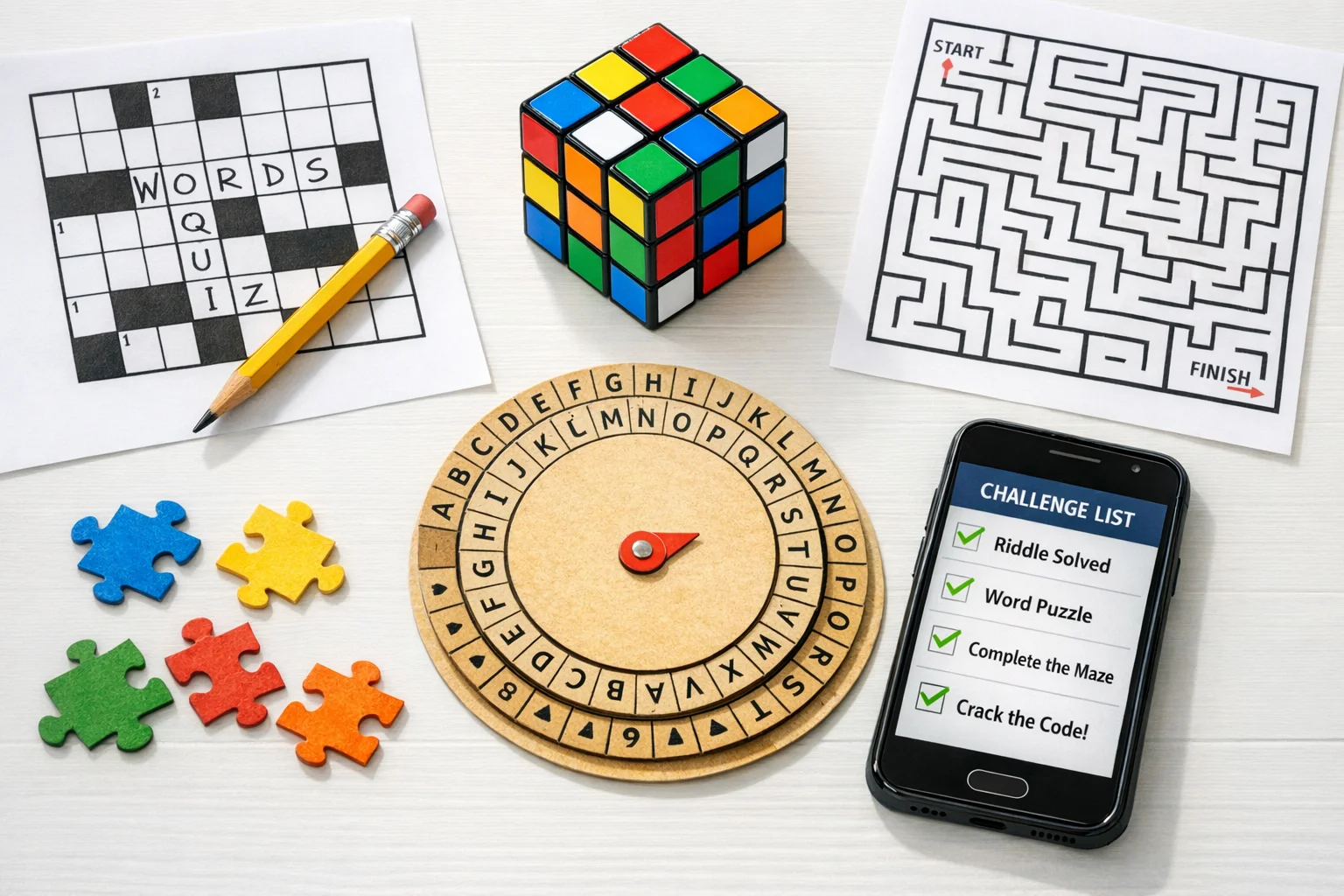
Puzzles aren’t just idle time-fillers. In the hands of a good facilitator, they’re levers for attention, collaboration, and the kind of shared “aha” that quietly bonds a group. This guide breaks down 12 types of puzzles, why each one is so addictive, and how to use them in team building, onboarding, campus orientation, conferences, tourism activations, and more.
What makes a puzzle hard to put down isn’t just difficulty. It’s the rhythm of tiny uncertainties, mounting clues, and a sudden click when the pattern snaps into place. Neuroscience research connects those “aha” moments with distinct brain activity, which helps explain why the experience feels rewarding and memorable. For facilitators, the practical takeaway is simple: design toward moments of discovery, not just answers. Embed hints, partial confirmations, and reveal steps that produce mini-insights along the way. Scientific American’s explainer on the science of insight is a helpful primer if you want to peek under the hood. (scientificamerican.com)
A pattern we keep seeing: the best group puzzles allow multiple people to contribute in parallel, then converge into a single satisfying resolution. In practice that means:
Scavify’s browser-and-app format helps here: you can mix photos, videos, GPS check-ins, QR scans, multiple choice, and open-ended Q&A in one experience. Use that variety to keep energy high and let more people feel useful.
What it is. Those classic deduction charts where you use a set of clues to match people, places, times, or items.
Why it’s addictive. Every logical elimination delivers a micro-reward. The grid turns invisible reasoning into visible progress.
Where it shines. Remote teams, onboarding cohorts, and breakouts where you want structured collaboration.
Run it well. Assign roles: one person reads clues, one maintains the grid, others argue the logic. Add a twist by embedding the clues across locations or QR codes.
Example challenges to run in an app:
What it is. Word grids ranging from straightforward definitions to cryptics that hide wordplay (anagrams, containers, homophones) inside every clue.
Why it’s addictive. Crosswords drip-feed confirmation with each crossing letter. Cryptics add the rush of unraveling cleverly disguised instructions.
Where it shines. Conferences and campus events. You can theme clues around your culture, sponsors, or local landmarks.
Run it well. Keep clue difficulty varied. For cryptics, include a short “how-to” and a couple of gimme clues to onboard newcomers. If you’re new to cryptics, The Guardian’s ultimate beginner’s guide to cryptic crosswords is a friendly, credible walk-through of devices like hidden answers, double definitions, containers, and more. (theguardian.com)
Example, app-friendly:
What it is. Short prompts that require reframing the question rather than crunching data.
Why it’s addictive. The shift from a stuck interpretation to the correct frame produces a clean jolt of ‘aha.’
Where it shines. Icebreakers, tourism activations, or anywhere you need quick wins that prompt laughs and debates.
Run it well. Read riddles aloud so more people hear the wording. Seed subtle hints after 60–90 seconds to keep flow, not frustration.
Example prompts:
What it is. Number or symbol progressions, odd-one-out sets, or visual pattern families.
Why it’s addictive. Pattern recognition pings the brain’s prediction machinery. Each correct guess sharpens a hypothesis you’re motivated to test again.
Where it shines. Training and onboarding, where you can encode product knowledge into patterns.
Run it well. Offer one easy example that clearly fits the rule. Then escalate. Provide a checker so teams can validate guesses quickly.
What it is. Tangible puzzles you manipulate by hand, from disentanglement toys to twisty puzzles like the Rubik’s Cube.
Why it’s addictive. Tactile feedback plus visible state change. You can feel progress.
Where it shines. In-person offsites, expo booths, maker spaces.
Run it well. Use multiple identical copies so more hands are active. Consider time-boxed stations so teams rotate.
If you want a quick orientation to the larger family of puzzle genres (including mechanical and combination forms like the Rubik’s Cube), Britannica’s overview of puzzle history and types is a solid, concise reference. (britannica.com)
What it is. Piece-assembly challenges from classic cardboard to 3D tiling and tangrams.
Why it’s addictive. Interlocking shapes give constant micro-confirmations. Edge pieces, color grouping, and image cues create obvious “first moves” that invite participation from anyone walking by.
Where it shines. Large common areas, campus lounges, or as a persistent background activity at conferences.
Run it well. Pre-sort small clusters. Hide a few key connectors around the venue and release them as teams complete other tasks to link activities together.
What it is. Encoded messages using substitution, transposition, or modern twists like emoji alphabets and QR steganography.
Why it’s addictive. The first correctly decoded word transforms noise into signal. That flip is pure fuel.
Where it shines. Orientation and onboarding. Wrap policy or safety info inside a cipher so people actively reconstruct it instead of skimming.
Run it well. Give a crib (a known word to anchor the key). Add a frequency table or partial key to reduce brute force.
Example app challenges:
What it is. Find-a-thing images, visual oddities, or layered posters hiding symbols in plain sight.
Why it’s addictive. You feel the instant relief of seeing what you couldn’t a moment before. It’s a beginner-friendly loop that scales for experts with time pressure.
Where it shines. Tourism activations and brand experiences. Custom art can hide local references or product features.
Run it well. Use high-contrast art and clear constraints (e.g., “There are exactly 7 differences”). Provide a photo submission so teams must actually point to the find, not guess.
What it is. Route-finding on paper or in real space, from classic mazes to network-path problems.
Why it’s addictive. Movement turns abstract planning into embodied trial-and-error. People naturally split up to test branches.
Where it shines. Campus orientations and large venues where navigation is part of the learning.
Run it well. Combine GPS check-ins with paper clues. Use QR markers to confirm forks and prevent random wandering.
What it is. Short problems that test estimation, combinatorics, or probabilistic intuition.
Why it’s addictive. A wrong-but-confident intuition corrected by a crisp explanation is strangely satisfying. People want another go to “beat” their bias next time.
Where it shines. Training and leadership development. Great for sharpening decision-making instincts.
Run it well. Keep numbers simple. Reward reasoning steps, not just final answers. Offer a worked solution after submission to cement the lesson.
What it is. A field of interconnected puzzles whose answers combine into “metas.” Often capped by a final runaround.
Why it’s addictive. Teams operate like tiny R&D labs: parallel solves, sudden cross-pollination, and one glorious moment when the meta clicks and everything you’ve done snaps into place.
Where it shines. Company-wide events, hackweeks, student welcome weeks, or city-wide tourism games.
Run it well. Calibrate difficulty steps and ensure feeder puzzles give clean, extractable answers. If you want to see a long-running, beloved example, MIT’s annual Mystery Hunt is a good reference point for structure and culture, as covered in MIT News’ explainer on the hunt. (news.mit.edu)
Example meta-friendly challenges in an app:
What it is. Layered challenges where one step unlocks the next, often mixing observation, codes, logic, and physical props.
Why it’s addictive. A string of small reveals builds momentum and shared ownership. Everyone remembers the one step they cracked.
Where it shines. Offsites, onboarding cohorts, or conference lounges where teams can spend 15–30 minutes at a station.
Run it well. Design for parallelism: one visual search, one logic mini, one code. Include a clear reset so other teams can play quickly.
Example sequence:
To help you plan, here’s a compact recap with quick-start recipes for each type.
1) Logic grid puzzles. Use 5–8 clues, 3–4 categories, 4 items each. Visual grid for progress. Recipe: distribute half the clues physically, half digitally, and require both to solve.
2) Crosswords (incl. cryptics). Seed 3–5 themed entries from your culture or city. If using cryptics, onboard solvers with a brief primer like the Guardian’s guide and mark a few beginner-friendly clues. (theguardian.com)
3) Riddles & lateral thinking. Keep prompts short. Offer a nudge at 60 seconds. Celebrate creative wrong answers; they’re half the fun.
4) Pattern/sequence. Show two obvious examples and one tricky outlier. Provide a checker to avoid endless guessing.
5) Mechanical/combination. Multiple copies, clear time limits, and a public success bell. Tie solves to unlocks elsewhere.
6) Jigsaw/tiling. Use themed imagery. Pre-bag sections so anyone can contribute quickly. Plant a few connectors as rewards from other tasks.
7) Codes/ciphers. Give a crib word (like the event name). Offer a frequency table. Add an “auto-check” to confirm partial decodes.
8) Visual (hidden object/spot-the-diff). Declare a fixed number of targets. Require photographic proof pointing to each find.
9) Spatial/maze. Combine printed maps with real-world GPS steps. Validate forks with QR tags.
10) Math/probability. Keep arithmetic light; focus on reasoning. Reveal the trick after submission so the lesson sticks.
11) Puzzle hunts/meta. Calibrate feeder difficulty and make extractions clean. Favor metas that feel inevitable once seen.
12) Escape-style multi-step. Design parallel tasks that converge. Provide a reset kit. Celebrate each reveal.
In our experience, the stickiness comes from three loops:
If you want a research-backed window into that last loop, the cognitive science around insight problem solving is a useful lens. Popular summaries of lab work by researchers such as John Kounios and Mark Beeman describe how insight moments show distinct neural signatures, which aligns with the lived feeling solvers report. Scientific American’s coverage of insight offers an accessible starting point. (scientificamerican.com)
And if you’re mapping the broader landscape of puzzle genres for inspiration, Britannica’s overview of puzzle history and types remains a trustworthy, scannable reference to check your mix against. (britannica.com)
Common families include logic grids, crosswords (including cryptics), riddles and lateral thinking, pattern/sequence, mechanical/combination, jigsaw/tiling, codes and ciphers, visual hidden-object, spatial/maze, math/probability, puzzle hunts/meta-puzzles, and escape-style multi-step challenges. This mix covers verbal, spatial, numerical, and observational skills.
Puzzle hunts, crosswords, jigsaw/tiling, and escape-style sequences scale well because they allow parallel work. Design each with at least three distinct roles so multiple people can contribute simultaneously.
Aim slightly below your expert’s level and well above your beginner’s boredom line. Use optional hints, partial scoring, and clear end states so everyone experiences progress. Test with a mixed-ability pilot group and tune from there.
Theme clues and imagery around your values, office locations, mascot, or product names. Hide references in visual art, encode internal acronyms into ciphers, and write wordplay using familiar team names or building nicknames.
Each cryptic clue contains a definition plus wordplay (anagrams, containers, homophones, etc.). Once you learn the common devices, the format becomes approachable and very satisfying. The Guardian’s beginner’s guide is a strong starting point. (theguardian.com)
Structure parallel tasks and handoffs. Assign roles (reader, recorder, checker). Use physical distribution (posters, QR tags, map pins) so people must move, look, and gather inputs others need.
For most live settings, target 3–10 minutes per puzzle with a string of small arcs feeding a larger goal. This keeps energy high and helps facilitators maintain pacing without stalling a room.
For a cultural snapshot and sense of scale, read MIT’s overview of its Mystery Hunt tradition. It’s not a how-to manual, but it conveys the spirit and structure that make hunts so compelling. (news.mit.edu)