Solutions
Your first hunt, live this afternoon.
Free to start · No download for participants
Use team building activities for small groups to create real participation, with instructions, timing, group-size guidance, low-prep options. Plan smarter.
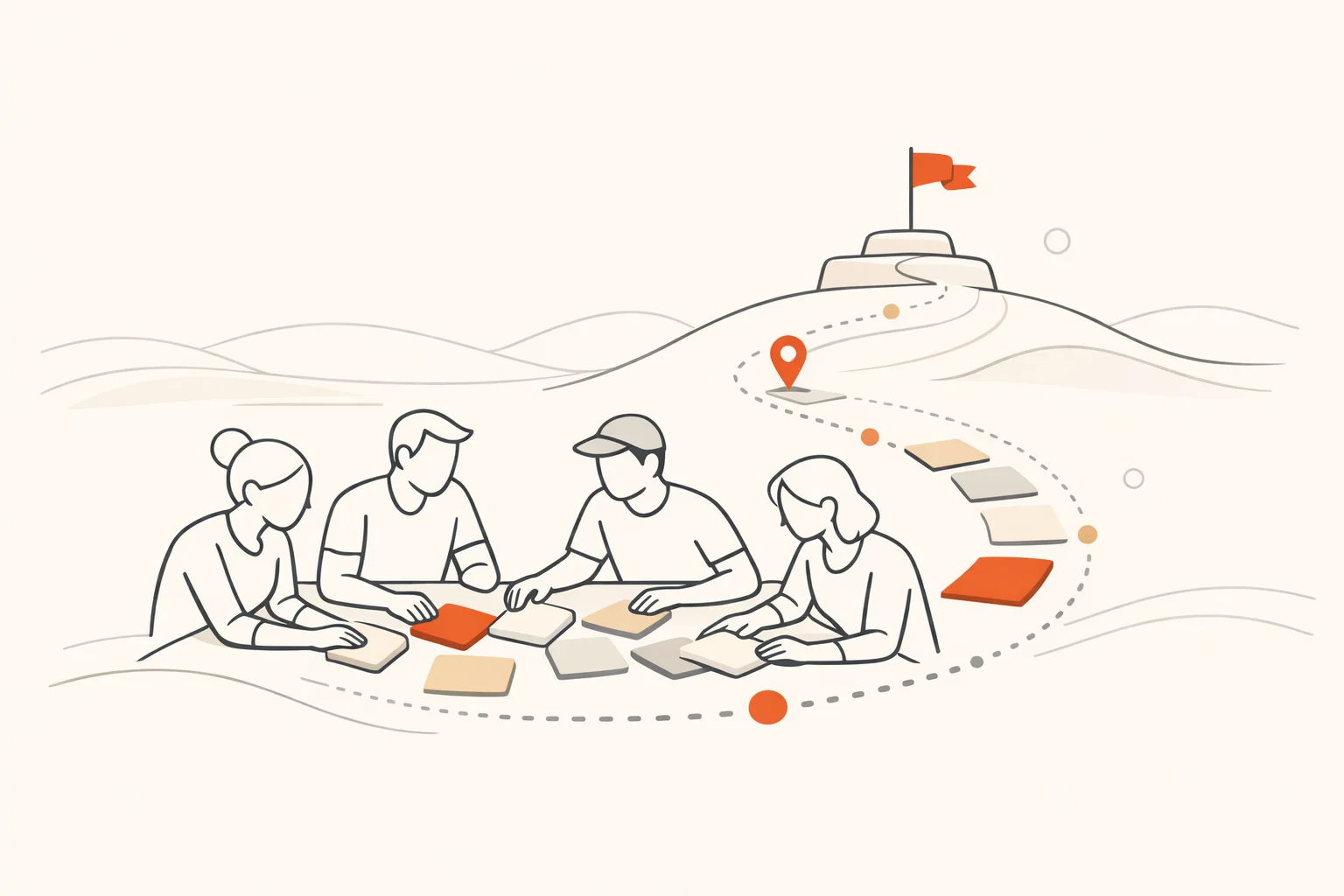
Small groups are where team building actually shows its work. The room is smaller. Voices carry. Every person matters. Done right, a short, focused activity can reset trust, sharpen collaboration, and give people a shared win they can feel. Done wrong, it is forced fun that drains energy and time.
This guide gives you 45 small‑group activities with clear instructions, timing, and group size guidance. Most are low‑prep. All have a point beyond entertainment. Mix and match by your goal, your constraints, and how your team naturally engages.
Small means advantages. You can rotate roles, debrief well, and keep everyone active. Use that.
Small groups create leverage. Psychological safety and shared challenge are easier to build when people can actually see and respond to each other. Research on team effectiveness keeps pointing to the same levers: psychological safety, equal turn taking, and clear goals. Google’s Project Aristotle and follow‑on guidance highlight psychological safety as the foundation for performance, not a bonus perk, and outline practical manager behaviors that support it. You do not need a lab to apply that in a 30‑minute activity. A clear task, a visible artifact, and a quick debrief will do it. See perspectives in Harvard Business Review on psychological safety, Google’s Project Aristotle guide, and the MIT Human Dynamics lens in The New Science of Building Great Teams.
Nobody quits a game they are winning. Start with a guaranteed early win and build from there.
Use these quick rules to choose well and run tight.
Best for: quick connection Time: 10–15 minutes Group size: 4–10
Classic with a small upgrade. Each person shares two truths and one twist, but the twist must relate to work history or a quirky skill. It keeps things light and relevant.
Best for: nonverbal collaboration Time: 10–15 minutes Group size: 5–12
Ask the group to line up by a criterion like distance from office, years in role, or birth month without speaking. Forces signal making, not speech making.
Best for: clarity under constraints Time: 15 minutes Group size: 4–12
Pairs sit back‑to‑back. One describes a simple shape arrangement while the other draws. Switch roles.
Best for: pulse check Time: 10 minutes Group size: 4–12
Each person picks one word for how they are arriving and pins it to a whiteboard quadrant: low energy to high energy, scattered to focused. The map becomes your facilitation guide.
Best for: rapid iteration Time: 15 minutes Group size: 4–10
Teams build and test planes to hit a target. After each throw, make one rule change and iterate.
Best for: creative problem‑solving Time: 18 minutes build + 7 minutes debrief Group size: 4–6
Build the tallest freestanding tower from spaghetti, tape, and string with a marshmallow on top. The learning is in prototyping early. For context and a crisp debrief, point to Tom Wujec’s Build a tower, build a team.
Best for: process clarity Time: 25–35 minutes Group size: 3–6
One person sees the model, one gives instructions, the rest build. Roles rotate. Miscommunication becomes visible and fixable.
Best for: listening and spontaneity Time: 15–20 minutes Group size: 4–12
Build a story one sentence at a time by starting every contribution with “Yes, and….” It trains accepting offers and moving work forward.
Best for: recognition Time: 15 minutes Group size: 4–10
Each person writes one specific thank‑you to every teammate about something they did recently. Quiet, powerful, and sticky.
Best for: customer empathy Time: 20–30 minutes Group size: 3–6
Teams write a postcard from a real or archetype customer: goal, friction, and a small change that would help.
Best for: risk spotting Time: 20 minutes Group size: 4–8
Assume the project failed. List causes, then mitigations. Small groups surface sharper risks without blame.
Best for: instructions and handoffs Time: 20 minutes Group size: 4–8
Recreate the classic “overly literal sandwich” lesson without food. Use blocks or office supplies. Watch assumptions surface.
Best for: root cause thinking Time: 10–15 minutes Group size: 3–6
Pick a small recurring issue and ask why five times. Stop when the answer becomes a behavior or a system.
Best for: role clarity Time: 20 minutes Group size: 4–8
Use cards labeled from “tell” to “delegate.” Discuss the right level for real decisions and align.
Best for: momentum Time: 20–30 minutes Group size: 3–8
Start with a list of tiny annoyances you can fix quickly. Then fix them. Small wins have an outsized effect on morale, a pattern echoed in observational research on team energy flows.
Best for: fast energy Time: 15–20 minutes Group size: 4–12
Simple, silly physical or dexterity challenges run in stations. Short rounds keep everyone engaged.
Best for: relationship building Time: 15–30 minutes Group size: pairs
Pairs stroll and cover three prompts. Movement changes conversation quality. Even indoors, the lap around the floor helps.
Best for: knowledge exchange Time: 30 minutes Group size: 6–12
Short timed conversations with rotating pairs. Everyone teaches and learns something practical.
Best for: team norms Time: 25–35 minutes Group size: 4–10
Teams bid limited points on behaviors like “clear handoffs” or “no‑meeting focus time.” Real tradeoffs surface.
Best for: light connection Time: 10–15 minutes Group size: 4–12
People share a cropped photo of their work area or favorite tool. Group guesses the owner, then hears the story.
Best for: communication fidelity Time: 20 minutes Group size: 4–8
Like number 7, but builders never see the model. Perfect for practicing unambiguous language.
Best for: quick reflection Time: 15 minutes Group size: 4–10
Each person chooses three emojis to summarize the last sprint or month, then explains in one minute.
Best for: peer learning Time: 30 minutes Group size: up to 10
Each person gives a two‑minute demo or tip. Low stakes. High yield.
Best for: fun focus reset Time: 15–20 minutes Group size: 4–10
Act out common tasks, tools, or team memes. Brain gets a break while collaboration stays active.
Best for: belonging Time: 20–30 minutes Group size: 4–12
Mix general and team‑specific questions. The inside jokes are the point.
Best for: shared narrative Time: 30 minutes Group size: 3–6
Teams create a 5‑photo sequence that tells a story about a customer, a value, or a recent project.
Best for: culture building Time: 15–20 minutes Group size: 4–12
Make a shared playlist for focus, celebration, or shipping day. Music bonds people fast.
Best for: sensory fun, low stakes Time: 25–35 minutes Group size: 4–10
Blind compare coffee, tea, or chocolate and agree on criteria. Watch alignment happen in a neutral domain.
Best for: prioritization Time: 15–20 minutes Group size: 3–6
Choose five items to survive from a list of 20. Then defend choices together. Substitute with a work‑relevant scenario for depth.
Best for: problem solving Time: 30–40 minutes Group size: 3–6
A tabletop set of sequential puzzles unlocks a final code. Build or buy one. The scale suits small groups perfectly.
Best for: creative constraint Time: 25–35 minutes Group size: 3–5
Build a bridge to hold a small weight with limited materials. Constraints spark design thinking.
Best for: fun physics Time: 30 minutes Group size: 3–6
Protect an egg from a short drop using basic supplies. Indoors, reduce height and mess risk.
Best for: storytelling Time: 20–30 minutes Group size: 4–10
Curate a two‑item exhibit from around the workspace that represents your team’s past and future. Then tour.
Best for: shared identity Time: 20–30 minutes Group size: 3–6
Build a simple team mascot from craft supplies or digital shapes. Put it on the wall or in your team space.
Best for: outdoor refresh Time: 25–35 minutes Group size: 3–6
Create a piece of art with natural materials from a safe, accessible area. Photograph and return everything to where you found it.
Best for: movement and discovery Time: 30–45 minutes Group size: 3–6
Pick nearby safe landmarks and add mini tasks at each stop. Light adventure without logistics overhead.
Best for: service and pride Time: 30–45 minutes Group size: 3–10
A quick community clean‑up earns instant shared pride. Make it safe and simple.
Best for: collaboration and delight Time: 45–60 minutes Group size: 4–8
Pick a dish with simple steps. Small teams plan, prep, and plate. Eat together.
Best for: remote problem‑solving Time: 45–60 minutes Group size: 3–6
Choose a reputable provider or design a lightweight puzzle path. Keep puzzle difficulty moderate so everyone contributes.
Best for: remote fun Time: 30–45 minutes Group size: 4–12
Run themed rounds in a browser. Mix general knowledge with internal lore.
Best for: remote bonding Time: 30–45 minutes Group size: 4–12
One teammate hosts a simple recipe on video. Others cook along or watch and chat.
Best for: remote energy Time: 15–20 minutes Group size: 4–12
Call out prompts like “an object older than you” or “your favorite tool.” People sprint and share.
Best for: light nostalgia Time: 15–20 minutes Group size: 4–12
Collect photos in advance. Share a slideshow. Guess and reveal.
Best for: alignment Time: 15–20 minutes Group size: 3–6
Sketch a quick end‑to‑end customer path with stickies. Circle one moment of truth to improve now.
Best for: authentic collaboration Time: 30–60 minutes Group size: 3–6
A compact scavenger hunt creates shared challenge without putting people on the spot. Use simple, varied tasks and a live leaderboard. An app removes logistics friction and captures photos, videos, and check‑ins so the debrief writes itself. If you want a browser or mobile experience that scales up or down fast, a modern scavenger hunt app keeps the focus on play, not paperwork.
End strong. Two to four minutes is enough. Ask what worked, what to try next time, and what one behavior the team will bring back to real work. That small close is where team building becomes team performance. The link between morale and output is not mystical. Even outside tech, studies have tied happier workers to higher productivity by meaningful margins, such as the Oxford finding of 13 percent. Keep debriefs practical and future‑focused.
Make every activity opt‑in friendly. Provide camera‑off or observer roles for virtual sessions. Balance physical tasks with low‑mobility alternatives. Design for psychological safety and you will see participation rise, a pattern reinforced in both field research and practical guides.
Pick one activity aimed at a real outcome. Keep it short. Make progress visible. Close with a tiny debrief. Repeat monthly. That simple cadence grows trust, speeds collaboration, and strengthens culture over time. If you want a ready‑to‑run path with automation, mix‑and‑match challenges, and a live feed that keeps energy high, Scavify makes it easy to spin up small‑group hunts for team building, onboarding, and events without heavy setup.