Solutions
Your first hunt, live this afternoon.
Free to start · No download for participants
Use team building activities for large groups to create real participation, with instructions, timing, group-size guidance, low-prep options. Plan smarter.
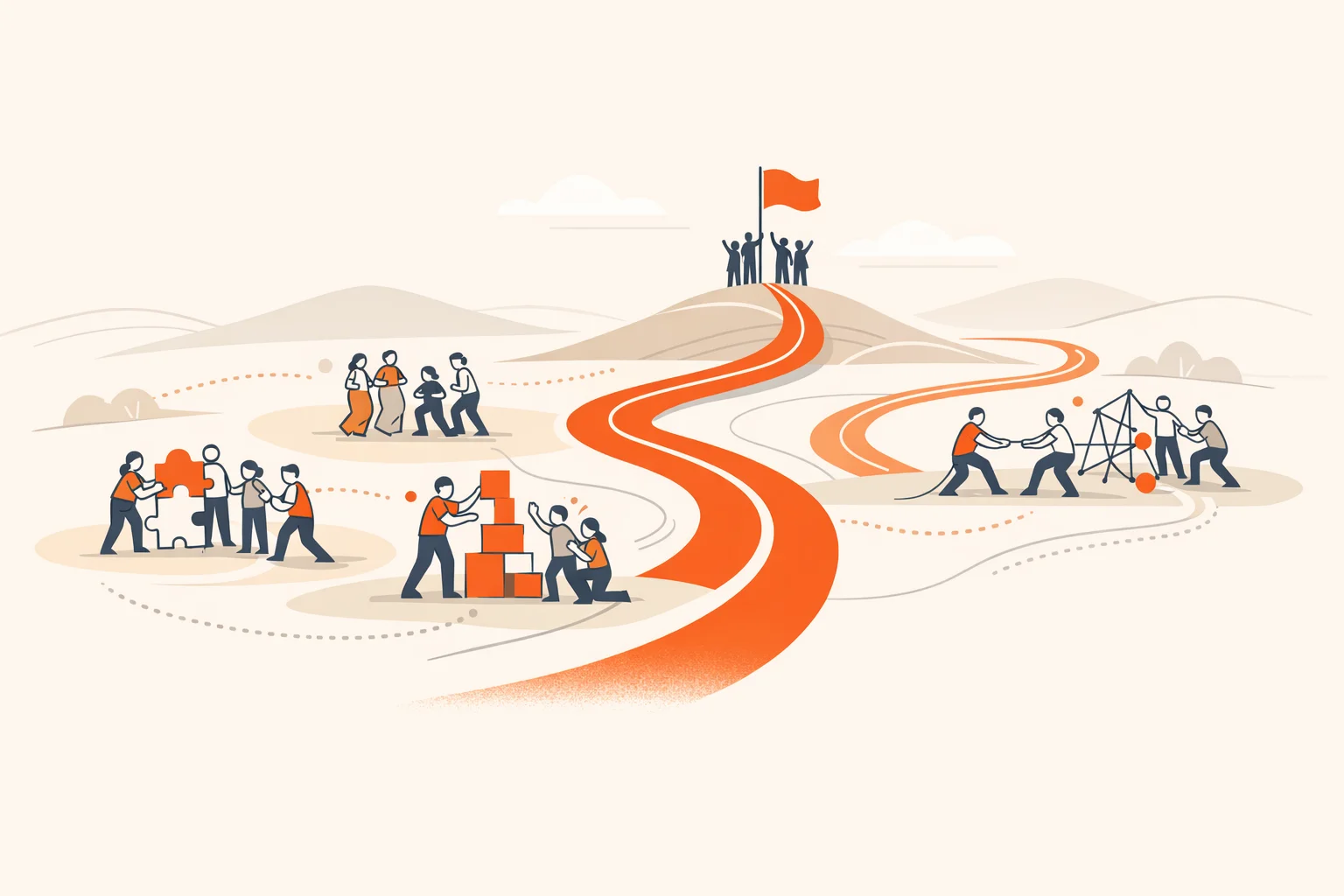
Large groups are tricky. Attention splinters. Lines form. The extroverts carry the mic while everyone else checks out. The fix isn’t louder music or a bigger stage; it’s architecture. Design the experience so hundreds move at once in small squads, with short rounds, visible progress, and zero dead time.
In our experience, the most reliable way to make a big headcount feel connected is to energize as one group, then build as small teams. Run parallel stations, rotate quickly, and make early wins effortless. Nobody quits a game they’re winning.
This guide delivers exactly that: 35 scalable team building activities for large groups, each with clear flow, light‑lift materials, timing guidance, and ways to adapt for indoor, outdoor, hybrid, and virtual. Use it to plan all‑hands, summits, onboarding days, orientation weeks, and city activations without burning hours on logistics.
What breaks at 50, 100, or 500 people is the wait. Any format that depends on one microphone, one presenter, or one brave volunteer collapses under its own weight. Most groups don’t need more entertainment. They need more lanes.
Two patterns consistently flip the dynamic:
When people feel safe to contribute and fail forward, participation jumps. Google’s Project Aristotle placed psychological safety at the top of the list for effective teams, which is why formats that reduce public embarrassment outperform those that spotlight individuals. See Google’s guidance on team effectiveness for the underlying behaviors managers can reinforce. Google’s guide to team effectiveness. (rework.withgoogle.com)
Design for contribution, not performance. The more personal risk you remove, the more people jump in.
Communication patterns also matter. Research popularized by MIT’s Alex Pentland shows that team communication dynamics predict performance more reliably than who’s on the team, which is why structured interactions beat unstructured mixers for large groups. The New Science of Building Great Teams. (hbr.org)
For accessibility specifics, lean on recognized checklists. The W3C’s guidance for accessible meetings covers in‑person, virtual, and hybrid considerations you can apply directly to large‑group formats. W3C’s accessible meetings guidance. (w3.org)
Each activity below includes why it scales, how to run it, rough timing, size guidance, low‑prep options, and virtual/hybrid notes where they add value. Treat times and sizes as directional, not dogma. Layout, culture, and goals will shape the exact run of show.
Why it scales: Teams spread across a campus, neighborhood, or city, making progress in parallel while sharing a common storyline and finish.
Run it like this: Kick off with a high‑energy briefing, then send small teams to complete photo, video, GPS, QR, and trivia challenges tied to your goals and locations. Close with a fast highlight reel and awards. A purpose‑built scavenger hunt app keeps scoring, submissions, and leaderboards automatic, so you can scale without manual tallying.
Timing: About 60–120 minutes depending on footprint.
Size: Scales from dozens to hundreds by adding routes and challenges.
Low‑prep option: Keep the quest hyperlocal using your venue’s interior and immediate surroundings.
Hybrid/virtual: Offer at‑home equivalents and let remote teams join the same leaderboard.
Why it scales: Ten or more mini‑stations run simultaneously. Teams rotate on a whistle. No lines, no dead air.
Run it like this: Mix skill types across stations so everyone finds a lane. Keep each station to a few minutes of effort and one clear success criterion. Use stamp cards or digital check‑ins.
Timing: About 60–90 minutes of rotations plus a 10‑minute close.
Size: Add stations and duplicate popular ones to absorb headcount.
Low‑prep option: Repurpose meeting rooms into stations with simple table‑top challenges.
Hybrid/virtual: Pair in‑room stations with browser‑based puzzles for remote participants.
Why it scales: Each squad solves a short puzzle to unlock the next. Dozens of relays run in parallel, then converge at a shared finale.
Run it like this: Build 4–6 bite‑size puzzles that hand off cleanly. Keep solutions obvious once solved to avoid bottlenecks. End with a group task only possible once teams combine clues.
Timing: About 45–75 minutes.
Size: Duplicate relay lanes for volume.
Low‑prep option: Print‑and‑play word, logic, and visual puzzles with simple props.
Hybrid/virtual: Use shared docs and breakout rooms for each squad.
Why it scales: Fast, social discovery without microphones or monologues.
Run it like this: Instead of “find someone who…,” design squares around shared experiences tied to your culture or event theme. Require micro‑stories, not just signatures. Cap each conversation at one square to keep people moving.
Timing: About 20–30 minutes.
Size: Works across a ballroom; squads validate each other’s cards.
Low‑prep option: Print cards; no extras needed.
Hybrid/virtual: Use collaborative boards with movable stickers.
Why it scales: Many hands contribute to one visible artifact.
Run it like this: Divide a large image or theme into tiles. Each team designs its tile with a constraint set. Assemble the mural live for a dramatic reveal.
Timing: About 45–90 minutes.
Size: Add tiles for more teams.
Low‑prep option: Sticky notes on foam board.
Hybrid/virtual: Remote teams create digital tiles you print and add.
Why it scales: Small teams prototype quickly, then connect sections into one span.
Run it like this: Provide uniform materials and an objective like spanning a set distance or bearing a light load. Join segments at the end; test and celebrate the wobbles.
Timing: About 40–70 minutes.
Size: Scale by kits and table count.
Low‑prep option: Cardboard, tape, string, and ingenuity.
Hybrid/virtual: Simulate with household materials or virtual whiteboards.
Why it scales: Tangible impact with simple, repeatable steps.
Run it like this: Turn tables into stations for assembling hygiene kits, school supplies, or care packs. Track totals on a large counter. Invite a partner org to speak briefly at the end.
Timing: About 45–75 minutes.
Size: Split the crowd into parallel lines.
Low‑prep option: Fewer SKUs, clearer flow.
Hybrid/virtual: Remote teams ship kits from home with standardized contents.
Why it scales: Nonverbal problem‑solving reduces spotlight pressure.
Run it like this: In grid zones, teams arrange themselves by a hidden rule without speaking. Debrief how they signaled and adapted.
Timing: About 15–25 minutes per round.
Size: Duplicate grids across the room.
Low‑prep option: Painter’s tape for grid lines.
Hybrid/virtual: Camera‑on gallery sorting with shared rules.
Why it scales: Short cycles keep ideas moving and people contributing.
Run it like this: Frame a real problem, set two or three short sprints, and end with one‑minute demos. Focus on scrappy prototypes and crisp storytelling.
Timing: About 90–150 minutes.
Size: Many squads, few reviewers. Post ideas to a shared gallery for async voting.
Low‑prep option: Provide prompt cards and a pitch template.
Hybrid/virtual: Breakouts, shared docs, and timed check‑ins.
Why it scales: Knowledge spreads in five‑minute doses across many mini‑stages.
Run it like this: Curate short talks, run them simultaneously, rotate audiences on a bell. End with a shared takeaway wall.
Timing: About 45–75 minutes.
Size: More stages, more rotation blocks.
Low‑prep option: Standing circles, no slides.
Hybrid/virtual: Use multiple concurrent meeting rooms.
Why it scales: Real problems, short cycles, fresh eyes.
Run it like this: Teams rotate through problem owners with one tight question each. Consultants offer three ideas, owner picks one to carry forward.
Timing: About 45–60 minutes.
Size: Many problem tables run in parallel.
Low‑prep option: Provide a one‑page brief template.
Hybrid/virtual: Breakout rooms with a rotating owner.
Why it scales: Multiple hosts keep pace; teams answer in parallel.
Run it like this: Short rounds, mixed topics, quick scoring. Spread hosts across zones to cut wait time.
Timing: About 45–75 minutes.
Size: Add hosts and duplicate question sets.
Low‑prep option: Printed answer sheets; simple scoring rubric.
Hybrid/virtual: Browser‑based buzzer tools with team channels.
Why it scales: Laughter without putting one person on stage.
Run it like this: In circles, each person adds one sentence to a prompt. Rotate prompts between circles to blend styles. Debrief on listening and building.
Timing: About 20–30 minutes.
Size: Many small circles at once.
Low‑prep option: Prompt cards.
Hybrid/virtual: Breakouts with a shared doc capturing the story.
Why it scales: Clear objective, low material cost, lots of teams.
Run it like this: Dry pasta, tape, string, a light topper. Short build window, one measurement, big cheers for creative failures.
Timing: About 25–35 minutes.
Size: Tables become build bays.
Low‑prep option: One material, one rule.
Hybrid/virtual: At‑home materials with photo proof.
Why it scales: Design, test, iterate fast.
Run it like this: Teams submit a model for distance or accuracy. Provide a test lane and a final lane. Highlight iteration, not just outcomes.
Timing: About 20–30 minutes.
Size: Multiple lanes reduce traffic.
Low‑prep option: Printer paper only.
Hybrid/virtual: Remote participants post flight videos.
Why it scales: Distributed kits eliminate venue bottlenecks.
Run it like this: Each squad gets a small box of puzzles with a story arc. Solutions unlock a final code shared across squads for a big‑room finish.
Timing: About 45–75 minutes.
Size: One kit per squad.
Low‑prep option: Envelope‑based puzzles.
Hybrid/virtual: Digital kits and shared drives.
Why it scales: Negotiation energy rises with more teams in play.
Run it like this: Each team holds unique resources and objectives. Rounds of trading and information exchange lead to collective goals.
Timing: About 45–60 minutes.
Size: More teams deepen the economy.
Low‑prep option: Simplify goods to colored cards.
Hybrid/virtual: Channels per team plus a main market room.
Why it scales: Everyone participates without high risk when designed thoughtfully.
Run it like this: Simple floor obstacles and cones. One blindfolded walker per squad, one guide gives verbal cues. Rotate roles.
Timing: About 20–30 minutes.
Size: Duplicate maze lanes.
Low‑prep option: Tape the path and use chairs or ropes.
Hybrid/virtual: Use camera framing and remote instructions for a desk‑top obstacle course.
Why it scales: Exponential fun. Losers become fans who cheer their conquerors until one champion remains.
Run it like this: Quick pairings, best‑of‑one, move winners forward. Build a hype lane for the final showdown.
Timing: About 10–20 minutes.
Size: Works with the whole company.
Low‑prep option: Just hands.
Hybrid/virtual: Use emoji reactions or bracket tools.
Why it scales: Bite‑size physical and dexterity challenges anyone can try.
Run it like this: Set simple 60‑second stations with clear success criteria. Rotate fast, score simply.
Timing: About 30–50 minutes.
Size: Add lanes for popular stations.
Low‑prep option: Office supplies and timers.
Hybrid/virtual: Desk‑friendly swaps.
Why it scales: Short, structured movement resets long agendas.
Run it like this: A facilitator teaches one simple combo, then squads rotate as leaders for the final run. Keep it joyful, not performative.
Timing: About 10–15 minutes.
Size: Whole‑room reset.
Low‑prep option: Single track, three cues.
Hybrid/virtual: Spotlight leaders in short windows.
Why it scales: Rhythm syncs big rooms without forcing the spotlight.
Run it like this: Hand percussion or body percussion. Teach two or three patterns, stack them, then swap section leaders.
Timing: About 20–30 minutes.
Size: Seat sections by pattern.
Low‑prep option: Buckets and sticks work fine.
Hybrid/virtual: Clap‑along with muted mics and local sound.
Why it scales: Zones allow multiple games at once with clear boundaries.
Run it like this: Light, low‑contact rules, clear sidelines, and short rounds. Rotate zones and roles.
Timing: About 45–60 minutes.
Size: Add fields for more teams.
Low‑prep option: Cones and fabric flags.
Hybrid/virtual: Virtual puzzle‑based CTF variant.
Why it scales: GPS check‑ins let many teams move at once.
Run it like this: Hide simple caches or mark GPS checkpoints. Teams verify via GPS, QR, or photos. Tie each stop to a micro‑task.
Timing: About 45–90 minutes.
Size: Expand the map.
Low‑prep option: QR codes at obvious waypoints.
Hybrid/virtual: Remote teams check in at local public spots.
Why it scales: Shared gallery, many perspectives.
Run it like this: Prompt teams to capture a moment that represents a theme. Print or project to a living wall. Add one‑line captions, then quick reflections.
Timing: About 20–40 minutes.
Size: The wall grows with the crowd.
Low‑prep option: Sticky notes under projected photos.
Hybrid/virtual: Digital gallery board.
Why it scales: Fast bidding creates lively debate without calling on individuals.
Run it like this: Give teams limited currency. Auction project values, practices, or tradeoffs. Debrief choices against real constraints.
Timing: About 30–45 minutes.
Size: Many bidder tables, one auctioneer per zone.
Low‑prep option: Printed paddles and play money.
Hybrid/virtual: Polling tools with breakout discussion.
Why it scales: Quick finds in your actual environment spark real stories.
Run it like this: Create prompts tied to artifacts, rituals, or origin stories. Teams document with photos and short captions. Share hits on a screen.
Timing: About 30–60 minutes.
Size: Spread across floors or a campus.
Low‑prep option: Photo‑only list.
Hybrid/virtual: Remote prompts from home offices or neighborhoods.
Why it scales: Solvers pitch back to problem owners, not judges.
Run it like this: Leaders present real problems, then circulate while squads ideate. Each squad returns one crisp pitch and a next step the owner agrees to try.
Timing: About 60–120 minutes.
Size: Many owners, many tables.
Low‑prep option: One‑page brief per problem.
Hybrid/virtual: Breakouts with rotating owners.
Why it scales: One output, many hands, huge reveal.
Run it like this: Assign color zones, provide a placement grid, and let squads build the image tile by tile. Film a time‑lapse.
Timing: About 30–60 minutes.
Size: Wall scale grows with attendance.
Low‑prep option: Pre‑mark anchor points.
Hybrid/virtual: Combine digital tiles into a final graphic.
Why it scales: Parallel sections connect into one long cascade.
Run it like this: Teams design short sequences with constraints. Connect segments and count successful transfers, not just total length.
Timing: About 30–60 minutes.
Size: Add lanes for fragile sections.
Low‑prep option: Dominoes and simple props.
Hybrid/virtual: Share clips and compile a supercut.
Why it scales: High participation without microphones.
Run it like this: Post big questions on butcher paper or digital boards. Everyone adds thoughts and votes silently. Close with facilitators synthesizing patterns.
Timing: About 20–30 minutes.
Size: More walls, more pens.
Low‑prep option: Sticky dots for voting.
Hybrid/virtual: Collaborative canvases.
Why it scales: Clear roles, delicious outcomes.
Run it like this: Give squads a shared pantry and constraints. Emphasize planning, food safety, and storytelling. Judges sample quickly; crowd favorites matter.
Timing: About 60–120 minutes.
Size: Add stations and simplify criteria.
Low‑prep option: No‑cook or grill‑only formats.
Hybrid/virtual: Remote teams plate at home and present.
Why it scales: Short legs, varied tasks, broad appeal.
Run it like this: Combine navigation, simple physical tasks, and light puzzles. Keep distances modest and emphasize teamwork over speed.
Timing: About 60–120 minutes.
Size: Staggered starts reduce congestion.
Low‑prep option: Use park fixtures and existing routes.
Hybrid/virtual: Local legs plus shared online checkpoints.
Why it scales: Self‑paced exploration with instant feedback.
Run it like this: Place QR codes at exhibits, booths, or landmarks. Scans trigger micro‑challenges or clues. Live scoring keeps teams moving.
Timing: About 30–60 minutes.
Size: Add codes and duplicate clue paths.
Low‑prep option: Print codes and tape them up.
Hybrid/virtual: Pair physical scans with browser unlocks.
Why it scales: Real conversations in controlled doses.
Run it like this: Three short courses at three different tables with small, rotating groups. Provide conversation prompts that avoid small talk and invite candor.
Timing: About 45–75 minutes.
Size: Many tables, timed rotations.
Low‑prep option: Paper table tents with prompts.
Hybrid/virtual: Rotating breakout rooms over lunch windows.
Psychological safety is a feature of your facilitation, not a vibe you hope appears. Brief formats that reduce embarrassment, spotlight listening, and encourage small risks. The payoff isn’t abstract: teams with high psychological safety tend to collaborate more effectively and retain people longer, a pattern echoed across Google’s work and in research syntheses. Research and manager actions on psychological safety. (resources.rework.com)
Below is a ready‑to‑run mix you can drop into an in‑office, campus, or city hunt. Adjust the story to fit your goals and locations.
Keep measurement simple and meaningful:
Gallup’s 2024 review of global workplace data ties engagement and wellbeing to practical levers leaders can influence. Your event won’t fix culture alone, but it can model the behaviors that sustain engagement day to day. Gallup’s 2024 State of the Global Workplace. (gallup.com)
If you’re running outdoor formats, build safety into the plan like any other requirement: hydration, shade, shorter cycles, and options that keep participation inclusive for all fitness levels. The CDC’s workplace heat guidance is a solid baseline to adapt for events. CDC overview on heat stress. (cdc.gov)
Finally, don’t overlook access. From captions and audio clarity to room navigation and lighting, inclusive details create real participation for more people. The W3C’s accessible meetings checklist is a practical reference when you’re mapping venues and tech. Accessible meetings checklist. (w3.org)
There’s no single cutoff, but once you pass a few dozen people, time inflation and attention drift make single‑track formats struggle. The fix is to keep plenary moments short and shift most of the work into parallel small‑team interactions.
Shorter than you think. Aim for quick rounds with breathing room between them. Most of the formats here work well in 20–30 minute bursts, with one or two longer anchors if your agenda needs them.
Mirror the core mechanics digitally: shared goals, clear rounds, and visible progress. Pair physical stations with browser‑based equivalents, and keep remote squads on the same scoreboard when you can.
Favor team‑centric tasks over individual spotlights. Offer role choice inside each activity, and use low‑risk ways to contribute like silent debate walls, photo prompts, and short build tasks.
Duplicate stations, cap rounds, and trim rules. Simple stamp cards or a lightweight digital flow can save hours of scoring and coordination.
Tell people what the activity is training, then ask one pointed debrief question about how they’ll apply it. Keep the debrief fast and specific, and capture one commitment per team.
In the rules and facilitation: clear consent cues, opt‑in roles, non‑embarrassing scoring, and debriefs that honor attempts, not just wins. That environment invites wider participation and richer ideas, as seen in research on effective teams. Communication patterns predict performance. (hbr.org)
Plan for shade, water, pacing, and clear opt‑outs. Shorten rounds, reduce exertion, and communicate symptoms to watch. When in doubt, slow down or move inside. Credible safety guidance is widely available. CDC heat recommendations. (cdc.gov)
A final note: if you want an easy on‑ramp to the scalable, parallel‑play formats in this list, a modern platform purpose‑built for interactive experiences does a lot of the heavy lifting for you. That’s why so many teams start with a city, campus, or office hunt and expand from there.