Solutions
Your first hunt, live this afternoon.
Free to start · No download for participants
Compare team building activities in Chicago by budget, group size, weather, and goal, with standout indoor, outdoor, and app-led options. Choose confidently.
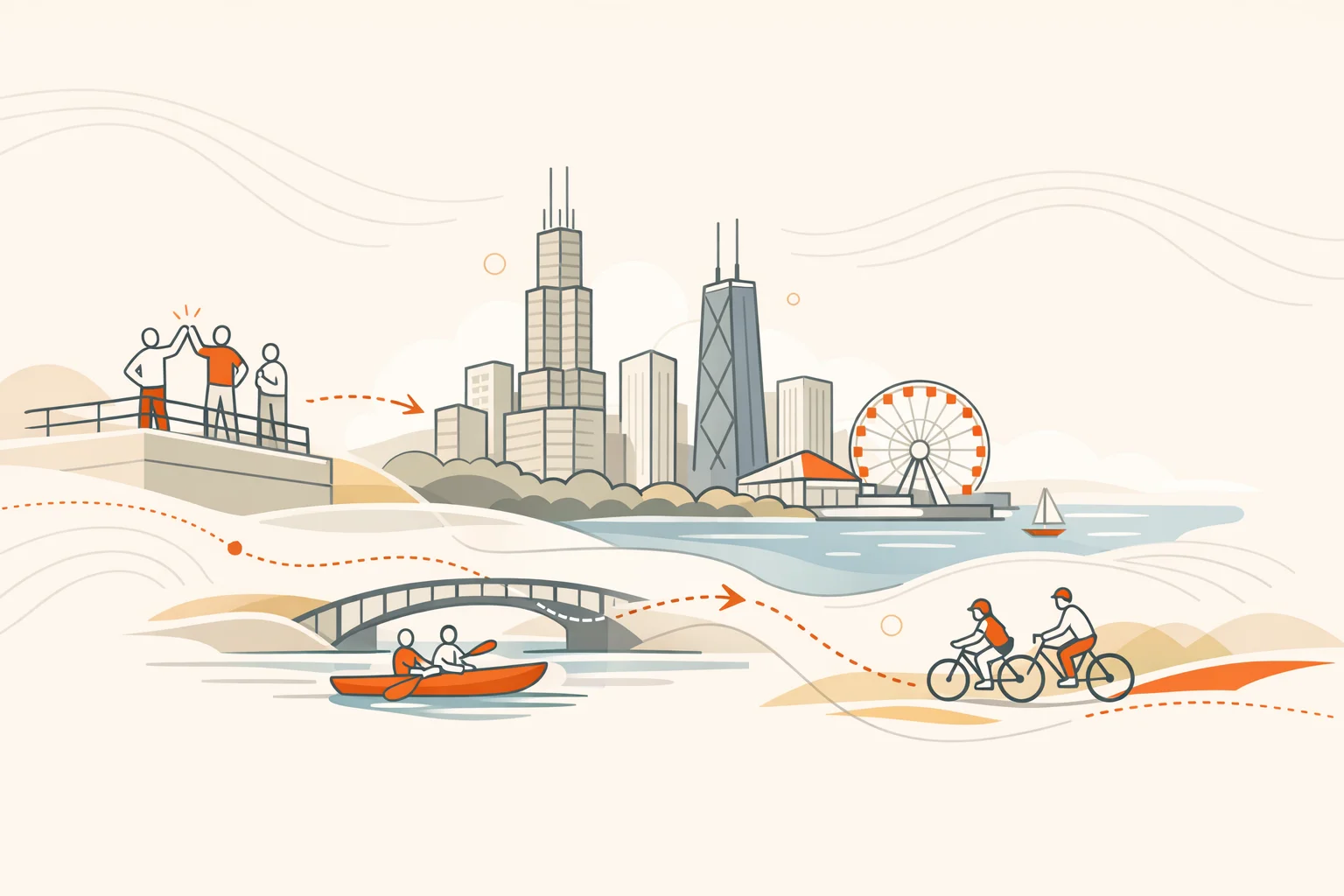
Chicago rewards planners who design for interaction, not attendance. Put a real backdrop behind your group and give them choices that require light collaboration. Keep venues clustered and the energy moves with you. Stretch the day across the river canyons, lakefront light, and neighborhoods with a point of view, and you’ll see people participate for real.
In our experience, the best Chicago team activities are short, social, and structured just enough. The city’s built‑in variety handles the rest. Below is a vetted list of 40 options across budgets and seasons, with quick planning notes you can actually use.
Chicago gives you four reliable canvases: river, lakefront, neighborhoods, and rooftops. Pick one, then dial intensity and time box to match your group’s energy.
| Format | Best when... | Tradeoffs |
|---|---|---|
| Outdoor | You want movement and city texture | Weather risk; sound can scatter groups |
| Indoor | You need weather‑proof, ADA‑friendly flow | Less sense of place if venue is generic |
| Hybrid (start outside, land inside) | You want the skyline moment and an easy after‑event | More logistics: two hosts/hand‑offs |
Why it works: Fast, social, and naturally inclusive. In 90 minutes, teams co‑create photos, videos, and clever finds while actually seeing the city. Best for: New teams, offsite kickoffs, cross‑functional mixers. Where: Start at the Riverwalk or Millennium Park and finish near your venue for snacks.
Nobody quits a game they’re winning. Make the first challenge a guaranteed win.
Why it works: Trained docents turn the skyline into a live story as you glide along all three branches. Timing: ~90 minutes. Planning note: Group and private options exist; shoulder seasons sell fast. Use this when you want a sense‑of‑place anchor without heavy logistics. See the official CAC group and private tours and the First Lady overview. (architecture.org)
Why it works: Teams self‑pace, talk, and coordinate under skyline canyons. Options: Nature‑framed outings from Ping Tom Park or architecture routes downtown. Providers like Wateriders, Kayak Chicago, or Shedd’s Kayak for Conservation cover gear and guidance. (wateriders.com)
Why it works: 18 miles of views connect beaches, parks, and skyline turns; you can play anywhere along it. Tip: Break into pods and checkpoint at a cafe or museum. The trail spans roughly 18–18.5 miles along the shoreline, per the Park District and city guides. (chicagoparkdistrict.com)
Why it works: A 18‑hole course dotted with Chicago icons keeps competition friendly and fast. Planning note: City Mini Golf runs group events; easy walk from the Loop. (maggiedaleypark.com)
Why it works: The Bloomingdale Trail gives you a safe, linear course through Bucktown, Wicker Park, and Logan Square. Prompt: Capture five neighborhood textures in 30 minutes. The trail runs about 2.7 miles end‑to‑end. (bloomingdaletrail.org)
Why it works: Tropical, desert, and fern rooms create a calm, immersive reset. Pair a guided tour with a quick creativity challenge. Private tours are available for adult groups. (garfieldconservatory.org)
Why it works: Murals spark conversation and quick photo prompts, and you’re near excellent taquerias for the debrief. Use a local operator like the one listed via Choose Chicago’s Pilsen Public Art Tours. (choosechicago.com)
Why it works: Landmark energy and easy wayfinding. Run a checkpoint game through the Family Pavilion and finish with group gondolas on the Wheel. Group tickets and discounts start at 20. (navypier.com)
Why it works: Shared nostalgia plus rare angles inside the Friendly Confines. Planning note: Group outings start around 15 tickets; private tours are available through the Wrigley Field Events team. (mlb.com)
Why it works: Easy to learn, hilarious to play, and cozy with heaters and hot drinks. Season: Mid‑November through mid‑March by reservation. (kaisertiger.com)
Why it works: Same fun, skyline view. Works as a hybrid with indoor lounge space. The Gwen’s winter terrace brings back curling each season; packages vary. (marriott.com)
Why it works: Wildlife backdrop without leaving the city; event spaces fit small meetings to large receptions. Corporate partnerships can include exclusive group experiences. (lpzoo.org)
Why it works: Short scenic walk between world‑class museums; minimal transport. Secure timed entry for groups and end with a quick “five finds” photo challenge. (fieldmuseum.org)
Why it works: Bumper cars meet hoops and wiffle balls. It’s ridiculous in all the right ways, and spectators stay engaged. Chicago’s venue handles groups from 10 to 500 with F&B on site. (choosechicago.com)
Why it works: Fast rounds, easy rotation, and built‑in hosts who keep it moving. Great for mixed‑skill groups; scales to big headcounts. (acebounce.com)
Why it works: Tech‑tracked games lower the barrier for non‑players. Private spaces, food, and a gamesmaster keep things on rails. (flightclubdartsusa.com)
Why it works: Weather‑proof play for golfers and non‑golfers; formats from long‑drive to target challenges. Locations in River North and the Loop support corporate events. (fiveirongolf.com)
Why it works: Clear roles, clock pressure, and satisfying wins. Great mid‑day block before dinner. Dedicated coordinators handle large groups. (theescapegame.com)
Why it works: 30–45 minute scenarios where squads communicate under pressure. Highlight videos are a built‑in debrief tool. (sandboxvr.com)
Why it works: A custom, high‑energy mix of party games with a pro host. Low physical demand, high laughter density. (gamenightout.com)
Why it works: Drop a portable game show into your meeting space for a reset block between sessions. Providers like The Go Game bring staging and emcees. (thegogame.com)
Why it works: Listening, offers, and yes‑and translate straight to collaboration. Sessions scale from icebreakers to leadership reps. (secondcity.com)
Why it works: Hands‑on, edible outcomes, and a little friendly plating competition. Eataly’s events team runs private classes for groups. (eataly.com)
Why it works: Structured menus, chef coaching, and a shared table at the end. Strong option when you need a turnkey culinary venue. (thechoppingblock.com)
Why it works: Sweet, collaborative, and approachable for all diets. Truffle‑making is popular for company team building. (katherineanne.com)
Why it works: Sensory learning plus social time. Use it as a capstone after an outdoor activity. Both offer private event options; Chicago Winery lists blending sessions. (chiwinery.com)
Why it works: Local grain‑to‑glass story, tastings, and optional mixology. Private tours and classes available in Ravenswood. (koval-distillery.com)
Why it works: Chicago’s largest independent brewer runs guided tours at the Kedzie taproom. Pairs well with a casual team hang. (revbrew.com)
Why it works: Light wellness that still feels like city time, not gym time. Options include runs, Riverwalk yoga, and guided walks. (choosechicago.com)
Why it works: Quiet, restorative reset in West Town. Good for leadership retreats or post‑conference decompression. Larger groups are managed by staff; silence rules apply. (beaire.com)
Why it works: Shared problem‑solving on the wall. Staff belayers and beginner routes make it safe for first‑timers. Multiple Chicago locations support group bookings. (faclimbing.com)
Why it works: Outdoor climbing in the heart of the city. Great as a summer breakout with a picnic pivot. Groups of 10+ coordinate via the park. (maggiedaleypark.com)
Why it works: The shared gasp moment. Add private space at CloudBar for awards or a toast; group rates and buyouts exist. (360chicago.com)
Why it works: Views, the Ledge, and an easy pre‑ or post‑dinner stop. Private events on upper floors are available. (theskydeck.com)
Why it works: Conversation blooms faster when you’re hunting details together. Third‑party providers run facilitated hunts for corporate groups. (watsonadventures.com)
Why it works: A quick, immersive Chicago flyover that works as a fun add‑on to a Pier plan. Group sales available. (navypier.com)
Why it works: Narrative plus nibbles, paced for conversation. Good for out‑of‑towners. (choosechicago.com)
Why it works: Impact you can feel in two hours. Repacking lines create natural micro‑teams and momentum. Corporate and group options are supported. (chicagosfoodbank.org)
Why it works: Curated volunteer experiences aligned to real needs, with logistics handled. Ideal when you want purpose at the center of an offsite. (chicagocares.org)
Use these as is or tweak to fit your route and culture.
Second City Works improv, AceBounce, Flight Club, Five Iron Golf, The Escape Game, and museum rentals all run strong without weather risk. Add rooftop curling at The Gwen for a winter‑only twist, then land indoors for snacks. (secondcity.com)
Pair each outdoor slot with a nearby indoor pivot that can hold a deposit or short cancellation window. Navy Pier’s group tickets, museum group entries, and lounges near the Riverwalk are reliable anchors. Keep comms clear: two plans, weather call by 9 a.m. (navypier.com)
Run a compact Lakefront Trail or 606 photo mission with three prompts, then debrief at a cafe. It costs little, gets people moving, and still feels like Chicago because the setting carries it. (choosechicago.com)
Docent‑led experiences (CAC river cruise, museum hunts), light‑movement games (ping pong, darts), and culinary sessions with clear roles (prep, plating, emcee) keep everyone engaged without putting anyone on the spot. (architecture.org)
Prime windows fill 4–8 weeks ahead (and faster in May–September or holiday season). Architecture cruises, rooftops, curling, and museum after‑hours go first. Hold a date early; fine‑tune headcount later. (cruise.architecture.org)
Yes. Vendors like The Go Game bring a live game show; AceBounce and Flight Club handle full‑venue takeovers; improv shops travel. Or run an app‑led scavenger game threaded through your meeting space and neighborhood for a hybrid. (thegogame.com)
Yes. The Greater Chicago Food Depository’s repack shifts and Chicago Cares curated projects work well in two to three hours and create visible impact. (chicagosfoodbank.org)
Planning a route or deciding between two formats and want a nudge? Use the city’s strengths: pick a backdrop with a story, keep choices simple, and let people move together. If a scavenger hunt is in the mix, an app‑led format like a scavenger hunt app keeps the game tight while you focus on the people.