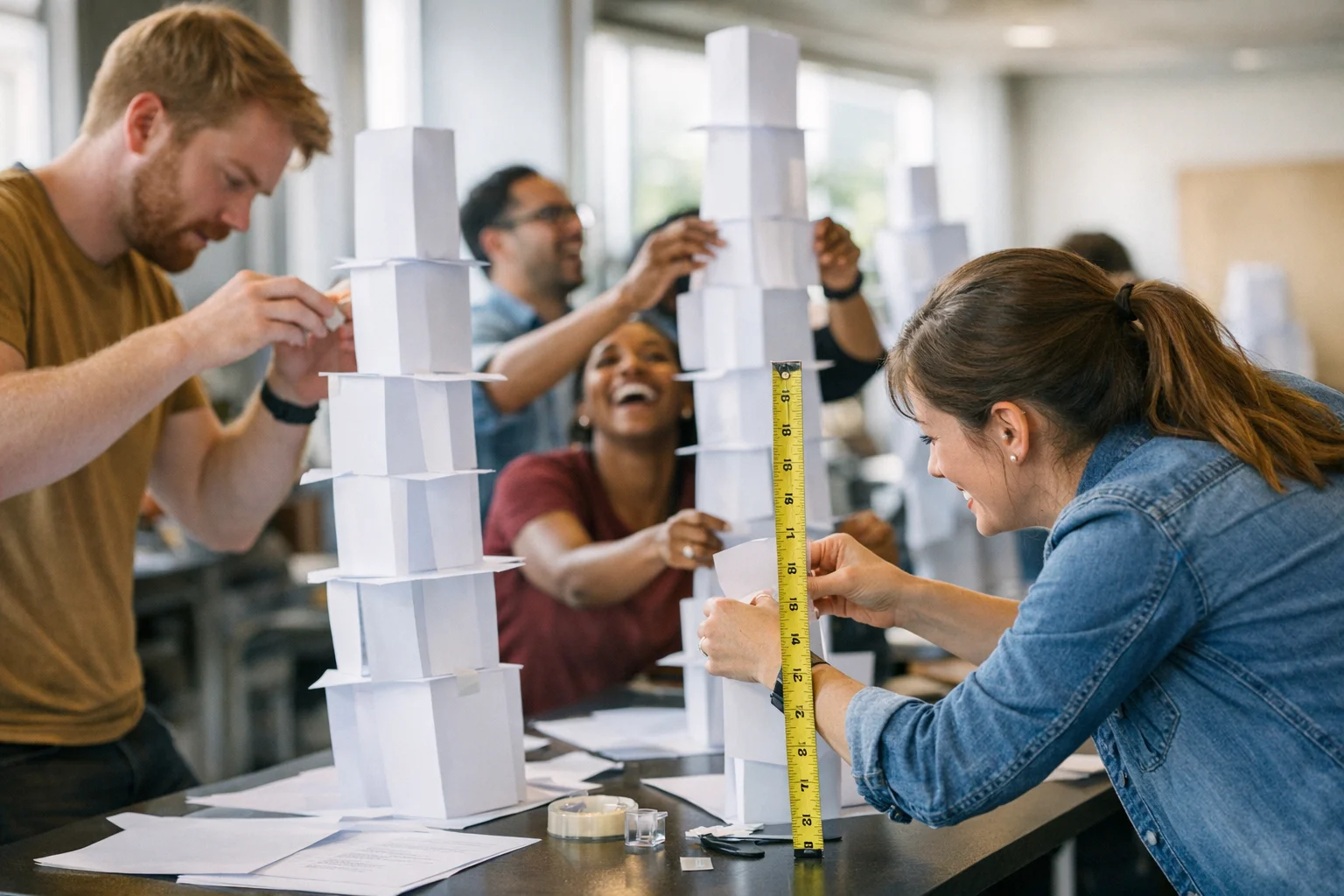
What the paper tower challenge is and why it works
The paper tower challenge is a fast, low-cost build activity where small teams race to construct the tallest free-standing tower they can using simple materials. It scales from classrooms to offsites, fills 20–45 minutes, and reveals how a group plans, iterates, and communicates under light pressure.
Two things make it stick. First, the constraint set is clean: usually just paper and tape, sometimes scissors. Tight limits force design choices you can actually observe. Second, the results are visible. A tower stands or it doesn’t. The conversation after practically runs itself. Many published versions use only paper and tape and forbid attaching to walls or people, which keeps comparisons fair. (sciencebuddies.org)
At a Glance
- Set a clear build window (typically 18–25 minutes) and a no-touch test window (30–60 seconds).
- Limit materials up front; standardize paper size and tape width.
- Pick a scoring model before you start; height-only is fine, but consider stability or efficiency bonuses.
- Measure from surface to highest structural point, then debrief using an engineering design lens.
- Use photos, checkpoints, and an automatic leaderboard if running inside an app.
Materials and room setup
Keep it simple. A clean constraint beats a cluttered supply table.
- Core materials: Letter/A4 paper (same size for all teams), tape (choose one type and width), scissors if allowed. Many established versions specify “paper and tape only.” (sciencebuddies.org)
- Per-team kit: Pre-counted stack of paper (for example 10–30 sheets), one tape roll or a measured tape length, one ruler or tape measure if you want self-measurement.
- Surfaces: Flat tables or clear floor space per team; space between teams to minimize bumping.
- Measurement tools: One official meter stick or tape measure for final judging; a level or plumb bob if you want to be fancy.
- Facilitator kit: Timer, visible scoreboard, debrief prompts, and a quick template for capturing heights.
Practical layout pattern we keep coming back to: teams on the boundary of the room building inward, with a wide center aisle reserved for your judging path. It keeps the “will it topple” suspense safely visible.
Rules that keep it fair (with optional twists)
Start with a crisp baseline. Add variations only if they serve your goal (creativity, iteration, communication, etc.).
Baseline rules
- Objective: Build the tallest free-standing tower within the time limit.
- Allowed materials: Only the provided paper and tape. Tools like rulers or scissors may be used for making but never as structural elements. (sciencebuddies.org)
- Surface: The tower must stand on the floor or table. No anchoring to walls, chairs, people, or ceiling fixtures. (sciencebuddies.org)
- “Hands off” test: After time expires, you’ll run a 30–60 second no-touch test. If the tower remains standing for the full window, it’s eligible for full points.
- Measuring: Measure from the supporting surface to the highest structural point. If you add a load test, measure to the bottom of the load platform. (sciencebuddies.org)
Optional, clearly stated twists
- Material caps: Limit to a specific sheet count (for example 15 or 25). The tighter the cap, the more thoughtful the bracing.
- Tape discipline: Limit tape by length (e.g., 1 meter) or by number of torn pieces.
- Load test: Require the tower to hold a fixed object (e.g., a full soup can) for 60 seconds. (sciencebuddies.org)
- Stability test: Lightly fan the tower from a fixed distance for 10 seconds; if it stands, add a bonus.
- Design brief: Add a theme (e.g., “brand monument”) and award a small aesthetics or story bonus.
- Iteration rounds: Two builds: a quick 8-minute sprint, debrief for 5 minutes, then a 12-minute redesign. Score the improvement delta to reward learning.
Write your rules on one sheet, read them once, and post them. If you need to repeat a rule more than twice, the rule is unclear or there are too many.
Step-by-step facilitation plan
You can run the whole thing in under 40 minutes without rushing.
1) Frame the challenge clearly (3 minutes). State the goal, materials, time, and scoring. Don’t oversell it. A calm tone signals that the fun will come from the making, not the hype.
2) Quiet design time (2 minutes). Ask teams to read the rules once more, sketch quickly, and assign roles: builder, cutter, stabilizer, timekeeper, test lead.
3) Build window (18–25 minutes). Set a visible countdown. Call out halfway and 5-minute marks. Resist the urge to “coach the design.” Your job is to watch for safety and rule compliance, not to teach trusses mid-race.
4) Freeze and test (3–5 minutes). “Hands off” means hands off. Start the stability timer, then measure height the same way for all teams. If you’re adding a load test, place the object gently and start the clock.
5) Quick results (2 minutes). Announce winners, but do not stop here. The debrief is where the value lives.
6) Debrief (10–15 minutes). Use a simple engineering design lens: What problem did you define? Which ideas did you try? What failed? What improved? A familiar model looks like: identify, brainstorm, select, prototype, test, and iterate. That loop maps cleanly to what teams just experienced. (jpl.nasa.gov)
Facilitator note: keep debriefs practical. Avoid “how did that make you feel” unless you’re trained for it. Ask what changed between sketch and structure. Ask where the first failure showed up. Ask who noticed it first and how the team adapted.
Scoring models that actually work
Height-only is simple and perfectly fine. If you want a richer conversation or tighter competition, use one of these.
1) Height only (pure speed-and-brace).
- Score: Measured height. Tallest wins.
- Use when: You want a fast, clean race with obvious results.
- Watch out for: Fragile “flagpoles” that collapse as you measure. Use the no-touch test to keep it honest.
2) Height after load (strength under pressure).
- Score: Pass/fail on a 60-second load test, then rank by height among those that pass. Towers that fail rank below those that pass, regardless of height.
- Use when: You want to surface tradeoffs between height and structure.
- Why it’s good: It rewards teams that think about compression, buckling, and lateral bracing early. Many published versions use a can-of-food load, which is standardized and safe. (sciencebuddies.org)
3) Efficiency ratio (doing more with less).
- Score: Height divided by sheets used. A 130 cm tower using 10 sheets beats a 150 cm tower using 20.
- Use when: You want to showcase design minimalism and resource constraints.
- Tip: Cap total sheet count so the denominator doesn’t blow up the spread.
4) Stability bonus (because wobble tells a story).
- Score: Height plus a fixed bonus for surviving a consistent fan test or a 10-second shake of the table leg from a marked distance.
- Use when: You care about lateral bracing and base width.
- Tip: Standardize distance and intensity; the fairness of the bonus matters more than its size.
5) Two-round improvement (learning as a metric).
- Score: Round 2 height minus Round 1 height. Highest delta wins. Bonus for passing the load test in Round 2.
- Use when: Your objective is iteration, not raw performance.
Tiebreakers that avoid debates
- Lowest sheet count among tied teams.
- Fastest completion time recorded on a visible timer.
- Straightest vertical line judged with a plumb bob or level.
Variations to match your goals
You don’t need every twist. Choose one that aligns with the behavior you want to surface.
- No-tape variant. Only paper. Teams must learn to lock, slot, fold, or roll. Great for rapid prototyping skills.
- Budgeted build. Assign fake costs to paper and tape. Teams “buy” supplies and track spend. Debrief priority tradeoffs.
- Silent start. First 3 minutes without talking. Forces nonverbal planning. Then full-voice build.
- Role rotation. Switch the timekeeper to builder mid-way. You’ll hear the conversation tighten.
- Theme brief. “Build the future HQ.” Adds a light narrative while keeping the physics honest.
- Remote-friendly. Ship identical mini-kits and measure on camera. Use photos for verification.
Debrief that turns activity into insight
The best debriefs feel like a design review, not a therapy session. Anchor to a simple engineering design process so teams can name what they actually did: identify the problem, brainstorm, select, prototype, test, and iterate. It’s a familiar loop used across K–12 and professional engineering contexts. (jpl.nasa.gov)
A few prompts that regularly produce useful discussion:
- Definition: What problem did you actually optimize for: maximum height, least wobble, or “don’t embarrass ourselves”? How did that change mid-build?
- Tradeoffs: Where did you add mass for stiffness? Where did you accept wobble to gain height?
- Signals: What first told you the design was failing: creasing at the base, twist at mid-height, or buckling at joints?
- Iteration: What did Round 2 change if you ran two rounds: base geometry, joint design, or load placement?
- Communication: Where did planning help most: early sketching, role clarity, or agreeing on a stop-build point?
Two evidence-backed lenses are especially helpful.
- Constraints can sharpen creativity. Research synthesizing studies across domains shows that the right level of constraint tends to focus attention, reduce search space, and improve solution quality. A moderate constraint (like fixed materials and a time box) often beats a blank check for useful ideas. (repub.eur.nl)
- Psychological safety boosts team performance. Google’s internal research on high-performing teams highlighted psychological safety as a primary driver, ahead of “star talent” lineups. In practice: teams that could admit “this will buckle” early and invite fixes tended to outperform teams that protected egos. (sre.google)
Troubleshooting and common pitfalls
Patterns we see over and over:
- Flagpoles with no base. Tall rolled tubes crumble without a broader footprint or cross-bracing. Nudge teams toward a wider base by reminding them that “free-standing” includes lateral stability.
- Overbuilding the bottom. Some teams burn all their paper stiffening the base and run out of material for height. This is where an efficiency ratio scoring model teaches more than a lecture.
- Measuring disputes. Avoid them by demonstrating the measurement once before the build and using the same official tool for all teams. If you’re doing a load test, be clear whether height is to the platform or the top.
- Tape chaos. Uncapped tape leads to sticky tables and infinite patches. Pre-measure or give one roll per team and call “scissors down” when time ends.
- Facilitator hovering. Coaching structure choices mid-build feels good and ruins the point. Observe. Enforce rules. Save the lessons for debrief.
Running it with Scavify (optional, practical)
For teams already using Scavify to make participation active, the paper tower fits neatly.
- Automate the clock. Use a timed challenge so the build window starts and stops for everyone at once.
- Proof and points in one place. Have teams submit a photo of their tower next to the official measuring stick, plus the measured height as a Q&A entry. The app timestamps and scores automatically.
- Live energy. A real-time leaderboard nudges late-stage iteration and makes “hands off” moments more electric without interrupting the room.
- Post-activity learning. Add a quick multiple-choice reflection on which design decisions mattered most; track patterns across teams for your recap.
If you want to run the paper tower inside a broader activation, layer in checkpoints for planning, building, and testing so the experience tells a story from sketch to stand.
Example in-app challenge set
- [Photo | 50 pts]: Capture your first napkin sketch next to your paper stack.
- [Q&A | 30 pts]: What single constraint is your design optimizing for and why?
- [Photo | 80 pts]: Submit your final tower with the measuring stick visible.
- [Multiple Choice | 30 pts]: Where did the first failure appear? Base, mid-height, or joint?
- [Video | 60 pts]: 10-second clip of the no-touch stability test.
FAQs
How long should the paper tower challenge take?
Most single-round runs fit in 25–35 minutes including briefing, building, testing, and a short debrief. If you add a second iteration round, plan for 40–50 minutes.
How many sheets of paper should each team get?
Anywhere from 10 to 30 sheets works. Fewer sheets increase creativity around joints and bracing; more sheets push height but can hide poor structure. Popular published versions set a cap and treat any cut sheet as a full sheet for counting. (sciencebuddies.org)
Can teams use scissors, rulers, or other tools?
You can allow tools for cutting and measuring, but keep them out of the structure. If tools become structural elements, comparisons get muddy quickly. Many formal versions forbid tools as structure entirely. (sciencebuddies.org)
What’s the fairest way to measure height?
Pick one method and demonstrate it once. The cleanest is surface to the highest structural point after a 30–60 second no-touch window. If you add a load, measure to the bottom of the load platform and be consistent across all teams. (sciencebuddies.org)
How do we handle ties?
Use a predetermined tiebreaker: fewest sheets used, earliest finish time on the official timer, or survival of a light fan test. Announce the order before the build starts.
What group size works best?
Pairs to quads keep everyone’s hands busy. Larger groups tend to create spectators. If you must run larger groups, layer roles (stability lead, joints lead, base lead, height lead) so no one is idle.
Is the activity safe?
Yes, when run with standard paper and office tape on stable surfaces. If you add a load test, choose something safe and enclosed. Many published versions standardize on a can-of-food load for consistency and safety. (sciencebuddies.org)
How do we make the debrief useful, not fluffy?
Anchor to a simple engineering design process and talk about decisions, not feelings: problem framing, tradeoffs, failure signals, and iteration. This mirrors models widely used in education and industry. (jpl.nasa.gov)
If you’re incorporating the paper tower into a larger team day, it pairs well with a quick “resource auction” warm-up or a short constraints-on-creativity reflection. The theme is consistent: simple limits, visible outcomes, and a clean line from design choice to result.