Solutions
Your first hunt, live this afternoon.
Free to start · No download for participants
Plan a memorable company event with 16 party games for large and small groups, including clear instructions, timing, materials, and facilitation tips.
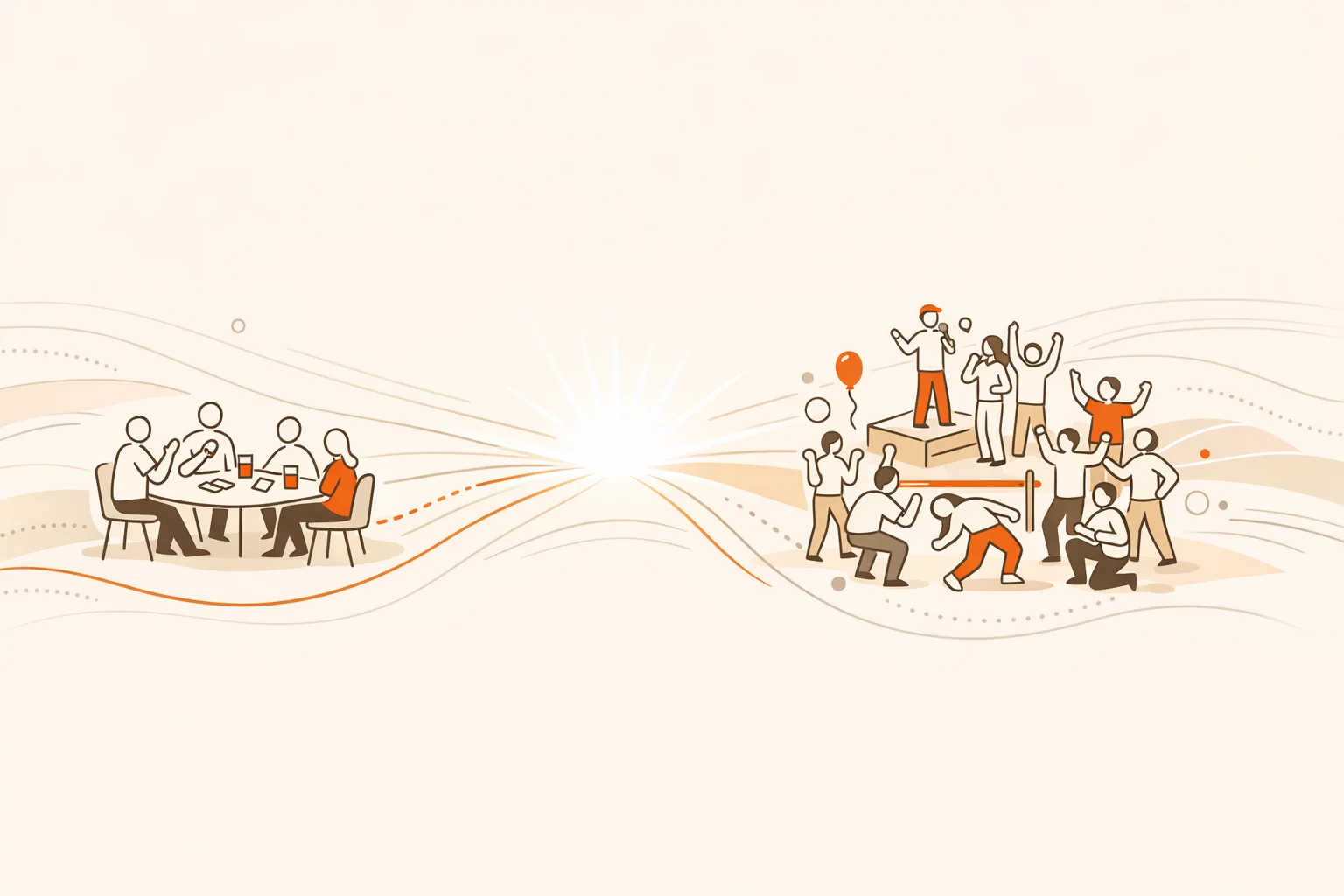
Company parties live or die on participation. Not RSVP counts, not décor. Participation. Get the room moving with games that are easy to start, inclusive by design, and simple to scale. Below are 16 company party games that teams actually enjoy, with clear instructions, timing signals, materials, and facilitation tips. They work for a holiday party in a ballroom, a summer picnic in the park, or a quarterly all‑hands in the cafeteria.
A pattern we keep seeing: start fast, finish strong, and do not over-explain. The more players do, the less you have to say. Design one obvious early win to hook skeptics, then plan a memorable finish people will talk about next week. Research on the peak‑end rule backs that memory pattern up. (frontiersin.org)
You will not need a warehouse of props. Most of these run with tape, printer paper, sticky notes, or what is already in the office kitchen. Where a digital tool helps, we note it.
Energy follows clarity. Tell people exactly how to win, then let them play.
What it is: A fast, photo‑based scavenger hunt that sends small squads racing for creative shots around the venue.
Setup: Split people into small teams. Set a tight time window so decisions beat deliberation.
How it works: Announce 5 photo prompts, start the clock, and watch the room light up. Award points for each completed photo plus a creativity bonus.
Time: 10 to 20 minutes, including quick review.
Materials: Phone cameras. Optional screen for a quick slideshow.
Facilitation tip: Read a few captions aloud during scoring. Laughter is your amplifier.
Use a scavenger hunt app if you want automatic scoring, a live leaderboard, and proof-of-completion photos without spreadsheets.
What it is: A mingle game that gets strangers talking without awkward icebreaker scripts.
Setup: Create bingo cards with squares like “Has visited HQ in another country” or “Can juggle three objects.”
How it works: Players roam to find people who match each square and collect initials. First to complete a row or blackout wins.
Time: 12 to 20 minutes.
Materials: Printed cards and markers.
Facilitation tip: Seed a few ringers who can sign many squares to prevent stalls. Offer small prizes for most signatures, best fun fact, and first blackout.
What it is: A station‑based gauntlet of quick skill challenges.
Setup: Create 6 to 8 stations: cup stacking, cookie‑to‑forehead, paper airplane distance, straw-and‑marshmallow lift, and so on.
How it works: Teams rotate through stations on a timer. Each success earns points.
Time: 25 to 40 minutes depending on stations.
Materials: Cups, cookies, tape, paper, string, spoons.
Facilitation tip: Assign one judge per two stations to keep lines moving. Start a mid‑event “double points” window to spike energy without extending time.
What it is: A trivia game balanced for mixed knowledge and quick collaboration.
Setup: Build a grid of categories: company history, pop culture, geography, product nicknames, and a wild card.
How it works: Teams choose a category tile, hear the question, and submit written answers. Offer one “lifeline” per team to trade a miss for a meme or a quick charade.
Time: 20 to 35 minutes.
Materials: Questions, pens, answer sheets, a bell.
Facilitation tip: Include 2 or 3 internal questions about the company to create shared pride without turning the whole game into training.
What it is: The classic spaghetti‑and‑marshmallow tower with a time box.
Setup: Hand each team dry spaghetti, tape, string, and one marshmallow.
How it works: Build the tallest free‑standing structure that supports the marshmallow on top.
Time: 18 minutes of build plus 5 minutes of judging.
Materials: Spaghetti, masking tape, string, one marshmallow per team.
Facilitation tip: Announce halfway and two‑minute warnings. Expect late collapses. That is part of the fun and the learning about iteration.
What it is: Silent charades with emoji cards as prompts for movies, phrases, and office slang.
Setup: Print prompt cards. Create two difficulty tiers.
How it works: One person acts, team guesses. Short rounds keep it snappy.
Time: 12 to 25 minutes.
Materials: Prompt cards, timer.
Facilitation tip: Use a “pass” token to keep momentum. Mix easy early prompts to let people warm up.
What it is: The board‑game hit adapted with company‑themed word lists.
Setup: Pre‑select words that matter to your culture and products. Split into two teams.
How it works: Spymasters give one‑word clues to help their team find related words while avoiding the other side’s. For remote or hybrid groups, use the official browser version.
Time: 20 to 35 minutes per match.
Materials: Word cards or a shared screen.
Facilitation tip: Rotate spymasters each round to spread speaking roles.
When you want to play digitally, use Codenames Online to run the game in a browser with no installs. (codenamesgame.com)
What it is: A short, high‑laugh performance contest with quick rehearsal time.
Setup: Let teams pick a 30 to 45 second song clip. Provide a prop bin.
How it works: Teams perform in sequence. Audience reacts. Judges score on commitment, not vocal ability.
Time: 20 to 30 minutes for five to eight teams.
Materials: Speakers, music clips, a prop bin.
Facilitation tip: Cap rehearsal at 5 minutes so production value does not swamp participation.
What it is: A simple escape‑room‑in‑a‑box that scales to a ballroom.
Setup: Place envelopes with successive puzzles at tables. The answer to each unlocks the next.
How it works: Teams race to “crack the vault” with word locks, pattern finds, and a final physical assembly.
Time: 25 to 45 minutes.
Materials: Printed puzzles, envelopes, a final prop to assemble.
Facilitation tip: Provide hint cards that cost time. Groups will trade pride for speed at the right moment.
What it is: A nonverbal challenge that tests observation and group problem solving.
Setup: Announce the rule: “Line up by birth month, no talking.” Use other sequences for repeat play.
How it works: Teams rely on gestures, hand signals, and props.
Time: 6 to 10 minutes per round.
Materials: None.
Facilitation tip: Debrief with two questions: what signal worked, what slowed you down. Keep it to 60 seconds.
What it is: A playful relay that combines short, safe micro‑events.
Setup: Four to six legs: paper plate discus, precision tape roll, chair slalom walking only, sticky note target toss, and a final team puzzle.
How it works: Teams complete each leg then tag the next person.
Time: 15 to 25 minutes.
Materials: Plates, tape rolls, sticky notes, cones or tape lines.
Facilitation tip: Keep lanes wide. Celebrate team effort, not speed alone, by awarding bonus points for best cheer squad.
What it is: Group improv storytelling that strengthens listening.
Setup: Gather teams in circles. Give a starter line related to your event theme.
How it works: Each person adds one sentence. The only rule is to build on what came before.
Time: 10 to 15 minutes.
Materials: None.
Facilitation tip: Coach “yes, and” to reduce blocking. Improv has documented benefits for collaboration and adaptability in service and business settings. (sciencedirect.com)
What it is: Oversized Jenga run as a bracket or round‑robin.
Setup: One to three towers depending on space. Mark safe zones.
How it works: Teams rotate. A fall eliminates you or drops you to a consolation round.
Time: 20 to 40 minutes based on towers.
Materials: Giant Jenga sets, floor tape.
Facilitation tip: Use a countdown for each pull to keep pace. Add a small trivia challenge for the opposing team while the block is in play to engage both sides.
What it is: A blind tasting that doubles as a conversation starter.
Setup: Create labeled, allergen‑aware tasting stations. Think seltzer flavors, spices, cheeses, or regional snacks.
How it works: Teams taste, discuss, and record guesses. Reveal answers by station.
Time: 15 to 25 minutes.
Materials: Small cups, tasting sheets, labels.
Facilitation tip: Keep portions tiny and label ingredients clearly. Pair with a water station and napkins.
What it is: A micro hunt that uses QR codes and optional GPS check‑ins to move groups through a space.
Setup: Place QR codes at sponsor tables, meeting rooms, or landmarks. Each scan reveals a fast challenge.
How it works: Teams earn points per scan and completion. Add a creative submission at two or three stops.
Time: 15 to 30 minutes.
Materials: Printed QR codes, posted rules, optional leaderboard screen.
Facilitation tip: Space codes so crowds spread. App‑enabled hunts reduce manual scoring, curb disputes, and keep more people engaged.
| Hunt operations | Scavify | DIY methods |
|---|---|---|
| Live leaderboard & activity feed | Yes | No |
| Photo, video, QR, GPS, trivia in one place | All five | Manual mix |
| Join by mobile browser | Yes | Usually not |
| Judge reviews & auto‑scoring | Built in | Spreadsheets |
| Time to launch | Minutes | Hours |
What it is: A lounge‑style corner running casual digital party games that people can drop in and out of between activities.
Setup: Project a screen, connect a laptop or console, and set up a few stools. Players join with their phones as controllers.
How it works: Rotate through short, funny games. Works well as a parallel track for mixed crowds.
Time: Open for the length of the event.
Materials: Screen, speakers, laptop or console, Wi‑Fi.
Facilitation tip: Post the join code big. Jackbox Party Packs are built for this style of play and use phone browsers as controllers, so anyone can hop in quickly. (jackboxgames.com)
What if people are not in the mood to play Make the first activity optional and short. Set a clear opt‑out path like “watch and cheer for two minutes” so no one feels trapped. Psychological safety beats pressure for long‑term engagement. (hbr.org)
How do I keep competitive people from steamrolling everyone Use team roles and cap how many turns any one person can take in a row. Award points for collaboration behaviors like using a hint strategically.
How do I scale these for 25 people versus 250 Keep the core mechanic and multiply stations, not rules. For very large groups, run heats, then a short final.
What prizes work without distorting the vibe Think recognition over cash. Mini trophies, punny certificates, a prime parking spot for a week, or the right to pick the playlist next Friday all land well.
What about remote or hybrid teams Many of these translate. Run Snapshot Showdown and QR Dash with digital submissions, or spin up a Codenames Online room so everyone can join from a browser. (codenamesgame.com)
How do I avoid cultural or dietary missteps in tasting games Label ingredients, offer non‑alcoholic and vegetarian options, and share a quick allergen form beforehand. Align with HR guidelines for parties with alcohol to reduce risk. (shrm.org)
How much explanation is too much If you are talking longer than 60 to 90 seconds before first action, it is probably too much. Start play, then clarify once people have context.
Pull one or two of these games into your next event, run them cleanly, and you will feel the shift in the room. Real connection beats forced fun. If you want automation and easy scaling for scavenger‑style formats, a modern platform can carry the load while you host.